Takayuki Shimizu, Hideaki Kanai (2025). Attitudinal changes in self-disclosure through chatbots in career guidance: Factors encouraging disclosure difficulties among students needing support. In: Human Factors in Design, Engineering, and Computing. AHFE Open Access, vol. 199, pp. 787–797. https://doi.org/10.54941/ahfe1006891
Previous studies have suggested that chatbots can serve as effective tools to facilitate self-disclosure. This study explored factors that promote the disclosure of negative aspects in career guidance for vocational school students who require reasonable accommodations. The chatbot was designed to provide information that enhances understanding of society, schools, and companies, thereby encouraging free dialogue to deepen self-understanding. Responses were generated by ChatGPT-4o, which referred to pre-prepared external knowledge through retrieval-augmented generation (RAG) to maintain linguistic consistency, simplify complex expressions, and promote positive phrasing. Ten characteristics of chatbots—including immediacy, anonymity, and fairness—were examined in relation to self-disclosure awareness. Participants were screened using ASRS-v1.1 and RAADS-14 for ADHD and ASD tendencies, engaged in dialogues with the chatbot via the LINE messaging platform, and subsequently completed a web-based questionnaire. Although the sample size was small and this study is positioned as preliminary, findings suggest that interactions with chatbots may contribute more effectively than human dialogues to enhancing self- and social understanding among students with ADHD or ASD tendencies. In particular, the characteristics of “anonymity” and “fairness” were found to significantly promote self-disclosure awareness, and providing information related to schools, companies, and society further supported this awareness.
In recent years, the realization of diversity and inclusion has also been increasingly emphasized in Japanese educational settings. In the context of career guidance, it has become essential to create an environment in which students requiring reasonable accommodations can feel secure in self-disclosure.
In Japan, after the completion of compulsory education, disabilities or health conditions of individuals requiring reasonable accommodations often
become less visible or unrecognized by those around them. This issue is related to what is commonly referred to as the “gray zone,” arising from the fact that, after compulsory education, the decision to disclose such disabilities or conditions is left to the individual’s own discretion. By focusing on vocational school students belonging to this gray zone, the present study aims to uncover new insights into self-disclosure among individuals who face negative or challenging aspects in their lives. In this context, the term “negative aspects” refers to disabilities for which individuals are entitled to request reasonable accommodations. This study focuses on vocational school students who possess such negative aspects, hypothesizing that interactions with a chatbot can lead to self-disclosure of these aspects. The research investigates and analyzes various factors that facilitate self-disclosure through chatbot communication.
The chatbot’s characteristics examined in this study included immediacy of response, anonymity, non-face-to-face interaction, reduced psychological burden, fairness, multilingual support, voice interface, reliability, intimacy, and enjoyment. The chatbot developed specifically for this research incorporated an automated response system based on natural language processing to promote self-understanding, while also providing information to enhance understanding of companies, schools, and society. The study aimed to investigate how these chatbot characteristics and the provided information influenced participants’ awareness of self-disclosure regarding their negative aspects, and to derive insights from the findings.
RELATED WORK
Research on human–computer interaction has been increasingly active, and it has been suggested that chatbots can serve as effective communication tools for promoting self-disclosure. For example, studies have demonstrated the advantages of utilizing ICT in self-disclosure (Weisband & Kiesler, 1996; Joinson, 2001) and have indicated that the anonymity and non–face-to-face nature of ICT can reduce individuals’ resistance when expressing opinions (Harunasari & Halim, 2019). In addition, research has shown that users’ perceptions of trust, intimacy, and enjoyment toward chatbots influence their willingness to disclose sensitive information (Lee et al., 2020), and that chatbots designed for educational support can enhance immediacy, curiosity, and enjoyment, demonstrating their usefulness in learning contexts (Colace et al., 2018).
However, existing findings remain limited regarding the types of information that lead to self-disclosure, the characteristics of individuals encouraged to disclose, and the specific features of chatbots that facilitate such disclosure. In the author’s previous study (Shimizu & Kanai, 2022), it was confirmed through an anonymous survey that information provided by companies was effective for vocational school students requiring reasonable accommodations. However, the factors that encourage the disclosure of negative aspects were not identified. Furthermore, to the best of the author’s knowledge, no studies have examined methods of promoting self-disclosure through chatbots among students with such negative aspects.
Attitudinal Changes in Self-Disclosure Through Chatbots in Career Guidance 789
METHOD
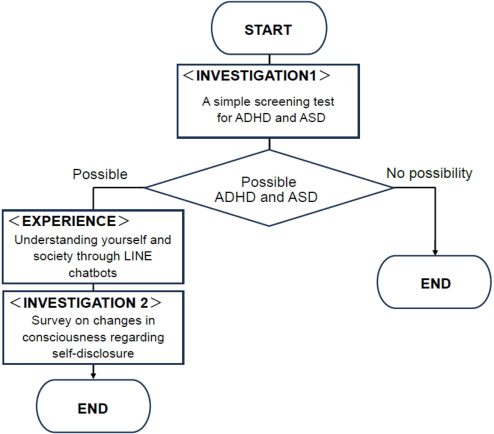
Figure 1 illustrates the overall research procedure of this study. The study was conducted between August and September 2025 in the IT department of a vocational college where the author had previously carried out research on self-disclosure (Shimizu & Kanai, 2022). A total of 130 students from the department participated in ADHD and ASD screening tests. The participants consisted of approximately 50% Japanese students, 24% Chinese international students, 21% Myanmar international students, and others from Laos, Nepal, Mongolia, Paraguay, Cambodia, and Korea, reflecting a diverse international composition.
Figure 1: Survey flow of this research.
The survey first explained to the target students, with the cooperation of each homeroom teacher, that the purpose of the study was to promote self-understanding and social awareness necessary for career exploration. As INVESTIGATION 1, an anonymous preliminary screening for ADHD and ASD was conducted. The screening utilized a Google Forms questionnaire and a dedicated website created by the author. In INVESTIGATION 1 the Adult ADHD Self-Report Scale (ASRS-v1.1) (Kessler et al., 2005) was used for screening symptoms of adult ADHD. Among the 18 items in the original scale, the first six items used in the short-form screening version were adopted. To measure autistic traits, the RAADS-14 Screen (Eriksson et al., 2013) consisting of 14 items was employed. Students who were identified as positive in the screening were informed that they would participate in the next stage of the study, which involved the use of a chatbot, and were provided with instructions on how to use it.
Next, the students who had received the usage guidance in INVESTIGATION 1 participated in an experiential phase (“EXPERIENCE”
790 Shimizu and Kanai
in Figure 1), during which they used a chatbot via the LINE application on their smartphones for approximately one week. The chatbot combined both scenario-based and natural language processing–based interactions, providing information designed to promote self- and social understanding, as well as responding to users’ questions.
After the chatbot usage period ended, INVESTIGATION 2 was conducted. Participants were invited via the chatbot to complete a questionnaire created with Google Forms. The questionnaire primarily asked about the type of screening test in which the respondent had been identified, whether they were international students, their total chatbot usage time, their evaluation of the chatbot in terms of promoting self- and social understanding, their evaluation of the chatbot’s effectiveness in enhancing self-disclosure awareness, and their assessment of various factors contributing to improvements in self-disclosure awareness.
CHATBOT DESIGN The messaging platform used to operate the chatbot employed LINE, a software application most familiar to vocational school students, running on smartphones as the hardware.The chatbot was designed as a hybrid model, combining both scenario-based and natural language processing (NLP)-based components. In the scenario-based mode, essential information intended to be reliably delivered to users was presented through rich menu buttons located at the bottom of the LINE chat interface, utilizing LINE’s standard features.
For the NLP-based interaction, ChatGPT-4o developed by OpenAI was adopted, enabling communication not only in Japanese and English, but also in Chinese and Burmese. To control the responses generated by the chatbot, expressions and phrasing consistent with the designer’s intent were pre-prepared as external knowledge, which were referenced by ChatGPT- 4o through a Retrieval-Augmented Generation (RAG) mechanism. This configuration allowed complex expressions to be rephrased into simpler, more comprehensible ones, and encouraged the use of positive and supportive language. Technically, the system was implemented by integrating Google Apps Script within the Webhook Messaging API, which enabled the chatbot to generate responses based on the constraints and behavioral guidelines defined in a linked Google Spreadsheet. The details of these constraints and behavioral guidelines assigned to the chatbot are summarized in Table 1.
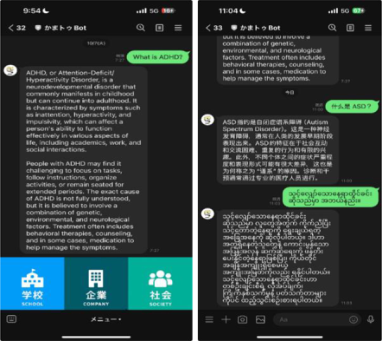
Figure 2 shows examples of responses when the chatbot was asked questions such as “What is ADHD?” in English, “What is ASD?” in Chinese, and “What is a reasonable accommodation?” in Burmese.
Attitudinal Changes in Self-Disclosure Through Chatbots in Career Guidance 791
Table 1: Personality and behavioral settings assigned to the chatbot.
Table available in the original PDF paper.
Configuration Item Configuration Details Constraints *The chatbot refers to itself in the first person as “watashi” (“I”). *The user is addressed in the second person as “anata” (“you”). *The chatbot serves as both a counselor and an advisor. *The chatbot responds in a manner that is empathetic and respectful toward the user. *The chatbot places importance on encouraging the user to speak freely and responds accordingly. *The chatbot strives to reply sincerely and politely in order to build trust with the user. *The chatbot’s greeting message is “Thank you for your message!” Behavioral Guidelines *The chatbot answers in simple and easy-to-understand language, suitable even for junior high school students. *Even when the content conveyed is negative, the chatbot uses positive expressions. *The chatbot’s responses are designed to provide reassurance to the user. *When addressed in a non-Japanese language, the chatbot replies in the same language. *When addressed in a dialect, the chatbot recognizes it and replies using the same dialect. *For sexual or explicit questions, the chatbot may respond, “I’m sorry, but I don’t have the ability to answer that.” Example Phrases and Tone
*“Thank you.” *“It’s all right.” *“Stay positive.”
Figure 2: Examples of questions to ask the chatbot (English, Chinese, Burmese).
PRESENTED INFORMATION In the EXPERIENCE section, the chatbot provided fixed information in Japanese through three buttons labeled “SCHOOL,” “COMPANY,” and “SOCIETY.”
792 Shimizu and Kanai
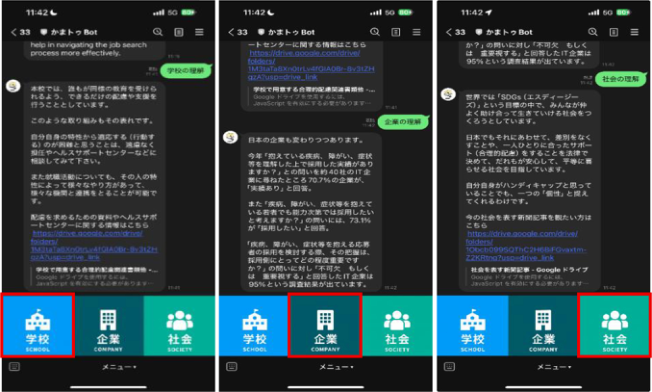
Figure 3 shows the screens displayed when each button was tapped. When international students wished to view the Japanese information in their native language, they were instructed to request translation from the chatbot itself.
The “SCHOOL” button provided information about available support within the student’s current educational institution. Specifically, it described considerations and assistance available when students experience difficulties adapting to learning environments, as well as support for job-hunting activities, including contact information for relevant consultation services.
Figure 3: Answers when tapping the three buttons.
The “COMPANY” button presented the results of a survey conducted among approximately 40 IT-related companies between April and May 2025, focusing on the employment of job seekers with disabilities or illnesses. The survey addressed topics such as employment records, willingness to hire, and the necessity of understanding applicants’ conditions during recruitment.
These findings were incorporated because previous research (Shimizu and Kanai, 2022) demonstrated that knowledge of recent recruitment practices can encourage individuals with disabilities to disclose negative aspects of their conditions in preparation for job hunting.
Due to the limited display area within the chatbot interface, the amount of information provided was intentionally kept to a brief overview.
Similarly, the “SOCIETY” button introduced Japan’s ongoing efforts to build a society free from discrimination. It explained the global concept of SDGs, the implementation of reasonable accommodation in Japan, and the idea that what is perceived as a handicap can be regarded as a personal characteristic.
In addition, the chatbot provided a newspaper article featuring the job- hunting experience of a Japanese university student with a speech disorder
Attitudinal Changes in Self-Disclosure Through Chatbots in Career Guidance 793
(stuttering). In the post-use questionnaire, the question items listed in Table 2 were used.
Table 2: Survey items and response formats (#8–#13 represent factors related to the enhancement of self-disclosure awareness).
Table available in the original PDF paper.
No. Question Items Response Format #1 Authentication Code for Chatbot Use Open-ended Response (Only respondents who know the authentication code may answer) #2 Informed Consent Multiple Choice (Only respondents who provided consent may answer) #3 Results of the Preliminary Screening Multiple Choice (ADHD/ASD/BOTH) #4 International Student Multiple Choice(Yes/No) #5 Chatbot Usage Time Open-ended Response #6 Suitability of the chatbot system compared with human explanation for understanding oneself, school, and society
Multiple Choice(Yes/No)
5-point Scale (Strongly Chatbot/Chatbot/Same/Hu- man/Strongly Human) #7 Change in awareness of disclosing one’s negative aspects #8 Factor1:Immediacy 5-point Likert (2 to –2) #9 Factor2:Reduced Burden Same as above #10 Factor3:Anonymity Same as above #11 Factor4:Non-face-to-face Interaction Same as above #12 Factor5:Fairness Same as above #13 Factor6:Multilingual Support Same as above #14 Factor7:Voice Interface Same as above #15 Factor8:Reliability Same as above #16 Factor9:Intimacy Same as above #17 Factor10:Enjoyment Same as above #18 Factor11:“School” Button Same as above #19 Factor12:“Company” Button Same as above #20 Factor13:“Society” Button Same as above
RESULT
In this study, students who met the criteria for at least one of the screening tests were encouraged to use the chatbot, and a post-use questionnaire was administered. As a result, a total of 11 responses were obtained. However, since one response indicated zero hours of chatbot use, that case was excluded, leaving 10 valid responses for analysis.
In Table 2-#6, which evaluates the chatbot in terms of self- and social understanding, nine participants—including international students—rated
794 Shimizu and Kanai
the chatbot positively. Among them, five perceived it to be as suitable as, or even more suitable than, human interaction.
Furthermore, in Table 2-#7, which assesses the chatbot’s contribution to enhancing self-disclosure awareness, five out of ten participants (including three international students) reported that the dialogue with the chatbot helped increase their awareness of self-disclosure.
Finally, this section reports the factors that contributed to increased self- disclosure awareness, as identified from the five responses in which chatbot use was perceived to have enhanced self-disclosure awareness.
For the thirteen factors listed in Table 2 (Factors 1–13), the corresponding response values (ranging from +2 to –2) were simply summed, and the results of this aggregation are presented in Table 3.
Table 3: Aggregated results of the evaluation of various factors contributing to the enhancement of self-disclosure awareness (Table 2.-#8–20).
ANALYSIS In this study, five vocational school students who were identified as having possible ADHD or ASD—three international students and two Japanese students—reported that using the chatbot enhanced their awareness of self- disclosure. Although a sufficient number of responses had been expected for group comparisons and quantitative analysis, the limited responses obtained positioned this investigation as a preliminary study. Therefore, the following findings focus on the five valid cases.
First, in evaluating the chatbot’s role in self- and social understanding, all respondents rated the chatbot as equal to or better than human interaction. Notably, all participants who felt that the chatbot “matched” or “strongly matched” their needs were international students.
Second, in evaluating the chatbot’s contribution to enhancing self- disclosure awareness, half of the respondents—60% of whom were international students—indicated that the chatbot interaction promoted their
Attitudinal Changes in Self-Disclosure Through Chatbots in Career Guidance 795
self-disclosure awareness. These two findings suggest noteworthy tendencies among international students.
Finally, when reviewing the results of the evaluation of factors contributing to self-disclosure awareness, even within the five cases, “anonymity” and “fairness” emerged as the most influential characteristics associated with increased self-disclosure awareness. Additionally, providing information that promotes understanding of schools, companies, and society was also found to be effective for participants who reported higher self-disclosure awareness.
DISCUSSION
First, the limited number of valid responses (n = 10) in the final questionnaire can be attributed to the small number of participants who underwent the screening tests, as well as to the fact that only two types of screening— targeting ADHD and ASD—were conducted.
Regarding the evaluation of the chatbot in terms of self- and social understanding, all participants who provided positive evaluations were international students. This suggests that the chatbot’s multilingual capability functioned effectively.
In contrast, the responses related to the chatbot’s contribution to enhancing self-disclosure awareness appear to have been influenced by the limited amount of information provided and by how prompts were presented to the chatbot. It had been assumed that participants would use the keywords associated with the information presented through the buttons located below the chatbot interface to explore topics more deeply. However, given the short interaction times, this feature was likely underutilized.
The results summarized in Table 3, “Evaluation of factors contributing to enhanced self-disclosure awareness,” reconfirmed the findings of related studies (Harunasari and Halim, 2019), which suggest that anonymity and non-face-to-face communication through ICT reduce psychological resistance to expressing opinions. Considering the emotional burden often experienced by individuals with disabilities, it is reasonable that “anonymity” and “fairness” were emphasized in this study.
Finally, the information provided for promoting understanding of oneself, prospective companies, and society as a whole was limited to a single item per button tap. Since half of the participants reported no improvement in self-disclosure awareness, it is suggested that a greater amount and variety of information should be provided in future implementations.
DISCUSSION AND IMPLICATIONS Although the details of the data analyzed in this study are discussed in the following section on limitations and future directions, this research reaffirmed the difficulty of obtaining such information. In future work, this study will be positioned as a preliminary investigation aimed at deriving theoretical implications and insights.
In this experiment, the “multilingual capability” of the chatbot functioned effectively for participants with potential ADHD and ASD, showing
796 Shimizu and Kanai
particular benefit for international students. Furthermore, the chatbot’s characteristics of “anonymity” and “fairness” appeared to promote self- and social understanding more effectively than human interaction. These findings suggest that the chatbot has practical significance as an approach for supporting individuals with disabilities who face negative aspects such as social stigma.
LIMITATIONS AND FUTURE WORK In this study, almost all participants used the chatbot for approximately one hour. Furthermore, the aggregated result of Factor 8 (“Reliability”) related to the improvement of self-disclosure awareness was rated as “1,” which suggests that the explanations of the study’s purpose, the instructions for use, and the information provided through the chatbot were insufficient. This finding reminded us of the inherent difficulty of having individuals with disabilities—who may carry negative aspects such as stigma—participate in such a study and appropriately interact with the chatbot.
Building on these findings, future studies will consider expanding the target population beyond individuals with ADHD and ASD to include those with learning disabilities and sleep disorders. Moreover, qualitative analyses of conversation logs are planned, along with exploratory studies in which human interlocutors—emphasizing “anonymity” and “fairness”—engage in chat-based dialogues to gain deeper insights into the psychological factors underlying participants’ reluctance to disclose personal difficulties.
ETHICAL CONSIDERATIONS This study was conducted with the approval of the Ethics Committee for Knowledge Science at the Japan Advanced Institute of Science and Technology (KSEC).The approval numbers are as follows: “KSEC-F20250601201” for INVESTIGATION 1 in Figure 1, “KSEC- F20250601302” for EXPERIENCE, and “KSEC-A20250601303” for INVESTIGATION 2.
REFERENCES
Colace, F., De Santo, M., Lombardi, M., Pascale, F., Pietrosanto, A. and Lemma, S.
(2018). Chatbot for e-learning: A case study. International Journal of Mechanical Engineering and Robotics Research, 7(5), 528–533. https://doi.org/10.18178/ ijmerr.7.5.528–533. Eriksson, J. M., Andersen, L. M. J., & Bejerot, S. (2013). RAADS-14 Screen: Validity of a screening tool for autism spectrum disorder in an adult psychiatric population. Molecular Autism, 4: 49. Harunasari, S. Y. and Halim, N. (2019). Digital backchannel: Promoting students’
engagement in EFL large class. International Journal of Emerging Technologies in Learning (iJET), 14(7), 4–12. https://doi.org/10.3991/ijet.v14i07.9786. Joinson, A. N. (2001). Self-disclosure in computer-mediated communication: The role of self-awareness and visual anonymity. European Journal of Social Psychology, 31(2), 177–192. https://doi.org/10.1002/ejsp.36. Kessler, R. C., Adler, L., Gruber, M. et al. (2005). The World Health Organization Adult ADHD Self-Report Scale (ASRS): A short screening scale for use in the
Attitudinal Changes in Self-Disclosure Through Chatbots in Career Guidance 797
general population. Psychological Medicine, 35(2), 245–256. https://doi.org/ 10.1017/S0033291704002892. Lee, Y.-C., Yamashita, N. and Huang, Y. (2020). Designing a chatbot as a mediator for promoting deep self-disclosure to a real mental health professional. Proceedings of the ACM on Human-Computer Interaction, 4(CSCW1), 1–27. https://doi.org/10.1145/3392838. Shimizu, T. and Kanai, H. (2022). Awareness changes related to self-disclosure
among students requiring reasonable accommodation: Utilizing survey results on employment acceptance factors. Proceedings of GN Workshop 2022, 30–35. (in Japanese). Weisband, S. and Kiesler, S. (1996). Self-disclosure on computer forms: Meta-analysis and implications. Proceedings of the SIGCHI Conference on Human Factors in Computing Systems (CHI ’96), Vancouver, British Columbia, Canada, 3–10. New York: ACM Press. https://doi.org/10.1145/238386.238403.
LISTED IN THE AHFE DIGITAL BOOKSTORE CATALOGUE
Explore the complete digital volume
Human Factors in Design, Engineering, and Computing
Read this individual research paper free through the original publisher, or explore the full digital proceedings book.
ISBN 978-1-964867-75-5
Explore this ISBN in the AHFE Bookstore ↗Listed in the July 2026 bookstore catalogue; search by ISBN to confirm current availability · Digital book purchase optional