Ziting Gong, Hideaki Kanai (2024). Impact of Audience Presence on Pressure and Running Performance: The Potential of AR Presence. In: Human Factors in Design, Engineering, and Computing. AHFE Open Access, vol. 159, pp. 405–413. https://doi.org/10.54941/ahfe1005605
This study investigated the impact of audience presence on the experience of running on a treadmill by specifically examining perceived pressure, calorie expenditure, and heart rate. The primary objective was to understand how various types of audiences—live audience, video call, augmented reality (AR) characters, and no audience—affect runners' performance and psychological states. By exploring these scenarios, this study identified the role of audience presence in influencing exercise outcomes. The significance of this study lies in its potential to enhance exercise interventions and promote long-term commitment to physical activity. By leveraging AR technology, our results may contribute toward managing pressure and improving performance by offering innovative solutions to support both physical and mental well-being in the exercise context.
Social facilitation is a widely explored strategy that enhances exercise performance (Zajonc, 1965) by introducing opponents to increase competitiveness (Hamada et al., 2022), or incorporating audiences to provide positive feedback (Kappen et al., 2014). Although these methods stimulate the exercise experience, they often introduce varying levels of perceived pressure, which can challenge sustained long-term commitment to regular exercise (Richard et al., 1997). Furthermore, few prior studies have focused on the stress of being watched, possibly because of the positive correlation between pressure and performance. Nonetheless, it is crucial to consider intrinsic motivations and find a balance between leveraging social facilitation and minimizing undue pressure.
The present study addresses this balance by investigating the use of augmented reality (AR) characters. Previous research has shown that verbal encouragement improves exercise performance and motivation (Edwards et al., 2018). However, as the validity of these findings is limited by small sample sizes, the efficacy of social facilitation by computer-generated agents (Bolton et al., 2014; Sterna et al., 2019; Strojny et al., 2020;
Yu et al., 2023) and robots (Riether, 2012) remains uncertain. Consequently, further investigation is required into the influence of AR characters as virtual supportive agents on exercise performance and intrinsic motivation.
In this study, we compared the effects of AR characters and audience presence on user experience during physical activity, focusing on perceived pressure, calorie expenditure, and heart rate. The findings reveal that live and video call audiences are associated with higher perceived pressure and heart rates than the AR and no-audience conditions. The integration of AR characteristics effectively balanced the dynamics between perceived pressure and performance, demonstrating the potential to reduce pressure on individuals with high trait anxiety while stimulating non-habitual exercisers. These findings underscore the ability of AR to influence both psychological and physiological responses in physical activity interventions, providing valuable insights into how AR and video call audiences affect individual experiences during exercise, and thus expanding our understanding of the effects of social facilitation. Ultimately, our results demonstrate that innovative applications of exercise psychology and augmented reality technology can be utilized to encourage and enhance participation in physical activities.
METHODOLOGY
We adopted a within-subjects design, with each participant engaging in the four experimental conditions in a randomized order. These conditions, ranked in descending order of social presence, were live audience (Live), video call audience (Video), AR audience (AR), and no audience (Absence). As shown in Figure 1, the same individual assumed the audience’s role in all three audience-based conditions. The AR character was generated via Ready Player Me software (https://readyplayer.me/) using this individual’s photograph and animated in Unity to simulate natural body movements while standing.
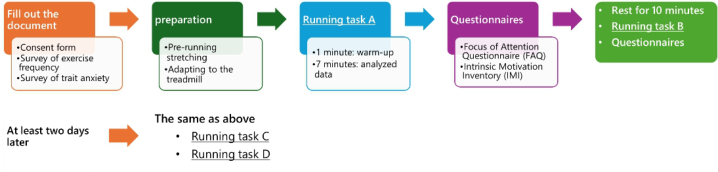
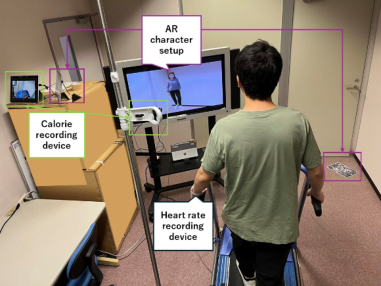
Figures 2 and 3 illustrate the experimental flow and room layout, respectively. The experimental procedure began with the participants completing a consent form, followed by a survey assessing exercise frequency and trait anxiety using the State-Trait Anxiety Inventory (STAI_trait) (Spielberger et al., 1971). Participants were informed that the running task was designed to promote their physical health. Subsequently, they engaged in pre-running stretching and adapted to the treadmill. The participants then performed Running Task A, which included a 1-minute warm-up at a speed of 3.5 km/h and 7 min of running with no speed limits, during which the data were analyzed. Afterward, they filled out the Focus of Attention Questionnaire (FAQ) (Woody, 1996) and the Intrinsic Motivation Inventory (IMI) (Ryan, 1982). Following a 10-minute resting period, participants completed Running Task B and answered the same set of questionnaires. The entire session lasted approximately one hour.
At least two days later, the participants returned for a second session, replicating the same procedure for the remaining conditions. Each participant received a compensation of 2000 yen for their participation.
Impact of Audience Presence on Pressure and Running Performance 407
This study was approved (Approved No. 05-005) by the Life Science Committee of the Japan Advanced Institute of Science and Technology on June 20, 2023.
Figure 1: Experimental conditions (From left to right: live audience, video call audience, AR audience, no audience).
Figure available in the original PDF paper.
Participants Twenty-four subjects (six females and eighteen males, age 22–33) participated in this experiment.
Data Collection IMI_Pressure/Tension We evaluated participants’ intrinsic motivation using the Pressure/Tension IMI subscale, which measures negative predictors of intrinsic motivation (Hamada et al., 2022).
FAQ To compare the participants’ attentional focus across different experimental conditions, we used the FAQ, which includes two five-item subscales – self- focus and external-focus – measuring attention to internal body reactions and the environment, respectively.
Calorie Expenditure and Heart Rate We assessed the participants’ exercise performance using the treadmill’s built- in calorie consumption feature. Additionally, we recorded the participants’ heart rates in real time during the running process with the Apple Watch SE (2nd generation) and HypeRate API (https://www.hyperate.io/).
Figure 2: Experimental procedure.
408 Gong and Kanai
Figure 3: Room layout.
RESULTS AND DISCUSSIONS We utilized a linear mixed model to analyze the impact of the four conditions during the seven-minute free-running phase. Subjects and order were included as random intercepts in the model, and the analysis was conducted using Jamovi software (https://www.jamovi.org/). The reported p values underwent adjustment for multiple comparisons using the Bonferroni correction.
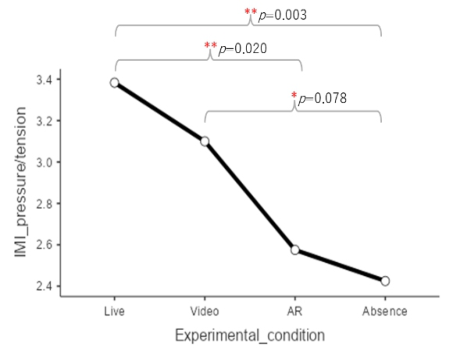
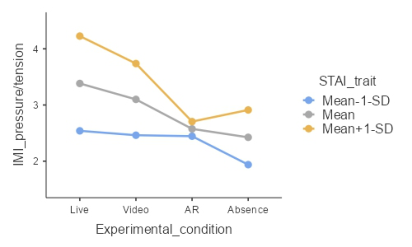
IMI_Pressure/Tension The audience conditions were found to significantly affect perceived pressure (p=0.001, Figure 4), with a slight interaction effect (p=0.061, Figure 5) observed with STAI_trait (p=0.005). Significant differences were observed between the live-audience condition and both the no-audience (p=0.003) and AR (p=0.020) conditions. A slight difference was also observed between the video-call-audience and no-audience conditions (p=0.078).
Figure 4: IMI_pressure scores across conditions.
Impact of Audience Presence on Pressure and Running Performance 409
Figure 5: Interaction of STAI_trait and IMI_pressure scores.
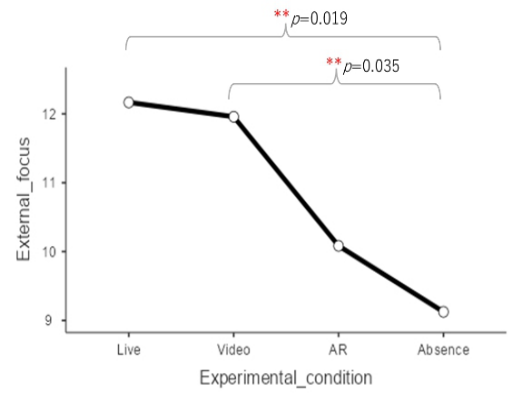
External Focus Both the audience conditions (p=0.007, Figure 6) and trait anxiety (p=0.020) had significant effects upon external focus. Participants exhibited higher external focus in the presence of live (p=0.019) and video-call (p=0.035) audiences, compared to the no-audience condition.
Figure 6: External_focus scores across conditions
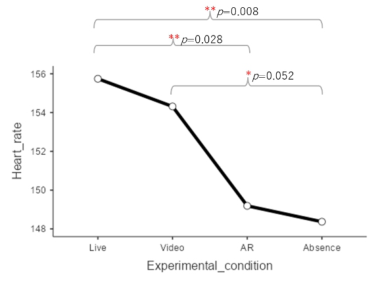
Mean Heart Rate Both audience conditions (p=0.002, Figure 7) and exercise habits (p=0.017) significantly impacted heart rates. Significant differences were observed between the live-audience condition and both the no-audience (p=0.008) and AR (p=0.028) conditions. A slight difference was also observed between the video-call-audience and no-audience conditions (p=0.052).
410 Gong and Kanai
Figure 7: Mean heart rate across conditions
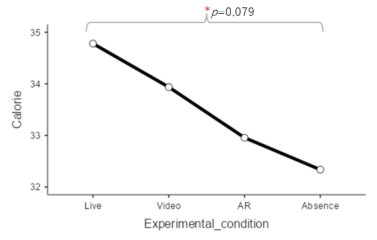
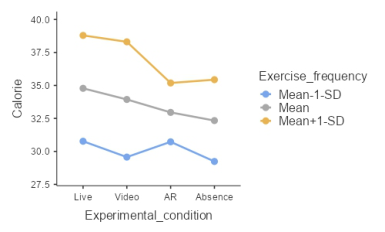
Calorie Consumption Both audience conditions (p=0.063, Figure 8) and exercise habits (p=0.057) had slight effects upon calorie consumption, with no significant interaction (p=0.112, Figure 9). Calorie consumption was marginally higher in the live- audience condition than in the no-audience condition (p=0.079).
Figure 8: Calorie expenditure across conditions.Figure 9: Interaction of exercise frequency and calorie expenditure.
Impact of Audience Presence on Pressure and Running Performance 411
CORRELATION We conducted a Spearman correlation analysis in the IBM SPSS software to individually compare the following variables in pairs: IMI Pressure/Tension (IMI_pressure), self-focus, external-focus, heartrate, and calories (see Table 1). IMI_pressure exhibited a slightly positive correlation with external focus and calorie intake.
Table 1. Correlations between variables (** Correlation is significant at the 0.05 level: 2-tailed).
We found that the external focus of attention affects physical activity differently in social and non-social contexts. In non-social contexts, increased external attention has been shown to improve performance (Wulf, 2013). However, in our study, increased social presence enhanced external attention, which showed a slight positive correlation with self-perceived pressure. Moreover, higher external attention is moderately associated with increased self-awareness, including with respect to actions and emotions.
Participants reported higher perceived pressure in conditions with greater social presence than in the AR and no-audience conditions, in terms of both self-perception and mean heart rate. Interestingly, in terms of exercise performance, only minor differences were observed between the presence and absence of live audiences. These findings indicate that the audience has a greater impact on the user’s perceived pressure during exercise than on their actual performance. Furthermore, the presence of an AR audience showed promise in both alleviating pressure for individuals with high trait anxiety and improving performance among non-habitual exercisers, suggesting its potential in exercise interventions.
Although no significant differences in self-focus scores were observed across the different conditions, distinct patterns emerged for other measures. In the live-audience condition, participants experienced the highest levels of perceived pressure and heart rate accompanied by moderate calorie consumption. Similarly, the video-call-audience condition resulted in high perceived pressure and heart rate, with calorie expenditure comparable to that under the live-audience condition. Conversely, the AR-audience condition led to a lower perceived pressure and heart rate while maintaining moderate calorie consumption. Under the no-audience condition, participants reported the lowest levels of perceived pressure and heart rate, along with slightly reduced calorie consumption. These variations highlight the potential of AR to blend the benefits of social facilitation with reduced pressure, making it a promising tool for enhancing exercise
412 Gong and Kanai
adherence and performance. Participants also desired to interact with AR characters because of their perceived low cognitive demand, potentially shifting their focus away from physical fatigue. This feedback supports our goal of enhancing enjoyment and boosting intrinsic motivation through increased AR character interactions in future studies.
CONCLUSION
Social facilitation can be achieved when competitors or spectators are utilized to boost performance in physical activities. However, the presence of others can also introduce pressure, potentially affecting long-term commitment to exercise. This study examined how various forms of audience presence impacted the experience of running on a treadmill in terms of perceived pressure, calorie expenditure, and heart rate. The results indicate that high social presence affects perceived pressure more than performance. Ultimately, AR offers distinct advantages and insights into improved exercise interventions.
REFERENCES
Bolton, J., Lambert, M., Lirette, D., & Unsworth, B. (2014). PaperDude: a virtual reality cycling exergame. In CHI’14 Extended Abstracts on Human Factors in Computing Systems (pp. 475–478). Edwards, A. M., Dutton-Challis, L., Cottrell, D., Guy, J. H., & Hettinga, F. J. (2018).
Impact of active and passive social facilitation on self-paced endurance and sprint exercise: encouragement augments performance and motivation to exercise. BMJ Open Sport & Exercise Medicine, 4(1), e000368. Hamada, T., Hautasaari, A., Kitazaki, M., & Koshizuka, N. (March 2022). Solitary jogging with a virtual runner using smartglasses. In 2022 IEEE Conference on Virtual Reality and 3D User Interfaces (VR) (pp. 644–654). IEEE. Kappen, D. L., Mirza-Babaei, P., Johannsmeier, J., Buckstein, D., Robb, J., & Nacke,
L. E. (2014, October). Engaged by boos and cheers: the effect of co-located game audiences on social player experience. In Proceedings of the first ACM SIGCHI annual symposium on Computer-Human Interaction in Play (pp. 151–160). Richard, M., Christina, M. F., Deborah, L. S., Rubio, N., & Kennon, M. S. (1997).
Intrinsic motivation and exercise adherence. Int J Sport Psychol, 28(4), 335–354. Riether, N., Hegel, F., Wrede, B., & Horstmann, G. (2012, March). Social facilitation with social robots?. In Proceedings of the seventh annual ACM/IEEE International Conference on Human-Robot Interaction (pp. 41–48). Ryan, R. M. (1982). Control and information in the intrapersonal sphere: An
extension of cognitive evaluation theory. Journal of Personality and Social Psychology, 43(3), 450. Spielberger, C. D., Gonzalez-Reigosa, F., Martinez-Urrutia, A., Natalicio, L. F., & Natalicio, D. S. (1971). The State-Trait Anxiety Inventory. Revista Interamericana de Psicologia/Interamerican Journal of Psychology, 5(3 & 4). Sterna, R., Strojny, P., & Rebilas, K. (2019). Can Virtual Observers Affect Our
Behavior? Social Facilitation in Virtual Environments: A Mini-Review. Social Psychological Bulletin, 2019, Vol. 14(3), Article e30091, https://doi.org/10. 32872/spb.v14i3.30091
Impact of Audience Presence on Pressure and Running Performance 413
Strojny, P. M., Du˙zma´nska-Misiarczyk, N., Lipp, N., & Strojny, A. (2020).
Moderators of social facilitation effect in virtual reality: Co-presence and realism of virtual agents. Frontiers in Psychology, 11, 503209. Yu, K., Wen, S., Xu, W., Caon, M., Baghaei, N., & Liang, H. N. (2023). Cheer for me: effect of non-player character audience feedback on older adult users of virtual reality exergames. Virtual Reality, 27(3), 1887–1903. Woody, S. R. (1996). Effects of focus of attention on anxiety levels and social
performance of individuals with social phobia. Journal of Abnormal Psychology, 105(1), 61. Wulf, G. (2013). Attentional focus and motor learning: a review of 15 years.
International Review of Sport and Exercise Psychology, 6(1), 77–104. Zajonc, R. B. (1965). Social Facilitation: A solution is suggested for an old unresolved social psychological problem. Science, 149(3681), 269–274.
LISTED IN THE AHFE DIGITAL BOOKSTORE CATALOGUE
Explore the complete digital volume
Human Factors in Design, Engineering, and Computing
Read this individual research paper free through the original publisher, or explore the full digital proceedings book.
ISBN 978-1-964867-35-9
Explore this ISBN in the AHFE Bookstore ↗Listed in the July 2026 bookstore catalogue; search by ISBN to confirm current availability · Digital book purchase optional