Qijia Yang (2026). AR Children’s Game Design From the Perspective of Attention Restoration Theory: A Case Study of Dunhuang Feitian Park. In: Metaverse, Virtual Environments and Game Design. AHFE Open Access, vol. 217, pp. 184–192. https://doi.org/10.54941/ahfe1007665
With the acceleration of urbanization and the widespread use of electronic products, the phenomenon of children's natural deficiency has become increasingly prominent, negatively affecting their inability to concentrate, insufficient emotional regulation ability, and weakened environmental adaptability. Currently, children generally prefer indoor activities and spend long periods immersed in electronic products, which exacerbates the negative effects. To address the issues of emotional regulation and nature education for children with natural deficiency, this study proposes an innovative solution that integrates Chinese excellent traditional culture and AR technology. Based on the attention restoration theory and with the core of the Dunhuang IP image, this study selects the Dunhuang Flying Heaven Park as the natural practice location and mainly targets outdoor natural interaction games for children with natural deficiency aged 4-10. This game integrates the Dunhuang cultural IP and the real plants in the park through AR technology, creating an interactive game exploration that can guide children to observe nature and unlock the stories of the murals. This study provides innovative ideas for emotional regulation and exploration of nature for children with natural deficiency and offers practical references for the digitalization of traditional culture in the field of children's physical and mental health.
With the development of urbanization construction, the area of natural green spaces has been shrinking year by year, and the space for people to have close contact with nature has become increasingly scarce. The growing environment for contemporary children is mostly composed of artificial buildings and electronic products, resulting in many children suffering from nature deprivation syndrome. Nature deprivation syndrome refers to a series of behavioral, psychological and physiological problems that contemporary children develop due to insufficient contact with the natural environment. Such problems include distraction of attention, difficulty in emotional regulation, and decline in creativity. This concept was proposed by Louv, who believes that the root cause lies in the substantial separation of children from Received February 4, 2026; Revised March 31, 2026; Accepted April 20, 2026; Available online July 20, 2026
AR Children’s Game Design From the Perspective of Attention Restoration Theory 185 the natural world (Louv, 2008). This phenomenon stems from urbanization and parental safety concerns limiting outdoor time. Dunhuang’s artistic IP holds educational value, while recent policy initiatives emphasize guiding children back to nature.
In recent years, the vigorous development of natural education research has continuously deepened and expanded the application of AR technology in this field. This innovative technology can seamlessly integrate virtual information with the real world, providing unique advantages for designing contextualized natural practice experiences. AR and other immersive technologies have positive potential for improving children’s attention states (Goharinejad, Goharinejad, Hajesmaeel-Gohari, et al., 2022). Urbanization and safety concerns limit children’s outdoor time; policy and Dunhuang IP now aim to reverse this.
This study integrates Attention Restoration Theory and Dunhuang cultural IP into an AR game framework using Dunhuang Flying Heaven Park as a case, addressing children’s urbanization-driven nature deficit through culturally embedded, attention-restorative outdoor exploration, and providing a design reference for digital nature education tools.
RELEVANT WORK Current State of Product Research and Main Challenges
Currently, children’s nature education products are becoming increasingly diverse, covering various forms such as furniture, toys, and picture books. The core design strategy lies in creating a natural atmosphere or using game- based methods to convey knowledge. However, there are still challenges in achieving the goal of deep educationLi (Y.T.2024). With the development of digital technology, innovating children’s nature experiences through immersive technologies has become an important trend. Wang Jianning, Cao Tingting, and others have created a digital experience exhibition of Dunhuang culture based on how to utilize various interactive technologies such as interactive art installations, immersive projections, and mobile applications (Wang, Cao, Wen, 2023). The aim is to break through the limitations of physical cultural protection and attract the public with more interesting and compelling innovative forms. Zhou Beier and Yang Liu analyzed the application of Dunhuang mural images in contemporary IP design and pointed out that there are problems such as a single design approach, disconnection from modern aesthetics, and insufficient exploration of cultural connotations (Zhou, Yang, 2025). Their research aims to propose strategies such as cross-border cooperation and innovative transformation based on modern aesthetics, thereby promoting the inheritance of traditional culture in the consumer marker. Zhai Jiajia applied the elements of Dunhuang mural characters and clothing to AR interactive illustrations. The purpose of the research is to design based on the two principles of easy recognition and fun, as well as the interaction principles of ease of use and multi-sensory perception (Zhai, 2022). This research aims to provide specific design method references for the digital display of cultural heritage through AR technology and interaction design principles.
186 Yang Current children’s nature education products increasingly integrate digital technology yet remain limited: most lack theory-driven healing design to address nature deprivation symptoms, and cultural IP like Dunhuang is superficially displayed without deep narrative integration. These gaps define the focus of this study.
The Current Application Situation of AR Technology in Children’s Education Field The application of augmented reality (AR) technology in the field of children’s education has accumulated a wealth of cases, and it has demonstrated positive potential in multiple areas, such as in language learning. Chen Yajie combined the ARCS motivation model with AR technology and designed an AR educational game for primary school English, effectively enhancing students’ learning motivation, reducing cognitive load, and significantly improving their English knowledge acquisition level (Chen, 2023); in labor and practical education, Xi Chu based on the content of primary school labor courses and developed an “Little Godson Plantation” AR educational game, enabling students to master labor tool usage and crop management knowledge in virtual planting tasks, and enhancing their labor literacy and practical interest (Xi, 2023); in interdisciplinary and contextual learning, Cai Su and her team conducted AR teaching practices in multiple primary and secondary schools, such as observing the virtual solar system in English classes, learning contour topography in geography classes, and simulating photoelectric effect experiments in physics classes, proving that AR can visualize abstract knowledge, break through experimental conditions limitations, and support inquiry-based and immersive learning (Cai, Zhang, 2023). AR enhances immersion, interactivity, and appeal across diverse learning contexts—from knowledge to culture—and demonstrates empirical potential in improving children’s attention and motivation.
AR technology shows promise for nature education and cultural heritage, but current applications lack health-oriented goals like attention restoration for nature-deficit children, and remain confined to indoor or virtual settings rather than real natural environments. This limits its ability to reconnect children with nature.
SOLUTION The solution proposed in this study consists of three parts: 1. A design framework centered on the theory of attention restoration; 2. Design based on the natural scenes and feedback mechanisms of the Dunhuang Flying Heaven Park; 3. A Dunhuang IP and interactive design that conforms to children’s cognitive characteristics.
Theoretical Framework and Overall Design This study takes the attention restoration theory as its core framework. This theory was proposed by Kaplan. The “directional attention” of individuals becomes fatigued after prolonged use of electronic products, leading to distraction and irritability. The ubiquitous characteristics of natural environments can attract
AR Children’s Game Design From the Perspective of Attention Restoration Theory 187 attention in an effortless manner, allowing the directional attention system to rest and recover (Kaplan, 1995). This study has transformed it into operational AR design principles: First, compatibility, meaning that virtual content should be in harmony with the natural environment and not cause cognitive conflicts; second, extensibility, meaning that digital narratives should originate from and expand upon the cultural and natural features of the physical space; third, attractiveness, using dynamic, gentle, and story-telling virtual elements to naturally capture children’s interest; fourth, detachment, by constructing a fantastical narrative framework different from the daily learning pressure, allowing children to escape from the fatigue of directional attention.
This study adapts Dunhuang Heavenly Spirit Park’s existing routes into three progressive AR zones informed by Attention Restoration Theory— cultural cognition, deep immersion, and autonomous exploration—forming a guided-to-free healing journey that embeds Dunhuang IP within real natural settings.
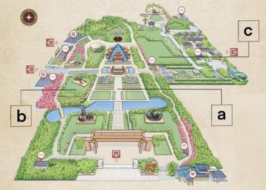
Based on the attention restoration theory and the Dunhuang cultural IP, this study divides the physical space of the Dunhuang Heavenly Spirit Park into three functionally coherent AR experience areas, and the specific design content is as follows:
Zone A (Entrance Corridor): Children use AR glasses to gaze at the statues to “activate” them, listen to cultural introductions, and complete sequence tasks to obtain virtual companions. This section aims to complete the initial cultural context introduction and gently guide attention (Figure 1a).
Zone B (Mural Statue Area): Children need to find designated real plants and project the collected “natural energy” onto the murals, thereby restoring and activating the animated story, allowing the IP characters such as the Nine-Colored Deer and the Flying Spirit to “emerge” from the murals. This section aims to achieve narrative immersion and deep emotional connection with the culture (Figure 1b).
Zone C (Open Green Area): Children can freely follow the virtual characters for exploration. They can trigger environmental feedback such as the blooming of Dunhuang patterned flowers by touching the trees. This area does not have fixed tasks but is filled with discoverable interactive “clues”, encouraging children to transform from task performers into active explorers of the environment. Their attention flow is completely driven by curiosity, simulating the ideal state of complete relaxation and recovery of the mind when wandering in pure nature (Figure 1c).
Figure 1: In various scenes of the Dunhuang Heavenly Being Park, appropriate educational content on scientific knowledge is provided.
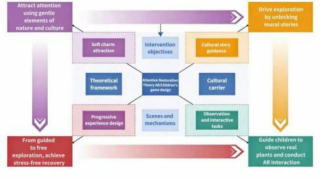
188 Yang Through a gradual transition from guidance to autonomy, and ensuring compliance with the theory of attention restoration, this plan has designed a set of integrated and multi-layered feedback mechanisms that run throughout the process. These mechanisms aim to maintain the positive engagement of attention through immediate interactive feedback, deepen cognition through feedback on knowledge internalization, and consolidate positive experiences through social and emotional feedback, thus forming a complete healing cycle, as shown in Figure 2.
The specific feedback mechanisms include: (1) Through AR glasses, children activate IP characters, collect natural energy
via gestures, and trigger environmental effects through free exploration— receiving immediate visual, auditory, and tactile feedback such as glowing murals, character voices, and gentle vibrations. This multisensory positive feedback embodies ART’s “soft fascination” mechanism, sustaining attention without stress. All effects are timed and dosed to be salient yet non-intrusive, following a prompting-not-disturbing principle. (2) Educational content feedback: Through the two core tasks of “unlocking cultural stories” and “collecting natural guides”, children learn about Dunhuang culture and natural knowledge during exploration. When the tasks are completed, the system provides feedback through the affirmation of IP characters, the popping of knowledge cards, and the collection progress. This design is based on the theory of contextual cognition, integrating knowledge into the exploration environment (Wang, Cao, Wen, 2023). The difficulty of the tasks is gradually distributed, from linear guidance in Area A to free exploration in Area C, and provides a space for attempts without failure penalties, enabling children to gain a sense of achievement and control in simple challenges, effectively stimulating learning motivation and promoting cognitive development. (3) Social and emotional feedback: After the project concludes, the generated
exploration journey report can be shared and exchanged, containing the collected cultural and natural elements. This feedback mechanism follows the principles of social culture theory and positive psychology, consolidating learning outcomes through social sharing, enhancing emotional connections, and helping children establish cultural identity, natural connection, and positive emotions in shared cultural and natural experiences.
Figure 2: Flowchart of feedback mechanism.
AR Children’s Game Design From the Perspective of Attention Restoration Theory 189 Storyline and Game Experience Design
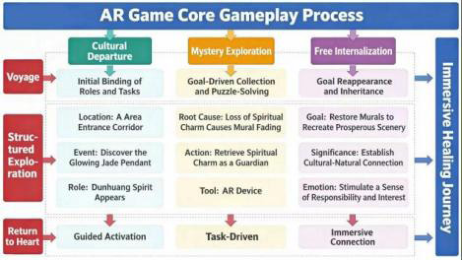
Structured as Cultural Departure – Mystery Exploration – Free Internalization, this AR experience begins at Park A, where faded murals prompt children to become guardians who restore them by collecting spiritual essence through real-world plant observation and AR puzzle-solving. Guided by goal-driven tasks and emotional interaction with flying spirits, children progressively unlock mural stories, receive gratitude from revived characters, and earn a digital guardian certificate. The journey weaves nature, culture, and fantasy into a stress-free adventure that cultivates aesthetic sensitivity, ecological awareness, and cultural resonance through immersive, heart-mind engagement. See Figure 3.
Figure 3: Storyline design.
Specific Interaction and Visual Design The overall visual style and color scheme of this design strictly follow the principles of compatibility and distance. The colors are derived from Dunhuang mineral colors, but through the enhancement of brightness and saturation, a bright and pleasant atmosphere is created. This design not only harmoniously coexists in terms of color with the natural light and shadow of the park, avoiding visual conflicts between virtual information and the real environment, but also, through a light and clear visual experience, forms a sharp contrast with the stimulating layout of traditional classrooms or electronic screens, constructing a fantasy tone that can help people detach from daily stress and provides an aesthetically pleasing and enjoyable atmosphere, offering a gentle visual environment for relaxation of attention.
The Dunhuang spirit IP, digitally adapted from flying figures and caisson motifs, uses expressive animation and encouraging gestures to create sustained emotional engagement. Rather than didactic instruction, it naturally sustains attention through narrative. The IP adjusts dialogue, task complexity, and cultural depth across ages 4–10 and game stages—shifting from emotional cues to open-ended metaphors—ensuring coherent experience and consistent cultural transmission throughout the healing journey.
Overall, the Dunhuang IP design is not only a contemporary translation of traditional visual elements, but also a cultural reach practice targeted at children. Through aesthetic harmony, symbol reconstruction, and emotional narrative, Dunhuang culture achieves a perceptible, tangible, and approachable communication effect in immersive interaction.
Table 1: IP role design.
Table available in the original PDF paper.
Element Extraction Color Extraction IP Image Ancient buns, floral ornaments, Tang-style sets and patterned embroidery create a cute, charming look.
Soft white base with blue & pale gold patterns; pink-yellow hair accessories, fresh elegant palette.
Ancient hairpins, floral ornaments, Chinese stand collars & cloud patterns, charming lively design.
Pale yellow base with warm yellow, dark blue, green & warm pink florals, elegant lively palette.
Ancient hairpins, floral ornaments, Chinese lapels & embroidery, charming elegant finish.
Pale white base, warm brown/ blue/pale gold accents; warm yellow hair accessories, fresh elegant palette.
Pale white base with warm brown, azure, warm yellow; pink-orange hair accessories, lively elegant palette.
Across three park zones, children trigger interactions via gaze, remote click, or slide—all with gentle visual and vibration cues. Gesture recognition features wide tolerances and voice assistance to prevent frustration. A progressive guidance system uses opening animation, floating-spirit prompts, and subtle edge lighting, which gradually fade as proficiency grows, enabling a smooth shift from guided to autonomous recovery.
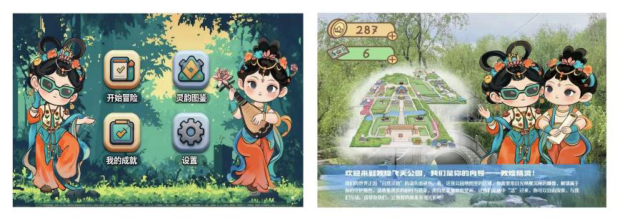
The main interface design of the game is extremely simple, thereby reducing the difficulty and adopting interactive design that conforms to children’s cognitive characteristics (Abdulhameed, Rashid 2022). Main menu features four realistic icons with voice labels; two Dunhuang IP characters greet users to create a friendly, low-stress entry. IP then guides rules and goals via voice and map, as shown in Figure 4.
Figure 4: The main page of the AR game scene.
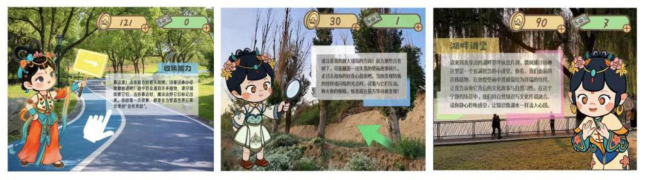
AR Children’s Game Design From the Perspective of Attention Restoration Theory 191 Upon park entry, AR guidance overlays IP characters holding directional cues onto real pathways and trees, shifting children’s focus from screen to surroundings. Knowledge interfaces position the IP as a teacher-like guide, pointing to plants and previewing Dunhuang patterns before interaction— embedding cultural context into anticipation and framing the upcoming play as meaningful discovery. See Figure 5.
Figure 5: Task guidance in AR game scenarios.
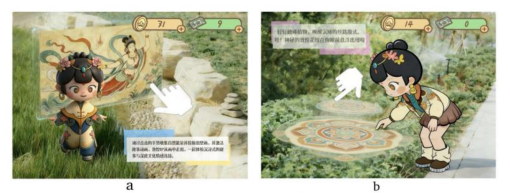
Interactive feedback pairs dual demonstrations—IP character and finger icon touching real plants—triggering Dunhuang-pattern blooms, clearly communicating gesture, target, and reward to reduce learning costs. In story activation, correct gestures unlock floating AR murals with emerging IP characters, transforming abstract capture into vivid restoration moments that strengthen achievement and cultural connection, as shown in Figure 6.
Figure 6: Interactive feedback in the AR game scene.
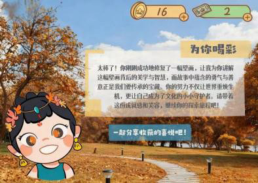
In the final quiet scene, IP characters offer verbal praise and celebratory animation, transforming external rewards into internal achievement and warmth—closing the healing journey with positive emotional reinforcement rooted in positive psychology, as shown in Figure 7.
Figure 7: Summary feedback of AR game scenarios.
DISCUSSION AND CONCLUSION This study presents an AR game framework integrating Dunhuang IP with real natural environments, grounded in Attention Restoration Theory, to guide children through a progressive healing journey from cultural cognition to autonomous exploration—alleviating nature deficit symptoms via stress-free, narrative-driven immersion. Limitations include the need for empirical validation, technical dependence on outdoor AR device performance, and current site-specificity that hinders direct scalability.
Future work will develop prototypes to assess attention, emotion, and nature connection outcomes; integrate more stable, lightweight AR technologies for outdoor fluency; and build a modular content and narrative system adaptable to diverse cultural-natural sites—toward scalable digital healing solutions that unite cultural identity, mental health, and ecological reconnection.
REFERENCES
Abdulhameed, Rashid. Child drawing development optimization algorithm based on child’s cognitive development[J]. Arabian Journal for Science and Engineering, 2022, 47(2): 1337–1351. Cai, S., Zhang, J. (2023). “Augmented Reality (AR) Technology Transforms
Education and Teaching”, People’s Education, (09), pp. 33–37. Chen, Y.Y. (2023). “Design and Application Research of an AR Educational Game for Primary School English Based on the ARCS Model—Taking ‘Animal’ as an Example”. Goharinejad, S., Goharinejad, S., Hajesmaeel-Gohari, S., et al. (2022). “The
usefulness of virtual, augmented, and mixed reality technologies in the diagnosis and treatment of attention deficit hyperactivity disorder in children: an overview of relevant studies”, BMC Psychiatry, 22(1), p. 4. Kaplan, S. (1995). The restorative benefits of nature: Toward an integrative framework. Journal of Environmental Psychology, 15(3), 169–182. Li, Y.T. (2024). “Research on Children’s Nature Education Product Design from the
Perspective of Nature-Deficit Disorder”, Luoyang Normal University. Louv, R. (2008). Last child in the woods: Saving our children from nature-deficit disorder. Algonquin Books. Wang, G. (2024). “The theory, principles, and strategies of the application of
situational teaching method in history teaching”, Farabi Journal of Social Sciences, 10(1), pp. 54–61. Wang, J.N., Cao, T.T., Wen, Y.F. (2023). “The Development and Application of Dunhuang Art under Interactive Technology”, China Market, (15), pp. 73–76. Xi, C. (2023). “Design and Development of an AR-Based Labor Education Game for
Primary Schools—Taking ‘Little Shennong Plantation’ as an Example”. Zhai, J.J. (2022). “Research on the Application of Dunhuang Mural Figure Costumes in AR Interactive Illustration”, Western Leather, 44(18), pp. 144–146. Zhou, B.E., Yang, L. (2025). “Research on the Application of Dunhuang Mural
Images in Contemporary IP Design”, Tiangong, (29), pp. 62–65.
LISTED IN THE AHFE DIGITAL BOOKSTORE CATALOGUE
Explore the complete digital volume
Metaverse, Virtual Environments and Game Design
Read this individual research paper free through the original publisher, or explore the full digital proceedings book.
ISBN 978-1-964867-93-9
Explore this ISBN in the AHFE Bookstore ↗Listed in the July 2026 bookstore catalogue; search by ISBN to confirm current availability · Digital book purchase optional