Miki Namatame, Chie Tsutsumi (2025). Exploring Augmented Reality Applications in Botanical Gardens: A Pilot Study on Overcoming Seasonal Barriers. In: Human Factors in Design, Engineering, and Computing. AHFE Open Access, vol. 199, pp. 819–827. https://doi.org/10.54941/ahfe1006894
Botanical gardens face persistent challenges with seasonal limits hindering plant observation and visitor engagement. This study examines how augmented reality (AR) addresses these barriers by enabling interaction with 3D models of off-season plants, offering visitors experiences otherwise unavailable during certain times of year. At Tsukuba Botanical Garden, field experiments let visitors manipulate digital models created by photogrammetry, providing an immersive, interactive layer beyond physical exhibits. Stamp rallies with quiz elements boosted participation. This paper focuses on the AR experience: forty participants of various ages moved freely through greenhouses and used AR to access details of six plant species, regardless of seasonal display. Building on these interactions, the survey showed that 95% of participants felt satisfied with the AR experience, and even those with little prior interest in plants engaged highly. Further analysis found a weak positive but non-significant correlation between participants’ prior interest in plants and their satisfaction with the AR observation. Participants also reported that AR deepened their understanding of plant structures and let them observe flowers not in bloom at the time. Taken together, these findings suggest that AR can significantly boost educational value and visitor motivation, highlighting its potential as a tool for inclusive, year-round botanical education.
Botanical gardens now use digital tools to boost education and visitor engagement (Liu, 2024). Augmented reality (AR) overlays interactive plant models on real environments, letting visitors explore species not in bloom. This supports active learning year-round. The restricted duration of flowering periods limits opportunities for plant education and results in inconsistent visitor experiences. According to Falk and Dierking (2013), visitors are motivated by exploration, restoration, and learning. When floral displays are limited, these motivations may not be met, potentially reducing attendance. AR can maintain visitor engagement by delivering immersive experiences that support these objectives throughout all seasons (Syerov,
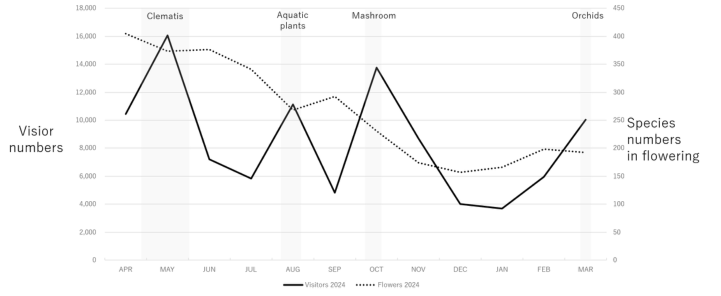
2025; Xiao, 2024; Brischetto, 2023; Benente, 2023). At Tsukuba Botanical Garden (Tsukuba Botanical Garden, 2025), both the number of flowering species and visitor attendance reach their highest levels in spring and decline during winter (see Figure 1). This pattern demonstrates the significant impact of seasonal displays on visitor engagement and underscores the necessity for year-round educational solutions.
This study investigates the extent to which AR can overcome seasonality in botanical gardens by providing consistent plant observation opportunities. It specifically examines the role of AR in sustaining visitors’ understanding, motivation, and enjoyment of plant exhibits year-round.
Figure 1: Seasonal trends in visitor numbers and flowering species at Tsukuba Botanical Garden (2024). Monthly visitor counts (solid line, left axis) and numbers of flowering species (dotted line, right axis) are shown. Gray bands indicate special exhibition periods. Both measures peak in spring and drop in winter, illustrating the strong seasonal dependence of visitor engagement.
METHODOLOGY
Researchers carried out the field study at Tsukuba Botanical Garden, part of the National Museum of Nature and Science in Japan (Tsukuba Botanical Garden, 2025). Situated at the southern base of Mount Tsukuba, the garden spans about 14 hectares of lush natural terrain. The facility features over 7,000 plant species, including iconic flora of Japan, tropical and arid-region plants from around the world, and species native to the Tsukuba area. It serves both as a public botanical garden and as a research institute advancing plant science.
The study focused on two main greenhouses:
Savanna Greenhouse (America, Africa, and Australia zones) – This area supports plants from regions with distinct dry and wet seasons and low annual rainfall. The display includes cacti, agave, aloe, Cactus, and euphorbia. These show adaptive strategies for water storage and drought resistance.
Tropical Resource Plants Greenhouse – This area features plants that support human life in tropical regions. They are organized by their
Exploring Augmented Reality Applications in Botanical Gardens: A Pilot Study 821
practical uses. The collection includes food plants (e.g., banana, cacao) and industrial raw materials (e.g., rubber tree). It also has timber species (e.g., mahogany), spices (e.g., pepper, nutmeg), medicinal herbs (e.g., Orthosiphon aristatus), and ornamental species (e.g., hibiscus).
To help visitors visualize plants not currently in bloom, the research team developed three-dimensional AR content using photogrammetry. They took high-resolution photos of target plants from multiple angles and used 3DF Zephyr Lite software to process these into 3D computer-generated (CG) models. When users scanned a printed image marker with their smartphone camera, the system overlaid a 3D model of the plant in real- world space. This system lets visitors see flowers or fruits not in bloom and observe fine morphological details difficult to see with the naked eye. Users can actively rotate, zoom, and view the 3D models from any angle they choose. This interactive feature invites them to explore digital plants in a self-directed way, fostering curiosity and engagement. These actions help visitors gain a deeper understanding of plant structures while enjoying an immersive, hands-on learning experience that goes beyond traditional static observation.
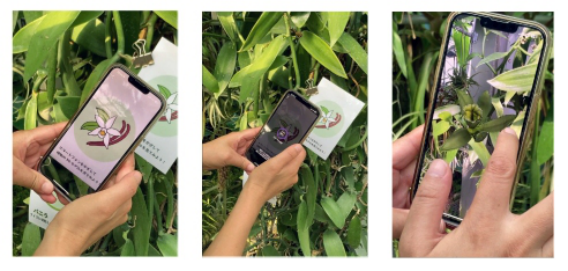
The overall operation process is shown in Figure 2. Visitors open the AR app on their smartphones, scan the image marker near a plant exhibit, and see the corresponding 3D object in real space. By rotating and enlarging the virtual model, users can explore plant features not visible to the naked eye. This includes internal structures or flowers not currently in bloom.
Figure 2: Operational flow of the AR plant observation system (left to right).
Target Plants: Six plants were used for AR modeling: banana (Musa sp.), lemon (Citrus limon), vanilla (Vanilla planifolia), climbing ylang- ylang (Artabotrys hexapetalus), bougainvillea (Bougainvillea spectabilis), and Uncarina grandidieri. These flowers or fruits are not usually observed. Banana and vanilla flowers are short-lived. Climbing ylang-ylang has inflorescence hooks for climbing. Bougainvillea flowers, surrounded by colorful bracts, are often overlooked. Uncarina grandidieri fruits have prominent spines to attach to animals for dispersal.
822 Namatame and Tsutsumi
We captured a 360
series of photographs by rotating a turntable, fixing flowers or fruits at the center. For each material, we took about 180 photos per rotation at three camera angles: 0
, 30
, and 60
. For the large banana inflorescence, we took photos outdoors, circling the inflorescence.
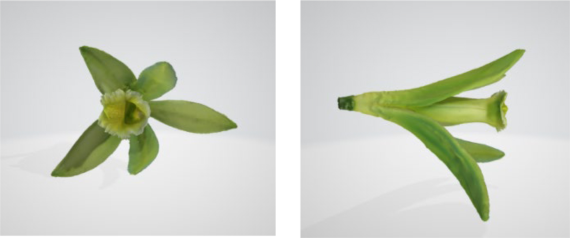
Figure 3: 3D model of a vanilla flower.
Marker Design: The AR markers were created in partnership with botanical experts to guarantee visual clarity and scientific accuracy.
Banana/Lemon: Represented using fruit shapes for quick identification.
Vanilla: Described the elongated fruit and unique flower shape.
Ylang-ylang: Emphasizing the attractive flower while maintaining the climbing trait in the model.
Bougainvillea: Illustrated the three tiny flowers encircled by colorful bracts.
Uncarina grandidieri: The AR model displayed the fruit, while the marker showed the flower for balance.
Several challenges arose during the modeling process. The small size and delicacy of flowers made it difficult to reconstruct thin petals and fine textures accurately. Lighting and background uniformity (blue or black) were adjusted to produce high-quality images. Some 3D models displayed imperfections such as small holes or jagged petal edges, highlighting the need for further refinement. These imperfections may lead to potential learner misconceptions, such as distorted petals causing misidentification, which underscores the importance of accuracy in educational tools. To mitigate these risks, future work should explore integrating multi-lens scanning or structured-light techniques to improve precision.
EXPERIMENT Purpose and Overview: The field experiment aimed to evaluate the effectiveness of AR technology in enhancing plant observation experiences in a botanical garden setting. The study investigated how AR influences visitor satisfaction, learning motivation, and interest in plants. It also explored how different age groups respond to interactive AR in an informal learning environment. The experiment took place on September 8, 2024, at the Savanna Greenhouse and Tropical Resource Plants Greenhouse of the Tsukuba Botanical Garden. These indoor environments were chosen because they provide stable lighting and weather conditions.
Exploring Augmented Reality Applications in Botanical Gardens: A Pilot Study 823
Participants: 40 visitors, ranging in age from teenagers to people in their seventies, voluntarily participated in the study. These participants were general visitors who happened to visit the garden on the day of the experiment. All were given a verbal explanation of the study’s purpose and procedures, and informed consent was obtained before they participated. Participants installed the AR app on their smartphones and received a map showing the locations of six AR target plants. They were instructed to explore the greenhouses freely, scan the image markers near each plant, and experience the AR content at their own pace.
Procedure: The experimental process consisted of three steps: 1) Introduction and briefing, where participants learned about the purpose and operation of the AR system and received the map of the location; 2) Free exploration, where participants navigated through the greenhouses, scanned AR markers, and viewed the 3D models of plants; and 3) Post-experience questionnaire, where participants immediately filled out a paper survey to assess their satisfaction, interest, and suggestions for improvement.
Questionnaire Design: The post-experience survey included both closed- ended and open-ended questions. The closed-ended part featured five-point Likert scale questions that assessed: 1) Satisfaction with the AR experience; 2) Ease of use of the app; 3) Interest in plants before and after the AR experience; 4) Willingness to visit the botanical garden again; 5) Perceived educational value of the experience.
The open-ended section encouraged participants to freely share their impressions, suggestions, and perceived benefits or challenges. Demographic details like age group and how often they visit the botanical garden were also gathered.
RESULTS
Overview: A total of forty participants, ranging in age from teenagers to seniors, used the AR-based plant observation system and completed a post-experience questionnaire. Overall satisfaction was very high: 95% of participants reported being either “very satisfied” or “satisfied,” and no one rated the experience as “highly dissatisfied” (see Table 1). The results show that the AR system effectively offered engaging and educational experiences for different age groups. Summary of participants’ ratings of the overall experience and AR-based plant observation. Percentages indicate the proportion of respondents who selected each satisfaction level, with the number of respondents in parentheses.
Table 1: Summary of participant evaluations.
Table available in the original PDF paper.
Evaluation Item
Very Satisfied Satisfied Dissatisfied Very Dissatisfied 65.0% (26) 30.0% (12) 5.0% (2) 0 Overall evaluation
62.5% (25) 27.5% (11) 7.5% (3) 0 AR observation
824 Namatame and Tsutsumi
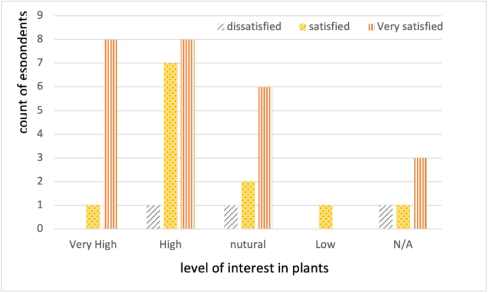
Quantitative Findings: Figure 4 demonstrates the correlation between participants’ degree of interest in plants and their satisfaction with the augmented reality observation experience. A clear trend was observed: participants with greater prior interest in plants generally reported higher satisfaction levels. Nevertheless, satisfaction levels remained consistently high across all interest groups, demonstrating that the augmented reality experience universally appealed to visitors, irrespective of their previous botanical interests.
To analyze this relationship quantitatively, satisfaction levels were assigned numerical scores (L_satisfaction = 1, Satisfaction = 2, H_satisfaction = 3). Each participant’s satisfaction score was then compared with their corresponding interest level (Low = 1, High = 2). Participants who did not answer the interest-level question (n = 5) were excluded. A correlation analysis demonstrated a weak positive yet non-significant association (Pearson’s r = 0.28, Spearman’s ρ = 0.25, p > 0.10), suggesting that although participants with higher interest levels tended to exhibit marginally greater satisfaction, the relationship lacked statistical significance.
Furthermore, a chi-square test of independence was conducted utilizing categorical frequency data to assess whether satisfaction distributions exhibited differences between high- and low-interest groups. The outcome was not statistically significant (χ2(2, N = 35) = 0.47, p = 0.79), thereby confirming that satisfaction levels with the augmented reality experience did not differ substantially between the two groups. In conclusion, these findings indicate that the augmented reality (AR) system delivered an inclusive and engaging experience for visitors with diverse levels of prior interest in plants.
Figure 4: Evaluation of AR observation by level of interest in plants.
Qualitative Feedback: Open-ended comments highlight the educational and emotional impact of the AR experience. Examples include:
Visuals made explanations easier to understand.
Using a smartphone engaged younger people more easily.
It was like holding the plant in my hands and inspecting it carefully.
Exploring Augmented Reality Applications in Botanical Gardens: A Pilot Study 825
The AR experience directly built key botanical skills, such as analysing a flower’s anatomy in detail. By letting learners interact with 3D flower models, the AR tool deepened comprehension and sparked curiosity, making observation dynamic and engaging. Notable challenges still arose, as detailed below.
Technical and Usability Observations: While most feedback was positive, several participants—especially older users—reported operational issues, including marker detection problems and app responsiveness. In addition, comments about heavy data loads and short smartphone battery life informed the following design principles:
Loan tablet devices to users for a more seamless experience.
Optimize data size (reduce how much storage or memory the app uses) for better app performance.
Together, these principles strengthen usability and accessibility for future deployments.
DISCUSSION
Educational and Experiential Benefits of AR: The field experiment demonstrated that augmented reality (AR) —adding computer-generated images or information to what you see in the real world via a device like a smartphone or tablet —effectively addresses the temporal (time-related) and spatial (space-related) limitations of plant observation. Participant feedback, including statements such as “I could see flowers that were not blooming” and “I understood plant structures more deeply,” confirmed that AR facilitated experiences that were not attainable with conventional displays. These findings align with previous research emphasizing AR’s capacity to promote active, inquiry-based learning through visual interaction.
Inclusivity and Accessibility: AR engaged participants across a wide age range, from teenagers to older adults, demonstrating broad appeal. However, older users encountered challenges with marker recognition and complex operations. To enhance accessibility, interfaces should be simplified, instructions clarified, and multimodal aids such as voice or tactile feedback incorporated. For example, voice-guided scanning can assist first-time users. Implementing these measures will advance universal design and foster more inclusive AR learning environments.
Technical and Production Challenges: Creating precise 3D photogrammetry models was challenging due to the fragility of plant structures. Photogrammetry is the process of producing detailed three- dimensional models by taking many photographs from different directions and combining them. Model accuracy depended on factors such as lighting, background contrast, and camera stability. Although the overall quality was high, minor defects persisted in delicate or translucent regions. Future enhancements should incorporate multi-angle imaging, structured-light scanning (using projected patterns of light to capture shape), or hybrid modelling (combining multiple techniques) to achieve greater precision.
826 Namatame and Tsutsumi
Environmental and Operational Barriers: AR implementation encountered environmental and logistical challenges. Logistical challenges refer to organizational or operational barriers, such as arranging equipment, staff, or reliable connections. Sustainable deployment requires stable network connectivity, lightweight (efficient and easy to run) applications, and the provision of loaner devices for elderly or novice users. Strengthening infrastructure will ensure reliable and accessible experiences in both indoor and outdoor settings.
Transformative Potential of On-Site AR: Despite these challenges, AR has significant potential to transform botanical education as both a visualization tool and an experiential medium. It extends learning beyond seasonal and geographic constraints by fostering multisensory understanding and combining scientific content with aesthetic appreciation. Conducting these activities in garden settings grounds learning in authentic contexts, enabling visitors to engage with digital content while experiencing living plants, climate, and space. This sensory immersion enhances comprehension, memory, and empathy, highlighting the pedagogical value of on-site AR learning.
Summary and Future Direction: In summary, AR technology:
Inspires motivation and curiosity through active engagement.
Supports inclusive and accessible learning.
Faces practical challenges in usability and infrastructure.
Collectively, these findings indicate that AR-based learning can reshape educational approaches in museums and botanical gardens by fostering sustainable and inclusive environmental education. To realize this potential, botanical gardens, museums, educators, and technology partners should collaborate to establish an open AR model library, accelerating innovation and cultivating a global community for AR-driven learning (Silverman, 2009; Anderson, 2004).
CONCLUSION
This study demonstrates that augmented reality (AR) meaningfully enhances visitor experiences in botanical gardens by overcoming challenges like seasonality and limited plant visibility. At Tsukuba Botanical Garden, AR significantly increased visitors’ observational engagement, motivation to learn, and curiosity about plants—even among those previously uninterested. Most participants (95%) reported high satisfaction, noting AR’s effectiveness for viewing absent flowers and fruits. The results highlight AR’s unique capacity to help visitors surpass temporal and spatial limitations, providing educational and emotional benefits beyond traditional observation. Incorporating AR with interactive activities, such as quizzes and workshops, could further deepen engagement and encourage repeat visits. Despite these strengths, barriers remain: technical issues, particularly affecting older users, must be addressed. Improving accessibility and reliability is crucial for AR’s wider adoption in outdoor settings. This study underscores AR’s role in fostering inquiry-based, multisensory, and inclusive
Exploring Augmented Reality Applications in Botanical Gardens: A Pilot Study 827
learning, and suggests that integrating digital technology with environmental education can strengthen connections between people and the natural world.
ACKNOWLEDGMENT
We want to thank all the visitors to the botanical garden who participated in the experiment. We also want to thank Chikako Ishii, Sho Nagata, and Hiromi Kobayashi for helping with the photos. Additionally, we thank M. Saito for designing the marker illustrations.
This work was supported by JSPS KAKENHI Grant Number JP23K25138.
REFERENCES
Anderson, G. edt. (2004). Reinventing the Museum, Bloomsbury Publishing, 416 p. Benente, M. (2023). “Technology as a tool to study visitor behaviour in museums”, in Proceedings of the AHFE 2023 International Conference on Human Factors in Museums and Cultural Heritage, Lecture Notes in Networks and Systems, Springer, Cham. Brischetto, A. (2023). “Digital technologies in museums: Critical issues and
implementation opportunities”, in Proceedings of the AHFE 2023 International Conference on Human Factors in Museums and Cultural Heritage, Lecture Notes in Networks and Systems, Springer, Cham. Falk, H. J. and Dierking, D. L. (2013). The Museum Experience Revisited, Routledge, New York, 416 p. Liu, Q. and Sutunyarak, C. (2024). “The impact of immersive technology in museums
on visitors’ behavioural intention”, Sustainability, 16 (22), 9714. Silverman, H. L. (2009), The Social Work of Museums, Routledge, London, 208 p. Syerov, Y. and Petrinec, F. (2025). “Innovative solutions for visitor engagement: Augmented reality-based application”, Procedia Computer Science, Volume 257, pp. 661–667. Tsukuba Botanical Garden, (October 24, 2025), https://tbg.kahaku.go.jp/english/
index.php. Xiao, Y. (2024). “The application of AR, VR, and MR technologies in the museum field”, in Proceedings of the AHFE 2024 International Conference on Human Factors in Virtual, Augmented and Mixed Reality, Lecture Notes in Networks and Systems, Springer, Cham.
LISTED IN THE AHFE DIGITAL BOOKSTORE CATALOGUE
Explore the complete digital volume
Human Factors in Design, Engineering, and Computing
Read this individual research paper free through the original publisher, or explore the full digital proceedings book.
ISBN 978-1-964867-75-5
Explore this ISBN in the AHFE Bookstore ↗Listed in the July 2026 bookstore catalogue; search by ISBN to confirm current availability · Digital book purchase optional