Mohammad Jeelani, Michael Prieto (2025). Using the Wearable Acceptability Range (WEAR) Scale to Rate Social Acceptability of Mixed Reality and AI Enabled Head-Mounted Wearables. In: Human Interaction and Emerging Technologies (IHIET 2025). AHFE Open Access, vol. 197, pp. 350–356. https://doi.org/10.54941/ahfe1006751
As head-mounted wearable technologies, including those featuring augmented reality (AR) capabilities and other integrated technologies, gain popularity, social acceptability emerges as a critical factor for their adoption. Unlike less visible tech products such as smart phones, tablets, laptops, and smart home devices, head-mounted wearables are also considered to be fashion accessories, serving as an extension of personal style and identity. Furthermore, head-mounted wearable technologies, such as AR devices, are often perceived to pose privacy and security concerns for both users and bystanders due to their ability to record, track, or display information in real-time. If a wearable device is perceived to be intrusive, unsecure, or unappealing, widespread adoption of the technology could be hindered despite its technical utility as demonstrated by several product failures ranging from earlier attempts at AR hardware to personal transportation devices.Quantifying social acceptance presents significant challenges. Unlike technical performance, social acceptability is a very subjective and nuanced metric that is influenced by factors including social norms and individual preferences. To address this challenge, the Wearable Acceptability Range (WEAR) Scale was utilized for this study to assess the social acceptability of different commercially available AR devices. Originally developed by Gilbert and Kelly (2016), the WEAR Scale measures four key factors: Design and Aesthetics, Self Expression, Consequence, and Reflection by Others. The original 50-item WEAR Scale has since been revised by Nam and Lee (2020) to a 15-item version focusing specifically on smart technology, streamlining the assessment process while maintaining comprehensive coverage of both aesthetic and functional wear across a broader range of products including wearable technology.For this study, a group of 29 participants were each introduced to four of six popular AR devices: Ray-Ban Meta, Engo 2, Xreal Air2, TCL Rayneo X2, Even Realities G1 and Apple Vision Pro. For each device, participants were walked through key device features and tasks followed by a survey using the WEAR scale to gauge their perceptions on social acceptability. Overall, the results indicated varying levels of social acceptability across the devices. The Ray-Ban Meta glasses received the highest ratings across all factors, despite being the only device that did not feature a digital display, due to its compact size and resemblance to traditional eyewear. Bulkier devices such as the Apple Vision Pro and the Xreal Air2 received lower social acceptability scores, particularly in areas related to design and their perceived impact on social interactions.The WEAR Scale proved to be an effective tool for quantitatively evaluating the social acceptability of popular head-mounted wearables. The scores for each device were highly correlated with the product size, weight, and its resemblance to traditional prescription glasses. Further research opportunities include using the WEAR Scale to evaluate products and prototypes with more subtle differences in form factor, to better understand its applicability in contexts where variations between devices are less pronounced.
Mixed reality (MR) and artificial (AI) enabled head-mounted wearables (HMW’s) have recently garnered significant interest for both consumer use and professional use across various industries. These devices offer a wide range of applications including communication, navigation, entertainment, workplace assistance, remote collaboration, data visualization and enhanced accessibility. However, unlike less visible technologies such as smartphones, tablets, and laptops, HMWs are worn on the face, making them not only functional tools but also fashion accessories that reflect personal style and identity. This visibility, combined with the ability of these devices to record bystanders with subtle user inputs and without consent, has led
Using the Wearable Acceptability Range (WEAR) Scale to Rate Social Acceptability 351
to legitimate concerns about privacy, security, and social intrusiveness. Mainstream adoption of these technologies has faced barriers due to public skepticism, highlighting the importance of measuring and understanding social acceptability.
Quantifying social acceptability presents challenges due to its subjective nature. Social acceptability is highly affected by regional social norms, familiarity with the technology, and individual preferences. The Wearable Acceptability Range (WEAR) Scale, originally developed by Gilbert and Kelly (2016) to evaluate the social acceptability of HMW’s and refined by Nam and Lee (2020) for smart wearables, provides a framework for quantifying social acceptability. This research examines the extended WEAR Scale’s effectiveness in evaluating the social acceptability of MR and AI enabled HMW’s. By considering key factors identified by Nam and Lee (2020) including aesthetics, self expression, consequences, and reflection by others, we assessed how well potential users of commercially available MR and AI enabled HMR’s perceive their social acceptability.
BACKGROUND
The development of MR and AI enabled HMW’s has seen rapid growth in recent years. The market size for AR alone was estimated to be $83.65 billion for 2024 with an expected compound annual growth rate (CAGR) of 37.9% from 2025 to 2030 (Grand View Research, 2023). While earlier commercial product releases for these technologies faced backlash due to concerns related to appearance and bystander privacy, recent iterations have delivered products that more resemble traditional eyeglasses leading to better market adoption. Despite these advancements, negative perceptions surrounding social acceptability still serve as barriers for mass adoption.
Dunne et al. (2014) highlight that aesthetics are becoming more of a key consideration for the consumer adoption of wearable technology now that basic comfort and usability issues for this technology are being addressed, and that the wearer’s social experience needs to be considered by design teams as an aspect of wearability. Profita et al. (2016) discuss how factors including the device’s appearance, placement on the body, interaction methods, and bystanders’ familiarity with the technology affect social acceptability, along with privacy concerns due to the ability of these devices to record or capture images. Profita et al. (2016) also discuss how bystanders are likely to be more accepting of this technology if they are aware that the wearer has a disability and that the device is being used as assistive technology. Kelly and Gilbert (2018) emphasize the importance of context in social acceptability, showing that perceptions of wearable devices can vary based on factors such as description, function, and familiarity with technology.
352 Jeelani and Prieto
THE WEAR SCALE The WEAR Scale was developed by Gilbert and Kelly (2018) to quantify the social acceptability of wearable devices from the wearers’s perspective. It was developed through a research process that included a literature review and expert input and was validated by users of bluetooth audio headsets. The WEAR scale consists of 50 items and is grouped into the following categories: appearance, perceived functionality, usability, privacy concerns, comfort, and social appropriateness. The questions on the WEAR scale are presented in the form of agreement/disagreement statements where the respondent provides a rating on a likert scale from 1 (strongly disagree) to 7 (strongly agree) to indicate their level of agreement with each statement. The scores for each of the 50 questions are averaged to provide an overall score for social acceptability for the wearable device for that respondent. Scores for individual respondents are then aggregated to yield a final score.
Nam and Lee (2020) introduced an extended WEAR scale, refining the questions and streamlining them to only 15 items and validating this modified scale for smart apparel as shown in Table 1. Like the original WEAR Scale, the extended WEAR scale uses a similar Likert scale and analysis process to calculate social acceptability scores. The 15 items included in the extended WEAR scale are grouped into four categories: design and aesthetics, self-expression, consequence, and reflection by others.
Table 1: Extended WEAR scale questions.
Table available in the original PDF paper.
Category Questions Design and Aesthetics 1. This wearable product is aesthetically pleasing. 2. This wearable product is stylish. 3. This wearable product is fashionable. 4. This wearable product is sleek, not clunky. Self-expression 1. I like what this wearable product communicates about its wearer. 2. This wearable product is consistent with my self-image. 3. This wearable product would enhance the wearer’s image. 4. I could imagine aspiring to be like the wearer of such wearable product. Consequence 1. This wearable product seems like it would be annoying or add confusion to the typical interactions of people. (R) 2. This wearable product’s placement on the body could cause awkwardness or embarrassment. (R) 3. Use of this wearable product would be more threatening than exciting. (R)
Continued
Using the Wearable Acceptability Range (WEAR) Scale to Rate Social Acceptability 353
Table 1: Continued Category Questions
Table available in the original PDF paper.
Reflection by others 1. This wearable product would be generally accepted by the vast majority of people. 2. The wearer of this wearable product would get a positive reaction from others. 3. The majority of people probably think this wearable product is ok to wear in public. 4. I think my peers would find this wearable product acceptable to wear.
METHODOLOGY
To assess the social acceptability of MR and AI enabled HMW’s, we conducted a study using the extended WEAR Scale to evaluate six different head-mounted wearables: Ray-Ban Meta, Engo 2, Xreal Air2, TCL Rayneo X2, Even Realities G1, and Apple Vision Pro. The devices tested for this study, along with their weights and physical dimensions, can be found in Table 2. Participants (N = 29) were internally recruited at a company developing AR technology, and participated in a focus group study where they were exposed to four of these devices. Each participant received a brief training and was given the opportunity to perform a series of scripted tasks for each device. Following each device demonstration, participants completed a survey that included the 15 extended WEAR Scale questions. Unlike the original WEAR Scale and the extended WEAR Scale which use a 7 point likert scale, a 5 point likert scale was utilized to maintain simplicity and ease-of-use.
(Standard) ENGO 2 (Standard) 36 grams 138 mm 49 mm 133 mm XREAL Air 2 72 grams 148 mm 51 mm 161 mm TCL RayNeo X2 119 grams 155 mm 48 mm 150 mm Even Realities G1 40 grams 141 mm 47 mm 139.2 Apple Vision Pro 600–650 grams (headset only)
160 mm 90 mm 250 mm (headset depth)
RESULTS AND DISCUSSION
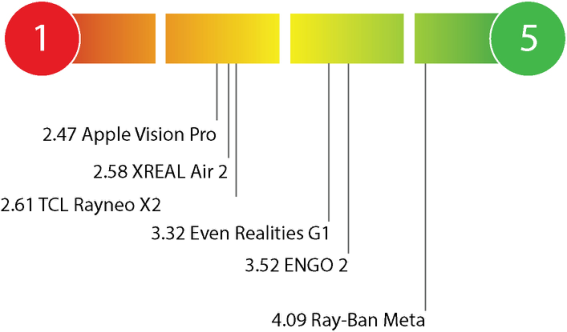
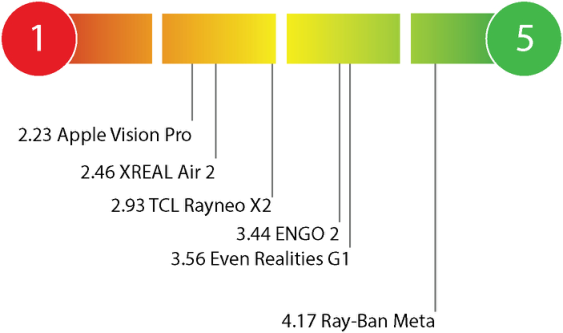
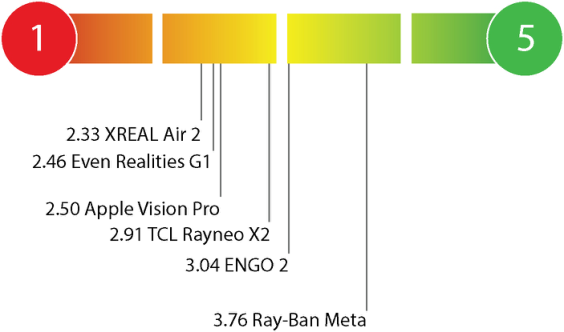
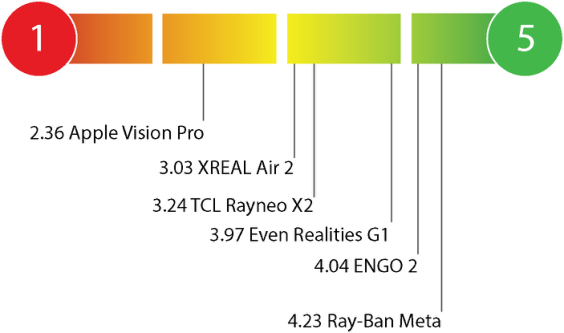
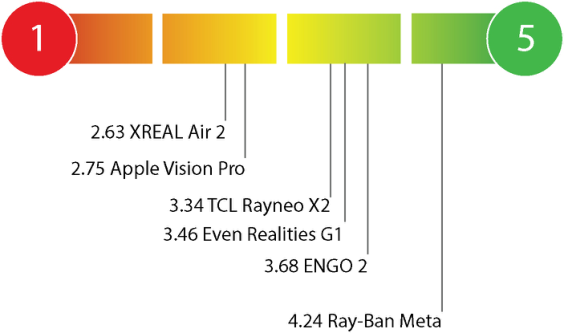
The overall WEAR Scale results are shown in Figure 1 and results for each of the four categories (Design and Aesthetics, Self Expression, Consequence, and Reflection by Others) are shown in Figures 2–5 respectively. The Ray-Ban Meta received the highest overall WEAR Scale score, as well as the highest score for each of the four categories. Despite not having a digital display and limited features, the Ray-Ban Meta appeared to be the preferred device by
354 Jeelani and Prieto
most participants likely due to its high resemblance to traditional prescription glasses. The Even Realities G1, which also features a glasses form factor, and the Engo 2, which resemble wraparound sports sunglasses, also tended to score high. Larger devices, such as the Apple Vision Pro and the XReal Air 2 general scored the lowest for overall social acceptability as well as each of the individual categories.
Figure 1: Overall social acceptability.Figure 2: Design and aesthetics.
Using the Wearable Acceptability Range (WEAR) Scale to Rate Social Acceptability 355
Figure 3: Self expression.Figure 4: Consequence.Figure 5: Reflection by others.
356 Jeelani and Prieto
CONCLUSION
The WEAR Scale was found to be an effective method for evaluating the social acceptability of MR and AI enabled HMW’s. In particular, the findings from this exercise revealed that social acceptability was highly correlated with low product weight and resemblance to traditional eyewear. The integration of WEAR Scale scores during the design process is likely to enable wearable technology product developers to create more socially acceptable devices, resulting in higher adoption rates and more satisfying user experiences.
While the questions on the extended WEAR scale worked well for evaluating MR and AI enabled head-mounted wearables, those questions were originally selected specifically for smart wearables. Future opportunities include refining the extended WEAR scale specifically for MR and AI enabled HMW’s, such as incorporating questions related to bystander privacy. Future research opportunities include increasing the sample size and range of devices evaluated, performing longitudinal studies to assess how social acceptability evolves over time and should consider how different user archetypes perceive social acceptability differently in various social settings. Furthermore, opportunities are present to develop techniques for evaluating social acceptability from the bystander’s perspective.
REFERENCES
Augmented Reality Market Size & Share Report, 2030. Grand View Research, 2023, www.grandviewresearch.com/industry-analysis/augmented-reality-market. Dunne, L. E., et al. “The Social Comfort of Wearable Technology and Gestural Interaction.” IEEE Xplore, 2014, ieeexplore.ieee.org/abstract/document/ 6944540. Kelly, Norene, and Stephen Gilbert. “The WEAR Scale.” Proceedings of the 2016
CHI Conference Extended Abstracts on Human Factors in Computing Systems, 7 May 2016, https://doi.org/10.1145/2851581.2892331. Kelly, Norene, and Stephen B Gilbert. “The Wearer, the Device, and Its Use: Advances in Understanding the Social Acceptability of Wearables.” Proceedings of the Human Factors and Ergonomics Society... Annual Meeting, vol. 62, no. 1, 27 Sept. 2018, pp. 1027–1031, https://doi.org/10.1177/1541931218621237. Nam, Changhyun, and Young-A Lee. “Validation of the Wearable Acceptability
Range Scale for Smart Apparel.” Fashion and Textiles, vol. 7, no. 1, 5 May 2020, https://doi.org/10.1186/s40691-019-0203-3. Profita, Halley, et al. “The at Effect: How Disability Affects the Perceived Social Acceptability of Head-Mounted Display Use.” CHI ’16: Proceedings of the 2016 CHI Conference on Human Factors in Computing Systems, 7 May 2016, pp. 4884–4895, https://doi.org/10.1145/2858036.2858130.
LISTED IN THE AHFE DIGITAL BOOKSTORE CATALOGUE
Explore the complete digital volume
Human Interaction and Emerging Technologies (IHIET 2025)
Read this individual research paper free through the original publisher, or explore the full digital proceedings book.
ISBN 978-1-964867-73-1
Explore this ISBN in the AHFE Bookstore ↗Listed in the July 2026 bookstore catalogue; search by ISBN to confirm current availability · Digital book purchase optional