Xiang Wu (2026). Activation of the Grand Canal Cultural Heritage for Generation Z: A Design Research Based on IP Narrative and Gamified AR. In: Human Factors in Communication of Design. AHFE Open Access, vol. 216, pp. 38–53. https://doi.org/10.54941/ahfe1007623
As a living World Cultural Heritage site still in active use, the Grand Canal serves as a vital carrier of the Chinese nation's historical lineage and collective memory. Its preservation and revitalization are crucial for sustaining cultural continuity. This research focuses on the digital revitalization and dissemination of the Grand Canal's cultural heritage. However, its current digital communication faces significant intergenerational challenges: mainstream approaches, characterized by static and one-directional delivery, struggle to establish deep emotional connections and cultural resonance with Generation Z, who are digital natives. To address this, grounded in gamification design theory, this study proposes an innovative framework of "IP-Narrative-Driven, Gamified-Task-Carried, AR-Spatial-Integration." This framework employs the original IP character "Spirit of the Canal" as the narrative core and emotional guide. A lightweight Augmented Reality (AR) application prototype was developed via the WeChat Mini Program platform. Implemented in the Gongchen Bridge area, it utilizes a "Discovery-Puzzle-Solving-Reconstruction" gamified task flow to create immersive narrative scenes that blend virtual and physical realities. The design aims to systematically enhance Generation Z's cognitive understanding, emotional engagement, and willingness for autonomous dissemination regarding Canal culture. Through framework construction and prototype implementation, this study provides an actionable design approach for the youth-oriented and intelligent dissemination of linear cultural heritage.
Amidst the dual impact of urbanization and digital technology, the transmission of World Cultural Heritage is undergoing a profound intergenerational shift. The Grand Canal, a living heritage corridor traversing north and south China while maintaining practical functions, has seen its preservation and activation extend beyond mere physical conservation to encompass the effective intergenerational transfer of cultural meaning and emotional resonance. The prevailing heritage dissemination models, primarily reliant on static museum displays, pictorial signage at scenic sites, and unidirectional audio guides, are inherently one-way and static information outputs. This creates a structural
Activation of the Grand Canal Cultural Heritage for Generation Z 39 mismatch with the patterns of Generation Z (typically born between 1995 and 2009), who are accustomed to understanding the world through interactive experiences, immersive contexts, and social sharing. Consequently, when engaging with traditional heritage activities, they often feel a sense of detachment and barrier. Kondrateva et al. (2023) noted that Generation Z shows lower interest in classical museums, preferring collaborative and highly interactive cultural experiences. This indicates a clear “experiential gap” forming between the object-centric, unidirectional dissemination logic and the younger generation’s cognitive habits, which rely on interaction, context, sociality, and game mechanics to construct meaning.
Both international and domestic policies and practices have recognized the urgency of bridging this gap. UNESCO’s Charter on the Preservation of the Digital Heritage calls for leveraging digital technologies to create new ways of engaging with heritage. Chinese policy documents, such as the Opinions on Implementing the Project for the Inheritance and Development of Chinese Excellent Traditional Culture, explicitly advocate using new media and technologies to innovate cultural expression and dissemination. These directives provide a crucial policy foundation for this research.
However, many current digital practices still suffer from issues such as “prioritizing technology over narrative” or “superficial gamification with hollow content.” For instance, numerous AR heritage applications merely overlay 3D models onto real scenes, lacking narrative design grounded in local historical context. Many gamification attempts mechanically apply points and badge systems, failing to touch the spiritual core of cultural heritage or inspire the deep motivation for sustained exploration among Generation Z. This disconnection between technological application and cultural connotation results in superficial experiences, hindering the establishment of lasting emotional bonds and cultural identity.
In response to these issues, this paper focuses on the following research questions:
1. How can a narrative guidance mechanism be designed around the IP character “Spirit of the Canal” to lower the cultural cognitive threshold of linear living heritage for Generation Z? 2. How can an immersive task flow be constructed based on AR and gamification ghmechanisms to stimulate Generation Z’s active exploration and emotional investment?
Based on gamification design thinking and the demands of heritage activation, this study constructs a trinity framework of “IP-Gamification-AR” with the “Spirit of the Canal” IP at its narrative core. Leveraging the WeChat Mini Program platform to develop a lightweight AR interaction prototype and deploying contextual exploration tasks in the Gongchen Bridge area, the research aims to systematically validate the framework’s effectiveness in enhancing Generation Z’s cognitive understanding, emotional engagement, and participatory dissemination of cultural heritage. This endeavor seeks to provide theoretical support and practical examples for the younger-oriented and sustainable dissemination of linear cultural heritage in the digital age.
RELATED WORK
HSI experts contribute by ensuring that human capabilities and limitations are considered. It has become clear that treating the system as separate from the users results in poor performance and potential failure in the operational setting. Continued growth in technology has not delivered desired results. Systems engineers and others are beginning to understand the role humans play in technology systems. The core challenge is to balance successful hardware and software solutions with human friendly implementations. To define the requirements of humans as a fundamental system component, it is essential to understand the inherent capacity of user populations and their typical operational environment (Booher, 2003). A description of a population’s capacity incorporates more than the basic anthropometrics or the cognitive capability of the average member of the user population (Chapanis, 1996).
Current State of Digital Dissemination for Cultural Heritage The digital dissemination of cultural heritage has evolved from static documentation to a phase of deep integration and experiential construction, aiming to reshape the ways the public, particularly younger groups, connect with history through technology.
Regarding high-precision digital archiving and virtual experiences, the Dunhuang Academy’s “Digital Dunhuang” (Jian et al., 2022) project (2016) is a prominent example. Founded on principles of permanent preservation and global sharing, the project established a digital archive covering hundreds of caves using high-definition photography and 3D laser scanning, alongside launching a panoramic resource platform and VR theater. It addresses the fundamental conflict between heritage preservation and public access, demonstrating digital technology’s key role in the permanent preservation of fragile heritage, cross-regional immersive access, and remote education. Concerning the construction of large-scale offline integrated virtual-physical experience spaces, the “Patterns of the Way” — Palace Museum Shenzhen Digital Experience Exhibition (2021–2022) (Chunhui et al., 2024), a collaboration between the Palace Museum and Tencent, offers a cutting- edge case. The exhibition systematically integrated VR, AR, naked-eye 3D, curved-screen projection, and intelligent somatosensory interactive devices within a physical venue, creating seven narrative scenes including the digital opera stage of the “Juanqin Zhai” and the interactive “Ingenious Patterns” exhibition hall. Visitors could not only “enter” the historical context inside artifacts via AR glasses but also trigger the dynamic evolution of patterns through gestures and light interactions, achieving a dual immersive experience of “physical co-presence” and “remote virtual presence.” This case indicates that digital dissemination has progressed from an auxiliary guiding tool to a core medium capable of independently constructing deep narrative fields and stimulating cross-temporal cultural imagination. In exploring nonlinear interactive narratives, the National Museum of Korea’s “Peace Mountain” heritage metaverse project on the Zepeto platform provides a forward-looking
Activation of the Grand Canal Cultural Heritage for Generation Z 41 example (J.S. et al., 2024). Research (Kim, 2024) suggests the project not only allowed users to explore digital heritage spaces with virtual avatars but, more importantly, by creating a “healing garden” virtual environment, it expanded the museum’s physical “Room of Quiet Contemplation” into a boundless experiential space. This marks a paradigm shift in digital dissemination logic beyond one-way interpretation, advancing toward an immersive narrative network supporting “spatial expansion” and “personalized interpretation,” truly moving from “institutional storytelling” to “audience exploration and resonance within personalized contexts.”
Despite exploring diverse paths, the aforementioned digital practices commonly face a deep-seated challenge: digital forms and the spiritual essence of cultural heritage often achieve only superficial integration, with technological displays failing to adequately convey core historical significance and emotional value. Simultaneously, existing models remain insufficient in responding to Generation Z’s demands for deep interaction, emotional empathy, social co-creation, and identity formation. Therefore, future development urgently requires a shift toward a more integrative design approach: deeply fusing emotional cultural narratives with gamified interaction mechanisms to construct cultural experience frameworks that genuinely inspire resonance, guide deep participation, and encourage sustained exploration among younger groups (Xue et al., 2023). This demands that digital dissemination move from “technology-empowered display” to “narrative-driven connection,” offering new solutions to the core dilemma of cultural transmission.
Application Status of AR and Gamification in Cultural Education The integrated application of AR and gamification in cultural education centers on enhancing learning outcomes through contextual immersion and motivational design. However, achieving their organic integration rather than simple superposition remains a key issue in current research and practice. Three representative application models have emerged, reflecting different pathways from skill transmission and history education to literacy cultivation.
In the digital gamified transmission of intangible cultural heritage (ICH) craftsmanship, the Wuxi Huishan Clay Figurine interactive game, centered on the iconic “Da Afu” figure (Qiuru et al., 2023), systematically deconstructs traditional crafting processes like kneading, molding, and painting into seven interactive steps (“selecting the mold,” “adding facial features,” “choosing hairstyle,” etc.), integrated with shadow play and paper-cutting style animated narratives. While ensuring the authenticity of the craft, it significantly lowers the learning barrier. Its design emphasizes edutainment, effectively enhancing users’, especially teenagers’, cultural identity and craft cognition regarding ICH. In AR serious games supporting history and humanities education, the “Explore Ancient Greece” AR game, developed by the University of Macedonia, Greece (Bekas et al., 2023), constructs a three- tier progressive experience framework of “learning journey—quiz—escape
42 Wu room.” Through the organic combination of AR scene restoration, interactive Q&A, and narrative puzzle-solving mechanisms, it aims to stimulate learners’ intrinsic motivation and deepen their understanding and memory of historical knowledge. Subsequent empirical studies indicate the game not only improved students’ knowledge acquisition but also enhanced learning immersion and emotional investment. In AR gamified design for local culture and comprehensive literacy cultivation, the “KideClass” project developed by Mahidol University for the Maha Sawat community in Thailand creates six thematic task modules around local agricultural cultural heritage (Onwong et al., 2025). Utilizing AR technology for virtual-physical integrated scene interactions, it focuses on cultivating users’ 21st-century core skills like critical thinking, scientific inquiry, and community participation. Practical evaluation shows the project not only strengthened participating families’ perception and transmission awareness of local culture but also achieved high user satisfaction and continued usage intention. These cases collectively indicate that AR and gamification in cultural education are gradually shifting from unidirectional display to bidirectional interaction, from knowledge transmission to literacy construction, forming a new generation of learning support characterized by systematicity, immersiveness, and empowerment.
Thus, while AR and gamification have demonstrated positive effects in cultural education, it is also essential to recognize that if they fail to integrate deeply with the core content of cultural heritage, the experience can easily become superficial. This manifests as interaction mechanism designs potentially being detached from historical-cultural contexts, leaving users’ participation motivation at the superficial level of completing tasks or obtaining rewards, rather than stemming from genuine interest and understanding of the cultural content itself. To overcome this limitation, it is necessary to establish a core cultural narrative thread in the design, using it to orchestrate and deepen both AR scenarios and gamification mechanisms, ensuring technological means serve the goals of meaning construction and deep cognition.
Cultural Consumption and Media Usage Characteristics of Generation Z As digital natives, Generation Z’s cultural consumption exhibits distinct interactive, community-based, and emotional characteristics, posing new requirements for cultural heritage dissemination to construct “interest-based entry points.” This group not only pursues the reception of cultural content but also emphasizes self-expression, social identity, and emotional resonance through participation.
Regarding participatory narrative construction, based on participatory culture theory, Zhang (2025) proposed that libraries on the Bilibili platform could construct a three-stage participatory space of “field preparation— content attraction—motivation catalysis” through strategies like creating collection-based IPs, incentivizing UGC creation, and implementing online- offline linkage. This aims to propel Generation Z users from cultural consumers to narrative co-creators and dissemination nodes, addressing their strong
Activation of the Grand Canal Cultural Heritage for Generation Z 43 desire for expression and community belonging. In spatially narrative-driven experience design, Wang et al. (2024), using Beijing’s 798 Art District as a case study, constructed multi-layered AR experiences aligned with Generation Z’s behavioral habits by excavating spatial stories, connecting narrative threads, and translating virtual-physical information. This enhanced their willingness to explore, emotional resonance, and cultural immersion within physical-digital interwoven spaces. Concerning gamified cultural heritage immersion experiences, practices like “Dream Back to the Southern Tang Banquet” (Yuyang et al., 2022) indicate that Generation Z learners favor first-person narratives, strongly interactive tasks, and immediate feedback mechanisms. Using tasks such as character dialogue and craft simulation to advance the plot, combined with multi-sensory immersive environments, can significantly enhance their learning initiative and emotional empathy, reflecting this group’s deep-seated expectations for flow experiences and meaning acquisition.
In summary, the focus of cultural heritage activation design for Generation Z should shift from unidirectional knowledge transmission to constructing bidirectional, participatory interactive experiences. The key lies in designing starting points that can evoke this group’s emotional identification and social interactive participation. A culturally affinity and zeitgeist-aligned IP character can play a crucial guiding role in this process, using personalized narration to lower cultural cognitive thresholds and inspire young audiences’ intrinsic motivation for autonomous exploration and dissemination of cultural heritage.
PROPOSED SOLUTION Theoretical Foundation: Basis for Constructing the Gamification Design Framework
This study adopts gamification design theory as its fundamental methodology, aiming to systematically address two key pain points in engaging Generation Z: “insufficient participation motivation” and “high cultural cognitive threshold.” Gamification is defined here as a systematic experiential method based on motivational psychology, which shapes deep engagement and cultural meaning construction through mechanism design. The research employs the Octalysis (Octalysis Behavioral Framework) as the core design tool. Its eight core drives—such as Epic Meaning & Calling, Development & Accomplishment, and Empowerment of Creativity & Feedback—enable the precise translation of cultural dissemination objectives into concrete mechanisms that stimulate the intrinsic psychological needs of Generation Z, thereby providing a “motivational engine” for the entire framework.
The study selects the Gongchen Bridge area in Hangzhou as the practical scenario. This region is a significant node of the Grand Canal World Cultural Heritage, rich in historical remains, yet existing tour methods offer limited attraction to younger groups. Based on gamification theory, this research narratively reconstructs its spatial and historical resources, designing an immersive exploration route titled “Tracing the Canal’s Memory.” This route transforms scattered cultural knowledge points into a coherent gamified
44 Wu journey through IP guidance and AR tasks, aiming to guide Generation Z users in deeply perceiving Canal culture through active exploration.
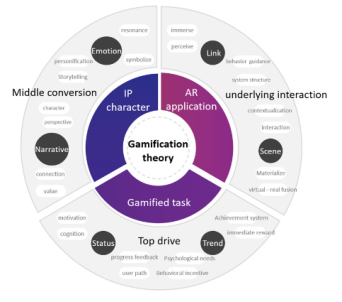
Core Framework: The “IP-AR” Collaborative Model Based on Gamification Theory Based on the aforementioned theory, the research proposes the innovative activation framework of “IP-Narrative-Driven, Gamified-Task-Carried, AR-Spatial-Integration” (Figure 2). This framework uses gamification theory as the top-level driver, defining the user psychological needs and flow channels to be satisfied. The IP character “Spirit of the Canal” serves as the emotional narrative carrier, responsible for personifying and storifying abstract history to establish emotional connections. The AR application acts as the contextualized interaction interface, making tasks and feedback tangible within real space. The three work synergistically: IP guides from the emotional-narrative dimension, AR carries from the behavioral-interaction dimension, all under the overarching logic of gamification to achieve the goals of enhancing cognition, emotion, and dissemination willingness.
Figure 2: The framework of “IP narrative-driven - game-based task-carrying - AR space integration.”
Emotional Narrative Carrier: “Spirit of the Canal” IP Design The design of the “Spirit of the Grand Canal” IP is a systematic process of cultural translation and narrative carrier construction. Its image and core are derived from the extraction and creative transformation of the cultural genes of the Grand Canal heritage: visual symbols are extracted from the forms of “water ripples” and “sails”, historical elements are transformed from physical objects such as “transport ships” and “bridge piers”, and the spiritual images of “flow” and “communication” are concretized as the personality traits of “traversing time and space, and guarding memories”. This ensures that the IP carries the profound cultural genes of the Grand Canal from its very birth.
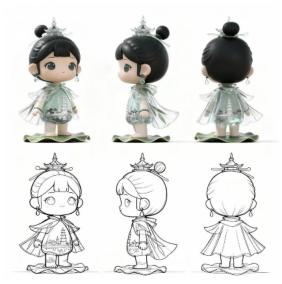
Activation of the Grand Canal Cultural Heritage for Generation Z 45 To effectively connect with the Z-generation, the design has been meticulously shaped in multiple aspects. In terms of character setting, it is positioned as an approachable and curious “time-space guardian”, aiming to establish an equal and collaborative partnership rather than an authoritative and distant image. In terms of visual design, it combines the charm of traditional Chinese culture with modern aesthetic tastes, using extracted cultural symbols to form a fresh and lively overall image (see Figure 3), which aligns with the aesthetic preferences of the Z-generation. In terms of narrative tone, it adopts a first-person perspective, transforming the complex history into an “adventure story of ‘me’” and through guiding dialogues such as “Would you like to help me find it back?”, positioning the users as collaborators of the story. In terms of functional mechanisms, the IP assumes dual core roles: first, as a narrative guiding mechanism, it breaks down the complex history into linear task chains such as “searching for memory fragments”; second, as an emotional maintenance mechanism, its appearance will undergo visual growth changes according to the user’s exploration progress, dynamically binding the user’s achievements with the “life journey” of the IP, aiming to build a long-term emotional bond.
Figure 3: IP three-view drawing.
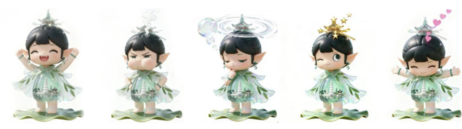
To enhance the affinity and daily penetration of the IP in social dissemination, this study, based on the core image of the Canal Spirit, has developed a series of emoticons (see Figure 4). Emoticons, as lightweight and high-frequency visual carriers in digital social interactions, are designed to capture and express the exaggerated and cartoonish moments of the IP’s personality traits (such as curiosity, joy, encouragement, etc.) in an instant, in order to adapt to the dissemination scenarios of mainstream social platforms like WeChat and QQ. By transforming historical cultural IPs into emotional communication tools, it can significantly shorten the distance with the Z-generation users, continuously strengthen users’ emotional identification and memory in informal communication, and provide low-barrier and easily-shareable digital materials for the interesting dissemination of cultural heritage.
Figure 4: IP funny emoticons.
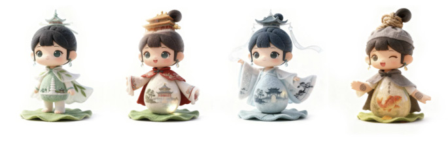
To further expand the narrative inclusiveness and application scenario adaptability of the IP, this study carried out a series of extended design for the clothing and basic forms of the “River Spirit” (see Figure 5). The extended design follows the principle of “form changing but spirit remaining the same”, maintaining the consistency of core facial features and spiritual temperament. By changing the style, color, and accessories of the clothing, it achieves the integration of the IP with different historical contexts, seasonal themes, or activity scenarios. For example, it can design “transportation period” attire with a combination of rustic and elegant styles, and “modern tour” casual outfits that are fresh and lively. This modular form extension system not only enriches the visual expressiveness of the IP, enabling it to flexibly integrate into various contexts ranging from solemn historical explanations to relaxed cultural tourism promotion, but also provides a systematic visual asset support for the subsequent development of peripheral derivatives (such as cultural products, online and offline event images), effectively expanding the application boundaries and long-term vitality of the IP in the value chain of cultural heritage revitalization.
Figure 5: IP clothing and form expansion.
GAMIFIED AR APPLICATION DESIGN To translate the theoretical framework of “IP-Narrative-Driven, Gamified- Task-Carried, AR-Spatial-Integration” into tangible user experiences, this study designed and implemented a set of lightweight, contextual AR application interface systems based on the WeChat Mini Program platform. This interface system strictly adheres to gamified flow channel principles, aiming to guide users through a complete cultural experience journey from attraction and exploration to achievement and sharing via a series of functional interfaces.
The IP character guidance and narrative initiation interface undertakes the core functions of emotional connection and meaning assignment. After users enter the application, they do not directly encounter the function menu. Instead, they encounter the IP character “River Spirit” through a short video that combines traditional Chinese animation and first-person narration. The visual
Activation of the Grand Canal Cultural Heritage for Generation Z 47 design of the interface uses cultural symbols extracted from the canal (such as water ripples and ship sail silhouettes) as the background, and the narrative tone is friendly yet full of a sense of mission, for example, making a call like “Ancient memories are fading away. Would you like to join me in retrieving it?” This interface design directly corresponds to the “epic significance and sense of mission” driving force in the octagonal behavior analysis framework, positioning users from passive tourists to key collaborators in the narrative, effectively lowering the cognitive threshold of cultural heritage and establishing an emotional exploration starting point (see Figure 6).
Figure 6: IP character guidance and narrative initiation interface.
Figure available in the original PDF paper.
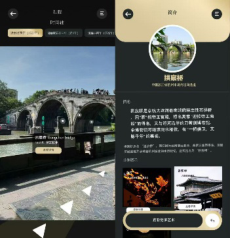
The AR real-scene scanning and contextual task-triggering interface serves as the key hub connecting the virtual narrative and the physical space. The interface maintains a minimalist style, with the core being the camera viewfinder of the mobile phone, supplemented by micro-animation to guide users to scan the designated real objects (such as bridge piers carvings, ancient brick walls). Once the recognition is successful, the interface will smoothly transition, and overlay the AR virtual content related to the location on the real scene image, such as revealing a three-dimensional model of a historical canal boat, or playing a floating subtitle and background sound effect about the past events of this place. This design follows the principles of “intuitive usability” and “contextual immersion”, using AR technology as an interpretation and extension of the physical environment rather than a rigid digital overlay, allowing users’ exploration behavior to naturally blend into the real environment (see Figure 7).
Figure 7: AR real-scene scanning and contextualized task-triggering interface.
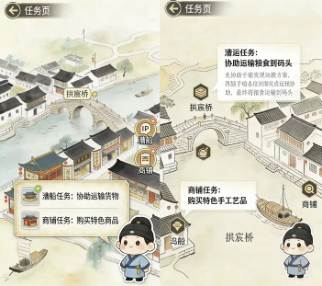
48 Wu The Task-Guided Interface activates upon the user’s arrival at a task point or the triggering of an exploration node. Its core function lies in enabling a smooth transition and contextual pre-setting from spatial exploration to content interaction. Typically presented as a hybrid view integrating map navigation and narrative cues (as shown in Figure 8), this interface aims to clearly identify task objectives, briefly outline historical backgrounds, and provide concise operation guidelines. For instance, when a user scans a specific marker in the Gongchen Bridge area, the interface may highlight task-related physical objects with gentle visual effects, accompanied by brief voice or text prompts from the IP character “Canal Spirit,” such as “Look, this bridge abutment is engraved with the 密码 of past water transport— try to decipher it.” The design emphasizes clear information hierarchy and intuitive guidance, avoiding information overload. Its purpose is to lower the cognitive threshold for users entering the puzzle-solving phase, maintain narrative continuity, and inspire continued exploration.
Figure 8: Task guidance interface.
The cultural puzzle and interactive challenge interface is the core interaction stage of the user experience. Its design directly follows the task prompts of the guiding interface and transforms into specific and operable AR interaction scenarios (as shown in Figure 9). This interface is usually presented as a dynamic AR overlay view. Users can interact with the virtual historical cultural elements in real time through gestures such as touching, dragging, and rotating. For example, in the “Canal Transport Secret” task, the interface will provide 3D components of ancient ships that can be disassembled, and users need to assemble them completely based on historical structure knowledge; in the “Commercial Port Past” task, the interface may display an interactive ancient ledger, requiring users to calculate the quantity of goods or verify the incoming and outgoing records. These designs closely rely on the “creativity and authorization” and “development and achievement” driving forces in the gamification theory, reconfiguring the one-way knowledge transmission into an immersive problem-solving process.
Figure 9: Cultural puzzle and interactive challenge interface.
Progress visualization and dynamic feedback interfaces are integrated throughout, aiming to maintain users’ long-term motivation for participation. At the corner of the main interface, there is an entry for the memory reference guide, which visually presents the memory fragments collected by the user and the task chains to be completed. The image of the IP character, the Waterway Spirit, will also present visualized growth on this interface according to the user’s progress (such as gradually richer clothing details and changes in the surrounding light and shadow), binding the user’s personal achievements with the life journey of the IP. This design ingeniously utilizes the drive of ownership and possession, converting abstract cultural cognitive progress into concrete, collectible digital assets and emotional bonds, inspiring users to continuously explore to witness the complete growth story (see Figure 10).
Figure 10: Cultural puzzle and interactive challenge interface.
Figure available in the original PDF paper.
The Achievement Display and Social Dissemination Interface is responsible for completing the experience loop and expanding cultural influence. Upon completing a story chapter or collecting all fragments, the application guides the user to a specific physical location, triggering a highly immersive “Scene Restoration” AR animation as the ultimate reward for their exploration. Subsequently, users can view earned digital badges and achievement certificates in “My Collection Hall.” The interface provides convenient one- click sharing functionality, supporting the sharing of personalized journey posters or achievement cards to social platforms, and features regional leaderboards and lightweight community access. This segment fully activates the “Social Influence & Relatedness” drive, transforming personalized cultural experiences into shareable, discussable social resources, thereby stimulating autonomous dissemination behavior and forming a diffusion path from individual experience to community resonance.
50 Wu In summary, the application interface design in this study is not an isolated pile-up of functions but an organic system with gamified psychological drives as its internal logic, IP narrative as its emotional thread, and AR technology as its presentation means. The interfaces connect seamlessly, collectively constructing a reinforcing cycle of “Motivation—Action—Feedback,” systematically serving the core objectives of enhancing Generation Z’s cultural cognition, deepening emotional identification, and promoting autonomous dissemination.
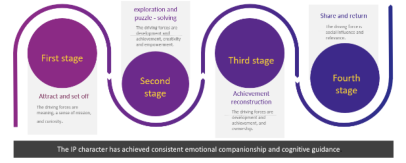
Integrated Experience Flow The entire user experience is designed as a complete “motivation-action- feedback” loop driven by game theory, guided by IP, and carried out through AR, which can be clearly divided into four stages:
The first stage is the attraction and initiation, with the core driving forces being meaning and mission, as well as curiosity. The Canal Spirit IP issues a call through short stories or dynamic posters, establishing the narrative tone; users conveniently enter the application by scanning the physical markers with AR and establish an initial sense of immersion. The second stage is exploration and puzzle-solving, with the driving forces being development and achievement, creativity and authorization. The IP acts as a guide throughout the process and provides task clues and background knowledge at key nodes; users discover trigger points in the real environment according to AR guidance and complete cultural puzzle challenges through the AR interface, successfully obtaining memory fragments and immediate feedback. The third stage is achievement reconstruction, with the driving forces being development and achievement, as well as ownership. When users collect all the fragments, the IP appears to congratulate and guide the moment of witnessing the reenactment; AR triggers the playback at the relevant real location and plays back the animation related to the history of the location, while users receive digital medals and store them in their personal collection. The fourth stage is sharing and return, with the driving force being social influence and relevance. The IP encourages users to share their journey gains; the AR application provides convenient sharing functions and community interaction entrances, allowing users to share their achievements on social platforms and view the leaderboard, thereby converting their personal experience into widespread social dissemination and stimulating secondary exploration. Through the design of these four stages, the game- driven motivation is continuously activated in the narrative progression, the IP character achieves emotional companionship and cognitive guidance throughout, and the AR technology ensures the high contextualization and immersion of interaction, ultimately systematically integrating the design goals of enhancing cultural cognition, deepening emotional identification, and promoting autonomous dissemination into a complete, coherent, and attractive user experience journey (see Figure 11).
Figure 11: “Motivation - Action - Feedback” loop.
DISCUSSION AND LIMITATIONS Although the activation framework constructed in this study is innovative, it still faces multiple constraints. Technically, outdoor AR stability is susceptible to interference from lighting and weather, and variations in user device performance may compromise immersion and generalizability. In content design, the core challenge lies in balancing gamified fun with the depth of historical interpretation, avoiding experiences that become superficial or lead to motivation alienation (e.g., pursuing rewards only). Regarding research evaluation, existing empirical studies focus more on short-term user experience and attitude changes; the long-term nature and complexity of cultural heritage’s impact on individual identity and society require verification through more in-depth longitudinal research. At the application and operation level, the sustained creation, updating, and maintenance costs of high-quality narrative content and interactive tasks are high, posing a practical challenge for achieving comprehensive coverage and sustainable operation of linear heritage like the Grand Canal, which spans vast distances and contains rich historical information.
CONCLUSION AND FUTURE WORK Addressing the challenges in disseminating the Grand Canal cultural heritage to Generation Z, this study constructed a digital activation framework of “IP-Narrative-Driven, Gamified-Task-Carried, AR-Spatial- Integration.” Using the emotionalized IP “Spirit of the Canal” as a narrative and emotional hub, the framework systematically integrates gamification’s motivational engine with AR’s spatial interaction capabilities, aiming to shift the heritage experience from a technology-display orientation to a meaning-construction orientation. Theoretically, it provides a new integrated perspective for transcending the simple superposition model of “technology-content”; practically, its feasibility and application potential were preliminarily verified through prototype design and testing in the Gongchen Bridge area.
Future work will focus on the following directions: First, conducting long- term user studies to empirically assess the framework’s lasting impact on users’ cultural identity and related behavioral intentions. Second, exploring the application of Generative AI (AIGC) in dynamic narrative generation, personalized task adaptation, and intelligent interaction feedback to enhance
52 Wu the experience’s intelligence level and content generation efficiency. Third, attempting to construct online-offline integrated participatory cultural communities to explore sustainable operation models based on user co-creation. Fourth, expanding the framework’s application boundaries, adapting and applying it to other types of heritage scenarios (e.g., historical districts, intangible cultural heritage) to develop more universal and adaptable solutions for the digital activation of cultural heritage.
REFERENCES
Bekas, A., Xinogalos, S. (2024). Exploring Historical Monuments and Learning History through an Augmented Reality Enhanced Serious Game. Applied Sciences, 14, 6556. Chen, C.M., Li, M.C., Kuo, C.P. (2023). A game-based learning system based on
octalysis gamification framework to promote employees’ Japanese learning. Computers & Education, 205, 104899. Huang, Q.R., Yang, F., Shen, A.W. (2023). Research on Interactive Game Design Based on Traditional “Intangible Cultural Heritage” Culture. Packaging Engineering, 44(12): 235–239+249. Kim, J.S. (2024). A Room of Quiet Contemplation: Seeing and Identification in the
National Museum of Korea. Religions, 15, 1416. Friedenthal, S. Moore, A. Steiner, R. (2008) A Practical Guide to SysML: The Systems Modeling Language, Morgan Kaufmann; Elsevier Science. Kondrateva, D.V., Pakhalov, A.M., Rozhkova, N.A. (2023). Much More Than
a Museum: Motivations and Experiences of Young Visitors at Urban Cultural Clusters. In: Katsoni, V. (eds) Tourism, Travel, and Hospitality in a Smart and Sustainable World. IACuDiT 2022. Springer Proceedings in Business and Economics. Springer, Cham. Liamruk, P., Onwong, N., Amornrat, K., et al. (2025). Development and evaluation of an augmented reality serious game to enhance 21st century skills in cultural tourism. Scientific Reports, 15, 13492. Li, C.L. (2022). The Z-generation Youth in Socio-economic Transition: Composition,
Ideas and Behaviors. China Youth Study, 2022. Riar, M., Morschheuser, B., Zarnekow, R., Hamari, J. (2022). Gamification of cooperation: A framework, literature review and future research agenda. International Journal of Information Management, 67, 102549. The State Council of China. (2019). Opinions on the Implementation of the Project
for the Inheritance and Development of Chinese Excellent Traditional Culture. Chinese Excellent Traditional Culture Research, 2019(00): 3–13. Wang, S., Kong, C. (2024). AR Scene Experience Design from the Perspective of Spatial Narratology. Art Research, 2024(04): 118-122. Wang, X., Wang, Y.Y., Qiao, Y.F., Jia, X.H., Niu, Y.J. (2023). The Gamified Design
of “Integration of Learning and Testing” in Online Course Resources: Theoretical Model and Mechanism. e-Education Research, 2023. Wang, Y.J., Shi, Y.X. (2023). Preserving Human Heritage in the Digital Age: Evolution and Prospects of UNESCO’s Digital Heritage Policy. Library Tribune, 43(07): 38–48.
Activation of the Grand Canal Cultural Heritage for Generation Z 53 Wu, J. (2022). A New Mode of Digital Art Presentation of Cultural Heritage: Taking
the Digital Dunhuang Exhibition Concept and Visual Communication as an Example. Art Observation, 2022(10): 18–22. Xiong, Q., Wang, X.Y., Feng, F.P., Liao, Y.X. (2024). Research on IP Image Design and Narrative Strategy of “Yue Brand” Agricultural Product Brand. Packaging Engineering, 2024. Zhang, X.W. (2025). Research on the Operation of Library Social Media Platforms
from the Perspective of Participatory Culture: Taking Bilibili as an Example. Library Work and Study, 2025(02): 97–102. Zhang, Y.Y., Li, W.T., Luo, Y.L., et al. (2022). Educational Games of Cultural Heritage Based on Experiential Learning Model: Taking “Dream Back to the Southern Tang Banquet” as an Example. Modern Educational Technology, 32(07): 48–56.
LISTED IN THE AHFE DIGITAL BOOKSTORE CATALOGUE
Explore the complete digital volume
Human Factors in Communication of Design
Read this individual research paper free through the original publisher, or explore the full digital proceedings book.
ISBN 978-1-964867-92-2
Explore this ISBN in the AHFE Bookstore ↗Listed in the July 2026 bookstore catalogue; search by ISBN to confirm current availability · Digital book purchase optional