Georgios Gerentes, Asterios Leonidis, Nikolaos Menelaos Stivaktakis, Maria Korozi, Constantine Stephanidis (2024). Enhancing Motorcycle Safety through Augmented Reality: Design and Development of a Smart Helmet Prototype. In: Human Factors in Design, Engineering, and Computing. AHFE Open Access, vol. 159, pp. 1089–1099. https://doi.org/10.54941/ahfe1005675
1 Institute of Computer Science, Foundation for Research and Technology—Hellas (FORTH), 70013 Heraklion, Crete, Greece ↗
2 Institute of Computer Science, Foundation for Research and Technology—Hellas (FORTH), 70013 Heraklion, Crete, Greece; University of Crete, Department of Computer Science Heraklion, University of Crete 70013 Heraklion, Crete, Greece ↗↗
Motorcyclists, often regarded as some of the most vulnerable road users, encounter many hazards on the road, ranging from swiftly altering weather conditions to vehicles hiding in their blind spots. Traditional helmets provide physical protection but they lack the capability to enhance situational awareness. Recent advancements in motorcycle safety include the development of Advanced Rider Assistance Systems (ARAS), connected motorcycle technologies, and wearable technology such as smart helmets with embedded sensors. Augmented Reality (AR) Head-up Displays (HUDs) offer real-time information overlays for riders, while artificial intelligence is utilized to analyze rider behavior. This paper introduces a prototype helmet incorporating a pair of AR smart glasses in order to provide enhanced situational awareness and safety, as well as an improved overall riding experience through its comprehensive suite of features. The Smart Helmet aims to provide an immersive and intuitive interface for riders to access critical information without distractions, whereas by consolidating multiple functions into a single device, it offers convenience and efficiency, eliminating the need for riders to juggle multiple gadgets or systems while riding. Through its immersive interface, it overlays real-time information directly onto the rider's frontal visual field, including GPS navigation prompts, weather condition notifications, and visual alerts for vehicles in blind spots. In addition to visual information, the Smart Helmet employs voice commands to enable hands-free control of various functions, such as turning on the rear camera for enhanced rearward visibility, activating Advanced Driver Support System (ADAS) features, or transmitting important information in case of an emergency. Finally, through artificial intelligent the helmet can recognize obstacles ahead and issue timely visual and auditory warnings to prevent accidents. The incorporation of multiple modalities was considered an absolute necessity considering the application domain, which in turn offers a more natural and intuitive interaction paradigm.The design process of the Smart Helmet followed an iterative User-Centered Design (UCD) approach, beginning with an extensive literature review on smart helmets, AR technologies, and road safety applications. This review identified gaps and defined key system features. Interviews with motorcycle users and brainstorming sessions with interaction designers were conducted to gather insights and generate ideas. Subsequently, a prototype was created, featuring a common helmet in which various sensors were embedded and AR glasses were properly mounted, so as to evaluate and test the design concepts. Finally, a heuristic evaluation was performed to assess the prototype's interaction usability and identify areas for improvement, before proceeding with user testing.This paper presents a thorough analysis of related systems and a comprehensive literature review, laying the foundation for the design and development of the Smart Helmet. It elaborates on the iterative design process undertaken, detailing the conceptualization, user requirements gathering, and incorporation of feedback from experts. The functionality of the prototype is described in depth, highlighting its innovative features and how they address identified user needs and safety concerns. Finally, the findings of the heuristic evaluation conducted on the Smart Helmet prototype are discussed, providing insights into its usability, safety, and user experience.
Motorcycling, while providing an exciting and thrilling experience, is one of the most dangerous ways to travel. Motorcyclists are significantly more vulnerable compared to other road users due to their exposure to environmental hazards, limited visibility, and the inherent instability of two- wheeled vehicles (Yousif et al., 2020). According to the European Road Safety Observatory motorcyclists face heightened risks from rapidly changing weather conditions, obstacles, and vehicles that may be obscured in their blind spots (European Road Safety Observatory, 2023). These challenges are exacerbated by the lack of built-in safety features that are standard in cars, such as Advanced Driver Assistance Systems (ADAS) (Kukkala et al., 2018).
Traditional motorcycle helmets, though essential for physical protection, fall short in enhancing situational awareness or providing real-time information that could potentially mitigate these risks. Recent technological advancements, however, offer promising solutions to these limitations (Choi and Kim, 2021). One such advancement is the development of Advanced Rider Assistance Systems (ARAS). ARAS integrate various sensors and technologies to enhance motorcycle safety by providing real-time information and assistance to riders (Savino et al., 2020). Among these advancements, the integration of Augmented Reality (AR) and wearable technology into motorcycle helmets presents a novel approach to addressing various concerns (e.g., safety, comfort). AR head-up displays (HUDs) can overlay key information directly onto the rider’s visual field, thereby improving situational awareness (Von Sawitzky et al., 2020). Additionally, artificial intelligence (AI) can be utilized to analyze rider behavior and predict potential hazards, further enhancing safety by providing timely alerts and recommendations (Chang et al., 2020). Despite their benefits, ARAS systems typically function as standalone devices or add-ons, often requiring riders to divide their attention between multiple gadgets, which can be distracting and cumbersome.
The proposed Smart Helmet aims to provide an immersive and intuitive interface for riders to access information without distractions, consolidating multiple functions into a single device. This approach offers convenience and efficiency, eliminating the need for riders to rely on multiple gadgets or systems while riding. Through its immersive interface, it overlays real- time information directly onto the rider’s frontal visual field, including GPS navigation prompts, weather condition notifications, and visual alerts for vehicles in blind spots.
In addition to visual information, the Smart Helmet employs voice commands to enable hands-free control of various functions, such as turning on the rear camera for enhanced rearward visibility, activating ARAS features, or transmitting important information in case of an emergency. Finally, through artificial intelligence, the helmet can recognize obstacles ahead and issue timely visual and auditory warnings to prevent accidents. The incorporation of multiple modalities was considered an absolute necessity for the application domain, offering a more natural and intuitive interaction paradigm.
This paper presents a thorough analysis of related systems and a comprehensive literature review, laying the foundation for the design and development of the Smart Helmet. It elaborates on the iterative design process undertaken, detailing the conceptualization, user requirements gathering, and incorporation of feedback from experts. The functionality of the prototype is described in depth, highlighting its innovative features and how they address identified user needs and safety concerns. Finally, the software architecture of the Smart Helmet prototype is examined, followed by concluding remarks and insights into its usability, safety, and user experience.
Enhancing Motorcycle Safety Through Augmented Reality: Design and Development 1091
RELATED WORK
Advanced Rider Assistance Systems (ARAS) are designed to enhance motorcycle safety by providing real-time support and information to riders (Huth and Gelau, 2013). These systems integrate various technologies, including radar, cameras, and sensors, to deliver features such as adaptive cruise control, collision warning, blind spot detection, and lane deviation alerts (Savino et al., 2020). ARAS can automatically adjust the motorcycle’s speed, detect potential collisions, monitor blind spots, and even provide turn- by-turn navigation. By improving situational awareness and reducing the risk of accidents, ARAS aims to make riding safer and more manageable, particularly under heavy traffic or adverse conditions.
However, integrating various ARAS components without overwhelming the rider with information remains a key challenge. Recent advancements focus on combining ARAS with wearable technologies like smart helmets (Sobhana et al., 2021), employing more sophisticated AI algorithms (Chang et al., 2020) for better hazard prediction, and enabling vehicle-to-everything (V2X) communication for enhanced safety and coordination on the road (Dhinesh Kumar and Rammohan, 2023).
The AR in such systems, particularly through HUDs, has gained attention for its ability to enhance situational awareness by overlaying critical information onto the user’s visual field (Von Sawitzky et al., 2020). AR HUDs have been employed in automotive contexts to display navigation information, speed, and hazard alerts directly onto the windshield, allowing drivers to access vital information without diverting their gaze from the road (Park et al., 2013). The application of AR in motorcycles, however, remains relatively underexplored, with few studies addressing the unique challenges faced by motorcyclists.
Wearable technology, including smart helmets, represents a burgeoning field aimed at integrating advanced features into everyday objects. Smart helmets for cyclists and motorcyclists have been designed to include built-in communication systems, rear-view cameras, and fitness tracking capabilities (Choi and Kim, 2021). Several smart helmets have been developed and commercialized, each offering unique features aimed at improving rider safety and experience. However, none fully integrate all the advanced functionalities into a single, user-friendly system. Commonly included features are: Head-Up Displays (HUDs): Several helmets, such as the CrossHelmet X11, JARVISH X-AR2, and Skully AR-13, incorporate HUDs to display essential information like navigation, speed, and weather conditions directly in the rider’s field of view.
Rear-View Cameras: Helmets like the CrossHelmet X11, JARVISH X-AR2, and Skully AR-13 include rear-view cameras to provide riders with a better view of their surroundings, enhancing situational awareness.
Voice Controls and Connectivity: Voice-activated controls and connectivity features, found in helmets such as the JARVISH X-AR2 and Quin Quest4, enable hands-free operation, allowing riders to manage calls, music, and navigation without distraction.
Crash Detection and SOS Features: Safety features like crash detection and SOS beacons, seen in the Quin Quest helmet4, are crucial for ensuring that help can be quickly dispatched in the event of an accident.
Integration with Mobile Apps: Helmets like the Argon Transform5 utilize mobile apps for system control and GPS navigation, allowing for enhanced customization and real-time updates.
Despite advancements in smart helmet technology, several limitations remain. Many helmets feature advanced technologies but operate as fragmented systems, causing user distraction as riders juggle multiple interfaces. Additionally, while AI has the potential to provide advanced rider support, such as context-aware hazard alerts and situational analysis, the current presentation media are often underutilized. Most heads-up displays offer only basic information instead of delivering a more immersive and enhanced view of the surroundings. Moreover, integrating multiple sensors and features can lead to complex user interfaces, which might detract from rather than enhance the overall riding experience. To this end, this paper introduces a solution for the identified gap by introducing a prototype helmet that integrates AR smart glasses and AI-driven features (e.g. safety monitoring, car detection, blind-spot support).
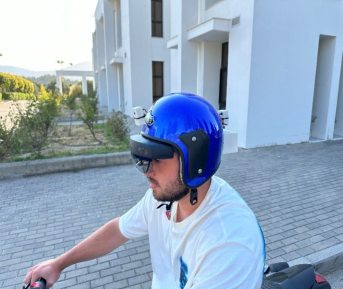
SMART HELMET FUNCTIONALITY AND FEATURES The Smart Helmet prototype (Figure 1) integrates cutting-edge technology designed to enhance rider safety, situational awareness, and overall riding experience. The helmet includes two cameras: one mounted at the front center and the other at the rear center. A lightweight power bank positioned beneath the rear camera powers both cameras. Inside the helmet, a HoloLens is integrated to deliver augmented reality features, while Bluetooth headphones and a microphone are also included for hands- free communication. Additionally, the helmet features a gyroscope and a vibration sensor that work together to monitor its orientation and movement. These sensors enable the system to detect significant tilts or vibrations, which could indicate a crash.
The central control unit is designed to be mounted on the motorcycle’s handlebar and is powered directly from the bike, located beside the speedometer. Above the central control unit, a stabilization cradle is provided to securely hold and protect any mobile phone, ensuring it remains vibration- free and visible for various uses.
Enhancing Motorcycle Safety Through Augmented Reality: Design and Development 1093
Figure 1: The smart helmet prototype.
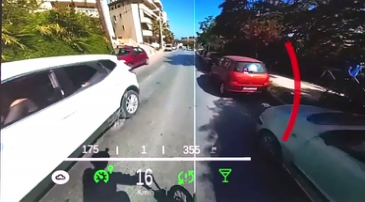
One feature of the Smart Helmet is the integrated GPS navigation system, which offers turn-by-turn directions through a combination of visual 3D AR cues (Figure 2) and voice commands. Riders see virtual directional signs in their field of view, along with essential navigation details such as total distance, estimated time of arrival, and distance for each leg of the journey. This immersive navigation experience ensures riders can follow routes without taking their eyes off the road.
To further enhance situational awareness, the helmet features a live rear camera feed that provides real-time images from the rear-looking camera mounted on the helmet, simulating a rear-view mirror. This is crucial for monitoring blind spots and maintaining a comprehensive view of surrounding traffic. Additionally, the rear collision detection system continuously captures and analyses images of approaching vehicles. By determining the distance and position of each vehicle, it provides timely visual and auditory alerts, helping to prevent rear-end collisions.
Safety is also prioritized with the brake check feature, where a front camera monitors the speed of vehicles ahead and warns the rider if they are approaching too quickly. This real-time, context-aware alert system enhances safety by preventing forward collisions. Complementing these features is the speed alert system, which continuously monitors the motorcycle’s speed and compares it against local traffic regulations. If the rider exceeds the speed limit, the system issues a visual and auditory alert, encouraging speed adjustment and promoting adherence to traffic laws.
Figure 2: Snapshots from the AR interface of the smart helmet.
The weather feature leverages real-time weather data obtained through a connected API to provide current weather updates based on the rider’s location. Severe weather alerts are prominently displayed through the AR interface, ensuring that riders are prepared for adverse conditions. In the event of a crash, significant vibrations in the helmet trigger the crash alert and healthcare feature, which automatically sends the rider’s pre-stored medical information and current GPS location to emergency services, ensuring quick dispatch of help.
For convenience, the helmet allows riders to save frequently visited destinations such as home, work, and favourite restaurants using a companion mobile app. These locations can be accessed quickly, allowing for easy setup of navigation routes. Moreover, the talk button facilitates hands- free operation, enabling riders to activate features and receive information through voice commands. This combination of visual, auditory, and voice- based interaction techniques ensures that critical functions are accessible without distracting the rider from the road.
DESIGN PROCESS The design process of the Smart Helmet followed the AmI-Design Process (Stephanidis et al., 2024) – an iterative methodology for designing Intelligent Environments (IEs), which is rooted in Design Thinking principles (Brown and others, 2008). This process steers the design of Intelligent Spaces (e.g., Intelligent Homes), their associated intelligent artifacts (e.g., smart coffee tables), and related applications. It involves several stages: Understand, Define, Ideate, Filter & Plan, Design, Implement, and Test. When designing a specific artifact such as a Smart Helmet, once these stages are complete, it can be integrated into the intended IE and become a functional component of the broader intelligent ecosystem (i.e., Smart City). Although a helmet is typically seen as a standalone artifact where a “traditional” User-Centered Design (UCD) process would be sufficient, we argue that in the context of a smart city, a smart helmet should be viewed as an integral component that enhances the city’s overall functionality. Therefore, we employed the AmI-Design Process, specifically developed for such integrated scenarios. In particular, the steps taken are analyzed as follows:
Understand & Define: The process began with an extensive literature review focused on smart helmets, AR technologies, and road safety applications. This aimed to gain a thorough understanding of the current landscape, identify existing gaps, and gather insights on relevant technologies and user needs. Additionally, a series of meetings with the design team (including analysts, designers, and engineers) and several potential end users (both male and female motorcycle users, aged 20 to 45, with no disabilities), scenarios and personas were developed. Based on the above, key system features and high-level requirements for the Smart Helmet were defined.
Ideate: The ideation phase involved brainstorming sessions with interaction designers to generate innovative ideas and solutions. This collaborative effort was crucial for exploring various design alternatives and conceptualizing potential features and functionalities of the Smart Helmet.
Enhancing Motorcycle Safety Through Augmented Reality: Design and Development 1095
Creative thinking during this phase helped to identify how to best integrate AR technologies and sensors to meet the defined high-level requirements.
Filter & Plan: Numerous ideas were generated and then filtered through interviews with domain experts in fields such as engineering, automation and robotics, industrial design, and AR technology. This process excluded ideas deemed unfeasible or overly challenging to implement with the current state- of-the-art technology. For example, detecting road flaws was found to be overly complex and confusing for the user due to the poor quality of roads in the area (R5 in Table 1). Additionally, an algorithm designed to detect user fatigue based on eye movements had to be discarded because the available cameras could not accurately capture eye movements (R7 in Table 1). Experienced interaction designers and developers reviewed the remaining ideas, providing valuable insights and preferences for the most promising concepts based on innovation, research interest, and user appeal. This step led to the solidification of the final high-level requirements (Table 1).
Design: The design phase entailed the creation of the Smart Helmet prototype, which involved embedding various sensors into a standard helmet and properly mounting AR glasses. This required scanning the helmet, and then designing and 3D printing cases to hold the components in place. After fitting together, the 3D model of the helmet and the 3D model of the AR glasses, cut-throughs were made in proper places in the helmet to ensure the glasses remained at eye-sight level. The design process was focused on integrating these components to ensure they worked together seamlessly and met the defined requirements. Prototyping included developing interfaces for the AR display, visualizing real-time information such as GPS navigation, weather updates, and alerts for vehicles in blind spots. Additionally, user interfaces for voice control were developed to facilitate hands-free operation and intuitive control of the helmet’s features.
Implement & Test: In the implementation phase, the helmet prototype was built and assembled according to the design specifications. This involved integrating the sensors and AR glasses into the helmet, ensuring that all components were properly installed and functional. Prior to implementing the AR interfaces, User Experience (UX) experts assessed the prototypes, offering valuable feedback and identifying usability issues early in the design process. The revised prototypes were subsequently implemented by the development team, incorporating the feedback and refinements suggested during the evaluation phase. Examples of feedback received from experts include: incorporating day and night colour schemes to enhance legibility under varying lighting conditions, repositioning certain elements (e.g., rear mirror, notification pop-ups) to reduce distractions, and redesigning virtual cues (e.g., when approaching an obstacle) to more effectively inform the rider about its position and distance in the physical world. The next step involves conducting user-based evaluations to assess the effectiveness and UX of the final implementation, ensuring that the helmet meets its design goals and provides a seamless, engaging interaction for end users.
Table 1. High-level requirements for the smart helmet.
Table available in the original PDF paper.
implemented
Safety Features R1 Obstacle Detection: The system should detect and warn riders about nearby obstacles and potential collisions.
implemented
R2 Blind Spot Alerts: The system should alert the rider about vehicles in blind spots.
implemented in simulation
R3 Emergency Alerts: The system should automatically send alerts with location details to predefined contacts or emergency services in case of a crash or emergency situation.
R4 Alcohol Detection: The system should prevent helmet use if the rider is under the influence of alcohol.
future
designed, not integrated yet R5 Road Flaw Detection: The system should detect and alert the rider about road flaws such as depressions.
future
R6 Crash Detection: The system should detect crashes. implemented in simulation R7 Fatigue Detection: The system should use an algorithm to assess rider fatigue based on eye movements and provide alerts if fatigue is detected.
implemented
Visibility and Navigation R8 Rear-View Camera: The helmet should integrate a rear-view camera that provides a live feed to the rider, improving rearward visibility.
Implemented
R9 Real-Time Information: The system should display real-time information, such as GPS navigation, weather updates, and alerts for vehicles in blind spots, directly onto the rider’s visual field.
implemented
Communication and Interaction R10 Hands-Free Operation: Hands-free operation should be available for controlling various functions, such as activating the rear-view camera.
implemented
R11 Auditory Feedback: Auditory feedback should be provided for actions and system status updates to keep the rider informed without needing to visually check the helmet.
implemented
Other Features R12 Customization: Users should be able to customize the information displayed based on their preferences.
future
R13 Communication: The helmet should offer built-in communication for talking with other riders or passengers.
implemented
R14 Notifications: The system should provide immediate visual and auditory notifications for important information such as incoming calls, navigation changes, and safety warnings.
implemented
User Experience R15 Information Clarity: The user should be able to view the desired information easily, with the interface designed to present data clearly and without confusion.
implemented, pending user evaluation
R16 Information Overload: The system should avoid presenting overwhelming amounts of information at once, ensuring that only relevant and timely information is displayed to prevent distractions.
Enhancing Motorcycle Safety Through Augmented Reality: Design and Development 1097
SOFTWARE ARCHITECTURE The Smart Helmet system is composed of three interconnected components: (1) the MicroComputer mounted on the bicycle, (2) the Augmented Reality (AR) helmet, and (3) the companion mobile application. The decision to separate the MicroComputer from the helmet was made to reduce the overall weight of the helmet, thereby balancing its advantages against the rider’s fatigue during prolonged use (Woodcock, 2007). This separation also enhances the system’s energy efficiency, as certain components are significantly more power-intensive than others. By minimizing the electronics integrated into the helmet, the power requirements are reduced, resulting in a lighter battery and overall sensor components that do not substantially increase the helmet’s weight.
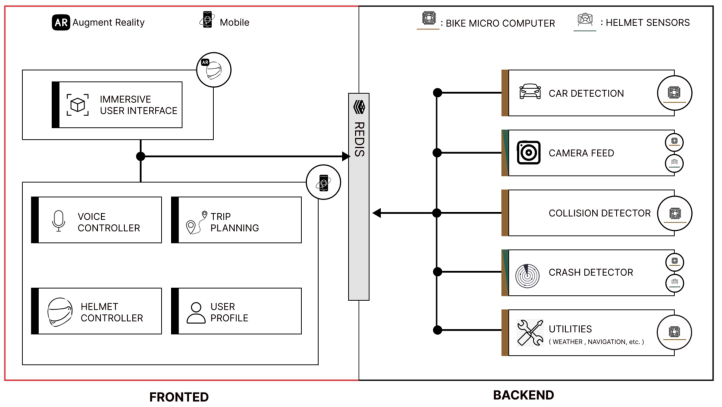
From an engineering standpoint, as illustrated in Figure 3, the system architecture of the Smart Helmet is divided into two primary sections: the Frontend and the Backend. The Frontend encompasses components responsible for user interaction in a multimodal fashion, serving as the central control units. This includes the AR subsystem, which overlays information directly within the rider’s field of view, and the mobile companion application, which allows users to perform tasks requiring more interaction, such as trip planning and preference configuration. The Backend consists of the MicroComputer for core processing and various sensors embedded in both the helmet and the MicroComputer. These sensors are crucial for obstacle detection, collision detection for safety, and managing system configurations and statuses. Adopting a microservice-based architecture, the system can be easily modified to incorporate additional functionalities or to enable/disable existing features in a personalized manner according to the rider’s preferences.
Figure 3: High-level software architecture.
CONCLUSION AND FUTURE WORK From a Human-Computer Interaction (HCI) perspective, the development of the Smart Helmet represents a significant step forward in enhancing motorcycle safety and rider experience through advanced technology integration. The iterative User-Centered Design (UCD) approach employed in this project ensured that user needs and feedback were central to the design process, resulting in a prototype that addresses key safety and usability concerns identified by motorcyclists.
Despite the innovative features, several limitations were identified. The integration of multiple features and sensors can lead to a complex user interface, potentially distracting riders instead of aiding them. Additionally, the current AR HUD primarily displays basic information, leaving significant potential for more immersive and interactive AR applications to further enhance the riding experience. Moreover, as the helmet collects and transmits personal data, ensuring robust data privacy and security measures is crucial to protect user information.
Future plans for the Smart Helmet include refining the user interface to minimize distractions and enhance usability. Enhancing the AR capabilities to provide more immersive experiences and integrating more sophisticated AI for predictive hazard detection are also key areas of focus. Additionally, extensive field testing and user feedback will be essential to iteratively improve the design and functionality. Collaboration with industry partners and stakeholders will be pursued to ensure the Smart Helmet meets regulatory standards and user expectations, ultimately aiming to bring a safer and more enjoyable riding experience to motorcyclists.
ACKNOWLEDGMENT
This work has been supported by the FORTH-ICS internal RTD Programme ‘Ambient Intelligence and Smart Environments’.
REFERENCES
Brown, T., others, 2008. Design thinking. Harvard business review 86, 84. Chang, C., Chen, W.-R., Kuo, X.-M., Song, Y.-J., Liao, P.-H., Kuo, C., 2020. An Artificial Intelligence-based Proactive Blind Spot Warning System for Motorcycles, in: 2020 International Symposium on Computer, Consumer and Control (IS3C). IEEE, pp. 404–407. Choi, Y., Kim, Y., 2021. Applications of Smart Helmet in Applied Sciences: A
Systematic Review. Applied Sciences 11. https://doi.org/10.3390/app11115039 Dhinesh Kumar, R., Rammohan, A., 2023. Revolutionizing Intelligent Transportation Systems with Cellular Vehicle-to-Everything (C-V2X) technology: Current trends, use cases, emerging technologies, standardization bodies, industry analytics and future directions. Vehicular Communications 43, 100638. https://doi.org/10.1016/j.vehcom.2023.100638 European Road Safety Observatory, 2023. Road Safety Thematic Report - Motorcycles - European Commission [WWW Document]. Mobility & Transport - Road Safety. URL https://road-safety.transport.ec.europa.eu/european-road-saf ety-observatory/data-and-analysis/thematic-reports_en (accessed 7.29.24).
Enhancing Motorcycle Safety Through Augmented Reality: Design and Development 1099
Huth, V., Gelau, C., 2013. Predicting the acceptance of advanced rider assistance systems. Accident Analysis & Prevention 50, 51–58. Kukkala, V. K., Tunnell, J., Pasricha, S., Bradley, T., 2018. Advanced driver-assistance
systems: A path toward autonomous vehicles. IEEE Consumer Electronics Magazine 7, 18–25. Park, H. S., Park, M. W., Won, K. H., Kim, K.-H., Jung, S. K., 2013. In- Vehicle AR-HUD System to Provide Driving-Safety Information. ETRI Journal 35, 1038–1047. https://doi.org/10.4218/etrij.13.2013.0041 Savino, G., Lot, R., Massaro, M., Rizzi, M., Symeonidis, I., Will, S., Brown, J., 2020.
Active safety systems for powered two-wheelers: A systematic review. Traffic injury prevention 21, 78–86. Sobhana, S., Sowmeeya, S., Srinathji, M., Tamilselvan, S., 2021. Smart Helmet, in: IOP Conference Series: Materials Science and Engineering. IOP Publishing, p. 012116. Stephanidis, C., Leonidis, A., Korozi, M., Kouroumalis, V., Adami, I., Ntoa, S.,
2024. Design for Intelligent Environments, in: Human-Computer Interaction in Intelligent Environments. CRC Press. Von Sawitzky, T., Wintersberger, P., Löcken, A., Frison, A.-K., Riener, A., 2020.
Augmentation concepts with HUDs for cyclists to improve road safety in shared spaces, in: Extended Abstracts of the 2020 CHI Conference on Human Factors in Computing Systems. pp. 1–9. Woodcock, K., 2007. Rider errors and amusement ride safety: Observation at three carnival midways. Accident Analysis & Prevention 39, 390–397. Yousif, M. T., Sadullah, A. F. M., Kassim, K. A. A., 2020. A review of behavioural
issues contribution to motorcycle safety. IATSS Research 44, 142–154. https:// doi.org/10.1016/j.iatssr.2019.12.001
LISTED IN THE AHFE DIGITAL BOOKSTORE CATALOGUE
Explore the complete digital volume
Human Factors in Design, Engineering, and Computing
Read this individual research paper free through the original publisher, or explore the full digital proceedings book.
ISBN 978-1-964867-35-9
Explore this ISBN in the AHFE Bookstore ↗Listed in the July 2026 bookstore catalogue; search by ISBN to confirm current availability · Digital book purchase optional