Sven Bendzioch, Sven Hinrichsen (2023). Informational Assistance System – a Key to Self-Empowerment of Persons with Cognitive Disabilities in Manual Assembly?. In: Human Interaction & Emerging Technologies (IHIET 2023): Artificial Intelligence & Future Applications. AHFE Open Access, vol. 111, pp. 548–556. https://doi.org/10.54941/ahfe1004061
The development trend in manual assembly towards increasing demands in terms of quality, variety, and cost pressure makes the transition for people with cognitive disabilities to the general labor market extremely difficult. Nevertheless, this employment sector is a central component of many activities in a sheltered workshop. Therefore, this paper investigates the use of an informational assistance system for persons with cognitive impairments to close the gap between the characteristics of this group and the operational requirements. In this way, the transition from the sheltered workshop to the general labor market will be facilitated and promoted.
For many people with cognitive disabilities, the transition from the sheltered workshop to the general labor market remains extremely difficult (Pracht and Welti, 2021). The reasons for this are as varied as the individual limitations of the persons themselves, but can generally be located in the incongruence between the requirements of the general labor market and the performance characteristics of persons with cognitive impairments. Against the back- ground of the shortage of skilled workers and labor in Germany, reducing these discrepancies holds great potential for all stakeholders (Bächler et al., 2015). Participation in value-adding work processes is also considered as a fundamental and guaranteed human right and should therefore be an essential goal of societies (United Nations, 2006).
An important area of employment in this context is the field of manual assembly, since many activities in the sheltered workshop are based on simple assembly and sorting tasks (Doose, 2009). However, despite the experience gained in this field of activity, the transition to the general labor market is proving difficult in view of the increasing demands in terms of quality, diver- sity of variants, and cost pressure, for example. Against this background, this paper investigates the application potential of an informational assem- bly assistance system for persons with cognitive disabilities. The study aims
Informational Assistance System – A Key to Self-Empowerment of Persons 549
to find out to what extent an assistance system can compensate cognitive impairments of persons in order to enable them to participate in working life. For this purpose, a comparative laboratory study is being conducted to investigate the human-oriented and economical application potential of such an assistance system for persons with cognitive support needs compared to a control group without an assistance system.
STATE OF RESEARCH Informational assistance systems are already used at many workplaces in industrial assembly, because even employees without cognitive disabilities use them to cope with the increasing complexity (Senderek and Geisler, 2015; Fast-Berglund et al., 2013). Thus, informational assistance systems support employees in their assembly activities by providing the right information at the right time in the right form (Clays et al., 2015; Hinrichsen et al., 2016). In this context, the information output can occur via various output devices, such as a monitor, where the required information is acquired via sensors in the work system, processed, and output to the user (Clays et al., 2015; Geiser, 1997). Assistance systems consist of hardware and software components configured depending on operational and personnel requirements. Central design fields are the required hardware components, the user interface, and the connection to other systems (Hold, 2017).
Informational assistance systems offer considerable potential for responding quickly to changing market requirements and complying with the constantly increasing demands for high process capability and efficiency. Although various studies confirm the human-oriented and economical appli- cation potential of such systems, e.g. Keller et al. (2021) and Bendzioch et al. (2020), these studies only allow limited conclusions to be drawn about the target group of people with cognitive disabilities considered in this paper.
Only four studies could be identified that explicitly investigate the applica- tion potentials of assistance systems in relation to persons with special needs (Aksu et al., 2019; Funk et al., 2015a; 2015b; Korn et al., 2013). Two of the four laboratory studies used Lego models instead of industrial assem- blies as assembly objects (Funk et al., 2015a; Korn et al., 2013). Various display and output modalities were tested. The study by Aksu et al. (2019) considers a cutting process in which five participants had to work with and without an assistance system. However, due to the number of participants, the results are limited in their significance. The fourth study investigated a beamer-based assistance system with an image processing unit, taking into account three display modalities – illustration, short video, and component contour – in comparison to verbal instruction by an expert (Funk et al., 2015b). The participants did not have to perform any (variant-rich) assem- bly tasks, as they only had to insert five components of a screw clamp into a machine. As a result, the informational assistance system with the projected contours followed by the projected images performed better than the com- parison medium regarding assembly task time, errors, and mental stress. The findings are predominantly insignificant, so no conclusive statement about the application potential could be made. Since the study did not deal with real industrial assembly tasks, the transferability of the results to assem- bly is limited. Against this background, further studies should be conducted
550 Bendzioch and Hinrichsen
to quantify the application potential of informational assembly assistance systems for persons with cognitive impairment. The question arises to what extent such assistance systems are suitable for compensating performance deficits of employees from sheltered workshops in order to enable them to access the general labor market.
RESEARCH DESIGN Based on the current state of research and the associated need for research, a single-factor research design is selected in a first study phase to investigate the effects of an informational assembly assistance system on the target group, persons with cognitive disabilities, in more detail. Within the research design, the extent of support for these persons is varied in two stages. The initial medium is the paper-based instruction, which is still most commonly used in industrial practice (Bannat, 2014). This reference medium is compared with the RICOH SC-10A (H) assistance system. This system uses a monitor as an output device and is equipped with an image processing unit, meaning a vision sensor is above the workstation for optical quality assurance. For both media, paper and monitor, the information is provided via step-by-step instructions. The information presented includes assembly hints, the required tools, and materials. Material removal is supported in both media by high- lighting the relevant container positions in a true-to-scale image of the flow rack. Therefore, the type and scope of the information provided is identical for both media, paper and monitor. In contrast to the paper-based assem- bly instruction, the assistance system (with the monitor as the output unit) provides feedback. This is done visually via the monitor, which displays a live image recorded by the camera based on predefined checkpoints. Only if the image processing unit determines that the assembly step has been carried out without errors, i.e., that all checkpoints have been fulfilled, the monitor displays information on the next assembly step.
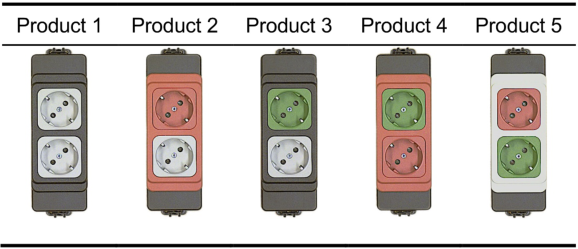
Five different products from a manufacturer of electrotechnical compo- nents are the objects of the study (see Figure 1). The products are different variants of multiple socket strips. They differ only in their color design. The participants must correctly assemble 18 individual parts per product and distinguish 13 parts from each other. An electric screwdriver with the correct bit and torque is required at the workstation for assembly.
Figure 1: Assembly tasks in research design.
Informational Assistance System – A Key to Self-Empowerment of Persons 551
The following dependent variables are considered in the laboratory study: Execution time, assembly error, picking error, and mental stress. Execution time is the time needed to fully assemble multiple sockets. Assembly and picking errors are recorded for each assembly in a standardized error list that includes the following characteristics: Tool not used, component assembled in wrong position, wrong orientation of component, component not assem- bled, other error during assembly, and wrong component picked. Finally, mental stress is recorded after each assembly (five times per participant) using the NASA-TLX questionnaire (Hart and Staveland, 1988). For this purpose, the six questionnaire items were worded so that the participants could understand them (“easy language”).
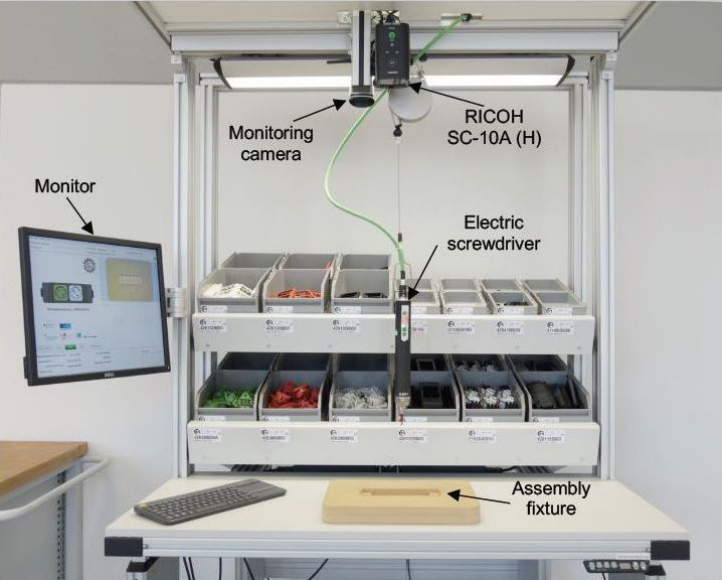
The study takes place at a standing workstation (see Figure 2) where the required components are available on two flow rack levels. To ensure an ergonomic posture, the workstation is height-adjustable, and the previously mentioned electric screwdriver is attached to a traction device in the center of the workstation. Furthermore, there is an assembly fixture on the work surface to simplify the handling of the parts.
Before the experiment is carried out, personal data is collected, sufficient visual performance is checked (eye test), and motor skills are assessed using a Lego reference model. This is followed by the assembly of the five products in increasing order (products 1 to 5), with the medium assigned to a par- ticipant as the independent variable (paper-based instructions vs. assembly
Figure 2: Experimental setup.
552 Bendzioch and Hinrichsen
assistance system). To influence the participant as little as possible, the expe- riment is monitored with the help of an additional camera (see Figure 2). The empirical study focuses on five hypotheses in order to further specify the human-oriented and economical application potentials of informational assistance systems:
1. It is expected that due to the continuous feedback of the assistance system equipped with an image processing unit, the execution times are significantly lower than those of the paper-based instruction. 2. Against the background of this feedback function, the number of assem- bly errors is also expected to be significantly lower using the information- based assistance system instead of the paper-based instruction. 3. With the postulated decrease in execution times and assembly errors, it is further expected that the labor productivity using the informatio- nal assistance system will be significantly different from the paper-based instruction. 4. Regarding the number of picking errors during assembly, it is expe- cted that they do not differ due to the same information content or presentation format. 5. Regarding the level of mental stress achieved, no significant differe- nces are expected between the two comparison groups due to the approximately equal information content of both support systems.
RESULTS
The statistical analysis of the results was performed with the program SPSS® 28. Twenty participants (10 with paper-based instructions and 10 with assembly assistance system) with cognitive disabilities (7 female and 13 male) aged between 21 and 65 years (M = 34.30; SD = 14.34) took part in the ini- tial study. During the experimental procedure, all participants were employed in a production area of the sheltered workshop, where they performed, for example, simple assembly, metalwork and carpentry tasks. On average, the participants rated their manual skills as 7.55 on a scale of 1 to 10. Further- more, the participants indicated no previous experience with the study task. The examination of visual performance and motor skills revealed no signifi- cant differences between the two subgroups reference medium (paper-based instruction) and assistance system.
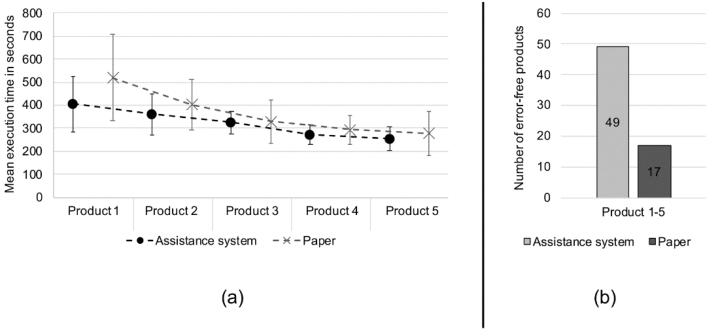
To verify the first hypothesis, the distribution-free Mann-Whitney-U-Test was used (Shapiro-Wilk-Test significant). The test indicates that the two subgroups differ in execution time both at the level of individual products (UP1. = 27.000, p = .082; UP2. = 37.000, p = .329; UP3. = 46.000, p = .762; UP4. = 41.000, p = .496; UP5. = 50.000, p = 1.000) as well as across all pro- ducts (UP1-5 = 36.000, p = .290) do not differ significantly from each other. Accordingly, there is no statistical difference between the use of the paper- based instruction and the assistance system. Hypothesis 1 must therefore be rejected. Descriptively, however, it can be seen (see Figure 3(a)) that the execution time of the participants who used the assistance system is on ave- rage 11% shorter (on average, 42 sec. per assembly). Significant differences
Informational Assistance System – A Key to Self-Empowerment of Persons 553
Figure 3: (a) Average execution times of the five products depending on the two support systems. (b) Number of error-free products.
emerge when testing the second hypothesis, also using the Mann-Whitney- U-Test. According to this, the participants with the assistance system caused fewer assembly errors across all five products (UP1-5 = 11.000, p = .003, r = .661), so the second hypothesis is confirmed. On average, these decrease by 74%. It should be noted that all errors in the experiment were recorded, including those which were corrected by the assembler. In addition, to verify the third hypothesis, the absolute number of error-free products was also recorded (see Figure 3(b)).
Figure 3(b) shows that when the assistance system was used, only the assembly of a single product was incorrect (49 out of 50 correct). The cause of this error was a subsequent correction of an assembly step that had already been completed and checked by the assistance system. Howe- ver, the assistance system recognized this subsequent correction as an error in the last assembly step. In difference, the participants with the paper-based instructions were able to assemble only 17 of 50 products without errors. An important criterion in this context is the key performance indicator of labor productivity. This comprises the ratio of output (number of products assembled without errors) and input (sum of execution times). Based on this calculation rule, each participant’s labor productivity was determined and checked with a t-Test. According to this, the assistance system has a signifi- cant influence on labor productivity (tP1-5 (18) = 6.074, p = <.001, r = .819), so the third hypothesis is confirmed.
Concerning the fourth hypothesis – the number of picking errors – it could be determined that the two subgroups do not differ significantly from each other (UP1-5 = 47.000, p = .819). Thus, the assumption that the two forms of support (paper-based instructions vs. assistance system) do not differ due to the same information content can be confirmed. Nevertheless, the data tend to favor the assistance system since 50% fewer picking errors occur on ave- rage. The examination of the perceived stress (hypothesis 5) with the help of the modified NASA-TLX questionnaire showed that the participants recor- ded a low and comparable level of mental stress in all six dimensions of the
554 Bendzioch and Hinrichsen
instrument. On a scale of 1 to 5, participants rated mental stress an average of 1.6 for the paper-based instruction and 1.9 for the informational assistance system. A review of the data set using the distribution-free Mann-Whitney- U-Test (Shapiro-Wilk-Test significant) confirms this result, indicating that the stresses are not significantly different depending on the two forms of instruction (UNASA-TLX Score = 33.000, p = .198). The assumption of the fifth hypothesis can thus be confirmed.
DISCUSSION
The results of the laboratory study show that the investigated informational assistance system has both economic and human-oriented application poten- tials for persons with cognitive disabilities. For example, the results of the first hypothesis show that the execution time tends to be shorter, probably due to the lower number of assembly errors and the centralized provision of information on the monitor at eye level. However, this time difference is not significant. This may be because the comparison between the specified and executed assembly step – checkpoints fulfilled or not fulfilled – caused by the assistance system is presumably much more time-consuming than in the control group. The latter again had difficulties in assembling the indivi- dual products without errors due to the lack of feedback on assembly. For the persons themselves, the continuous feedback from the assistance system on the correctness of the assembly results in the possibility of developing and implementing self-determined learning and problem-solving strategies. Thus, people using the assistance system achieve significantly higher work productivity (hypothesis 3) than those using paper-based instructions. This difference results mainly from the number of good parts produced, associa- ted with a significant decrease in assembly errors (hypothesis 2). These results are of great importance for transitioning persons with disabilities to the gene- ral labor market. On the one hand, they are enabled to carry out assembly processes under industrial conditions on their own responsibility and, on the other hand, to deepen and expand their competencies with each assembly job. The latter also becomes evident in the course of the individual assembly executions (products 1 to 5) (see Figure 3(a)). Thus, despite varying confi- gurations, the execution times decrease from the assembly of one product to the assembly of the next. The course of execution times thus corresponds to a so-called “learning curve”. A similar picture emerges for the control group, but with the difference that the execution times take longer because incorrect assembly steps or action strategies have been internalized.
There is further potential for use in picking assembly-relevant components (hypothesis 4). It can be seen that despite the same information content of both forms of instruction, the results with the assistance system show clear differences compared to the control group (-50% on average), although the decrease is not significant. This difference also illustrates the application potential of such an assistance system. Despite the extraordinary increase in performance of the participants who used the assistance system, there is no difference in subjectively perceived stress (hypothesis 5). On the contrary, it can be assumed that both groups have approximately the same level of mental stress, which is at a low level.
Informational Assistance System – A Key to Self-Empowerment of Persons 555
The results presented here show that with the help of an informational assi- stance system, the chances of the affected group of people to get a job outside of a sheltered workshop, i.e., in a privately organized company, can be signi- ficantly improved. Nevertheless, it is not only the barriers resulting from the respective impairments that make the transition to the general labor market more difficult. For example, political framework conditions that promote a change from a sheltered workshop to an employment relationship with social insurance must be created. In the future, it will be necessary to examine such barriers as part of an expansion of the research design. Furthermore, concer- ning the design of the laboratory experiment, participants without cognitive impairments should also be included as a control group in a next step.
ACKNOWLEDGMENT
The authors acknowledge the financial support by the Federal Ministry of Education and Research of Germany (BMBF) in the project SInnAssist (FKZ 13FH047SB8).
REFERENCES
Aksu, V. Jenderny, S. Kroll, B. Röcker, C. (2019). A Digital Assistance System Providing Step-by-Step Support for People with Disabilities in Production Tasks, in: Advances in Usability, User Experience and Assistive Technology. AHFE 2018. Advances in Intelligent Systems and Computing, Ahram, T. & Falcão, C. (Eds), Volume 794, pp. 775–785, Springer, Cham, doi:/10.1007/978-3-319- 94947-5_76. Bächler, A. Bächler, L. Autenrieth, S. Kurtz, P. Heidenreich, T. Hörz, T. Krüll, G.
(2015) “Entwicklung von Assistenzsystemen für manuelle Industrieprozesse”, in: Proceedings of DeLFI Workshops 2015, Rathmayer, S. & Pongratz H. (Eds.), pp. 56–63, CEUR-Workshop, München. Bannat, A. (2014). Ein Assistenzsystem zur digitalen Werker-Unterstützung in der industriellen Produktion. TU Mu¨nchen (Dissertation). Bendzioch, S. Hinrichsen, S. Bornewasser, M. (2020) “Produktivität der Montage-
arbeit”, in: Informatorische Assistenzsysteme in der variantenreichen Montage: Theorie und Praxis, Bornewasser M. & Hinrichsen, S. (Eds.), pp. 113–134, Springer, Berlin, doi: 10.1007/978-3-662-61374-0_6. Claeys, A. Hoedt, S. Soete, N. Van Landeghem, H. Cottyn, J. (2015). Framework for Evaluating Cognitive Support in Mixed Model Assembly Systems, IFAC-PapersOnLine, Volume 48 No. 3, doi: 10.1016/j.ifacol.2015.06.201. Doose, S. (2009) “Berufliche Integration von Menschen mit Behinderung”, in: Hand-
buch Integrationspädagogik, Eberwein, H. & Knauer, S. (Eds.). pp. 245–26, Beltz, Weinheim, Basel. Fast-Berglund, Å. Fässberg, T. Hellman, F. Davidsson, A. Stahre, J. (2013).
Relations between complexity, quality and cognitive automation in mixed- model assembly, Journal of Manufacturing Systems Volume 32 No. 3, doi: 10.1016/j.jmsy.2013.04.011. Funk, M. Mayer, S. Schmidt, A. (2015a) “Using In-Situ Projection to Support Cognitively Impaired Workers at the Workplace”, proceedings of the 17th Inter- national ACM SIGACCESS Conference on Computers Accessibility, Association for Computing Machinery, New York, doi: 10.1145/2700648.2809853.
556 Bendzioch and Hinrichsen
Funk, M. Bächler, A. Bächler, L. Korn, O. Krieger, C. Heidenreich, T. Schmidt, A.
(2015b) “Comparing projected in-situ feedback at the manual assembly work- place with impaired workers”, proceedings of the 8th ACM International Confe- rence on PErvasive Technologies Related to Assistive Environments, Association for Computing Machinery, New York, doi: 10.1145/2769493.2769496. Geiser, G. (1997) “Informationstechnische Arbeitsgestaltung”, in: Handbuch Arbeitswissenschaft, Luczak, H. & Volpert, W. (Eds.). pp. 589–594, Schäffer-Poeschel, Stuttgart. Hart, S. G. Staveland, L. E. (1988) “Development of NASA-TLX (Task Load Index):
Results of empirical and theoretical research”, in: Hancock, P. A. & Meshkati, N. (Eds.). Human Mental Workload, Elsevier. Hinrichsen, S. Riediger, D. Unrau, A. (2016) “Assistance Systems in Manual Assembly”, proceedings of the 6th International Conference on Production Engineering and Management, Lemgo Hold, P. Erol, S. Reisinger, G. Sihn, W. (2017). Planning and Evaluation of Digi-
tal Assistance Systems. Procedia Manufacturing, Volume 9, pp. 143–150, doi: 10.1016/j.promfg.2017.04.024. Keller, T. Behling, M. Stockinger, C. Metternich, J. Schützer, K. (2021). Analysis of the influence of process complexity and employee competence on the effect of digi- tal assistance in industrial assembly, Production Engineering, Volume 15 No. 1, doi: 10.1007/s11740-020-01005-3. Korn, O. Abele, S. Schmidt, A. Hörz, T. (2013) “Augmentierte Produktion: Assi-
stenzsysteme mit Projektion und Gamification für leistungsgeminderte und lei- stungsgewandelte Menschen”, in: Mensch & Computer 2013 – Tagungsband, Boll, S. Maaß, S. & Malaka, R. (Eds.). pp. 119–128, Oldenbourg Wissenschaft- sverlag, Berlin, doi: 10.1524/9783486781229. Pracht, W. Welti, F. (2021). Studie zu einem transparenten, nachhaltigen und zukunftsfähigen Entgeltsystem für Menschen mit Behinderungen in Werkstätten für behin- derte Menschen und deren Perspektiven auf dem allgemeinen Arbeitsmarkt: Erster Zwischenbericht. Bundesministerium für Arbeit und Soziales (BMAS), Berlin. Senderek, R. Geisler, K. (2015) “Assistenzsysteme zur Lernunterstützung in der
Industrie 4.0”, in: Proceedings of DeLFI Workshops 2015, Rathmayer, S. & Pongratz H. (Eds.), pp. 36–46, CEUR-Workshop, München. United Nations. (2006). Convention on the Rights of Persons with Disabilities: Article 27 – Work and employment. Treaty Series, Volume 2515, p. 3, New York.
Read this individual research paper free through the original publisher, or explore the full digital proceedings book.
ISBN 978-1-958651-87-2
Explore this ISBN in the AHFE Bookstore ↗Listed in the July 2026 bookstore catalogue; search by ISBN to confirm current availability · Digital book purchase optional