Sven Hinrichsen, Robin Herbort, Dominik Green, Benjamin Adrian (2025). How to Design an Operation-Specific LLM-Based Information System. In: Human Interaction and Emerging Technologies (IHIET 2025). AHFE Open Access, vol. 197, pp. 160–170. https://doi.org/10.54941/ahfe1006709
The performance of large language models (LLMs) has improved significantly in recent years, with the result that they are now used in many companies in various industries. However, the design of a company-specific information system involving an LLM is associated with a large number of decisions. This leads to a high level of complexity in the design task. Against this background, companies need a structured approach that methodically supports the planning, development, implementation and long-term maintenance of LLM-based information systems so that domain- and company-specific requirements are taken into account as a result. This article therefore describes a method that supports the design, introduction and maintenance process of an LLM-based information system. The method consists of a process model and a list of design principles, which are also referred to as success factors. The process model developed is based on the proven six-stage REFA planning system. To identify and describe success factors, a systematic literature search was carried out. Based on an analysis of the contents of individual literature sources, success factors for the design of LLM-based information systems were identified. These success factors relate, for example, to the quality of the data provided, data security, user-centered system design and feedback mechanisms for improving information output.
The performance of large language models (LLMs) has improved considerably in recent years, so that these are now used in many companies in various sectors (Raiaan et al., 2024). Dommermuth et al. (2025), for example, describe how an AI chatbot was developed and introduced in a large industrial company. This bot provides users with trustworthy learning content. Ziche and Apruzzese (2024) explain how an LLM-based information system supports users in process modeling in the construction industry. In the software sector, such information systems, for instance, improve service processes and customer interaction (Buxmann et al., 2024). In the financial sector, for example, LLMs are used to analyze financial reports in order to obtain forecasts for individual key financial figures (Kim et al., 2024).
However, the design of a company-specific information system involving an LLM is associated with a large number of decisions. For example, the
How to Design an Operation-Specific LLM-Based Information System 161
selection of the LLM and the design of the company-specific database have a considerable influence on the quality of the information output of the system (Hafner & Hundertmark, 2024). Moreover, frequent updates of the LLM and the underlying database play a central role in ensuring a high level of efficiency and quality of information output in the long term (Annepaka & Pakray, 2024). Furthermore, LLMs and operational information can be linked via Retrieval-Augmented Generation (RAG). Also, prompt engineering, the design of the system input, has a major impact on the quality of the information generated by the system (Herbort et al., 2025). Further decisions have to be made regarding the design of system interfaces or the protection of personal data (HmbBfDI, 2024).
The large number of decisions involved in the design of LLM-based information systems leads to a high level of complexity in this task. Against this background, companies need a structured approach that methodically supports the planning, development, implementation and continuous maintenance of LLM-based information systems so that, as a result, domain- and company-specific requirements (Chen et al., 2024) are taken into account.
METHODS
The subject of this article is the development of a method that supports the user in developing, introducing and permanently establishing a company- specific LLM-based information system in a company. On the one hand, this method includes a process model which describes the essential development, implementation and further development phases of the information system. On the other hand, success factors are provided to the method user, which give orientation in the design of the information system. The success factors consist of design principles for LLM-based information systems.
To achieve this goal, a four-step procedure is chosen. In the first step, requirements for the method to be developed, consisting of a process model and design principles, are determined. In a second step, existing methods are identified based on a literature search and then evaluated with reference to the requirements established in the first step. In a third step, a process model is developed on the basis of the analysis results of the second step. In a fourth step, success factors for the design of LLM-based information systems are identified and described by means of a systematic literature review, using the PRISMA method (Page et al., 2021).
RESULTS
Identification of Requirements for the Method A total of five main requirements were identified. Firstly, the method should contain a process model consisting of several steps that logically build on each other. This process model should provide the user with orientation and ensure the effectiveness and efficiency of the task execution. Secondly, the process model should support the entire life cycle of the LLM-based information system by integrating a further development phase even after
system implementation. This continuous updating of the LLM and the database is important so that the system permanently ensures a high quality of information output (Annepaka & Pakray, 2024). Thirdly, the process model or components of the model should be tested in practice. Fourthly, since LLM-based information systems are human-technology systems, the method should ensure a holistic view – including people, technology and organization – since ethical aspects and questions of data protection and usability can also play a role in the context of generative artificial intelligence. Fifthly, the method should support its users by taking into account LLM- specific design principles, also known as success factors.
Identification and Evaluation of Existing Methods The selection of suitable methods and models for the design, implementation and further development of LLM-based information systems in companies is based on a literature search. Google Scholar and Web of Science were used as databases. As a result, the methods and process models CRISP- DM (Chapman et al., 2000), TDSP (Ericson et al., 2017), PAISE (Hasterok et al., 2021) and Enterprise AI Canvas (Kerzel, 2020) were identified. Models that do not consider LLM-specific content but are used by users to develop an LLM-based information system were also taken into account. The four models and methods were evaluated according to the requirements identified in the first step. The assessment results are shown in Table 1.
Table 1: Evaluation of existing methods.
Table available in the original PDF paper.
No. Requirements Methods CRISP-DM TDSP PAISE Enterprise AI Canvas
1 Process model X X X (X) 2 Consideration of the system life cycle - (X) X - 3 Practical testing and relevance X X (X) (X) 4 Holistic view - - (X) (X) 5 LLM-specific design principles - (X) - - Legend: X: Requirement fulfilled; (X): Requirement partially fulfilled; - Requirement not fulfilled.
For example, the CRISP-DM approach consists of a process model (requirement 1 fulfilled) that is considered established in operational practice for data-based projects (requirement 3 fulfilled). However, mechanisms for the further development of the information system are missing, so that the entire system life cycle is not taken into account (requirement 2 not fulfilled). This approach also focuses on the technical realization and not on a holistic view of an information system (requirement 4 not fulfilled). Furthermore, the approach does not consider LLM-specific content and design principles (requirement 5 not fulfilled).
Development of a Process Model The process model developed on the one hand is based on the proven six-step REFA planning system (REFA, 2015) and the process model for selecting a low-code platform (Hinrichsen et al., 2023). On the other hand, it contains
How to Design an Operation-Specific LLM-Based Information System 163
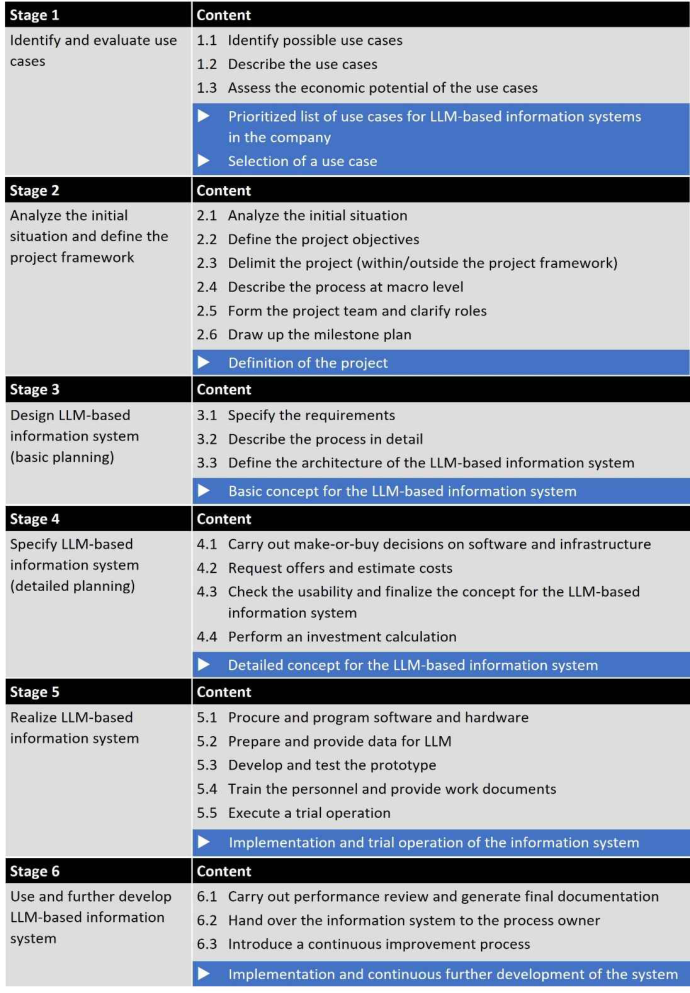
elements of the models outlined in the previous section. Figure 1 shows an overview of the process model (Hinrichsen et al., 2025).
Figure 1: Process model for the development of an LLM-based information system.
The first stage of the model involves the identification and selection of possible use cases for an LLM-based information system. This stage aims to identify business processes that can be optimized or (partially) automated
through the use of an LLM. When assessing the suitability of individual use cases, criteria such as those discussed by Kourani et al. (2024) should be used (e.g. availability of text-based descriptions, repetitive nature of the process). The result is a list of described and prioritized use cases after passing through the first stage. Prioritization is primarily based on an estimate of the respective economic potential. For the highest prioritized use case, an LLM- based information system is designed in the subsequent stages of the process model.
As the task of designing and introducing an LLM-based information system is highly complex, this task is organized as a project. As part of the second stage of the process model, the project framework is therefore defined in the form of a “project charter”. The components of the project charter are shown in Figure 1 (see points 2.1 to 2.6). In the third stage of the process model, the requirements for the information system to be designed are determined in detail. According to Mock et al. (2024), trustworthiness, compliance with regulatory specifications and the protection of sensitive data are fundamental requirements. Based on the requirements, a basic concept is developed in the third stage of the process model, which particularly focuses on a description of the system architecture and thereby addresses the LLM selection, data sources and interfaces, among other things (Moujahid et al., 2024). The fourth stage involves the detailed planning of the LLM-based information system. Make-or-buy decisions are carried out and offers are requested. In addition, the usability of the concept is verified. Finally, an investment calculation has to be executed to ensure the economic viability of the investment project. In the fifth stage, the practical implementation of the LLM-based information system is carried out by procuring resources, performing programming work, preparing data and training employees. The prototype system then has to be tested until it is considered suitable for use. Finally, the sixth stage involves the usage and continuous further development of the system. Further development can be performed, for instance, through the integration of feedback loops (Lee et al., 2023).
Identification and Description of Success Factors The design of a company-specific information system involving an LLM is accompanied by a large number of decisions in different fields of action. Therefore, success factors for the design of such a system were searched in a systematic literature review. This was done using the PRISMA method (Page et al., 2021). By using the four search strings listed below, a total of 112 literature sources were identified within the Web of Science database.
1. “Key factors” AND “large language models” 2. “Design principles” AND “large language models” 3. “Experiences” AND “large language models” AND “implementation” 4. “Experiences” AND “large language models” AND “integration.”
After screening the 112 references, five articles remained in which success factors for the design of LLM-based information systems are described. After reviewing the primary references for the five identified articles and a
How to Design an Operation-Specific LLM-Based Information System 165
subsequent additional literature search, further nine articles relevant to the research question were found. A qualitative content analysis according to Mayring (2000) was carried out on the 14 references through an inductive category formation. Based on the category formation, 20 success factors for the design of LLM-based information systems were identified. The success factors relate, for example, to the quality of the data provided, data security, user-centered system design or feedback mechanisms for improving information output. Table 2 shows an overview of the identified success factors. The configuration of the information system is addressed by success factors 1 through 12, whereas factors 13 to 20 relate to the input and output of information.
Table 2: Success factors for the development of an LLM-based information system.
Table available in the original PDF paper.
No. Success Factor Explanation Reference(s)
1 Integration into existing
The integration of LLMs into existing IT
Uygun et al., 2024;
systems
Annamaa, 2024; Singh, 2025
systems requires careful adaptation to existing processes, data structures and security requirements in order to ensure seamless interactions.
2 Integration of
The design of LLM-based information
Chakladar, 2024; Chen et al., 2024
domain-specific knowledge and superordinate company-specific guidelines
systems requires cooperation between the relevant specialist department (domain-specific knowledge) and the IT department. In addition, superordinate guidelines are required that describe how such systems have to be designed in the company. These guidelines have to be communicated to users and IT developers via training courses.
3 Sufficient IT
The availability of a robust computing
Chen & Zacharias,
infrastructure
infrastructure to handle complex LLM operations should be ensured in order to minimize waiting times between information input and output.
2024; Petro¸sanu et al., 2023; Singh, 2025; Chakladar, 2024 4 Tasks-specific use of
Specifying the tasks that the LLM has to
Chen & Zacharias,
LLMs
2024; Annamaa, 2024
perform can improve the quality of the output. The specification can be made, for example, by integrating own documents with the help of RAG.
5 Selection of the LLM The selection of the LLM has a major
Herbort et al., 2025; Singh, 2025 influence on the quality of the information output. The latest version of an LLM should be used.
6. Use of RAG as a tool
The use of RAG is recommended to avoid
Schelhorn et al., 2024;
for LLMs
Herbort et al., 2025
hallucinations in the output of an LLM. This method enables the integration of company-specific data, which can increase the relevance and quality of the generated content.
7 Resource-saving use of
The LLM system should offer a way to
Oelen et al., 2024;
LLMs
Singh, 2025 transparently show the consequences of use (e.g. energy consumption).
Continued
Table 2: Continued No. Success Factor Explanation Reference(s)
Table available in the original PDF paper.
8 Database management Compared to other types of databases, the
Uygun et al., 2024 use of vector databases to provide company data saves both computing time and effort for user queries to the LLM. In addition, it should be possible to expand vector databases dynamically.
9 User-centered design of
User-centered design aims to meet the
Chen & Zacharias,
the use of LLMs
2024; Oelen et al., 2024; Annamaa, 2024
criteria of software ergonomics. The focus here is on ensuring that the task is easy to understand, the system is quick to use and can be adapted to the available technical possibilities and user requirements.
10 Transparent use of
The use of LLMs in a system should be Freire, 2023; LLMs
Chakladar, 2024 clearly labeled to inform the user that the output may need to be checked for consistency.
11 Data security in using
The security of linking company data with Freire, 2023; Oelen LLMs et al., 2024 language models is of major importance, as this is crucial for user acceptance and confidence in such systems.
12 Monitoring of the
After implementation, the LLM has to be Singh, 2025 system updated regularly by integrating new data or updating existing data. By means of monitoring, the performance has to be supervised and the quality of the information output has to be checked.
13 Quality of input data The quality and relevance of entered data
Chen & Zacharias,
(input) is crucial for consistent LLM output. The data includes training data from the LLM, prompt input and data provided using RAG.
2024; Herbort et al., 2025; Uygun et al., 2024; Singh, 2025; Chakladar, 2024 14 Prompt engineering Information quality can be significantly Herbort et al., 2025; Chen et al., 2024
increased by using prompt engineering (method of information input).
15 Indication of the result
If the LLM detects uncertainties regarding Chen & Zacharias, quality in responses
2024
the quality of the output, it should inform the user that it is advisable to check it.
16 Provision of
The explanation on how an output of the
Chen & Zacharias, 2024; Chiang et al., 2023 LLM is derived enables the user to understand the result and thus ensure the reproducibility of the answer.
explanations regarding the derivation of results by the LLM
17 Provision of verification
The LLM system should provide verification Chen et al., 2024; mechanisms and review processes in which experts evaluate outputs.
Brachman et al., 2024; Lee et al., 2023 18 Request and use of user
The integration of user feedback into the
Oelen et al., 2024;
feedback
LLM system can increase the information quality of the output.
Freire, 2023; Delaflor, 2024; Lee et al., 2023; Chiang et al., 2023 19 Use of LLMs to identify
If a user recognizes an incorrect output
Chen & Zacharias,
helpful contacts
2024
generated by an LLM and reports it back to the LLM, the system should automatically create a suggestion for the involvement of expert personnel so that the user can obtain the required information in this way.
Continued
How to Design an Operation-Specific LLM-Based Information System 167
Table 2: Continued No. Success Factor Explanation Reference(s)
Table available in the original PDF paper.
20 Error management The LLM system should provide a way to
Oelen et al., 2024 react to errors. This system response can include a full error correction, a selection of suggested corrections or a new generation of the output.
DISCUSSION
Due to the increasing importance of LLM-based information systems, methodical support is required for the design and introduction of these systems. This support is provided on the one hand by the process model presented in this article and on the other hand by a list of success factors that should be considered during system design and implementation. In the next step, the method has to be tested in practice and further developed. The development and introduction of LLM-based information systems is a dynamically evolving field. The list of success factors in this article should therefore regularly be reviewed, updated and enhanced.
ACKNOWLEDGMENT
This article was created as part of the KIPRO project. The project is funded by the Bundeswehr Centre for Digitalization and Technology Research (dtec.bw) with grants from the European Union (NextGenerationEU).
REFERENCES
Annamaa, S. (2024) “Chatbots in Software Release Optimization: Case Study”.
https://urn.fi/URN:NBN:fi:jyu-202412197913 Annepaka, Y., Pakray, P. (2024) “Large language models: a survey of their development, capabilities, and applications”, in: Knowledge and Information Systems – An International Journal, Wu, X., Cook, D., Tao, D. (Eds). Springer Nature. https://doi.org/10.1007/s10115-024-02310-4 Brachman, M., El-Ashry, A., Dugan, C., Geyer, W. (2024) “How Knowledge Workers
Use and Want to Use LLMs in an Enterprise Context”, in: Extended Abstracts of the CHI Conference on Human Factors in Computing Systems, Association for Computing Machinery, Mueller, F. F., Kyburz, P., William-son, J. R., Sas, C. (Eds), proceedings of the CHI ‘24: CHI Conference on Human Factors in Computing Systems New York, NY. Association for Computing Machinery, pp. 1–8. https:// doi.org/10.1145/3613905.3650841 Buxmann, P., Glauben, A., Hendriks, P. (2024) “Die Nutzung von ChatGPT in Unternehmen: Ein Fallbeispiel zur Neugestaltung von Serviceprozessen.” in: HMD – Praxis der Wirtschaftsinformatik Volume 6. https://doi.org/10.1365/ s40702-024-01053-8 Chakladar, R. D. (2024) “Best Practices for Implementing Large Language Models at
Scale”. International Journal of Core Engineering & Management. https://doi.org/ 10-2024-current-issue/ Chapman, P., Clinton, J., Kerber, R., Khabaza, T., Reinartz, T., Shearer, C., Wirth, R.
(2000) “CRISP-DM 1.0 – Step-by-step data mining guide”. SPSS Inc.
Chen, B., Zhang, Z., Langrene, N., Zhu, S. (2024) “Unleashing the potentials of prompt engineering in Large Language Models: A comprehensive review”. https:// doi.org/10.48550/arXiv.2310.14735 Chen, J., Zacharias, J. (2024) “Design Principles for Collaborative Generative AI
Systems in Software Development”, in: Design Science Research for a Resilient Future, Mandviwalla, M., Söllner, M., Tuunanen, T. (Eds). Volume 14621. Proceedings of the International Conference on Design Science Research in Information Systems and Technology DESRIST. Lecture Notes in Computer Science, Springer, Cham, pp. 341 -354 https://doi.org/10.1007/978-3-031-61175- 9_23 Chiang, C. H., Lee, H. Y. (2023) “A Closer Look into Automatic Evaluation Using Large Language Models”. https://doi.org/10.48550/arXiv.2310.05657 Delaflor, M., Toxtli, C., Gendron, C., Li, W., Solorzano, C. (2024) “ReActIn:
Infusing Human Feedback into Intermediate Prompting Steps of Large Language Model”, in: Human Interaction and Emerging Technologies (2024), Ahram, T., Taiar, R. (Eds). Volume 120. Proceedings of the Artificial Intelligence and Future Applications. AHFE International Conference. AHFE Open Access, AHFE International, USA. http://doi.org/10.54941/ahfe1004597 Dommermuth, M., Riesch, L., Guedria. (2025) “Menschenzentrierter KI-Chatbot zur individuellen Bereitstellung vertrauenswürdiger Lerninhalte”, in: Arbeit 5.0: Menschzentrierte Innovationen für die Zukunft der Arbeit Kompetenzmodell für die Einführung, Verbreitung und Anwendung von digitalen und Kl- gestützten Prozessen und Technologien, Volume 43. Proceedings of Arbeitswis- senschaftlichen Kongress 2025, pp. 963–968. https://doi.org/10.61063/FK2025 Ericson, G., Rohm, W. A., Martens, J., Sharkey, K., Casey, C., Harvey, B.,
Schonning, N. (November 13, 2017) What is the Team Data Science Process? Microsoft Learn Website: https://learn.microsoft.com/en-us/azure/architecture/ data-science-process/overview. Freire, S. K., Foosherian, M., Wang, C., Niforatos, E. (2023) “Harnessing Large Language Models for Cognitive Assistants in Factories”, proceedings of the 5th International Conference on Conversational User Interfaces. Association for Computing Machinery, New York, NY. https://doi.org/10.1145/ 3571884.3604313 Hafner, N., Hundertmark, S. (2024) “Large Language Models im Kundendialog –
Chancen, Risiken, Ausblicke”, in: Kundendialog Management – Wertstiftende Kundendialoge in Zeiten der digitalen Automation. Hafner, N., Hundertmark, S. (Eds). pp. 239–248. https://doi.org/10.1007/978-3-658-42851-8_16 Hasterok, C., Stompe, J., Pfrommer, J., Usländer, T., Ziehn, J., Weber, M., Riedel, T. (2021) “PAISE® - Das Vorgehensmodell für KI-Engineering”. Karlsruhe: Fraunhofer IOSB. http://doi.org/10.24406/publica-fhg-301357 Herbort, R., Green, D., Hinrichsen, S. (2025) “Automatic Creation of Assembly Instructions by Using Retrieval Augmented Generation”, in: Intelligent Human Systems Integration (2025): Integrating People and Intelligent Systems, Ahram, T., Karwowski, W., Martino, C., Bucchianico, G. D., Maselli, V. (Eds). Volume 160. Proceedings of the AHFE International Conference. AHFE Open Access, USA. https://doi.org/10.54941/ahfe1005883 Hinrichsen, S., Nikolenko, A., Becker, K., Adrian, B. (2023) “How to select
and implement a suitable Low-Code Development Platform”, in: Human Systems Engineering and Design (IHSED 2023): Future Trends and Applications, Karwowski, W. et al. (Eds) Volume 112. Proceedings of the IHSED: Future Trends and Applications, AHFE. http://doi.org/10.54941/ahfe1004155
How to Design an Operation-Specific LLM-Based Information System 169
Hinrichsen, S., Herbort, R., Green, D., Adrian, B. (2025) “Vorgehensmodell zur Entwicklung und Implementierung von LLM-basierten Informationssystemen”, in: Gesellschaft für Arbeitswissenschaft e. V. (Eds). Volume 71. Proceedings of the Kongress der Gesellschaft für Arbeitswissenschaft. Aachen. GfA-Press pp. 642–647. HmbBfDI (July 15, 2024) Large Language Models und personenbezogene Daten.
Hamburgische Beauftragte für Datenschutz und Informationsfreiheit Website: https://datenschutz-hamburg.de/news/hamburger-thesen-zum-personenbezug-in- large-language-models. Kerzel, U. (2020) Enterprise AI Canvas Integrating Artificial Intelligence into Business, An International Journal Volume 35, No. 1. https://doi.org/10.1080/ 08839514.2020.1826146 Kim, A. G., Nikolaev, V. V. (2024) Context-Based Interpretation of Financial
Information, Journal of Accounting Research. https://doi.org/10.1111/1475- 679X.12593 Kourani, H., Berti, A., Schuster, D., van der Aalst, W. M. P. (2024) “Process Modeling with Large Language Models”, in: Enterprise, Business-Process and Information Systems Modeling, van der Aa, H., Bork, D., Schmidt, R., Sturm, A. (Eds). Volume 511. Proceedings of the BPMDS and EMMSAD Conference. Limassol. Springer Nature, pp. 229–244. https://doi.org/10.1007/978-3-031-61007-3 Lee, D., Whang, T., Lee, C., Lim, H. (2023) “Towards Reliable and Fluent Large
Language Models: Incorporating Feedback Learning Loops in QA Systems”. https://doi.org/10.48550/arXiv.2309.06384 Mayring, P. (2000) “Qualitative Inhaltsanalyse”, in: Qualitative Forschung. Ein Handbuch, Flick, U., Kardorff, E.v., Steinke, I. (Eds). Volume 53, pp. 468–475. https://doi.org/10.1007/s11577-001-0131-1 Mock, M., Schmidt, S., Müller, F. B., Görge, R., Schmitz, A., Haedecke, E., Voss,
A., Hecker, D., Poretschkin, M. (2024) Vertrauenswürdige KI-Anwendungen mit Foundation-Modellen entwickeln, Fraunhofer IAIS. https://doi.org/10.24406/ publica-2475 Moujahid, H., Boutahar, K., El Gannour, O., Saleh, S., Cherradi, B., El Abbassi, A. (2024) “A Scoping Review of Large Language Models: Architecture and Applications”. Proceedings of the 2024 4th International Conference on Innovative Research in Applied Science, Engineering and Technology (IRASET), FEZ, Morocco. https://doi.org/10.1109/IRASET60544.2024.10549006 Oelen, A., Auer, S. (2024) “Leveraging Large Language Models for Realizing Truly
Intelligent User Interfaces”, in: Extended Abstracts of the CHI Conference on Human Factors in Computing Systems, Association for Computing Machinery, Mueller, F. F., Kyburz, P., Williamson, J. R., Sas, C. (Eds). Proceedings of the CHI’24: CHI Conference on Human Factors in Computing Systems New York, NY. Association for Computing Machinery, pp. 1–8. https://doi.org/10.1145/ 3613905.3650949 Page, M. J. et al. (2021) The PRISMA 2020 statement: An updated guideline for reporting systematic reviews, The BMJ Volume 372, No. 71. https://doi.org/ 10.1136/bmj.n71 Petro¸sanu, D., Pîrjan, A., T˘abu¸sc˘a, A. (2023) Tracing the Influence of Large
Language Models across the Most Impactful Scientific Works, Electronics Volume 12, No. 4957. https://doi.org/10.3390/electronics12244957
Raiaan, M. A. K., Mukta, S. H., Fatema, K., Fahad, N. M., Sakib, S., Mim, M. M. J., Ahmad, J., Ali, M. E., Azam, S. (2024) A Review on Large Language Models: Architectures, Applications, Taxonomies, Open Issues and Challenges, IEEE Access, Volume 12. https://doi.org/10.1109/ACCESS.2024.3365742 REFA (2015) “REFA-Planungssystematik”, in: REFA Bundesverband e. V.: Industrial
Engineering – Standardmethoden zur Prozesssteigerung und Prozessoptimierung. Volume 2. Darmstadt. Schelhorn, T. C., Gnewuch, U., Maedche, A. (2024) “Designing a Large Language Model Based Open Data Assistant for Effective Use”, in: Design Science Research for a Resilient Future, Mandviwalla, M., Söllner, M., Tuunanen, T. (Eds). Volume 14621. Proceedings of the DESRIST: International Conference on Design Science Research in Information Systems and Technology, Trollhättan. Springer Cham, pp. 398–411. https://doi.org/10.1007/978-3-031-61175-9_27 Singh, S. (2025) “Systems Engineering of Large Language Models for Enterprise
Applications”. Preprints. https://doi.org/10.20944/preprints202501.0715.v1 Uygun, Y., Momodu, V. (2024) Local large language models to simplify requirement engineering documents in the automotive industry, Production & Manufacturing Research Volume 12, No. 1. https://doi.org/10.1080/21693277.2024.2375296 Ziche, C., Apruzzese, G. (2024) “LLM4PM: A case study on using Large Language
Models for Process Modeling in Enterprise Organizations”, in: Business Process Management: Blockchain, Robotic Process Automation, Central and Eastern European, Educators and Industry Forum, Di Ciccio, C. et al. (Eds). Volume 527. Proceedings of the BPM Conference 2024, Krakow. Springer Nature, pp. 472–483. https://doi.org/10.1007/978-3-031-70445-1_35
LISTED IN THE AHFE DIGITAL BOOKSTORE CATALOGUE
Explore the complete digital volume
Human Interaction and Emerging Technologies (IHIET 2025)
Read this individual research paper free through the original publisher, or explore the full digital proceedings book.
ISBN 978-1-964867-73-1
Explore this ISBN in the AHFE Bookstore ↗Listed in the July 2026 bookstore catalogue; search by ISBN to confirm current availability · Digital book purchase optional