Frederic Meyer, Sven Hinrichsen, Oliver Niggemann (2023). How to Generate Assembly Instructions with Robotic Process Automation. In: Human Interaction & Emerging Technologies (IHIET 2023): Artificial Intelligence & Future Applications. AHFE Open Access, vol. 111, pp. 629–638. https://doi.org/10.54941/ahfe1004070
With the trend towards shorter product lifecycles, smaller batch sizes, and more product variants, the complexity of manual assembly activities is increasing. To support employees in carrying out complex assembly tasks, the use of assembly instructions is indispensable to ensure high process capability and work productivity. However, the creation of assembly instructions is often time-consuming. Thus, the use of automation approaches can be a way to simplify the creation of assembly instructions. Therefore, this paper introduces a promising automation concept for applying robotic process automation (RPA) to generate assembly instructions automatically. Finally, the automation concept is demonstrated in a practical use case that illustrates the associated automation potential of RPA.
Manual assembly is highly relevant for many industries, such as mechani- cal engineering, automotive and electrical engineering. These industries are affected by increased product variants, smaller batch sizes, and shortened product lifecycles, leading to increased complexity in manual assembly. To cope with this trend, manufacturing companies must be able to respond flexibly and cost-effectively to changes in manual assembly as part of the production process (Khan and Turowski, 2016). A further challenge for these companies is the shortage of skilled workforce. Thereby, demographic change in an aging society is one of the biggest challenges for the labor market, affe- cting all G20 countries. Thus, it is necessary to promote the greatest possible productive potential of the working-age population (OECD, 2019).
Hence, increasing the use of assembly instructions offers an opportunity to address these challenges, as it contributes to greater flexibility and pro- ductivity of skilled workforces. Furthermore, assembly instructions enable unskilled workforces to perform more complex assembly tasks. However, generating assembly instructions is a company-specific process that is time- intensive and often affected by capacity bottlenecks. For this reason, the use of automation approaches can be a way to support the process of generating assembly instructions.
Against this background, this paper aims to investigate the automation potential of robotic process automation (RPA) as a novel approach for gene- rating assembly instructions. Within this context, the paper answers the question of which steps in generating assembly instructions RPA can auto- mate. In addition, the requirements for RPA implementation as well as the possibilities and limitations of using RPA for this type of application are discussed.
In light of this, an overview of current research on approaches for the automatic generation of assembly instructions and RPA is given first. Next, a novel automation concept for using RPA to generate assembly instructions is proposed. Finally, to demonstrate this automation concept, a first RPA- generated assembly instruction is realized within a case study for an assembly of a mechanical engineering company.
STATE OF RESEARCH The state of research on automation approaches and related aspects for generating assembly instructions already shows a variety of publications. To obtain a comprehensive overview of the various approaches, the con- tributions of Rea Minango and Maffei (2023) as well as Neb (2019) are recommended. Rea Minango and Maffei (2023) discuss approaches for repre- senting assembly information, while Neb (2019) reviews approaches for generating assembly sequences based on 3D models.
In difference to existing approaches, this paper examines the automa- tion potential of robotic process automation (RPA) as a novel approach for generating assembly instructions. RPA can be defined as a software-based approach for automating repetitive and rule-based informational tasks on a computer. Thereby, so-called software robots mimic human interactions with the user interface of a computer (Syed et al., 2019; Wewerka and Reichert, 2023). The state of research on RPA shows that applications have mainly been conducted in the service industry, with services being provided in business process outsourcing (BPO), finance, and healthcare (Enríquez et al., 2020). Within manufacturing companies, RPA applications are mainly used in indirect functional areas, with a high proportion of administrative tasks (Langmann and Turi, 2022). However, RPA applications in produ- ction or production-related areas such as industrial engineering (IE) are still rare (Pfeiffer and Fettke, 2021). To the author’s knowledge, using RPA to automate assembly instructions has not been discussed in the literature.
METHODS
In industrial practice, it is common for assembly instructions to be cre- ated by employees from the IE department in a time-consuming process. Essentially, two approaches can be distinguished in this process. The first approach involves creating assembly instructions for existing products that are already part of the assembly. For these products, there are either no assembly instructions or existing assembly instructions are outdated. In both cases, observations of assembly processes and interviews with experienced
How to Generate Assembly Instructions With Robotic Process Automation 631
assembly employees serve as information basis for creating assembly instru- ctions. Thereby, on the one hand, it is possible to document information on assembly activities and the tools used for assembly. On the other hand, recording the sequence of individual assembly steps is possible. In addi- tion, process observations have the advantage that photos can be taken. These can be used in assembly instructions to visualize and clarify individual facts.
In contrast to the previous approach outlined above, the second appro- ach involves developing assembly instructions for new products. Due to the limited or non-existent opportunity to observe assembly processes for new products or to interview assembly employees, an exceptional understanding of assembly processes is required to generate assembly instructions. Typi- cally, in such cases, construction data serve as an information basis, available as CAD drawings and bills of materials. Using CAD programs, it is possi- ble to determine assembly sequences, for example, by virtual and stepwise disassembly of assembly units (Gors et al., 2021). Screenshots are also taken during virtual disassembly, which are used as illustrations in assembly instru- ctions. In addition, information for the required assembly activities and tools to be used are noted for each component.
The subsequent processing of the collected assembly information is usu- ally carried out on a computer using appropriate programs, such as word processing programs. This processing is done regardless of whether it is a new or existing product. By using such a program, the information stored in various data sources is inserted into a formatting template. The resulting assembly instructions are then often provided digitally, such as in the portable document format (PDF), for further use in assembly.
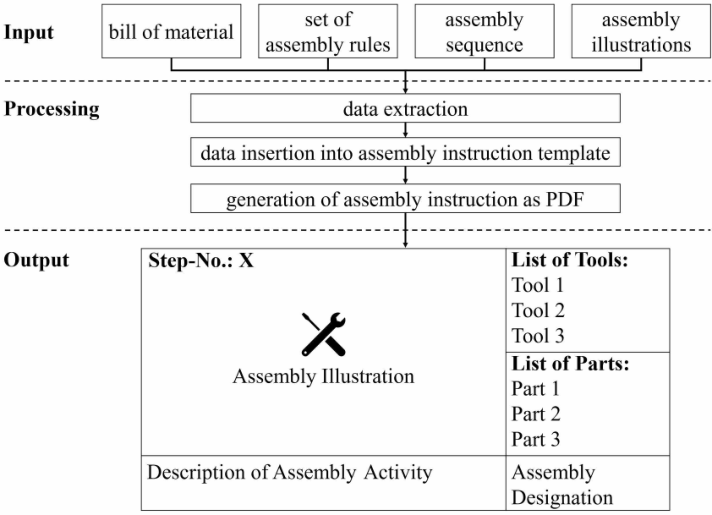
Against this background, an automation concept for generating assembly instructions using RPA is presented below. The automation concept is compa- tible with the described procedures and enables the automation of individual activity steps. Figure 1 shows the automation concept based on a three-stage input-processing-output (IPO) model. According to this, various input data are the basis for generating assembly instructions in stage 1. The input data consists of bills of materials, component-related assembly and tooling notes, assembly sequences and illustrations. These input data represent the raw data that first needs to be provided in a defined format for the automation pro- ject. This means, for example, that the input data must be stored in a defined file folder under a defined file name. The assembly illustrations are also to be designated according to the assembly step. Next, the raw data is proces- sed by being combined to provide assembly-relevant information. As a result, two documents are created. The first document is the set of assembly rules. This cross-assembly database contains component-related information on assembly activities and the tools to be used. The component reference is esta- blished via the individual part number of a component. For creating a set of assembly rules, special process knowledge is required. This knowledge is pro- vided by experienced employees themselves or obtained through interviews. The second document contains a bill of materials supplemented with assem- bly sequences and illustrations. This document represents assembly-specific information.
Figure 1: Automation concept for generating assembly instructions with RPA.
In stage 2 of the automation concept, the automatic processing of the input data is performed by the RPA software. For this, information is extra- cted from the combined input data based on assembly steps and inserted into a PowerPoint template for assembly instructions. Finally, a step-by-step assembly instruction is generated as a PDF document from the template and stored in a defined file folder. As a result, the generated assembly instru- ction is available for output as a PDF document in stage 3 of the automation concept.
To demonstrate the presented concept in an operational context, a suitable product must be selected for a case study. A product with low complexity and comprehensive input data is ideal for testing the automation concept. Based on these considerations, a pneumatic assembly of a mechanical engineering company was selected as a subassembly of a more complex unit. Choo- sing a pneumatic assembly as an initial case study is also suitable because mechanical engineering companies often assemble a large number of diffe- rent pneumatic assemblies, requiring many different assembly instructions for these assemblies.
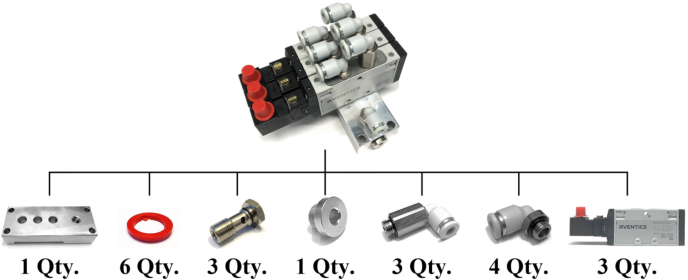
The assembly selected for the case study is shown in Figure 2 and has already been described in a study by Bendzioch et al. (2019). The assembly consists of conventional pneumatic components and connecting elements. In total, the assembly consists of 21 individual parts, which can be divided into seven different components. The manual assembly of the pneumatic assembly takes place in seven assembly steps. Three different hand tools are used for assembly: A screwdriver, an open-end wrench, and a cordless screwdriver.
How to Generate Assembly Instructions With Robotic Process Automation 633
Figure 2: Component overview of the pneumatic assembly used in the case study.
RESULTS
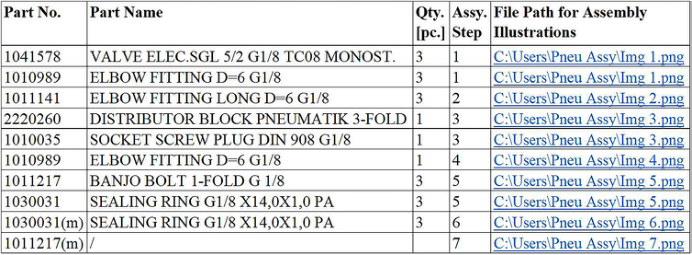
Based on the presented automation concept, an assembly instruction for the described pneumatic assembly was generated using RPA. The input data used for the case study consists of a set of assembly rules and assembly- specific information. Both files were created as Excel spreadsheets in the case study. Figure 3 shows the Excel spreadsheet with assembly-specific information for the selected pneumatic assembly. The spreadsheet con- tains bill of materials information on the number, designations, and part numbers of the components to be assembled. It also includes an assi- gnment of part numbers to assembly steps and file paths with assembly illustrations.
Figure 3: Excel spreadsheet with assembly-specific information as part of the input data.
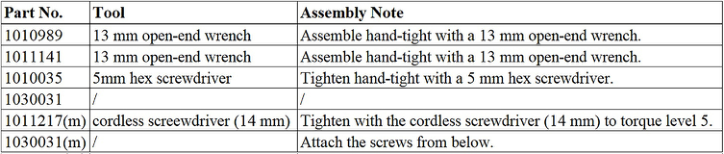
In addition to the assembly-specific information, notes on assembly tasks and the tools required are needed for the automated generation of assembly instructions. This information is compiled in a separate Excel spreadsheet called the set of assembly rules, as shown in Figure 4. The figure illustrates that, for example, a 13 mm open-end wrench is required to assemble the com- ponent with the part number “1010989”. Additionally, the set of assembly rules specifies that the component should be hand-tightened with a 13 mm open-end wrench.
Figure 4: Excel spreadsheet with the set of assembly rules as part of the input data.
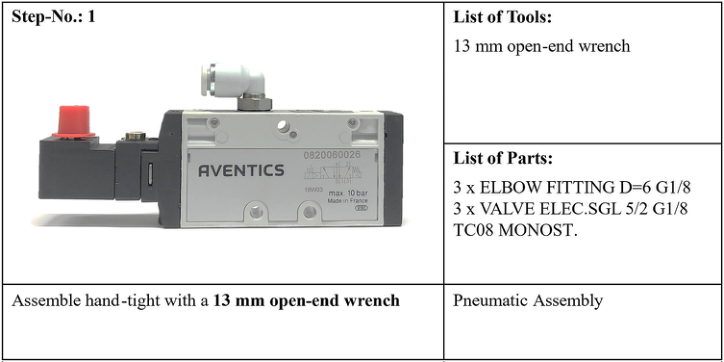
The two Excel spreadsheets presented are essential input data for the auto- mation process using RPA. These input data must be prepared in stage 1 (input) of the automation concept. Then, in stage 2 (processing) of the auto- mation concept, the prepared input data are processed by the RPA software. For this purpose, the RPA software first opens the two Excel spreadsheets containing the assembly-specific information and the set of assembly rules. Additionally, the RPA software opens a pre-designed PowerPoint template for assembly instructions, which includes a formatted slide with text fields and a placeholder for assembly illustrations. After opening the files, the RPA software stores the part numbers of the components used in an assembly step from the assembly-specific information in a cache. Next, the RPA software combines the information on tools and assembly activities stored in the set of assembly rules and inserts them into the PowerPoint template for assembly instructions. These steps are repeated for each assembly step. Finally, the RPA software saves the generated assembly instruction under a predefined name in a designated file folder as a PDF document. As a result, in stage 3 (output), a digital assembly instruction is available. Figure 5 shows the first assembly step of the automatically generated assembly instruction by the RPA softw- are. According to the illustrated assembly instruction, three pneumatic valves with one elbow fitting each must be hand-tightened using a 13 mm open-end wrench to assemble the pneumatic assembly.
Figure 5: Example of the first assembly step from the RPA-generated assembly instruction.
How to Generate Assembly Instructions With Robotic Process Automation 635
DISCUSSION
Based on the present case study, the suitability of RPA for the automated generation of assembly instructions is evident. Promising automation poten- tials have been identified, especially for repetitive and rule-based tasks. These tasks primarily involve processing input data, such as copying and pasting input data into a formatted template. Automating these tasks is expected to reduce the time required for creating assembly instructions, which will incre- ase the productivity of the IE employees. While a baseline effort is required to create the RPA program, the concept’s effectiveness rises with an increa- sing number of instructions that can be (partially) automated using the RPA program.
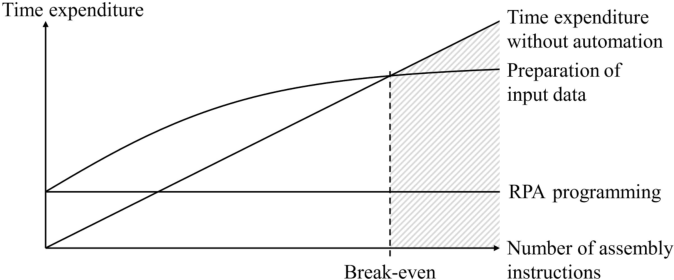
Figure 6 illustrates this relationship by schematically depicting the time required to create assembly instructions as a function of the number of instru- ctions to be created. Accordingly, the time required for the conventional creation of assembly instructions is proportional and has only a variable expenditure of time. With increasing assembly instructions to be created, the time required increases linearly. In contrast, the automated creation of assem- bly instructions using RPA follows a degressive course. It should be noted that the total time required consists of a fixed and a variable component. The fixed component is due to the one-time effort of RPA programming, while the variable component results from the preparation of input data. Consequ- ently, with increasing assembly instructions to be generated, the time required per instruction decreases. This relationship can be explained by the fact that the input data, particularly the set of assembly rules, must be continuously expanded. Therefore, as the number of assembly instructions to be genera- ted increases, it can be assumed that the number of reusable input data also increases. Based on these considerations, a break-even point is expected to exist, beyond which the automated creation using RPA is more advantage- ous than the conventional creation of assembly instructions. Currently, the break-even point cannot be quantified based on this initial case study. Furth- ermore, it can be assumed that the curves shown in Figure 6 are specific to the company’s operations, and hence, the break-even point is also company- specific. Nevertheless, even a schematic break-even analysis illustrates the fundamental advantages of the automation approach.
Figure 6: Break-even analysis for the creation of assembly instructions with RPA.
Beyond the present case study, there are several other tasks related to cre- ating assembly instructions that can potentially be automated using RPA in the upstream and downstream processes. For example, RPA can be used in the upstream data preparation process by combining data sources from indi- vidual data silos, such as Excel spreadsheets, with data from an ERP system. In the downstream process, RPA can distribute created assembly instructions in any IT system. In addition, employees can be automatically notified by e- mail about the creation of assembly instructions. Another application is the automated updating of assembly instructions following product changes or improvement notifications. If, for instance, a bill of materials changes, RPA can automatically update an existing assembly instruction and notify emplo- yees about the change via e-mail. Furthermore, RPA can also be relevant for the automated editing of assembly instructions in digital assistance systems (Schlund and Schmidt, 2021).
CONCLUSION AND OUTLOOK FOR FUTURE RESEARCH In this paper, the automation potential of RPA for generating assembly instru- ctions was examined based on an initial case study. The results show that specific steps in creating assembly instructions can be automated using RPA, resulting in time savings. Furthermore, compared to common procedures in industrial practice for creating assembly instructions, the RPA-based appro- ach can expand to previously undocumented assembly activities with less effort. Also, existing assembly instructions can be kept more up-to-date with less effort, for example, in the case of product modifications.
However, the case study also shows that the automation concept relies on input data as an information basis. Creating this data is currently time- consuming and takes up a significant portion of the overall effort for creating assembly instructions. To achieve a favorable cost-benefit ratio, a large num- ber of assembly instructions need to be automated. In addition, the effort required to create the necessary input data must be minimized. In this con- text, current research offers many approaches for simplifying the preparation of necessary input data. Combining RPA with various approaches, such as using ontologies as a formal representation of assembly information could be a future possibility to map the set of assembly rules. Currently, the set of assembly rules is represented in an Excel spreadsheet based on part numbers. This kind of provision has the disadvantage that for each new component, corresponding assembly notes and tool information must be added, even for similar components already existing in the set of assembly rules. Instead, using ontologies have the advantage that properties or attributes of a compo- nent can be inherited. As similar components are frequently used in manual assembly, this presents a promising potential to reuse once-created rules for other components. As a result, the time required for creating and maintaining the set of assembly rules can be reduced significantly.
In conclusion, the case study presented in this paper is considered as an initial investigation. The suitability of RPA for the automated creation of assembly instructions has been demonstrated, and promising automation
How to Generate Assembly Instructions With Robotic Process Automation 637
potential has been identified. A follow-up study should apply the presen- ted automation concept to further assemblies to investigate the productivity potential of the RPA-generated assembly instructions for the IE.
ACKNOWLEDGMENT
This research paper in the project KIPRO is funded by dtec.bw – Digi- talization and Technology Research Center of the Bundeswehr which we gratefully acknowledge. dtec.bw is funded by the European Union – NextGenerationEU.
REFERENCES
Bendzioch, S. Bläsing, D. Hinrichsen, S. (2020). Comparison of Different Assembly Assistance Systems Under Ergonomic and Economic Aspects. In: Ahram, T. Karwowski, W. Pickl, S. Taiar, R. (eds) Human Systems Engineering and Design II. IHSED 2019. Advances in Intelligent Systems and Computing, Volume 1026. Springer, Cham. DOI: https://doi.org/10.1007/978-3-030-27928-8_4. Enríquez, J. G. Jiménez-Ramírez, A. Domínguez-Mayo, F. J. García-García, J.
A. (2020). Robotic Process Automation: A Scientific and Industrial Syste- matic Mapping Study. In: IEEE Access, Volume 8, pp. 39113–39129. DOI: 10.1109/ACCESS.2020.2974934. Gors, D. Put, J.Vanherle, B. Witters, M.Luyten, K. (2021). Semi-automatic extraction of digital work instructions from CAD models. Procedia CIRP 2021, Volume 97, pp. 39–44. DOI: https://doi.org/10.1016/j.procir.2020.05.202. Khan, A. Turowski, K. (2016). A Survey of Current Challenges in Manufactu-
ring Industry and Preparation for Industry 4.0. In: Abraham, A. Kovalev, S. Tarassov, V. Snášel, V. (eds) Proceedings of the First International Scientific Con- ference “Intelligent Information Technologies for Industry”(IITI 2016). Advances in Intelligent Systems and Computing, Volume 450, pp. 15–26. Springer, Cham. DOI: https://doi.org/10.1007/978-3-319-33609-1_2. Langmann, C. Turi, D. (2022). Introduction. In: Robotic Process Automation (RPA) - Digitization and Automation of Processes, pp. 2–3. Springer Gabler, Wiesbaden. DOI: https://doi.org/10.1007/978-3-658-38692-4_1. Neb, A. (2019). Review on Approaches to Generate Assembly Sequences by Extra-
ction of Assembly Features from 3D Models. Procedia CIRP 2019, Volume 81, pp. 856–861. DOI: https://doi.org/10.1016/j.procir.2019.03.213. OECD (2019). Adapting to Demographic Change. Available under: https://www.oecd.org/g20/summits/osaka/OECD-Ageing-and-Demographic- change-G20-JPN.pdf. Pfeiffer, P. Fettke, P. (2021). 16 Applications of RPA in manufacturing. In: Czarnecki, C. and Fettke, P. (eds) Robotic Process Automation: Management, Techno- logy, Applications, pp. 315–346. De Gruyter Oldenbourg, Berlin, Boston. DOI: https://doi.org/10.1515/9783110676693-016. Rea Minango, N. Maffei, A. (2023). Beyond assembly features: systematic review of
the core concepts and perspectives towards a unified approach to assembly infor- mation representation. Research in Engineering Design, Volume 34, pp. 3–38. DOI: https://doi.org/10.1007/s00163-022-00400-4. Schlund, S. Schmidt, M. (2021). Robotic Process Automation in Industrial Engineering: Challenges and Future Perspectives. In: Trzcielinski, S. Mrugalska, B.
Karwowski, W. Rossi, E. Di Nicolantonio, M. (eds) Advances in Manufactu- ring, Production Management and Process Control. AHFE 2021. Lecture Notes in Networks and Systems, Volume 274, p. 324. Springer, Cham. DOI: 10.1007/978- 3-030-80462-6_40. Syed, R. Suriadi, S. Adams, M. Bandara, W. Leemans, S. J. J. Ouyang, C. ter Hofstede, A. H. M. van de Weerd, I. Wynn, M. T. Reijers, H. A. (2020). Robotic Process Automation: Contemporary Themes and Challenges. In: Computers in Industry, Volume 115, No 103162. DOI: https://doi.org/10.1016/j.compind.2019.103162. Wewerka, J. Reichert, M. (2023). Robotic process automation - a systematic mapping
study and classification framework. Enterprise Information Systems, Volume 17, No. 2. DOI: https://doi.org/10.1080/17517575.2021.1986862.
Read this individual research paper free through the original publisher, or explore the full digital proceedings book.
ISBN 978-1-958651-87-2
Explore this ISBN in the AHFE Bookstore ↗Listed in the July 2026 bookstore catalogue; search by ISBN to confirm current availability · Digital book purchase optional