Antonia Markus, Lea Marleen Daling, Esther Borowski, Ingrid Isenhardt (2024). Error Communication in Manual Assembly through a Projection-Based Assistance System. In: Human Factors and Systems Interaction. AHFE Open Access, vol. 154, pp. 179–188. https://doi.org/10.54941/ahfe1005365
While automation is advancing, manual labor continues to be relevant due to its flexibility, adaptability, cost considerations, and the unique qualities that humans bring to the workforce. In certain tasks and contexts, human involvement remains essential. One context is manual assembly which is still an essential part of many production systems due to the diversity of product variants and the challenges of producing in batch size 1. Manual assembly often outweigh the high costs of automated solutions. Nevertheless, a high variability of products and high quality standards pose a challenge to employees. Given the shortage of skilled workers, it is crucial to provide support for employees and ensure the quality of manual assembly. This includes assisting unskilled workers in the assembly process. In addition to optimizing training time and available instructions, error detection during the assembly process can serve as a mean to reduce errors and support employees. Error detection can be separated in two aspects: on the one hand the technological solution to recognize process steps and deviations and on the other hand the error communication when errors occur. This study lays the groundwork for the latter by investigating the effect of error communication during the process on assembly quality and employee satisfaction.An on-site manual assembly station was set up and n=12 participants have taken part in the study. Their task was to complete an assembly task based on instructions projected onto the work surface. In the control condition, participants independently navigated through the description of instructed assembly steps using displayed arrows. The experimental condition used a Wizard-of-Oz experimental design in which participants were informed that the assistance system automatically recognizes their process and detects errors. In the case of an error, a correction prompt emerged instead of the next instruction step. Performance measures included the required assembly time and recorded errors. Participants also completed questionnaires on workload (NASA TLX), usability (SUS), control beliefs in dealing with technology, and subjective performance.Data analysis is pending. Comparable measures will show in which regard the two conditions differ, shedding light on the effect of error communication during the assembly on quality and employee satisfaction. In the end, the implications for future research and application will be discussed in the paper.
The significance of manual assembly persists in various industries, particu- larly in tasks such as directed automotive part assembly, where automation faces economic and technological (e.g. complexity) limitations. Human workers, therefore, continue to be an essential part of manufacturing, espe- cially for Small and Medium-sized Enterprises (SMEs) (Casalino et al., 2021). In the future, both technological and market advancements driven by dig- italization and connected production systems pose challenges to manual assembly workers (Spena et al., 2016). The dynamic nature of assembly tasks, influenced by higher product variability and mass customization, necessi- tates a high degree of flexibility from workers, even as the expectation for
high-quality outputs persists (Cohen et al., 2017; Johansson et al., 2016). In addition, there is the challenge of a skilled labor shortage in Germany (Anding, 2018), requiring innovative solutions that automation alone cannot adequately address (Pfeiffer, 2016). These circumstances demand a broader skill set from individual assembly workers, prompting the need to acquire new competencies (Bauernhansl, 2017). Therefore, it has to be investigated how the assembly workers can be supported target-group specifically.
In this context, Augmented Reality (AR) emerged as a promising medium for assistance systems supporting the assembly worker in addressing the mul- tifaceted challenges. AR-supported systems not only hold the potential to reduce training costs significantly (Wang et al., 2016) but also accelerates the training process and contributes to shorter assembly times in the sub- sequent assembly tasks (Pathomaree and Charoenseang, 2005). Beyond the application context for training workers, the facilitation of in-process qual- ity assurance by AR technology has been a recent research topic. This can be realized by real-time feedback for error prevention or feedback on the cor- rect execution of assembly steps and potentially results in a reduction of the production of defective parts and thus the need for rework. However, amidst the optimism surrounding AR, counterarguments question its effectiveness in reducing human errors. Suggestions are that current AR technology may not be advanced enough to sufficiently address human-caused mistakes, poten- tially rendering the use of AR devices ineffective (Qeshmy et al., 2019). Especially, realizing the real-time objection recognition of the assembly parts with obstacles like occlusion of the parts by worker’s hand occurring in man- ual assembly is a yet unsolved technological challenge (Thamm et al., 2021). Associated with its technical feasibility raises the question of whether this kind of in-process error communication is beneficial for the worker.
Thus, this study aims to contribute to the ongoing discourse by exploring how AR-based assistance systems can best support manual assembly work- ers. Specifically, we investigate whether real-time error communication can offer additional support to workers in the assembly process by imitating the functionality of such a system.
The subsequent section delineates the current state of research on AR- based assistance systems in manual assembly, resulting in the formulation of the research question for this paper. This is succeeded by a description of the methodology employed and a presentation of the study’s findings. The discussion section comprehensively synthesizes the results and provides an outlook on future implications.
STATE OF THE ART: AR-BASED ERROR COMMUNICATION IN MANUAL ASSEMBLY AR is a technology that enables the precise overlay of computer-generated virtual imagery onto physical objects in real time. In contrast to virtual reality (VR), where users are fully immersed in a virtual environment, AR allows users to seamlessly interact with virtual images using real-world objects. An accepted definition of AR as a technology is that it (1) merges real and virtual
Error Communication in Manual Assembly 181
imagery, (2) facilitates real-time interaction, and (3) aligns virtual imagery with the actual environment (Azuma, 1997).
Leveraging Augmented Reality (AR) as the instructional medium in man- ual assembly offers several well-established advantages. Primarily, the expan- sion of the user’s visual experience from the physical world to the informa- tional space facilitates communication with tangible objects. This augmen- tation contributes to an enhanced comprehension of target objects, thereby deepening the usability and reliability of assembly operations (Henderson and Feiner, 2011; Syberfeldt et al., 2015; Westerfield et al., 2015). The application of AR instructions adheres to user cognition principles, thereby improving communication efficiency between assembly systems and users (Wang et al., 2021). Compared to conventional instructions, AR provides a more natural, intuitive interactivity and three-dimensional performance (Büttner et al., 2017; Yuan et al., 2008). Numerous studies indicate that incorporating AR into on-the-job training scenarios can significantly enhance both quality and efficiency (Dey et al., 2018).
Apart from using AR for the mere instruction of assembly tasks, researchers investigated the use of AR for error prevention to improve the per- formance of manual assembly in terms of effectivity and quality assurance: A primary focus application of error prevention has been the communica- tion of picking errors. For instance, a system sets human movements in the workstation environment, utilizing an app that marks the location of the component for the next step and provides immediate feedback on whether the correct box was selected (Faccio et al., 2019). Furthermore, various feed- back modalities, including haptic and auditory, have been compared, with the feedback related to grasping areas, specifically whether the correct compo- nent box was accessed. Communication occurred on a visual level through the illumination of red light, haptic feedback through vibration in a glove, and auditory feedback through a signaling tone. It was found that auditory feedback was perceived as distracting, and the combination of haptic and visual feedback proved to be effective (Funk et al., 2016). In a different vari- ation, not only were the corresponding picking boxes illuminated in red, but the entire work surface was colored, resulting in a faster assembly time com- pared to auditory and haptic conditions (Kosch et al., 2016). Another study investigated the effect of real-time feedback on the applied forces of a screw connection reporting that it supported the superiority in terms of time on task, number of errors, and subjective perception regarding the usability of the training system of virtual training compared to a video-based training (Loch et al., 2019).
In addition to the known disadvantages of AR in assembly, accuracy level, or safety aspects, it is reported that the systems do not provide adequate help for experts for whom the detailed description is not necessary and even slows them down in assembly times (Funk et al., 2017; Mark et al., 2020). This may lead to less frequent use of such assistance systems by experts in manual assembly. Yet human errors occur, so how can the performance still be supported? One solution might be real-time error feedback, although its effects on the worker are still unclear; thus this leads to the research question:
What are the effects of immediate/real-time error communication within manual assembly on the user in terms of perceived task load, system usability, subjective performance, as well as performance criteria such as assembly time and committed errors?
METHODOLOGY
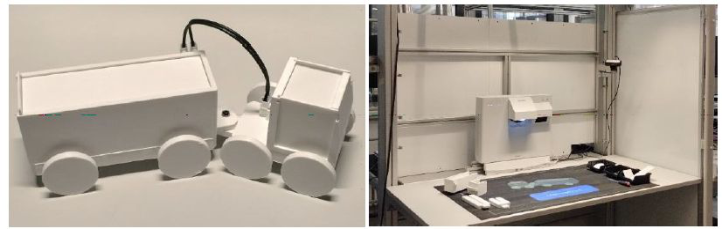
The sample consisted of 12 participants (Mage: 28,33 years SD: 5,02; 50% female) who were students and employees of the university and participated voluntarily without any incentives. An on-site manual assembly station was set up. The main element of the study was the completion of an assembly task based on instructions projected onto the work surface. The task was to assemble a 3D-printed truck (Fig. 1). The 27 components of the truck had to be assembled in 14 steps including performing plug connections, and screw- ing operations by hand, and with a manual screwdriver. The study setup (Fig. 1) was located within a shopfloor of the university to imitate a realis- tic shopfloor environment where assembly tasks are performed in practice. During the experiment, the participant stood in front of a table and all the necessary parts for the assembly were in boxes within reach range. A cam- era recorded the assembly area which captured the hands of the participants. Assembly steps were displayed on the work surface using a projector-based system.
Figure 1: Assembly task: 3D-printed truck model (left), experimental setup from the participant’s perspective (right).
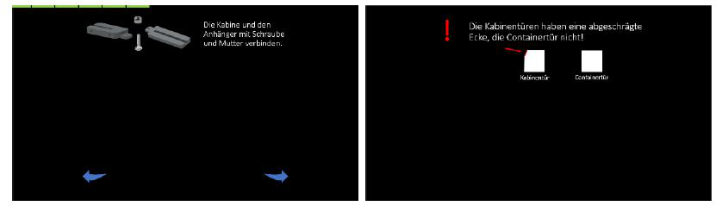
The participants were randomly assigned to a control group (n = 6) and an experimental group (n = 6). In the control condition, participants indepen- dently navigated through the description of instructed assembly steps using displayed arrows. The experimental condition used a Wizard-of-Oz experi- mental design in which participants were informed that the assistance system automatically recognized their process and detected errors. In the case of an error, a correction prompt (Fig. 2) emerged instead of the next instruction step.
There were two researchers, one of whom was present, welcomed the participants, explained the setup and assembly task, handed them the dec- laration of consent including consent recording a video of their hands while assembling, and guided the participants in general through the experiment.
Error Communication in Manual Assembly 183
The other one was hidden to imitate the automatic functioning especially the error communication of the assistance system. The latter stood behind a wall facing the participant and observing the participant’s hands via the camera. His task was to display the instruction to the participant at the right time imitating an automatic system. The instruction was facilitated by a Power- Point presentation and consisted of single written phrases and CAD pictures of the components necessary for the corresponding assembly step (Fig. 2). Additionally, in the experimental group, if the participant made an error, they displayed an error message communicating that the participant made an error and how to correct the error. Meanwhile, the investigator recorded the assembly time and documented which errors were made.
Figure 2: Instruction with arrows in the control condition (left), error communication in the experimental condition with a hint of how to correct it.
After finishing truck assembly, the participants completed questionnaires on their perceived workload, system usability, and control beliefs in dealing with technology. The NASA TLX Questionnaire (Hart and Staveland, 1988) operationalized perceived workload with six items reaching on a 100-step scale from low to high exemplary for the item mental effort, “how much mental effort was required to absorb and process information (e.g. thinking, deciding, calculating, remembering, looking, searching...)? Was the task easy or demanding, simple or complex, did it require high speed or is it error- tolerant?”
The System Usability Scale (SUS) (Brooke, 1996) measured usability using ten items on the 5-step scale “do not agree at all” to “fully agree”. One of the used items was “I thought the various functions in this system were well integrated”.
Moreover, we measured subjective performance and assessed the demo- graphic information of the participants. The scale of subjective performance was created by a colleague and used in a former experiment. It consisted of four questions like “How satisfied were you with the quality of your work?” which were assessed by the participants on a 5-step scale reaching from “not at all” to “extraordinary”.
Finally, the hidden investigator revealed themself and enlightened the par- ticipants about the non-automatic functionality of the assistance system and the purpose of the study.
RESULTS
The data was analyzed using SPSS software, determining the descriptive statistics (Tab. 1). Following, a Mann-Whitney-U-Test was calculated to determine if there were differences between the control group and the experi- mental group. The distributions differed between both groups, Kolmogorov- Smirnov p < .05. There could not be detected any significant differences in the objective performance measures assembly time and number of errors. For the worker-related measures task load, which was in the lower range of the scale (for both groups around 30 on a scale from 0 to 100) and subjective per- formance did also not differ significantly between the control group and the experimental group. There was a statistically significant difference in usabil- ity between both groups, U = 5.00, Z = −2.093, p < .05. The mean value of the control group was 88% over 80%, which indicates good to excel- lent usability. At the same time, the experimental group reported an average usability of 76% which does not have a borderline of 80% indicating good usability.
Table 1. Descriptive statistics.
Table available in the original PDF paper.
N Min Max Mean SD Assembly time (in min) Control 5 6.11 14.51 8.50 3.60 Experimental 6 6.13 17.33 8.88 4.18 Number of errors Control 6 0 7 2.83 2.48 Experimental 6 1 7 3.83 2.04 Task Load (Scale 1-100) Control 5 15.00 41.67 30.67 11.01 Experimental 5 18.33 45.00 28.50 10.31 Usability (max. 100) Control 6 70.00 97.50 88.13 10.05 Experimental 6 66.25 85.00 76.67 7.40 Subjective Performance (Scale 1-5) Control 6 2.25 4.75 3.95 0.96 Experimental 6 2.00 4.75 3.54 0.89
DISCUSSION
The present paper aimed to investigate if real-time error communication regarding the correct execution of manual assembly steps is an additional support for workers. We compared an experimental group, which was assem- bled with the support of real-time error communication, with a control, which received the same projection-based instruction without error commu- nication. We found no statistically significant differences regarding assembly performance (assembly times and errors) perceived task load, and subjective performance between the group with and without error communication. At the same time, a statistically significant difference was discovered regard- ing the system’s usability. The control group showed a higher mean value in usability.
Concerning the similarity of the assembly performance of the groups one can say that error could be easily detected by the worker himself at the latest in one of the next assembly steps. Thus, the control group would also detect
Error Communication in Manual Assembly 185
and correct their errors since all steps were reversible and easily corrected. Moreover, as expected both groups made a similar number of errors because the error communication occurred reactively and not proactively. Therefore, the group needed the same time to correct those errors. However, in other contexts, there could occur errors that cannot be detected during the sequent assembly and would produce defective parts or rework. A follow-up experi- ment could consider those aspects by reducing the detectability of errors and increasing the complexity of the necessary corrective actions.
The groups did not differ in their rather low level of perceived task load. This suggests the task complexity is not high enough that the support through the error communication would reduce especially the mental load. Error com- munication could relieve the worker from worrying about making an error and being solely responsible for possibly causing defective parts or rework. The usability of the systems differed significantly. The control condition sys- tem having higher usability could indicate that the participants are not used to the automatic correction of their actions and could be intimidated by the system’s surveillance with error communication. Furthermore, this result indicates that the design of the error communication was not optimal and must be examined what design features contribute to good error commu- nication. Concerning the subjective performance, no differences were found. This indicates that the fact that the errors were pointed out to the experimen- tal while the control group might unknowingly commit errors had no impact on the subjective performance. Future studies could investigate the difference between error communication during the assembly and error communication at the end of the assembly since the possibility of correction could affect sub- jective performance. All those interpretations must be validated by studies confirming those small mean differences and augmented with statistical anal- yses with bigger samples. The external validity of the study could be raised by using assembly workers as participants and a more complex assembly task. Although the wizard-of-Oz study design seems to be a valid approach to examine the effects of technologies before they are reliably functioning, we cannot be sure if every participant believed the manipulation. We included an estimation of the experimenters in the protocol, and they reported doubt about that for a least one participant of the experimental group.
OUTLOOK Although the approach of the imitated system seems to be suitable for further examination of reported weaknesses of previous systems through real-time feedback on committed errors, the setup has to be examined further con- cerning its robustness. For instance, the slowing down of assembly time for experts, caused by the display of detailed explanations or even distractions (Funk et al., 2017; Mark et al., 2020), could be mitigated by using only error communication without instructions. The extent to which such an approach can adequately support users with different levels of experience remains to be investigated. Especially a system adapting to the experience level of work- ers and how this adaption is implemented and perceived by the workers can be a future research direction. Despite various advantages of the Wizard of
Oz approach the impact of e.g. the response time of a real system cannot be evaluated with this method. Therefore, studies with a fully functioning system should be conducted in the future. Also, ethical issues concerning for example workers’ privacy (Funk et al., 2016) of systems monitoring workers closely have to be considered in future studies.
ACKNOWLEDGMENT
The joint project WIN:A (02L19C020 ff.) is funded by the Federal Min- istry of Education and Research as part of the funding measure “Regional Competence Centres for Labour Research” and supervised by the Project Management Agency Karlsruhe (PTKA). The responsibility for this article lies with the authors.
REFERENCES
Anding, M., 2018. Fachkräftemangel: Zur Lösung eines greifbaren Problems in digitalen Zeiten. Wirtsch. Manag. 10, 14–21. https://doi.org/10.1007/s35764-018- 0012-2 Azuma, R. T., 1997. A Survey of Augmented Reality. Presence Teleoperators Virtual
Environ. 6, 355–385. Bauernhansl, T., 2017. Die Vierte Industrielle Revolution – Der Weg in ein wertschaffendes Produktionsparadigma, in: Vogel-Heuser, B., Bauernhansl, T., ten Hompel, M. (Eds.), Handbuch Industrie 4.0 Bd.4: Allgemeine Grundlagen, Springer Ref- erence Technik. Springer, Berlin, Heidelberg, pp. 1–31. https://doi.org/10.1007/ 978-3-662-53254-6_1 Brooke, J., 1996. SUS: A “quick and dirty” usability scale, in: Jordan, P. W., Thomas,
B., Weerdmeester, A., McClelland, I. I. (Eds.), Usability Evaluation in Industry. Taylor & Francis, London, pp. 189–194. Büttner, S., Mucha, H., Funk, M., Kosch, T., Aehnelt, M., Robert, S., Röcker, C.,
2017. The Design Space of Augmented and Virtual Reality Applications for Assis- tive Environments in Manufacturing: A Visual Approach, in: Proceedings of the 10th International Conference on PErvasive Technologies Related to Assistive Environments. Presented at the PETRA’17: 10th International Conference on PEr- vasive Technologies Related to Assistive Environments, ACM, Island of Rhodes Greece, pp. 433–440. https://doi.org/10.1145/3056540.3076193 Casalino, A., Zanchettin, A. M., Piroddi, L., Rocco, P., 2021. Optimal Scheduling of Human–Robot Collaborative Assembly Operations With Time Petri Nets. IEEE Trans. Autom. Sci. Eng. 18, 70–84. https://doi.org/10.1109/TASE.2019.2932150 Cohen, Y., Faccio, M., Galizia, F. G., Mora, C., Pilati, F., 2017. Assembly system
configuration through Industry 4.0 principles: the expected change in the actual paradigms. IFAC-Pap. 50, 14958–14963. https://doi.org/10.1016/j.ifacol.2017. 08.2550 Dey, A., Billinghurst, M., Lindeman, R. W., Swan, J. E., 2018. A Systematic Review of 10 Years of Augmented Reality Usability Studies: 2005 to 2014. Front. Robot. AI 5, 37. https://doi.org/10.3389/frobt.2018.00037 Faccio, M., Ferrari, E., Galizia, F. G., Gamberi, M., Pilati, F., 2019. Real-time assis-
tance to manual assembly through depth camera and visual feedback. Procedia CIRP 81, 1254–1259. https://doi.org/10.1016/j.procir.2019.03.303
Error Communication in Manual Assembly 187
Funk, M., Bächler, A., Bächler, L., Kosch, T., Heidenreich, T., Schmidt, A., 2017.
Working with Augmented Reality?: A Long-Term Analysis of In-Situ Instructions at the Assembly Workplace, in: Proceedings of the 10th International Conference on PErvasive Technologies Related to Assistive Environments. Presented at the PETRA’17: 10th International Conference on PErvasive Technologies Related to Assistive Environments, ACM, Island of Rhodes Greece, pp. 222–229. https://do i.org/10.1145/3056540.3056548 Funk, M., Heusler, J., Akcay, E., Weiland, K., Schmidt, A., 2016. Haptic, Auditory, or Visual?: Towards Optimal Error Feedback at Manual Assembly Workplaces, in: Proceedings of the 9th ACM International Conference on PErvasive Technologies Related to Assistive Environments. Presented at the PETRA’16: 9th ACM Interna- tional Conference on PErvasive Technologies Related to Assistive Environments, ACM, Corfu Island Greece, pp. 1–6. https://doi.org/10.1145/2910674.2910683 Hart, S. G., Staveland, L. E., 1988. Development of NASA-TLX (Task Load Index):
Results of empirical and theoretical research. Adv. Psychol. 52, 139–183. Henderson, S. J., Feiner, S. K., 2011. Augmented reality in the psychomotor phase of a procedural task, in: 2011 10th IEEE International Symposium on Mixed and Augmented Reality. Presented at the 2011 IEEE International Symposium on Mixed and Augmented Reality, IEEE, Basel, pp. 191–200. https://doi.org/10. 1109/ISMAR.2011.6092386 Johansson, P. E., Mattsson, S., Moestam, L., Fast-Berglund, Å., 2016. Johansson, P. E., Mattsson, S., Moestam, L., & Fast-Berglund, Å. (2016). Multi- variant truck production-product variety and its impact on production quality in manual assembly. Procedia CIRP 54, 245–250. Kosch, T., Kettner, R., Funk, M., Schmidt, A., 2016. Comparing Tactile, Auditory,
and Visual Assembly Error-Feedback for Workers with Cognitive Impairments, in: Proceedings of the 18th International ACM SIGACCESS Conference on Comput- ers and Accessibility. Presented at the ASSETS’16: The 18th International ACM SIGACCESS Conference on Computers and Accessibility, ACM, Reno Nevada USA, pp. 53–60. https://doi.org/10.1145/2982142.2982157 Loch, F., Ziegler, U., Vogel-Heuser, B., 2019. Using Real-time Feedback in a Training System for Manual Procedures. IFAC-Pap. 52, 241–246. Mark, B. G., Rauch, E., Matt, D. T., 2020. Study of the impact of projection-
based assistance systems for improving the learning curve in assembly processes. Procedia CIRP 88, 98–103. https://doi.org/10.1016/j.procir.2020.05.018 Pathomaree, N., Charoenseang, S., 2005. Augmented reality for skill transfer in assembly task, in: ROMAN 2005. IEEE International Workshop on Robot and Human Interactive Communication, 2005. Presented at the ROMAN 2005. IEEE International Workshop on Robot and Human Interactive Communication, 2005., IEEE, Nashville, TN, USA, pp. 500–504. https://doi.org/10.1109/ROMA N.2005.1513829 Pfeiffer, S., 2016. Robots, Industry 4.0 and Humans, or Why Assembly Work Is More
than Routine Work. Societies 6, 16. https://doi.org/10.3390/soc6020016 Qeshmy, D. E., Makdisi, J., da Silva, E. H., Angelis, J., 2019. Managing human errors: Augmented reality systems as a tool in the quality journey. Procedia Manuf. 24–30. Spena, P. R., Holzner, P., Vidoni, R., Rauch, E., Matt, D. T., 2016. Requirements
for the design of flexible and changeable manufacturing and assembly systems: a SME-survey. Procedia CIRP 41, 207–212. Syberfeldt, A., Danielsson, O., Holm, M., Wang, L., 2015. Visual Assembling Guidance Using Augmented Reality. Procedia Manuf. 1, 98–109. https://doi.org/10. 1016/j.promfg.2015.09.068
Thamm, S., Huebser, L., Adam, T., Hellebrandt, T., Heine, I., Barbalho, S., Velho, S. K., Becker, M., Bagnato, V. S., Schmitt, R. H., 2021. Concept for an augmented intelligence-based quality assurance of assembly tasks in global value networks. Procedia CIRP 97, 423–428. https://doi.org/10.1016/j.procir.2020.05.262 Wang, X., Ong, S. K., Nee, A. Y. C., 2016. A comprehensive survey of augmented
User-oriented AR assembly guideline: a new classification method of assembly instruction for user cognition. Int. J. Adv. Manuf. Technol. 112, 41–59. https: //doi.org/10.1007/s00170-020-06291-w Westerfield, G., Mitrovic, A., Billinghurst, M., 2015. Intelligent Augmented Reality Training for Motherboard Assembly. Int. J. Artif. Intell. Educ. 25, 157–172. https: //doi.org/10.1007/s40593-014-0032-x Yuan, M. L., Ong, S. K., Nee, A. Y. C., 2008. Augmented reality for assem-
bly guidance using a virtual interactive tool. Int. J. Prod. Res. 46, 1745–1767. https://doi.org/10.1080/00207540600972935
LISTED IN THE AHFE DIGITAL BOOKSTORE CATALOGUE
Explore the complete digital volume
Human Factors and Systems Interaction
Read this individual research paper free through the original publisher, or explore the full digital proceedings book.
ISBN 978-1-964867-30-4
Explore this ISBN in the AHFE Bookstore ↗Listed in the July 2026 bookstore catalogue; search by ISBN to confirm current availability · Digital book purchase optional