Katharina Müller-eppendorfer, Katrin Meusinger (2024). Ergonomic Support for Manual Assembly Through Data-Based Assistance Systems - Challenges and Solution Ideas Considering the Legal Framework Conditions. In: Human Factors and Systems Interaction. AHFE Open Access, vol. 154, pp. 32–38. https://doi.org/10.54941/ahfe1005350
1 Hochschule Mittweida, University of Applied Sciences, Faculty Engineering Sciences, Institute InnArbeit - Centre of Innovative Process Planning and Ergonomics, Mittweida, Germany ↗
While automation is already well advanced in series production, manual production is still used for small batch sizes and multi-variant production. However, such workplaces also need to be modernized to produce not only economically but also sustainably. Improving ergonomic working conditions poses a challenge for work research: how can data-based assistance systems provide employees with recommendations on favourable work design while considering the tight legal framework regarding the collection of biometric data? A consortium of labour researchers from five colleges and universities, six network partners and more than 30 companies are working on this and other questions in the context of the introduction of AI solutions in the PerspektiveArbeit Lausitz structural change project (PAL). The declared aim is to support the transformation of the Lusatia coal mining region by enabling small and medium-sized enterprises to drive forward digitalization and use simple human-centred AI solutions to make work more people-friendly, thereby increasing their competitiveness and flexibility.The prototype is to be implemented at an electronics service provider with manual PCB production. In collaboration with Mittweida University of Applied Sciences, an application is being developed to improve activity-related ergonomics at the workplace. Visual sensors at and around the workplace will capture images that are compared with data from standards, guidelines, and ergonomics methods in real time to provide a direct message at the workplace in case of negative stress (e.g. forced posture, one-sided strain, gripping space). The video-supported analysis is intended to help identify and correct ergonomically critical movement sequences and avoid them in the long term to maintain the health of employees.Mittweida University of Applied Sciences develops an application to improve ergonomics by using visual sensors to record and evaluate ergonomic factors. The video-supported analysis is intended to identify ergonomically critical movement sequences and avoid them.It is important to not only "get employees on board” in this process from the outset in the sense of "informing" them, but to "involve" them in the implementation of the project to be able to incorporate their expertise into the development and to increase acceptance of the planned project. This is because AI applications that process personal data are regulated by the GDPR and soon also by the European Union's AI Regulation, which is expected for 2024. The Works Constitution Act (§87) must also be observed. It stipulates an economical and dedicated data collection and the avoidance of unnecessary data. What exactly needs to be considered when processing personal data using AI systems and what specific technical solution the assistance system provides to protect sensitive biometric data - this content is conveyed to the employees in awareness workshops
Ergonomic Support for Manual Assembly Through Data-Based Assistance Systems 33
INTRODUCTION
Particularly in small and medium-sized enterprises, seen as an important driver of the economy in Germany, the successful implementation of AI systems is often associated with considerable challenges. When it comes to ensuring that these AI systems are designed to meet the needs and expecta- tions of end users, the human-centered design (HCD) approach is proving increasingly promising. It is also used in the research project described here (Pietschmann, Müller-Eppendorfer, Bock and Goldhahn, 2023).
The strategy paper published by the European Commission in 2021 for the next industrial revolution, Industry 5.0, focuses on the interaction between humans and machines, based on the pillars of human-centered work, sustainability and resilience.
13 years ago, Industry 4.0 was proclaimed in Germany. But there are still major challenges with regard to digitalization, particularly in the SME sec- tor, and many companies are even questioning their own Industry 3.0 status. However, this development process should not be viewed in a linear way. On the contrary, especially for companies that are lagging behind in automation and digitalization, the concepts of Industry 5.0 offer new perspectives for the next steps, which they should by no means ignore. Regardless of the technical status in the company, the three pillars mentioned above should be applied in ongoing or new implementation processes (see the European Commission’s Industry 5.0 strategy paper).
NEED FOR SUPPORT IN ASSEMBLY ACTIVITIES Today’s working world in the field of assembly is characterized by high prod- uct variance and flexibly changing work tasks and content. Digital change and artificial intelligence (AI) offer many opportunities to support and pro- vide relief for people by using algorithms, data analyses and evaluations as well as visualizations. The focus here is also on protecting employees’ health and maintaining their ability to work as working life tends to be longer.
Especially in the assembly of individual and small series production with predominantly manual activities, potential is seen in the support of the employees. AI applications can be used to identify and visualize potential for improvement, particularly ergonomic stress, which in the long term will also make it possible to change individual work tasks towards more effi- cient and ergonomically less stressful processes (Goldhahn, Pietschmann, Müller-Eppendorfer, 2023).
SOLUTION APPROACH To avoid technical stress and to relieve employees and not burden them, it is necessary to design the technical applications (especially the software) in such a way that they function intuitively and consistently and do not hinder the actual work task. The aim of this research project is the prototypical addition of a data-based assistance system implemented at the respective workplace to support the ergonomics of the employee - without obstructive sensors close to the body, but instead camera-based and collecting and evaluating data almost
34 Müller-Eppendorfer and Meusinger
in real time. Essential and therefore a priority in the implementation is that the technical solution for SMEs must be designed in such a way that expen- sive hardware purchases (e.g. special cameras or sensors) or costly software licenses are avoided.
IMPORTANT CRITERIA To support the company in meeting the criteria of humane work (feasibility, harmlessness, freedom from impairment and personality development, see DIN, 2023, p. 35, Fig. 3), a data-based assistance system in the form of an edge AI will be implemented.
Above all, the absence of damage and impairment should be fulfilled by a near-real-time, ergonomic assessment. To achieve this, it is necessary to develop and prototypically test a procedure consisting of methods as well as hardware and software applications.
CURRENT WORK SYSTEM, POTENTIALS AND INITIAL IDEAS FOR IMPLEMENTATION The development of an assistance system and the active involvement of employees in its development is taking place in an SME in the electronics industry, primarily for the manual assembly of printed circuit boards. Human skills and abilities as well as a high level of motivation are required to be able to manufacture such products in a high-quality and error-free manner.
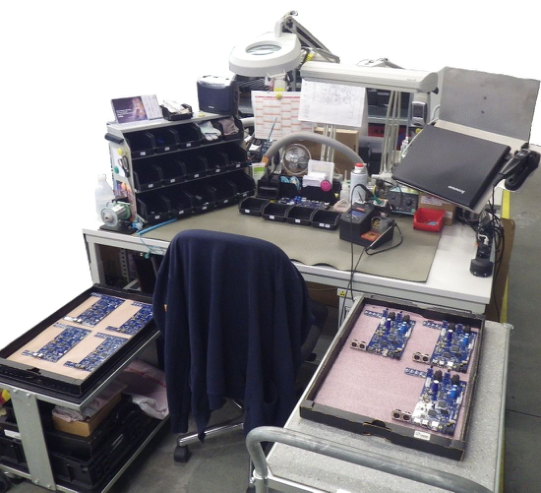
To make this work more humane, it is essential to consider ergonomic aspects. Figure 1 shows one of the workplaces which shall be improved.
Figure 1: Manual assembly, IMM electronics GmbH.
Ergonomic Support for Manual Assembly Through Data-Based Assistance Systems 35
The existing workstations will initially be replaced with height-adjustable standard workstations, which will be equipped with targeted provisioning equipment (including swivel arms and shelving) for an ergonomic workflow. The assistance system will then be implemented.
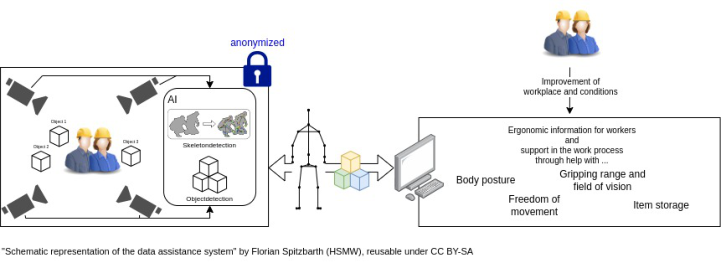
Its special feature is that it is a sensor-based, markerless system consisting of several cameras and corresponding software that enables personal data to be processed directly on site without data transfer to a cloud.
The AI models required for the functionality of the ergonomics assistance system developed in the research project are rolled out according to the prin- ciple of edge computing. In contrast to the principle of cloud computing, all computing steps are carried out on a computer installed locally at the respec- tive workstation. A central server within the company network is deliberately omitted to reduce data traffic - both for reasons of sustainability and, in par- ticular, regarding data protection, as the data collected is particularly sensitive biometric data. A positive side effect is that the local network is relieved.
The assistance system uses neural networks that have been optimized for mobile use (smartphone). These extract objects and body posture from the video data. Trained models are already available here, which generally have sufficient performance. In the course of the project, it will be investigated which special requirements, e.g. lighting conditions or licensing reasons, may make it necessary to train the models additionally. Extensive data collection and labelling will be carried out for this purpose.
The weaker results of mobile neural networks are compensated for by mul- tiple camera perspectives. This approach also offers the advantage of being less sensitive to occlusion, e.g. by furnishings in the workplace.
In addition to the AI models that solve the general tasks (object recognition exists in many contexts), application-specific models will be necessary. For example, ergonomics values are determined from the extracted postures. This is achieved by collecting a smaller amount of data that covers the use case in a study that is used to train specialized AI models (Müller-Eppendorfer, Pietschmann, Engelberger, Davies, Goldhahn, 2023).
Figure 2: Schematic representation of the data assistance system as developed in the project.
36 Müller-Eppendorfer and Meusinger
LEGAL FRAMEWORK CONDITIONS All AI applications that process personal data are regulated by the General Data Protection Regulation (GDPR) and soon also by the European Union’s AI Regulation, which is expected to be adopted in 2024.
The GDPR stipulates that personal data and “special categories of per- sonal data”, which include biometric data, may only be processed under certain criteria. The most important criterion is the consent of the data sub- ject, which requires that this person has been informed about the use of their personal data. Furthermore, consent must be active and voluntary, and it must be possible to withdraw it at any time and for any reason. For the assistance system currently under development, this means that it must be technologically ensured that employees who use the system actively decide to use it by switching it on and thus also have the option of opting out by not activating it. Separate regulations must be found for the training period of the assistance system during the training phase, as it will hardly be possible to delete such data later, and employees must be informed of this separately.
INVOLVING INSTEAD OF TAKING ALONG The often critical attitude of employees towards AI solutions, which is reinforced by regular media reports on the dangers of AI, poses a high risk for the acceptance of the introduction of such a system in acompany.
In addition to concerns about losing their jobs due to the new technology, there is also the fear of being monitored by their employer. For the successful application of a data-based assistance system for ergonomics monitoring, it is therefore essential to involve the affected employees in the design and imple- mentation of the project from the very beginning. The attitude required on the part of company management goes far beyond the frequently practiced attitude of “taking employees along” by informing them about a develop- ment. It includes the willingness to involve the affected employees as early as the development phase of the project and to incorporate their know-how. The main message, on which the company management must also clearly position itself, should be: “We are shaping this process together!” (Böhme, Graf-Pfohl, Meusinger, 2023).
In our project, this was kicked off with an AI acceptance workshop in which the legal framework and the management’s expectations of the project, as well as a description of the planned assistance system, were discussed with the employees.
A basic recommendation to companies in this context is to agree internally on a code of conduct for the use of AI. The “Human Friendly Automation Value Manifesto” (Schatilow, 2024), for example, is a suitable template for this. With the help of such a code of conduct, the company can state its posi- tion on the use of AI both internally and externally, thus enabling employees and potential applicants to deal with the new technologies in a trusting and safe manner.
Ergonomic Support for Manual Assembly Through Data-Based Assistance Systems 37
IMPLEMENTATION APPROACH The development and implementation of the assistance system is carried out in a multi-stage process based on AI-Lagom, which refers to recommenda- tions from practical manuals (Schröder, Höfers, 2022).
The individual steps are carried out partly sequentially and partly in par- allel in coordination with the persons responsible for project implementation within the company. These include:
Transparent process design right from the start,
Acceptance workshops with employees as the start of a dialog,
Several hours of visual workplace observation for informal discussions with employees to obtain information on specific ergonomic behaviour from them,
Visual representations and explanations of technical implementation that are also understandable for people without IT skills,
Exchange with the company’s data protection officer on the project,
Carrying out a data protection impact assessment in accordance with Section 35 (4) GDPR,
Risk and hazard assessment and
Continuous documentation, e.g. specifications, logs, photo documentation.
CONCLUSION
To be able to withstand the price pressure on the market, follow the technical trend and create humane workplaces, it is essential to join the digitalization trend, especially in the form of data-based assistance systems.
Both operational requirements and legal framework conditions must be created, especially when it comes to the collection of personal data. This article is intended to provide an approach as to which procedure can be implemented in SMEs with the involvement of employees and what needs to be taken into account. The basis of the procedure and the creation of the software is also limited to Germany and must be examined on a case-by-case basis or adapted to the circumstances applicable in the respective country.
In the further course of the project, the detailed examination of the announced EU AI law will be necessary to be able to react promptly if the existing framework conditions change as a result.
The assistance system currently under development should create real added value for employees to improve their daily work. Behind this is the company’s goal of retaining these skilled workers and attracting new skilled workers in the future.
ACKNOWLEDGMENT
The authors would like to thank the Federal Ministry of Education and Research for its financial support and the Project Management Agency Karl- sruhe (PTKA) for its support of the research project “PerspektiveArbeit Lausitz (PAL)”, funding code 02L19C300.
38 Müller-Eppendorfer and Meusinger
REFERENCES
Böhme, Carolin, Graf-Pfohl, Claudia and Meusinger, Katrin (2023). Human Centered Implementation Process of AI in SMEs – Conditions for Success. Germany: AI-Tomorrow-23. DIN e. V. (June, 10, 2023). Deutsche Normungsroadmap innovativer Arbeitswelt.
Website: https://www.din.de/resource/blob/788766/9fb5b7f6df05948374bad f569b43b947/nrminnovative-arbeitswelt-data.pdf. European Commission (January 25, 2024): Industry 5.0 - What this approach is focused on, how it will be achieved and how it is already being implemented. Webseite: https://research-and-innovation.ec.europa.eu/research-area/industrial- research-and-innovation/industry-50_en. DSGVO (January 25, 2024), Datenschutz-Grundverordnung 2016/679 des europäischen Parlaments und des Rates. Website: https://eur-lex.europa.eu/legal- content/DE/TXT/PDF/?uri=CELEX:32016R0679. Goldhahn, Leif; Pietschmann, Christina; Müller-Eppendorfer, Katharina: Systematik
datenbasierter Assistenzsysteme im Bereich dynamischer Ergonomiegestaltung für Montagearbeitsplätze. In: Gesellschaft für Arbeitswissenschaft e. V. (Hrsg.): Nachhaltig Arbeiten und Lernen. Analyse und Gestaltung lernförderlicher und nachhaltiger Arbeitssysteme und Arbeits- und Lernprozesse. Bericht zum 69. Kongress der Gesellschaft für Arbeitswissenschaft vom 01.-03. März 2023. Sankt Augustin: GfA Press. ISBN 978-3-936804-32-4, 2023, A.2.1. pp. 1–6. Müller-Eppendorfer, Katharina; Pietschmann, Christina; Engelberger, Alexander; Davies, Thomas; Goldhahn, Leif: Entwicklungsansatz eines datenbasierten Assis- tenzsystems zur dynamischen Ergonomiebewertung. In: Entwicklung hybrider Arbeitssysteme. Scientific Reports. Hochschule Mittweida, ISSN 1437–7624, 2023, No. 1, doi.org/10.48446/opus-14350, pp. 6–10. Pietschmann, Christina; Müller-Eppendorfer, Katharina; Bock, Dorit; Goldhahn,
Leif: Transformation hybrider Arbeitssysteme durch Entwicklung datenbasierter Assistenz. In: Hoppe, A. (Hrsg.). Tradition oder Innovation. Wieviel GESTERN braucht das MORGEN? Volume 6 aus der Reihe: Arbeit und Technik im Wandel. Düren: Shaker, 2023, pp. 211–222. Schatilow, Lars (January 25, 2024) Human Friendly Automation. Website: https: //de.humanfriendlyautomation.com. Schröder, Lothar, Höfers, Petra (2022). Praxishandbuch künstliche Intelligenz:
Handlungsanleitungen, Praxistipps, Prüffragen, Checklisten. Bund Verlag, E-BOOK ISBN 9783766385444.
LISTED IN THE AHFE DIGITAL BOOKSTORE CATALOGUE
Explore the complete digital volume
Human Factors and Systems Interaction
Read this individual research paper free through the original publisher, or explore the full digital proceedings book.
ISBN 978-1-964867-30-4
Explore this ISBN in the AHFE Bookstore ↗Listed in the July 2026 bookstore catalogue; search by ISBN to confirm current availability · Digital book purchase optional