Lingyue Li (2023). Emerging Technologies for Decarbonization in Building Sector: Evidence From Patent Inventions. In: Human Interaction & Emerging Technologies (IHIET 2023): Artificial Intelligence & Future Applications. AHFE Open Access, vol. 111, pp. 662–671. https://doi.org/10.54941/ahfe1004073
According to the "Global Building Construction Industry Report" released by the United Nations Environment Programme, the carbon emissions generated by building operations alone have reached about 10 gigatonnes in 2021. With its rapid and large-scale urbanization, China is one of the main contributors to the global carbon emission. Decarbonization thus became the central task for China's building sector. Emerging technologies, especially digital technologies, provide the potential for building decarbonization, which is possibly realized through the full life cycle of buildings. Yet, understanding towards a localized innovation of these technologies and how they engage carbon reduction remains far from clear. Moreover, due to the large scale and massive nature of buildings, threshold of business applications of these emerging technologies is high thus discussed insufficiently. Draws on literature and expert review, this research discloses the linkage of 14 specific emerging technologies and building decarbonization in a full life-cycle (the planning, construction, use/operation and demolition phases) of buildings. Yangtze River Delta, one of the fastest urbanizing and largest market for building sector in China, is selected for observation. With an OT-matrix and over thousand sorted patent inventions, it identifies that contribution of the emerging technologies to building decarbonization is most secondary. Quite a few general-purpose technologies (e.g., blockchain, IoT), which possibly disrupt the industry fundamentally, are almost vacant. State owned enterprises are the main actors in the technology innovation, followed by university and public research institutions. There is a mixed location of downtown, periphery and outskirts characterizing the spatial pattern of these technologies. The findings help to recommend policy makers, firm managers, professionals and researchers in accessing and developing disruptive technologies for low carbon building industry, and promote business application in this field.
Released by the United Nations Environment Programme, the latest “2022 global status report for buildings and construction – toward a zero- emissions, efficient and resilient buildings and construction sector” indicated
Emerging Technologies for Decarbonization in Building Sector 663
that construction activities have resumed to pre-pandemic levels in major economies. Carbon emissions from the building operation have surpassed the previous peak in 2019, reaching about 10 gigatonnes (GtCO2) in 2021. The Paris Agreement were then reiterated at the 26th Conference of the Parties to the United Nations Framework Convention on Climate Change (UNEP, 2022). Lack of fundamental structural changes of the buildings sec- tor to reduce energy demand and consumption was the main reason for the rebound of carbon emissions. Invention and application of the state-of-art technologies in building industry were in shortage due to the complexity to incorporate smart, often virtual and digital, technologies into physical envi- ronment (Opoku et al., 2021, Gawer, 2014). It is thus imperative to clarify how disruptive technologies can possibly be applied to building sector and assimilate advanced technology for building decarbonization throughout its full life cycle—planning and design (PD), construction (C), operation and maintenance (OM), and end of use or demolition of buildings (ED).
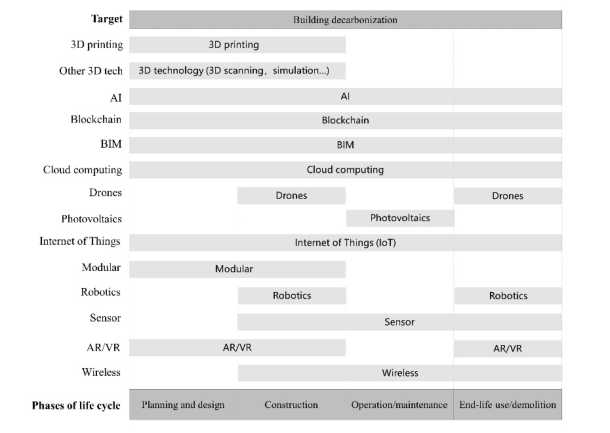
EMERGING TECHNOLOGIES AND DISRUPTIVE POTENTIAL FOR BUILDING DECARBONIZATION Abiotic building projects generate substantial carbon emissions throughout its life cycle and their giant and weighty nature has raise substantial envi- ronmental concerns. Consulting database of Scopus and Web of Science, this research traces 14 emerging technologies of potential for building decar- bonization and for reconciling negative environmental impacts of buildings. In the phase of planning and design, decarbonization can be achieved through the improvement of efficiency, accuracy and integration. Building informa- tion modelling (BIM) enhances design for saving material and supports the actualization of low-carbon idea (Charef and Emmitt, 2021). 3D BIM is pos- sible to simulate energy consumption, thereby optimizing the design of space geometry and material use for energy-saving (Charef, 2022). To achieve this, designers shall incorporate computational modeling or algorithm and com- bine BIM and AI to promote efficiency of design and materials use (Salet and Wolfs, 2016, Lagaros and Plevris, 2022). Building design can also be assisted by IoT and blockchain that can speed up the flow and sharing of informa- tion (Teisserenc and Sepasgozar, 2021), and by AI that enables automatic adjustment and optimization of low-carbon scenario through data mining and machine learning.
Construction is a crucial phase for decarbonization, during which dis- posal of building debris is the key to minimize the environmental impacts. Drones (also known as unmanned aerial vehicles) can help a precise onsite aerial surveying and reduce carbon emission compared with traditional aerial photography (Li and Liu, 2019). Robotics enables automatic operation and improves the accuracy of on-site construction work. 3D printing is one of the most promising technologies for zero waste construction. It opens the poten- tial to take advantage of state-of-art environmentally friendly materials such as biodegradable/biocompatible/natural polymer and to produce sophisti- cated structure and architectural model with lower cost and higher efficiency (Verma et al., 2022). Modular construction as an off-site production system is
another technic method to achieve less resource wastage. Researchers found that off-site modular construction, especially off-site prefabrication, enables waste multiply reduced as the recycling system in a factory environment is much more robust than that on-site. Prefabrication can also be aided by 3D printing and prefabricated modular buildings are able to minimize noise, transport and disruption on environment(Loizou et al., 2021, Ferdous et al., 2019). There is also construction waste recycling robot help waste manage- ment (Wang et al., 2019). In mining industry, sensor-based sorting technique facilitates construction and demolition waste recycling.
In building operation and maintenance, electricity power supply relying on traditional fossil fuel is the main factor contributing to carbon emission, use of renewable energy thus is a critical step for nearly zero energy build- ings (NZEB). Solar photovoltaics are most common technologies in NZEBs (Feng et al., 2019), often installed on rooftop and sometimes on facades in high-rise buildings. To utilize renewable energy and meet architectural requirements, professionals and researchers proposed building-integrated photovoltaic (BIPV) modules and systems to optimize buildings’ energy- saving performance (Martín-Chivelet et al., 2022). There is also other renew- able energy occasionally applied, e.g., wind and water. Integrating cyber physical technologies such as IoT and cloud computing into the application helps establish smart-building systems for accurate energy control. Building system’s sensitivity on temperature, thermal comfort, humidity and danger can be enhanced by applying sensors and wireless in favour of automatic building maintenance (Cheung et al., 2018, Debrah et al., 2022). Perfor- mance of the system also benefits from AI that provides real-time feedback and regulation based on instant information transfer and exchange enabled by the IoT, cloud computing, and blockchain (Debrah et al., 2022, Won et al., 2022). An example would be automatic building diagnosis for abnor- mal operation monitoring and fault detection by which the ‘black holes’ of energy consumption caused by unexpected man-made defects or equipment defects in heating, ventilation, and air conditioning can be identified (Allen et al., 2015). Energy-saving and environmental protection materials such as polymer nanocomposites are also essential for building decarbonization.
Decarbonization in end-life maintenance or demolition of buildings is equally significant but often less noted. With the development of VR and AR, emulation technology makes remote repair possible, thus could indi- rectly reduce carbon consumption for building refixing or regeneration. Like construction, demolition work produces substantial architectural garbage, for which recycling robots and related control system will greatly help. Tear- ing down buildings is also dangerous that workplace injuries, illnesses, and fatalities shall be avoided. Technologies of sensors, wireless communication, cloud computing, AI with advanced machine learning, and BIM have cre- ated opportunities for establishing safety management systems of buildings (Asadzadeh et al., 2020), helping refrain work redundancy and loss of energy. The disruptive potential of blockchain technology can go beyond the life cycle of buildings, extending to the bid, deliver, and secure payment by con- necting different technologies, devices, and stakeholders through peer-to-peer
Emerging Technologies for Decarbonization in Building Sector 665
networks. Doing so, work delay or redundancy can be avoided and its collab- oration with BIM is named ‘Blockchain of Circular BIM things’ (Teisserenc and Sepasgozar, 2021, Turk and Klinc, 2017) for energy saving.
Figure 1: Potential of 14 technologies in building decarbonization.
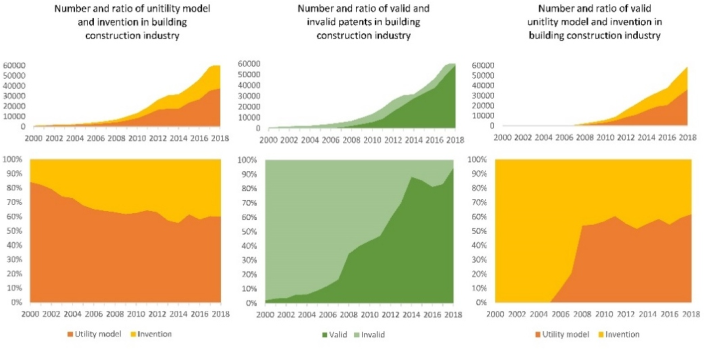
PATENT INVENTIONS OF THE EMERGING TECHNOLOGIES IN BUILDING SECTOR To understand how these technologies innovate, adjust or being applied in the local, this research focuses on Yangtze River Delta, one of the most urbanized and largest market for building industry in China, and collected patent data of each technology applied from this region. Initial collection encompasses over 7 million records and over 100 thousand records left after filtering valid patents in section E of building and fixed construction (Figure 2). With key- words search and data cleaning, the research sorts out around three thousand raw records of the 14 technologies.
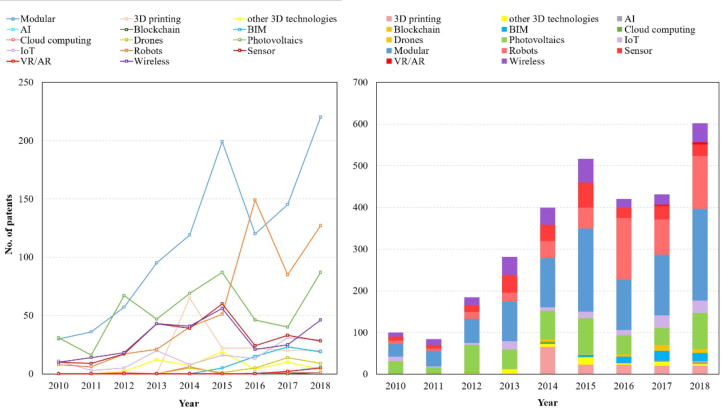
Patent inventions of the 14 technologies have overall increased since 2010. Modular (1021, 33.84%), robotics (502, 16.71%), photovoltaics (490, 16.24%), wireless (274, 9.08%) and sensors (263, 8.72%) have most patent inventions, followed by 3D printing (149, 4.94%), IoT (136, 4.51%), BIM (62, 2.06%), other 3D technologies (58, 1.92%) and drones (34, 1.13%). AI, cloud computing, VR/AR and blockchain only have less than 10 records each (Figure 3).
Most technologies are applied in construction and operation phases, which generate most carbon emission in building sectors (Table 1). 3D printing is mainly applied to produce walls for architecture, or structures for infrastruc- tures such as bridges or tunnels so that construction waste can be reduced. Most 3D printing technologies are used at the phase of construction, either on-site or off-site, but a few records show that it is also occasionally used in
Figure 2: Number and ratio of patents applications in building sector in YRD (2000- 2018).Figure 3: Trend for patent applications of the fourteen technologies during (2000-2018).
maintenance or renovation. 3D printing is occasionally mixed with sensors, wireless, robotics and intelligent technology (not AI). The most commonly mixed technologies with 3D printing are modular, which enables rapid con- struction with minimized waste on-site. Other 3D technologies primarily deploy 3D concept to simulate scenes or structures, help fix or better main- tain buildings. 3D-related technologies are mostly employed to optimize use experiences or warn danger through simulation. Different from 3D print- ing, the role of other 3D applications in waste reduction is minimal. Other 3D technologies also mix with 3D printing and modular but are more often combined with sensors and VR/AR. AI, blockchain, cloud computing and VR are rarely applied to building sector. The limited inventions contribute
Emerging Technologies for Decarbonization in Building Sector 667
to efficiency improvement of construction operation and maintenance but combination of AI, blockchain, and other technologies is inadequate. Though quite many records serve multiple, overlapping objectives and are designed to be as intelligent as possible, few are fused with AI. BIM is overwhelmingly used during construction for large scale buildings and sometimes bridges and infrastructures. Integrated modular technology, BIM is committed to reduce waste and environmental impacts through improving accuracy and efficiency of construction. Drones are mostly used to improve construc- tion and maintenance efficiency of roads, bridges and recently architectures. Photovoltaics enables the use of renewable energy for energy-saving. Pho- tovoltaics also combines modular assembly to avoid waste and speeds up installation. IoT often serves as platform technology for data sharing and information flows. Yet, most applications are small in scale, in windows or doors for anti-theft purpose. They also assist intelligent construction monitor- ing, operation and transportation management. As prefabricated constituent, modular primarily promotes work efficiency and reduces construction waste on site, thus contributes most to construction. Robotics mainly substitutes work once shall be conducted by human beings, especially those dangerous, environmental-unfriendly, and repetitive tasks, since automation improves precision, efficiency and reduces unnecessary resource consumption. Sensors often combine wireless technology for instant data and information transfer, thus enhance efficiency of building and construction operation. It is widely used to monitor operation status and to respond properly for energy and resource saving and supply (especially water supply). It also occasionally combines photovoltaics to utilize renewable resources. Wireless technology has similar application as sensors.
Table 1. Matrix analysis of emerging technologies in full life cycle.
Table available in the original PDF paper.
Tech-life cycle matrix Applied Life cycle
PD C OM ED Specific technology 3D printing - 149 2 2 Other 3D 24 31 AI 9 Blockchain 1 BIM 1 62 3 Cloud computing 1 8 Drones 2 3 20 Photovoltaics 57 109 324 IoT 7 129 Modular 10 829 56 3 Robots 1 177 320 4 Sensor 58 205 VR/AR 1 1 5 Wireless 29 250
Total 73 1448 1363 9
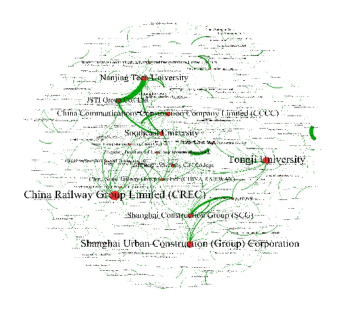
Among the top 15 applicants, state owned enterprises (SOEs) contribute most to patent inventions and are the main actor leading patents cooper- ation. Three central SOEs a municipal SOE produce 238 inventions. Tongji University (70), China University of Mining and Technology (41), Hohai Uni- versity (32) and Southeast University (30) are the main contributors among universities, which are secondary significant constituents for patent invention network. Private firms such as Wenzhou Suiren Intelligent Technology Co., Ltd. (32) and Zhejiang Yasha Decoration Co., Ltd. (23) are active, but the share of each firm is not substantial. Their cooperation with universities and main SOEs for the bases for cooperative network (Table 2, Figure 4).
Table 2. Main applicants in identified fourteen technologies.
Table available in the original PDF paper.
Applicant type No. Applicant name No. of patents 1 China Metallurgical Group Corporation, MCC 78 Enterprise -SOE 2 Tongji University 70 University China State Construction Engineering Group Co., Ltd 70 Enterprise -SOE 3 Shanghai Construction Group Co., Ltd 69 Enterprise -SOE 4 China University of Mining and Technology 41 University 5 Hohai University 32 University 6 Wenzhou Suiren Intelligent Technology Co., Ltd 32 Enterprise - Private 7 Southeast University 30 University 8 Zhejiang Yasha Decoration Co., Ltd 23 Enterprise - Private 9 China Railway Group Limited 21 Enterprise -SOE 10 Ma ** 19 Personal 11 Zhang ** 17 Personal 12 Jieshou Shaoen Precision Machinery Co., Ltd 16 Enterprise - Private 13 Ningbo Polytechnic 16 University 14 Zhejiang Heda Solar Technology Co., Ltd 16 Enterprise - Private 15 Nanjing IOT Sensor Technology Co., Ltd 14 Enterprise - Private
Figure 4: Cooperative patents in construction of roads and railways (left) and building (right).
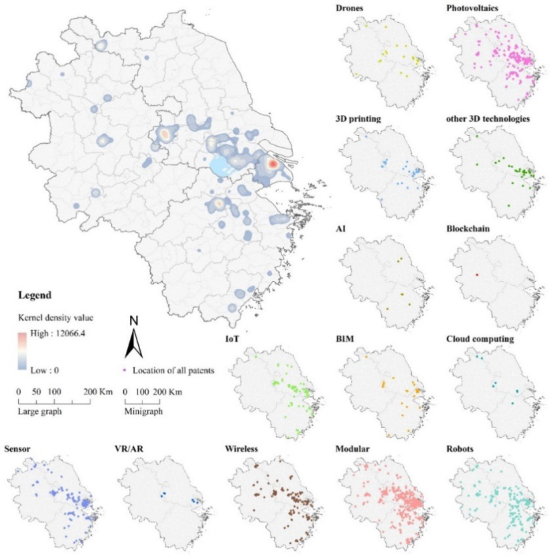
Figure 5 shows the spatial distribution of each technology and the ker- nel density of all the patents, which mainly concentrated in Shanghai, south Jiangsu and north Zhejiang and distributed in regional center cities
Emerging Technologies for Decarbonization in Building Sector 669
such Shanghai, Nanjing, Hangzhou, Suzhou, Hefei, Xuzhou, Wuxi and Changzhou as well as some county-level cities such as Taicang, Kunshan and Jiangyin along the highways and high-speed railways. A hybrid of monocen- tric and multi-nuclei spatial pattern characterized by gradient distribution came into being. In this hybrid pattern, Shanghai is the main kernel while Nanjing and Hangzhou are two sub-kernels, less intense than the kernel areas are Suzhou-Wuxi-Changzhou belts and Hefei-Xuzhou center, other places such as Nantong, Wenzhou, Anqing, Zhenjiang-Yangzhou, Ningbo Yinzhou-Beilun etc. have formed even lower-level agglomeration areas of innovation in the meanwhile. From the perspective of the spatial distribu- tion of various types of technology patents, patents of 3D printing, BIM, VR/AR and drones mainly distributed in Shanghai and Nanjing. Patents of IoT, Sensor and Wireless mainly distributed in Hangzhou, Ningbo and cities along the Shanghai-Nanjing highway. Patents of other 3D technolo- gies mainly distributed in cities along the Shanghai-Nanjing highway. Patents of modular, photovoltaics and robotics concentrated in Shanghai, southern Jiangsu, and northern Zhejiang. Patent distribution of AI, cloud computing and blockchain is sporadic.
Figure 5: Mapping innovative activities of the fourteen technologies in YRD.
CONCLUSION
This research reveals the emergent technologies and their potential for build- ing decarbonization. Observations from patent inventions in YRD suggest that contribution of the emerging technologies to building decarbonization
is most secondary. The general-purpose technologies (e.g., blockchain, IoT), which possibly disrupt the industry fundamentally, are almost vacant. State owned enterprises are the main actors in the technology innovation, fol- lowed by university and public research institutions. A mixed location of downtown, periphery and outskirts characterizes the spatial pattern of these technologies. The findings help to recommend policy makers, firm managers, professionals and researchers in accessing and developing disruptive tech- nologies for low carbon building industry, and promote business application in this field.
ACKNOWLEDGMENT
The authors would like to acknowledge the receipt from National Science Foundation of China [grant number 51808391].
REFERENCES
Allen, W. H., Rubaai, A. & Chawla, R. (2015). Fuzzy Neural Network-Based Health Monitoring for Hvac System Variable-Air-Volume Unit. IEEE Transactions on Industry Applications, 52, 2513–2524. Asadzadeh, A., Arashpour, M., Li, H., Ngo, T., Bab-Hadiashar, A. & Rashidi,
A. (2020). Sensor-Based Safety Management. Automation in Construction, 113, 103128. Charef, R. (2022). The Use of Building Information Modelling in the Circular Economy Context: Several Models and a New Dimension of Bim (8d). Cleaner Engineering and Technology, 7, 100414. Charef, R. & Emmitt, S. (2021). Uses of Building Information Modelling for Over-
coming Barriers to a Circular Economy. Journal of cleaner production, 285, 124854. Cheung, W.-F., Lin, T.-H. & Lin, Y.-C. (2018). A Real-Time Construction Safety Monitoring System for Hazardous Gas Integrating Wireless Sensor Network and Building Information Modeling Technologies. Sensors, 18, 436. Debrah, C., Chan, A. P. C. & Darko, A. (2022). Artificial Intelligence in Green
Building. Automation in Construction, 137. Feng, W., Zhang, Q., Ji, H., Wang, R., Zhou, N., Ye, Q., Hao, B., Li, Y., Luo, D. & Lau, S. S. Y. (2019). A Review of Net Zero Energy Buildings in Hot and Humid Climates: Experience Learned from 34 Case Study Buildings. Renewable and Sustainable Energy Reviews, 114, 109303. Ferdous, W., Bai, Y., Ngo, T. D., Manalo, A. & Mendis, P. (2019). New Advance-
ments, Challenges and Opportunities of Multi-Storey Modular Buildings–a State- of-the-Art Review. Engineering Structures, 183, 883–893. Gawer, A. (2014). Bridging Differing Perspectives on Technological Platforms: Toward an Integrative Framework. Research policy, 43, 1239–1249. Lagaros, N. D. & Plevris, V. 2022. Artificial Intelligence (Ai) Applied in Civil
Engineering. MDPI. Li, Y. & Liu, C. (2019). Applications of Multirotor Drone Technologies in Construction Management. International Journal of Construction Management, 19, 401–412. Loizou, L., Barati, K., Shen, X. & Li, B. (2021). Quantifying Advantages of Modular
Emerging Technologies for Decarbonization in Building Sector 671
Martín-Chivelet, N., Kapsis, K., Wilson, H. R., Delisle, V., Yang, R., Olivier, L., Polo, J., Eisenlohr, J., Roy, B. & Maturi, L. (2022). Building-Integrated Photovoltaic (Bipv) Products and Systems: A Review of Energy-Related Behavior. Energy and Buildings, 111998. Opoku, D.-G. J., Perera, S., Osei-Kyei, R. & Rashidi, M. (2021). Digital Twin Appli-
cation in the Construction Industry: A Literature Review. Journal of Building Engineering, 40, 102726. Salet, T. & Wolfs, R. Potentials and Challenges in 3d Concrete Printing. 2nd International Conference on Progress in Additive Manufacturing (Pro-Am 2016), May 16–19 2016, Singapore, 2016. Research Publishing, 8–13. Teisserenc, B. & Sepasgozar, S. (2021). Adoption of Blockchain Technology through
Digital Twins in the Construction Industry 4.0: A Pestels Approach. Buildings, 11. Turk, Ž. & Klinc, R. (2017). Potentials of Blockchain Technology for Construction Management. Procedia engineering, 196, 638–645. Unep 2022. Report on Global Building and Construction Industrial Development
(2022): Toward a Zero-Carbon, High Efficiency and Resilient Building and Construction Industry. Nairobi: Global alliance for buildings and construction. Verma, D., Dong, Y., Sharma, M. & Chaudhary, A. K. (2022). Advanced Processing of 3d Printed Biocomposite Materials Using Artificial Intelligence. Materials and Manufacturing Processes, 37, 518–538. Wang, Z., Li, H. & Zhang, X. (2019). Construction Waste Recycling Robot for
Nails and Screws: Computer Vision Technology and Neural Network Approach. Automation in Construction, 97, 220–228. Won, D., Hwang, B.-G. & Samion, N. K. B. M. (2022). Cloud Computing Adoption in the Construction Industry of Singapore: Drivers, Challenges, and Strategies. Journal of Management in Engineering, 38.
Read this individual research paper free through the original publisher, or explore the full digital proceedings book.
ISBN 978-1-958651-87-2
Explore this ISBN in the AHFE Bookstore ↗Listed in the July 2026 bookstore catalogue; search by ISBN to confirm current availability · Digital book purchase optional