Liyan Wei, Wenxuan Cheng, Zhengzheng Luo, Mo Kit Yu, Chan Hiu Tung, Zhengtao Ma, Yaqi Zhang, Stephen Jia Wang (2023). Designing A Rehabilitation-Purposed No-Direct-Contact Collaborative Robotic System For Stroke Patients. In: Human Systems Engineering and Design (IHSED 2023): Future Trends and Applications. AHFE Open Access, vol. 112, pp. 82–90. https://doi.org/10.54941/ahfe1004116
1 Intelligent system ntelligent Systems Design Specialism, Master of Design, School of Design, the Hongkong Polytechnic University, Hong Kong SAR, China ↗
2 Laboratory for Artificial Intelligence in Design, Hong Kong Science Park, New, Territories, Hong Kong Special Administrative Region, Hong Kong
3 School of Design, the Hongkong Polytechnic University, Hong Kong SAR, China ↗
Different from the traditional rehabilitation methods, rehabilitation robots can provide repetitive and meaningful tasks that make the rehabilitation process smarter and more efficient during upper extremity rehabilitation for stroke patients. Therefore, rehabilitation robots are often used to assist patients during their rehabilitation training. From a robotic system perspective, it needs to sense the user's various needs to provide real-time assistance and allow the user to trust the robot. This means that the system must be able to monitor and process the user's level of fatigue. The analysis of EMG signals is used as a criterion to determine the level of muscle fatigue. At the same time, the degree of intervention that stroke patients receive during the rehabilitation process is also a challenge(Fang et al. 2017). For instance, the current rehabilitation robots often help the user to complete the rehabilitation training by means of end traction, the robot is attached to the user's arm, pulling the arm to complete the training. This approach could reduce muscle fatigue and increase the efficiency of rehabilitation.Even though direct contact and traction have been proven in studies to help patients perform better in rehabilitation, from a general HSI perspective, the degree of direct traction assistance may reduce the patient's sense of independence which affects their cognitive and motor function. This paper proposes a No-Direct-Contact Collaborative (NDCC) robotic-arm system that assists patients with physical game tasks. The NDCC system means that the robotic arm doesn't directly touch and hold the patient's upper limb as traditional robots would, but rather works in a cooperative way to complete the task, picking up and moving objects together with patients when they need. The purpose of the NDCC system is to avoid excessive interference to the patient during rehabilitation training, which is beneficial to the patient's cognitive and motor function recovery. In recent years, there has been a gradual increase in the use of robotic systems to assist in rehabilitation exercises for stroke patients and different kinds of interaction have been proposed. (Janssen et al. 2017) suggested that “interactive, engaging game-based rehabilitation tools, which match the abilities of the participant, could provide variation and attractiveness, thereby facilitating recovery of residual motor and cognitive function.” For instance, HarmonySHR system provides end-traction assistance at different recovery stages to complete rehabilitation exercises. With game elements embedded in rehabilitation systems, older patients are not only more attached to the training process but also can train their cognitive controls that “allow them to interact with our complex environment in a goal-directed manner (Anguera et al.2013)”. Therefore, the robotic arm is a “guide” rather than a “teammate.” In our research, it has been possible to collect and process the user's EMG signal during the task in real-time and convert it to RMS (Root Mean Square), and use Huskylens sensors to enable the robotic arm to track the position of the user's upper limb in real-time. The proposed study will be verified through two types of experiments, including Expert Participation and User Experience Experiments, giving designers a new direction to think about the degree of interaction and intervention between robots and stroke patients. In future studies, feedback from the user's EMG signal data and Patient's Rehabilitation Questionnaire (Fang et al. 2017) will be collected and analyzed. The physiological state of the upper limb will be determined by examining the EMG signal. The Patient's Rehabilitation Questionnaire will also be given to the user, aiming to assess the user's cognitive status and sense of independence under the two different assistance methods.
From a robotic system perspective, sensing various patient needs and helping them in time to give the appropriate assistance so that the patient can trust the robot. This means that the system must be able to monitor and process the user’s level of fatigue. The analysis of EMG signals is used as a crite- rion to determine the level of muscle fatigue. At the same time, the degree of intervention that stroke patients receive during the rehabilitation process is also a challenge (Fang et al. (2017)). For instance, the current rehabili- tation robots often help the user to complete the rehabilitation training by means of end traction, the robot is attached to the user’s arm, pulling the
Designing a Rehabilitation-Purposed No-Direct-Contact Collaborative Robotic System 83
arm to complete the training. This approach could reduce muscle fatigue and increase the efficiency of rehabilitation.
Even though direct contact and traction have been proven in studies to help patients perform better in rehabilitation, from a general HSI perspec- tive, the degree of direct traction assistance may reduce the patient’s sense of independence which affects their cognitive and motor function. Also, after recognizing their disability, patients sometimes experience psychological and behavioral regressions that manifest as excessive dependence on others. Over- depending on people may even increase their guilt (Zhang et al. (2013)). It means that it’s important to consider the level of assistance and intervention of the robotic arm for the patients.
This paper proposes a No-Direct-Contact Collaborative (NDCC) robotic- arm system that assists patients with physical game tasks. The NDCC system means that the robotic arm doesn’t directly touch and hold the patient’s upper limb as traditional robots would, but rather works in a cooperative way to complete the task, picking up and moving objects together with patients when they need. The purpose of the NDCC system is to avoid excessive interfer- ence to the patient during rehabilitation training, which is beneficial to the patient’s cognitive and independence recovery.
LITERATURE REVIEW
Rehabilitation Robotic System In recent years, there has been a gradual increase in the use of robotic systems to assist in rehabilitation exercises for stroke patients and differ- ent kinds of interaction has been proposed. Harmony SHR system Provide end-traction assistance to patients at different recovery stages to effectively complete rehabilitation exercises (Harmony SHR (March 10, 2023)). The Arm Rehabilitation Robotics A2 developed by Yeecon added a lot of fus- ing game elements into an end-traction robotic arm system. Various video games are available on Arm Rehabilitation Robotics A2 (Arm Rehabilitation Robotics A2 (March 10, 2023)). Also, studies have shown that “interactive, engaging game-based rehabilitation tools, which match the abilities of the participant, could provide variation and attractiveness, thereby facilitating recovery of residual motor and cognitive function (Janssen et al. (2017))”. With game elements embedded in rehabilitation systems, the older patients are not only more attached to the training process, but also are able to train their cognitive controls that “allow them to interact with our complex envi- ronment in a goal-directed manner (Anguera et al. (2013))”. In this type of rehabilitation system, the robotic arm is playing a role of “guide” rather than a “teammate.” And the feedback is provided through screens but not tangible objects.
Assistance and Interaction Methods A research paper published in 2014 analyzes how the patients’ motivation, especially the elder patients’, can be increased while participating in com- petitive and cooperative gameplays. The results indicate that “there is great
potential for two-player rehabilitation games, in the form of greater enjoy- ment as well as potentially more intensive exercise compared to single-player games (Novak et al. (2014))”. A research proposed a robotic gaming proto- type for upper-limb exercise which is no longer attached to the user’s body but acts as a competitor in the 3D tic-tac-toe game. The result showed that both the younger and the older participants were more engaged and interested in this kind of robotic arms (Eizicovits et al. (2018)). Also, there are studies that show a stronger intention of independence by patients was associated with better motor function gains. Too much intervention and assistance for patients is not conducive to cognitive and motor recovery (Fang et al. (2017)). Therefore, from the perspective of this research, it is necessary to consider the level of intervention and the methods that the robot arm assists the user in order to help the user to have a better recovery of independence and cogni- tion. Cooperative interaction as a partner and level of intervention should be considered in the research.
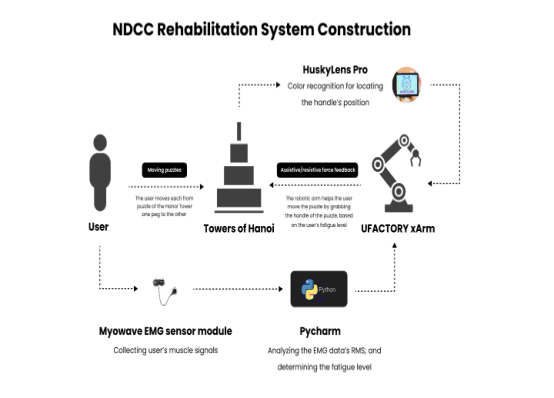
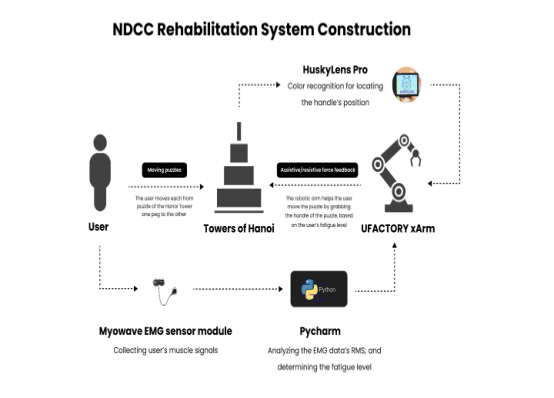
SYSTEM DESIGN The project proposes a robotic arm system that assists in rehabilitating stroke patients through a non-contact, collaborative approach, No-Directly- Contact Collaborative Robotic Arm System(NDCC). The project allows the user to complete a task based on the physical Tower of Hanoi game, which is a mathematical game or puzzle consisting of three rods and a number of disks of various diameters that can slide onto any rod (Wikimedia Foundation Inc (June 14, 2002)), to train upper limb rehabilitation-related movements, mon- itor the EMG of the user’s upper limb as the user moves the ring from one point to another, determine the user’s position in real-time through Huskylens sensors when the user’s upper limb needs assistance, and promptly trigger the robotic arm to go to the corresponding coordinates to grab the handle at the other end of the ring and the user. The robot arm is then triggered to go to the corresponding coordinates and grasp the handle at the other end of the circle. Figure 1 shows the system map of our study.
The system collects real-time EMG signals from the user and uses python to process the signals into a Root Mean Square (RMS) form, which is used as a criterion to determine the user’s motion. After triggering the help of the robotic arm, HUSKYLENS camera was used to track the real-time position of the user in relation to the object.
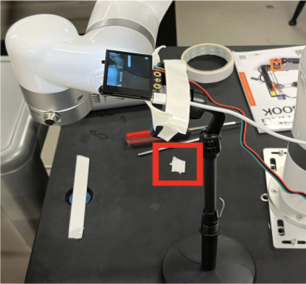
The visual range of Huskylens and the coordinates of the robotic arm movement are in two systems, so it’s significant to pair the visual position of Huskylens with the coordinates of the robotic arm movement. Let the Huskylens ‘study’ the object and then mapping the coordinates of the sensor’s visual range to the coordinates of the robot arm by recording the coordinate of the arm when it arrived at the border of the Huskylens. In Mapping, the coordinates (x1, y1) and (x2, y2) of the two diagonal edge points within the field of view of the HUSKYLENS camera are first recorded. Subsequently, the robot arm is moved to the two diagonal edge points within the field of view of the camera and the two coordinates (m1, n1) and (m2, n2) of the robot arm system are recorded at this point. Based on the above information, the (x, y)
Designing a Rehabilitation-Purposed No-Direct-Contact Collaborative Robotic System 85
Figure 1: System map of NDCC robotic arm system.
and (m, n) coordinates will be matched in the ARDUINO IDE. Whenever the HUSKYLENS camera reads a coordinate (x, y) of the object, the IDE will transform it into the corresponding coordinate in the robotic arm system, and then drive the robotic arm to the (m, n) coordinate in python.
EXPERIMENT PROCEDURE Participants Considering the limited mobility of stroke patients, 10 young people aged 20–25 were sought to complete a set rehabilitation task with the help of a
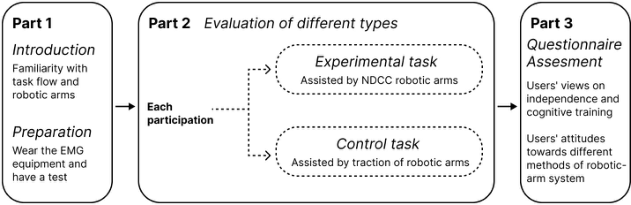
Figure 4: Procedure of experiment.
robotic arm, 6 males and 4 females, and a questionnaire was designed to investigate and interview the participants on their experience and perception of using it.
Tasks Presented Figure Shows the flow of the experiment. Part 1, informing participants of the experimental procedure, and wear the EMG equipment required for the experiment
Part 2, the experiment was divided into experimental and con- trol groups, with the experimental group assisted by NDCC robotic arms and the control group assisted by traction. The same set of tasks were completed for the Tower of Hanoi game. Each participant will finish both experimental and control groups. Part 3, feedback about user’s attitude will be collected and analyzed. Questionnaire Based on the Patient’s Rehabilitation Question- naire, which is used to detect the user’s independent intentions (Fang et al., 2017). The user feedback was measured using the six-point Likert scale. The Patient’s Rehabilitation Questionnaire will be given to the user, aiming to assess the user’s cognitive status and sense of independence under the two
Table 1. Questionnaire for participants.
Table available in the original PDF paper.
Scale Items Independence level
Q5: You think you should strive for more independent parts in your regular activities and training
Q1: You think that interventions from outside should allow you to maintain a certain level of independence during the rehabilitation process Q2: The non-direct contact collaborative form of training gives you a greater sense of independence than the traction form Active level Q3: You think you should be active in your training tasks during rehabilitation Q4: In training, non-direct contact collaborative forms of training are more motivating than traction training Independent level in regular activities Social level Q6: You think you should be more involved in social attribute activities as this will help you in your cognitive recovery Q7: In training, the non-direct contact collaborative form of training gives you a better sense of social attributes than traction-based training Write down user’s feeling Score for different system
Designing a Rehabilitation-Purposed No-Direct-Contact Collaborative Robotic System 87
different assistance methods. Participants were then asked to describe how they felt about using the two forms of assistance and to give a score for each system.
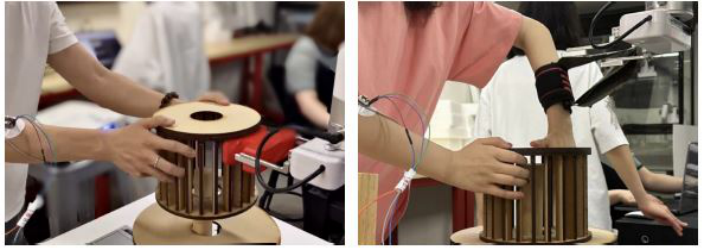
Experiment Content Each user is required to complete both the experimental and control groups. The experimental task is assisted by the NDCC robotic arm system, and the control task is assisted by a traction robotic arm system.
Traction Robotic Arm System: Traction Robotic Arm System means that the robotic arm attaches directly to the user’s upper limb and pulls the user through the task.
No-Directly-Contact Collaborative Robotic Arm System (NDCC): NDCC robotic arm system means that the robotic arm does not come into direct contact with the user but only helps the user pick up the other end of the object when the user needs help and finish the task together with users.
Figure 5: Test methods for NDCC robotic arm system (left) and traction system (right).
RESULT
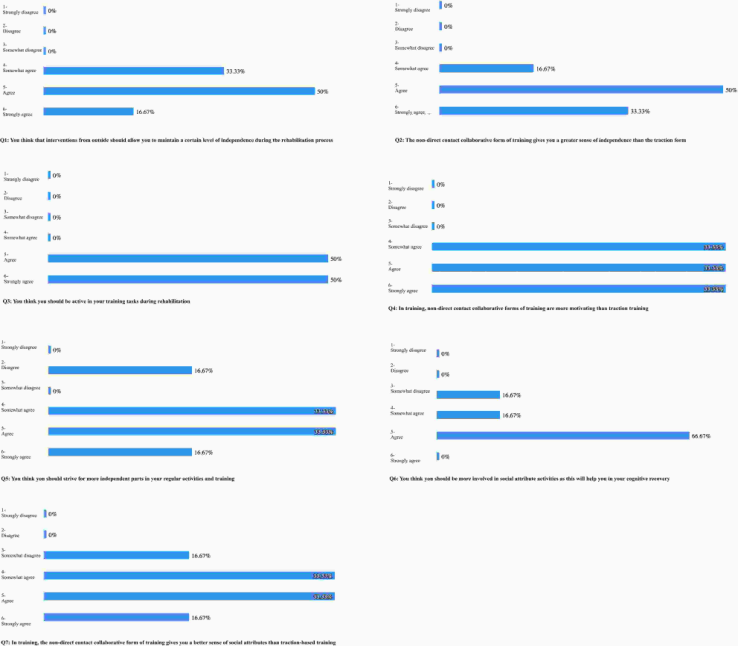
After completing the tasks in the experimental and control groups, users com- pleted a questionnaire on the “Impact of the NDCC system on independence and cognition” based on the Patient’s Rehabilitation Questionnaire. Ques- tions 1, 3, 5, and 6 of the questionnaire considered users’ attitudes toward the four dimensions of independence, motivation, social attributes and level of independence in rehabilitation. Questions 2, 4, and 7 of the questionnaire asked whether users felt that the NDCC system was more effective in the four dimensions of independence, motivation, social attributes, and level of independence in their experience of completing tasks.
The results of the data showed that the participants agreed that the robotic arm system should stimulate the independence and motivation of the user during recovery training, and the data collected all showed the attitude of agreement. The participants felt that the NDCC system in this study gave them more independence and motivation in completing their tasks. For mataining the independence in the daily life and considering social compan- ion in the recovery training, there’re also 83.33% of participants agree with them. And 83.33% of participants agree the way that NDCC robotic arm system interacts with user can give more social companion to users.
Figure 6: Result from the questionnaire.
After experiencing two different types of assistance with the robotic arm, the participants scored the two types of assistance. The average score for the NDCC system was 8.3 and the average score for the Traction system was 5. The NDCC system was rated better by the users.
DISCUSSION AND RECOMMENDATIONS We propose a new way of interacting with rehabilitation aids, which con- siders the level of intervention of the robotic arm regarding the user’s independence and cognitive recovery, and replaces the traction mode with a no-directly-contact collaborative mode. The study focused on users’ attitudes towards cognitive and independence recovery during rehabilitation training. The NDCC robotic arm system proposed in this study was also tested to see if the user could experience more independence, motivation and social companion in rehabilitation while using the NDCC system. Considering the user’s cognitive and independent rehabilitation, the NDCC robotic arm sys- tem proposed in this study reduces the degree of intervention of the robotic arm in the interaction between the robotic arm and the user. The NDCC sys- tem does not directly contact the user to avoid making the user feel passive during training. It allows the user to be more active and the robot arm acts
Designing a Rehabilitation-Purposed No-Direct-Contact Collaborative Robotic System 89
as a collaborative partner, working with the user to complete the task. The arm will instantly recognize the user’s position and go to the coordinates to help the user when needed, giving a better and smoother experience for the user.
The results show that users generally agree that independence, motiva- tion and social companion attributes should be considered in training, and that the NDCC robotic arm system proposed in this study is more likely to allow users to experience these characteristics. The user’s training method has changed from being passively pulled by the robotic arm to moving objects autonomously with the help of the robotic arm, which greatly increases the user’s independence in the rehabilitation process. At the same time, the direct traction becomes collaborative assistance, reducing the user’s frustra- tion with excessive help and intervention and increasing the user’s motivation to recover. The robotic arm also identifies the user’s needs in real-time during the training process and instantly helps the user to pick up the other end of the object to complete the lifting task together with the user, allowing the user to feel the collaboration and companionship of the partner and thus feel more of the social companion attribute. In general, according to the experiment, we have found that the NDCC System model is indeed more effective in help- ing the user to recover independence and cognition, and that the experience is better.
The results of the study show that by changing the way the robotic arm interacts with the user, it is possible to reduce the level of intervention of the robotic arm during the rehabilitation training. This can improve the user’s experience during training, increasing initiative and motivation, and the social companion. This has a positive impact on the cognitive and indepen- dence recovery of stroke patients. Therefore, future research should consider the level of intervention of the robotic arm from the user’s perspective and further improve the interaction between the user and the system to help stroke patients achieve better rehabilitation results.
LIMITATIONS AND FUTURE RESEARCH A limitation of this study was the inadequate sample. For future studies, we would like to study a larger sample of stroke patients. This will require us to optimize the accuracy and safety of the NDCC robotic arm system. The use of EMG signals can be more extensive and precise, and long-term data can be monitored and collected to test the NDCC system’s ability to provide better results in both physical and cognitive habilitation in long-term rehabilitation. In addition, the reference values of EMG fatigue level may vary from muscle group to muscle group and from individual to individual. We also hope that the system will be able to integrate more data to intelligently change the level and difficulty of rehabilitation training according to the physical and recovery condition of different users.
ACKNOWLEDGMENT
This project was funded by the Intelligent Systems Design Programme, School of Design, the Hong Kong Polytechnic University. The work was also
substantially supported by the Projects of Strategic Importance of The Hong Kong Polytechnic University (Project ID: P0036851). The authors would like to acknowledge the technical and ideation supports from Zhengtao Ma, Yaqi Zhang and Cong Fang at the Intelligent Systems Design Programme, School of Design, the Hong Kong Polytechnic University.
REFERENCES
Anguera, J. A., Boccanfuso, J., Rintoul, J. L., Al-Hashimi, O., Faraji, F., Janowich, J., Kong, E., Larraburo, Y., Rolle, C., Johnston, E. & Gazzaley, A. (2013). Video game training enhances cognitive control in older adults. Nature, 501, 97–101. Arm Rehabilitation Robotics A2. (March 10, 2023). Arm Rehabilitation Robotics
A2 [Online]. Available: https://yikangmedical.com:443/arm-rehabilitation- robotics-a2.html. [Accessed]. Eizicovits, D., Edan, Y., Tabak, I. & Levy-Tzedek, S. (2018). Robotic gaming prototype for upper limb exercise: Effects of age and embodiment on user preferences and movement. Restorative neurology and neuroscience, 36, 261–274. EMG Page. (March 10, 2023). Biology for Biological Engineering [Online]. Avail-
& Chan, C. C. (2017). Patient and Family Member Factors Influencing Outcomes of Poststroke Inpatient Rehabilitation. Arch Phys Med Rehabil, 98, 249–255. Harmony SHR. (March 10, 2023). Harmonic Bionics [Online]. Available: https://www.harmonicbionics.com/harmony-shr/rehabilitation-applications [Accessed]. Janssen, J., Verschuren, O., Renger, W. J., Ermers, J., Ketelaar, M. & van Ee, R.
(2017). Gamification in Physical Therapy: More Than Using Games. Pediatric Physical Therapy, 29. Novak, D., Nagle, A., Keller, U. & Riener, R. (2014). Increasing motivation in robotaided arm rehabilitation with competitive and cooperative gameplay. Journal of NeuroEngineering and Rehabilitation, 11, 64. Wikimedia Foundation Inc. (June 14, 2002). Tower of Hanoi [Online]. Available:
https://en.wikipedia.org/wiki/Tower_of_Hanoi [Accessed]. Zhang, W. N., Pan, Y. H., Wang, X. Y. & Zhao, Y. (2013). A prospective study of the incidence and correlated factors of post-stroke depression in China. PLoS One, 8, e78981.
LISTED IN THE AHFE DIGITAL BOOKSTORE CATALOGUE
Explore the complete digital volume
Human Systems Engineering and Design (IHSED 2023): Future Trends and Applications
Read this individual research paper free through the original publisher, or explore the full digital proceedings book.
ISBN 978-1-958651-88-9
Explore this ISBN in the AHFE Bookstore ↗Listed in the July 2026 bookstore catalogue; search by ISBN to confirm current availability · Digital book purchase optional