Jie Ma, Linghao Zhang (2023). Community walking system design from a co-creation perspective: The example of Hongqiao Airport New Village. In: Human-Centered Design and User Experience. AHFE Open Access, vol. 114, pp. 132–143. https://doi.org/10.54941/ahfe1004230
In the realm of urban development, human-scaled community walking systems are continually devoured in large-scale urban renewals. Pressing issues such as fragmentation and segmentation of pedestrian paths, poor walkway quality, and outdated walking facilities demand resolution. On the personal and societal levels, walking, being the most fundamental mode of transportation, has unmet demands, with decreasing neighborly interactions exacerbating societal isolation and loneliness.The paper introduces the co-creation concept and related theories to dissect the components and human-centric developmental trends of the community walking system. It focuses on Shanghai's Hongqiao Airport Village's current walking system, employing participatory research, in-depth interviews, and co-creation workshops. This bottom-up approach encapsulates the residents' walking needs, exploring strategies to design a community walking system from a co-creation perspective.The paper proposes four strategies: the construction of human-centric physical infrastructure, the development of multifunctional spaces, fostering of inclusive social interactions, and promoting sustainable development through community involvement. These strategies are aimed at enhancing urban community livability and fostering human connections.
During the early phases of urban development, the quest was for “efficiency”, leading to the separation and fragmentation of motorized and walking sys- tems. This subsequently leads to issues such as environmental pollution, spatial encroachment, and social isolation. These problems primarily emerge from an overemphasis on the designer’s perspective in community planning, leading to a disconnect between designer vision and public needs.
The focal point has thus shifted to establishing a human-centered com- munity walking system. Based on this, co-creation, an innovative design approach, brings forward human-centered solutions to complex problems and promotes positive social interaction. It introduces a refreshing perspec- tive to the walking system design in communities.
Community Walking System Design From a Co-Creation Perspective 133
This project applies the co-creative approach to the walking system design in Shanghai Honqiao Airport New Village, encouraging pedestrian participation throughout the design process. This shift from a bottom-up, designer-led strategy to user involvement signifies a move towards people- oriented and even beyond-people-oriented design principles.
LITERATURE REVIEW
Community Walking System Starting from the idea of “Garden City” at the end of the 19th century, road planning models such as “separation of people and vehicles” emerged. With the rise of the industrial revolution, pedestrian roads were encroached on by motor vehicles. From the 1960s to the 1990s, humanistic theories such as “walking first” and “street sharing” revived again, and pedestrian streets at a human scale returned to the focus of social attention.
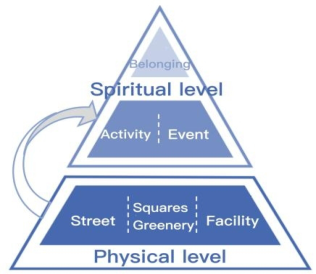
The genesis of the walking system is attributable to the unresolved antag- onism between pedestrians and motor vehicles in communal spaces. In an expansive sense, walking system refers to publicly walkable area, and it encompasses both the tangible and intangible aspects. The physical facet pertains to pedestrian thoroughfares, plazas, and landscaping, as well as environmental amenities. On the spiritual front, it involves the walking atmo- sphere, social affiliations, and the sculpting of pedestrians’ sense of belonging and engagement. In the community, walking system places greater emphasis on these intangible factors, as depicted in Figure 1.
Figure 1: Components of the community walking system.
Co-Creation and Its Intervention in Community Walking System Design In the design field, concepts such as “participatory design”, “co-design”, and “collaborative design” are collectively referred to as “co-creation”. Co-creation implies a partnership and power transfer between managers and participants.
Co-creation is a bottom-up approach to problem-solving. This is not a fleeting moment of innovation, but a systematic process involving design
134 Ma and Zhang
research, local modifications, and feedback. During the research phase, co- creation methods and tools explore residents’ needs from various demograph- ics. In implementation, co-creation translates into interactive installations, exhibitions, and events, encouraging residents’ involvement in the design modification process.
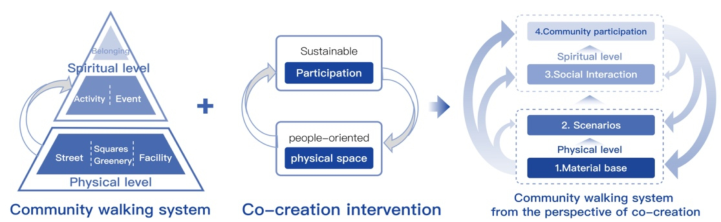
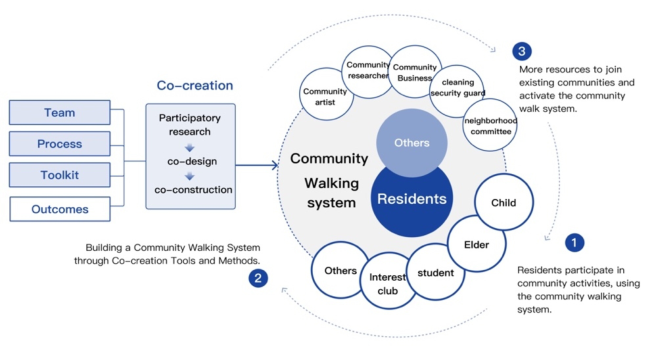
The intervention of co-creation fosters bi-directional interaction between community residents and physical spaces. On one hand, through multi- stakeholder participation in design co-creation, a human-centric community walking systems is constructed. On the other hand, co-creation increases communication and interaction among residents, advancing the sustainable development of community walking systems, as depicted in Figure 2.
Figure 2: Co-creation involved in community walking system design.
CASE STUDY: SHANGHAI HONGQIAO AIRPORT NEW VILLAGE Project Background
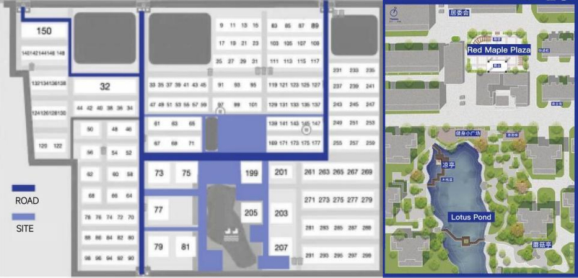
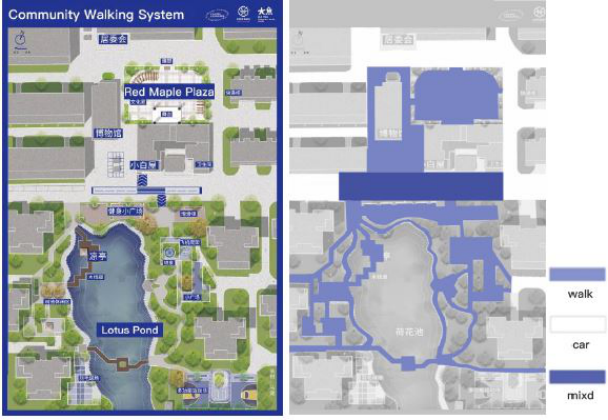
Located near Shanghai Hongqiao Airport, Hongqiao Airport New Vil- lage initially served as welfare housing for aviation entities. The design site is within Hongqiao Airport New Village, focusing on areas earmarked for government-sponsored renovation, As shown in Figure 3. This project aims to enhance the community’s walkability by establishing a user-focused walking system.
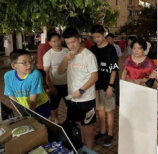
Participatory Research In relation to the walking system in Airport New Village, researchers conducted participatory research.Passing pedestrians were invited to mark their walking routes on a map, describe negative and positive factors they commonly encounter, As shown in Figure 4.
Physical Level Overall, residents’ material needs for the community walking system focus on enhancing the safety and functionality of streets and squares. They aspire to alter the current state of roads being dominated by cars, reducing motorized threats to pedestrians and clearing scenic routes to expand walking spaces. Furthermore, they seek to enhance the comfort and aesthetics of landscaping, thus improving the attractiveness of the community walking environment.
Community Walking System Design From a Co-Creation Perspective 135
Figure 3: Airport new village walking system.Figure 4: Participatory research process.
Spiritual Level Verbal and even physical conflicts frequently occur on the Red Maple Square between the elderly who dance “Square Dance” every evening and running children. Based on this, square dancers suggest expanding the pedestrian space. More importantly, they feel overlooked by community planning and social environment. Compared to material conditions, they need more respect on the spiritual level and a collective atmosphere, placing their loneliness in the community’s interpersonal network.
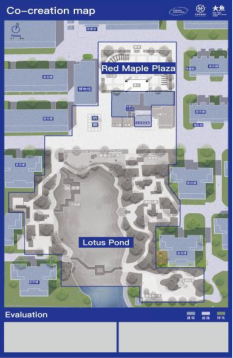
Co-Creation Co-Creation Toolkit Designers and researchers prepared a co-creation toolkit based on prior research, comprising a co-creation map and thought-stimulating stickers, as shown in Figure 5. Members were first presented with a current plan to estab- lish spatial understanding, then areas intended for modification and having financial support were indicated in grey on the map.The stickers are grouped into four categories: Infrastructure, Space Function, Social Activities, and Culture and Engagement.
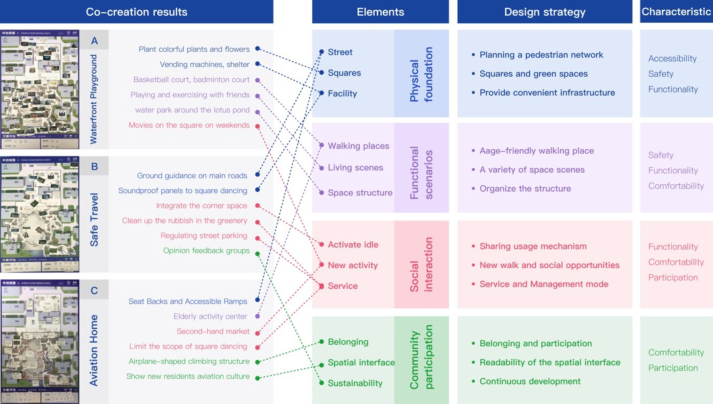
Co-Creation Teams and Outcomes In previous research, it was found that walking needs shared commonalities across age groups. Therefore, the co-creation team was divided into three age- based groups, with design themes determined as “Waterfront Playground”, “Safe Travel”, and “Aviation Home”. During the transition to design strategy,
136 Ma and Zhang
the achievements of the three co-creation groups A, B, and C were thor- oughly collated. The residents’ needs for the community walking system can be divided into four categories: infrastructure needs, functional needs, spatial atmosphere needs, and community culture and participation needs, as shown in Figure 6. Then, designers and researchers integrated the more satisfactory parts of each scheme to form the final design scheme.
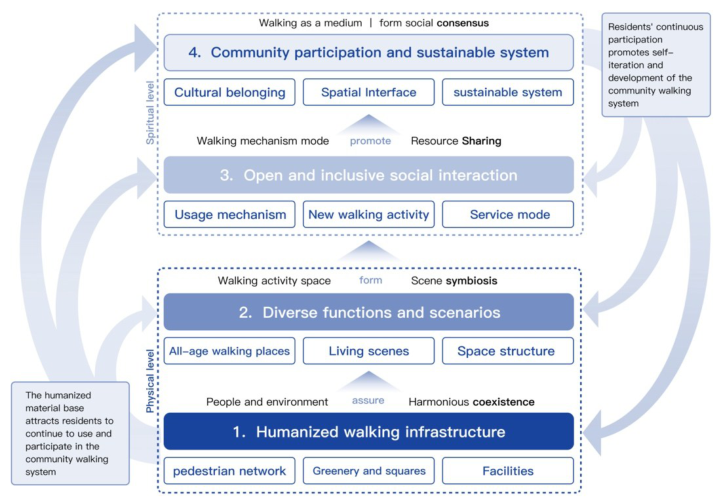
CONCLUSION: COMMUNITY WALKING SYSTEM DESIGN FROM THE PERSPECTIVE OF CO-CREATION Based on preliminary research and co-creation analysis, the author has sum- marized the community walking system design from a co-creation perspective
Community Walking System Design From a Co-Creation Perspective 137
into four tiers: physical foundation, functional scenarios, social interaction, and community participation, as shown in Figure 7.
Figure 7: People-oriented design strategy model of community walking system.
Coexistence: Building the Material Basis of Humanized Community Walking System Pedestrian Road Network Pedestrian and vehicular traffic should be as separate as possible. This “sep- aration” implies reducing the overlap between pedestrian and vehicular road networks and defining clear driving boundaries for motor vehicles, to ensure pedestrian safety.
As for the Airport New Village’s walking system, in key areas where pedestrian and vehicle movements intersect, ground guidance marks should be drawn to provide guidance for pedestrians crossing streets, as shown in Figure 8.
Community Squares and Green Spaces From a co-creation perspective, the design of the community walking sys- tem is human-centered. Therefore, the design of community squares should consider human scale and perception, avoiding excessively large spaces. Additionally, creating pleasant community gardens can be achieved through well-planned landscape and greenery arrangements.
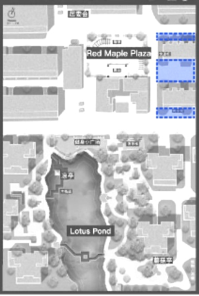
As in the design of the Airport New Village’s walking system, fragmented green spaces are integrated into the overall environment. A fountain plaza is added along the lotus pond, with low-lying herbaceous plants in the center, adding interest and beauty to pedestrians.
138 Ma and Zhang
Figure 8: Plane design of walking system in new village area of the airport.
Community Walking Infrastructure In a co-creation perspective, the community walking system revolves around the residents’ needs and life scenarios, providing practical and convenient pedestrian infrastructure. The location, quality, and form of these infrastruc- tures such as seats, lighting, trash cans, rain shelters, and restrooms, directly influence the walking experience. Besides, Pedestrian facilities should pay attention to the safety of the elderly, and people with disabilities.
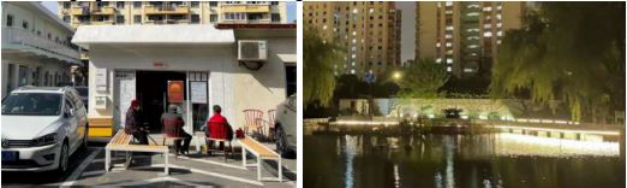
In the Airport New Village’s walking system, the design adds backrest benches for the elderly, minimizes pavement height differences, and main- tains facilities along the Lotus Pond. The implemented “illumination project” ensures night-time safety and enhances the environment’s beauty, while outdoor furniture provides additional resting spots, as shown in Figure 9.
Figure 9: Walking facilities.
Symbiosis: Construct Complex and Diverse Community Walking System Functional Scenarios Community Walking Activity Place for All Ages The community walking network aims to coordinate the walking needs of different groups while avoiding conflicts.
Community Walking System Design From a Co-Creation Perspective 139
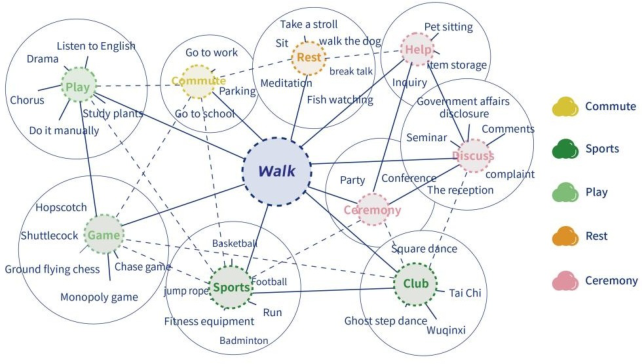
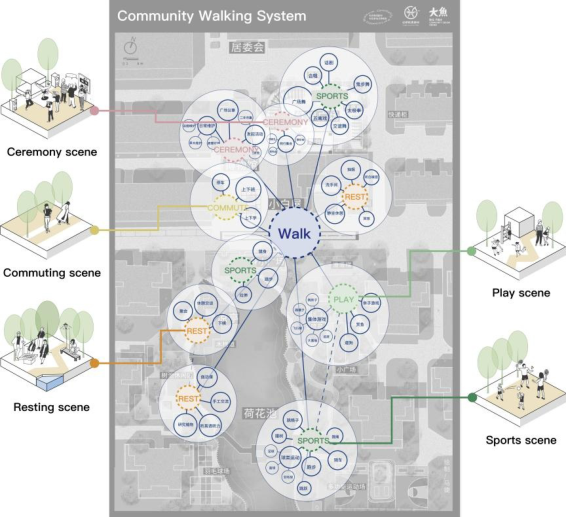
When designing the pedestrian system for Airport New Village, five main walking and living scenarios were identified based on the walking behavior of residents of different age groups: commuting, sports activities, playful inter- actions, rest and relaxation, and social gatherings, as shown in Figure 10. Some scenarios may be used for learning, while others may be more suitable for exercise or play. Given the aging society context, the design of the pedes- trian system in Airport New Village should pay more attention to the elderly population and provide facilities such as senior canteens or activity centers for them.
Figure 10: From walking behavior to life scenes.
Organize the Community Walking System Structure With Life Scenes The design of community walking systems should be resident-centered, incor- porating daily scenarios and generating a diverse array of walking spaces through holistic planning.
In the case of the Airport New Village’s walking system, the lotus pond helped alleviate some of the crowdedness in the Red Maple Square, mitigating the “square dance conflict”. Centering around the act of walking and its associated scenarios, the walking system forms a rich and integrated spatial framework, as depicted in Figure 11.
Sharing: Create an Inclusive and Open Social Interaction The Usage Mechanism of the Walking System for Energy Sharing The co-creation perspective on community Walking System design should fully consider residents’ walking experiences, affirm the subjective status of pedestrians, and stimulate community vitality through concepts such as “shared streets.” “Shared streets”transform original vehicle roads into spaces where pedestrians and vehicles coexist, separating roads using landmarks, tree pits. Shared streets expand pedestrian activity areas, allowing pedestrians to safely engage in various activities on spacious streets.
140 Ma and Zhang
Figure 11: Spatial structure of walking system in airport village.
In the walking system of Airport New Village, “shared streets” are designed in the street areas along the edges of buildings. The activation of “grey spaces” along the street expands the area available for pedes- trians, encouraging them to linger and converse, fostering various social interactions, as shown in Figure 12.
Figure 12: “Shared street” in airport new village.
New Community Walking Events and Social Opportunities Community stakeholders can employ gamified methods, such as competition or cooperation, to endorse walking activities and enhance their community
Community Walking System Design From a Co-Creation Perspective 141
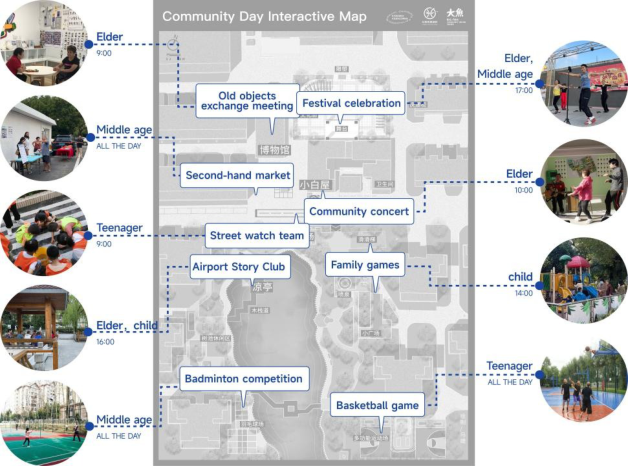
impact. Additionally, walking can facilitate socialization, with activities fos- tering neighborhood ties. In the Airport New Village, various walking and social activities exist but are scattered. To address this, universal appeal is fos- tered to bridge activities and invigorate the system. Management designates Saturdays as “Community Day,” promoting resident engagement in broad pedestrian streets and squares for various activities, As shown in Figure 13.
Figure 13: Build bridges for social interaction with “Community Day”.
Consensus: Promoting the Sustainable Development of Community Walking System Through Community Participation Sense of Belonging and Participation Based on Cultural Identity The establishment of community cultural consensus deepens residents’ under- standing of local history and stories. Furthermore, the incubation and growth of new cultures within the community walking system attracts younger par- ticipation, making the community walking system a shared space for all age of residents.
In the Airport New Village, the design of the walking system is informed by the local aviation history, incorporating aviation-related symbols in visual guides, ground decorations, and spatial forms. Furthermore, Temporary interactive setups, like “Pop-up Castle Parks” and “Community Stages” enhance community participation and incubates cultural growth.
The Readability of the Spatial Interface In the community walking system, clear, readable, and perceivable spatial interfaces positively influence residents’ usage and understanding.
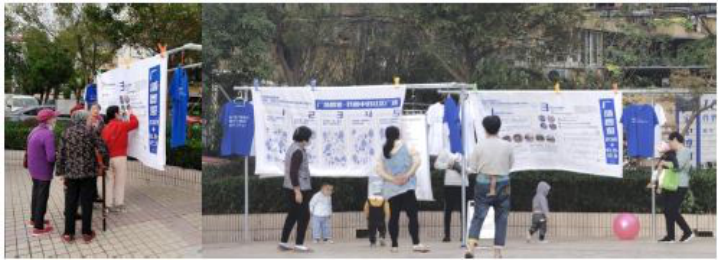
In the Airport New Village, researchers “exhibit” residents’ thoughts gath- ered from participatory surveys and co-creation processes in the square, as
142 Ma and Zhang
shown in Figure 14. After reading that, old people who do square dancing became more considerate of children playing nearby, children enjoyed safer and happier playtime, and the square evolved into a social hub.
Figure 14: Community curation.
Sustainable Community Innovation The community walking system encourages public participation and co- creation in the design, operation and governance process to form a sustain- able system, as shown in Figure 15.
Figure 15: Full-process participation of multiple roles.
In the Airport New Village project, the team recruite “community artists” through online public platforms, incorporating their artwork as installa- tions displays in the walking system. In this process, an interactive dynamic is created between internal community members and external researchers and designers, strengthening emotional ties, propelling sustained community innovation.
Community Walking System Design From a Co-Creation Perspective 143
ACKNOWLEDGEMENT
The research has been supported by project National Social Science Fund Art Major Project “Research on Chinese Urban Image Design” (Grant No. 22ZD18).
REFERENCES
Alfonzo, M. A. (2005). To Walk or Not to Walk? The Hierarchy of Walking Needs.
Environment and Behavior, 37(6). https://doi.org/10.1177/0013916504274016. Manzini, E. (2015). Design, when everybody designs: An introduction to design for social innovation. MIT press. 82–89. Xue Pei, Carla Sedini, Francesco Zurlo (2019). Co-designing a walkable city for the
elderly through system thinking approach. Zhong Fang, Liu Xin. (2018). Design for People, with People, by People: The Path, Challenge and Opportunity of Social Innovation Design[J]. Zhuangshi. 40–45.
LISTED IN THE AHFE DIGITAL BOOKSTORE CATALOGUE
Explore the complete digital volume
Human-Centered Design and User Experience
Read this individual research paper free through the original publisher, or explore the full digital proceedings book.
ISBN 978-1-958651-90-2
Explore this ISBN in the AHFE Bookstore ↗Listed in the July 2026 bookstore catalogue; search by ISBN to confirm current availability · Digital book purchase optional