Zhipeng Zhang, Xing Fang, Wenyi Xu (2023). A Method of Advertising Information Design in Subway Space based on Passengers' Needs for Cognition. In: Human-Centered Design and User Experience. AHFE Open Access, vol. 114, pp. 392–402. https://doi.org/10.54941/ahfe1004257
This study aims to explore the effectiveness and feasibility of subway advertising information design based on passengers' needs for cognition. Through the analysis and evaluation of the advertisement in the existing subway system, we find that there are some problems in the advertisement of subway space, which can not fully meet the needs for cognition of passengers. First of all, there are often design problems that are not coordinated with the subway environment. Secondly, some advertising content is over-commercialized and lacks practical and emotional resonance that is closely related to passengers' lives. Passengers' needs for cognition are closely related to subway advertising information. In the process of subway travel, passengers not only need travel information, but also want to obtain information about culture, history, art and other aspects related to the destination. They expect ads to provide valuable, meaningful information that will give them a pleasurable cognition experience during their short travel time. Passengers' needs for cognition for advertising include understanding of regional culture, exploring new things, and paying attention to social problems. In order to better meet the needs for cognition of passengers, we put forward a subway advertising information design method based on passenger needs for cognition, which is divided into demand layer, mechanism layer, transformation layer and target layer, and describes the needs for cognition of passengers for subway advertising information and their respective action mechanisms.The results of this study show that satisfying passengers' aesthetic needs, their needs for cognition for regional culture, new things and social problems, and their needs for interesting interactive ways can enhance the attraction and influence of advertising on passengers. Through designing advertisements that are coordinated with the subway environment and have practical content and emotional resonance, the communication effect of advertisements can be enhanced.
When it comes to subway advertising, in our impression it is colorful, change- able form, but also dazzling, chaotic. For passengers, they stimulate the senses, mobilize emotions and convey commercial messages in the subway space. An active commercial and entertainment atmosphere will be formed in the subway space rich in advertising information. Under this atmosphere,
A Method of Advertising Information Design in Subway Space 393
subway passengers’ entertainment emotions are more easily mobilized, thus promoting their shopping and entertainment behaviors.
However, the answer is not optimistic whether the advertising information in the current subway space can effectively convey the target information. Through the survey of user interviews, we found that passengers’ attitude towards advertising information in subway space is not very positive. Among the interviewees, most passengers think that advertising information in the subway is of little use to them, but it cannot be ruled out that they are not aware of the usefulness of advertising information. Some passengers think that they seldom pay attention to the content of advertising informa- tion, they argue that advertising information is not attractive to them. Some passengers proposed that the advertising information of some sites was too exaggerated, and even made them uncomfortable, and had previously seen the content of public complaints on the wechat public number, which was about the glare of the LED advertising screen. Other passengers think that there are too many advertisements in the subway, and the location of the advertisements is not correct, which will make them unable to distinguish some important directions. When asked “What kind of advertisement will attract you”, some passengers pointed out that he had been attracted by the advertisement of “King Glory” game and food, because he is a loyal player of “King Glory”, some passengers said that he was attracted by a cultural tourism advertisement, and some passengers said that he particularly likes “city limited” products, such as milk tea, etc. Because their visual design is very unique and interesting.
NEEDS FOR COGNITION OF SUBWAY PASSENGERS – THE KEY TO RESEARCH SUBWAY ADVERTISING INFORMATION DESIGN The research on subway spatial information can be carried out from the per- spective of passengers’ needs for cognition. Subway spatial information serves passengers and takes passengers as the center. In order to effectively promote the cognition of passengers, advertising information first needs to activate the needs for cognition of passengers in terms of vision and content, or reduce the threshold of passengers’ cognition. On the other hand, passengers have needs for cognition in the subway space, that is, basic functional information such as traffic information and safety information. In most cases, the design of advertising information must be based on the principle of “not interfering with this kind of information”.
Appropriate visual impact activates the needs for cognition of passengers, while excessive visual impact breaks the cognition harmony. Although there are many kinds of advertising information, it belongs to non-essential func- tional information in the whole process of subway ride, and passengers’ demand for such information is not just needed. At the same time, these messages are propaganda properties, they need to have enough visual impact to attract the attention of passengers. Most of this kind of information also has artistic properties, through the use of formal beauty rules to cause visual impact, to reconcile the boredom and boredom of passengers, to release the
harmonious and full aesthetic value, so that passengers feel happy, play a role in regulating emotions.
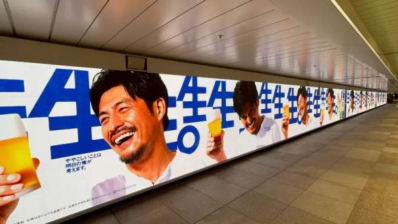
The first impression of the advertisement for Suntory draft beer in the sub- way in Japan is that it has a strong visual impact. The LED screen provides moderate light in the dark underground space, physiologically ensuring suf- ficient light stimulation without being too harsh. The visual content mainly uses a continuous way to produce the visual aesthetic feelings of rhythm and rhythm, combined with the use of faces and expressions, magnifies the visual effect, and also conveys a profound and joyful emotion. The whole ultra-long screen wall constantly refreshes and changes the advertising content, allevi- ates the visual numbness and rigidity, enriches the advertising content, and brings a more active visual experience (see Figure 1).
Figure 1: Suntory draft beer advertisement in the subway in Japan (adapted from Wechat public account “Guang Gao Kuang Ren”, 2023).
When the pursuit of strong visual impact becomes the practice of subway advertising information, many advertisements begin to use various means to “attack” the visual nerve of passengers, so that the effect is reversed.
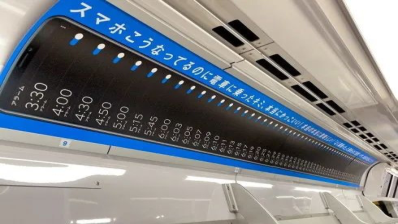
Also in the Japanese subway, an eye drop advertisement will be filled with mobile phone alarm clock interface, continuous alarm clock does bring a lot of visual impact to passengers, but also let the office workers suffering from the alarm clock crazy, this regardless of the real emotion of passengers “bad taste” visual impact is not desirable (see Figure 2).
Figure 2: An advertisement for eye drops on the subway in Japan (adapted from Wechat public account “Guang Gao Kuang Ren”, 2023).
A Method of Advertising Information Design in Subway Space 395
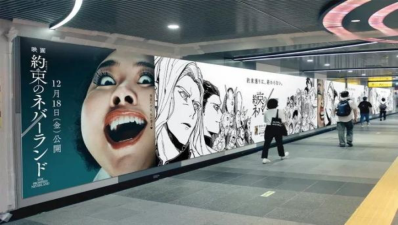
Another visual advertisement in the Japanese subway, the promotion of the live-action version of “Agreed Fantasy Island”, is also a visual impact infor- mation design. It directly uses exaggerated, weird and even horrible faces as the visual center to maximize the visual impact and attract users’ atten- tion. But at the same time, it is also easy to cause users fear and discomfort, affecting the user’s ride experience (see Figure 3).
Figure 3: A live-action subway AD for Neverland (adapted from Wechat public account “Guang Gao Kuang Ren”, 2023).
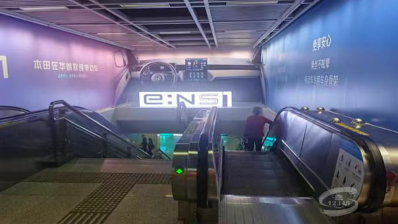
Digital technology has brought new possibilities for the visual presentation of subway information. Digital LED screens allow propaganda information to “shine” in the underground space with low light, but too strong light will also form light pollution and bring sensory discomfort to passengers. Honda e:NS1 billboards in Wuhan subway have been complained by citizens, claim- ing that “Jianghan Road subway station C entrance billboard light is too bright, the light is dazzling when getting off the elevator, it is recommended to move the billboard position back or remove”. It can be seen that the visual stimulation brought by strong light in the underground space also needs to be properly grasped, otherwise excessive stimulation will backfire (see Figure 4).
Figure 4: Light pollution in subway advertising (adapted from Wechat public account “Wuhan Citizen Hotline”, 2023).
The above excessive visual design, although aroused the passenger’s NFC, but then passed on to the passenger’s disharmonious feelings.
Interesting forms of interaction activate passengers’ needs for cognition. The advertising information of subway space does not perform the necessary
function of passengers’ riding, but provides sensory pleasure for passen- gers. In terms of entertainment, such information will be interactive in the form of digital screen display technology, sensing technology, AR technology, etc., to realize the interaction between people, machines and the environ- ment, increase the interest of information, and enhance the experience of passengers.
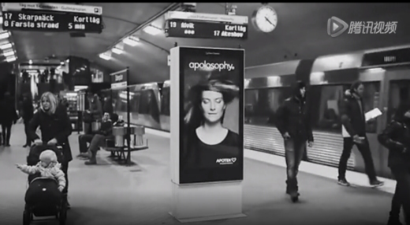
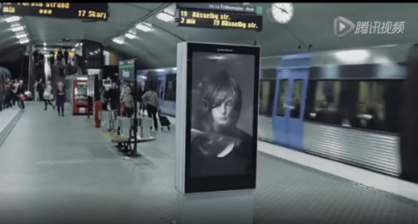
In the Swedish subway, there is an advertisement for shampoo, which is presented through a digital advertising screen erected beside the train. The visual subject is a woman with smooth hair. When the train enters the station, passengers can see the wind from the train blowing the woman’s hair. The principle is that the billboard is embedded with an interactive device that can monitor the ultrasonic wave of the subway, and the subway enters the station to activate the device, and the stationary advertisement moves at the moment the subway enters the station. This small and natural interaction makes passengers feel fun and happy (see Figure 5).
Figure 5: An interactive shampoo advertisement in the Swedish subway (adapted from Wechat public account “Planning Forum”, 2023).
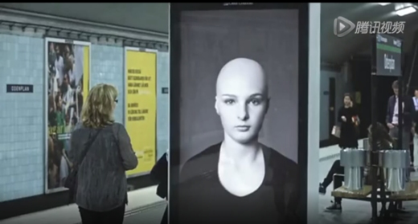
The Swedish Children’s Cancer Foundation has taken this idea a step fur- ther. Lyn, a 14-year-old girl suffering from cancer, is the main body. When the train comes into the station, the wind blows, the little girl’s hair flaps, and the passengers just think it is interesting, but at the end, the little girl’s hair is blown off the whole ground, which makes the passing passengers shocked and suddenly realize that this is a girl suffering from cancer. This public infor- mation touched all the passengers, they use the picture to build context, and then break psychological expectations. Also interactive, the design of this public information reflects a stronger narrative through the unexpected plot, which has a profound and meaningful impact on passengers (see Figure 6, 7).
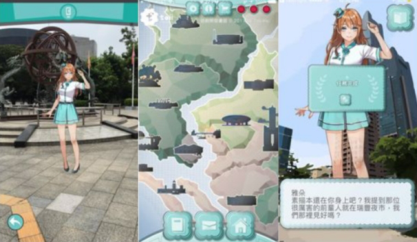
In addition to simple digital display interactions, AR interactions also pro- vide new ways for such information to be presented. AR interaction requires passengers to use mobile applications to interact. Mobile phones are tools that passengers carry with them, and interaction through mobile phones is a very simple and natural behavior, and interactive information can also have gamification properties. Taiwan Kaohsiung Metro has cooperated with the mobile AR game “Kaojie Love Travel” to provide passengers with a new interactive experience combining scenic spots.
A Method of Advertising Information Design in Subway Space 397
Figure 6: Creative AD for Swedish Children’s cancer foundation (adapted from Wechat public account “Planning Forum”, 2023).Figure 7: Girl’s hair ‘blown off’ by incoming metro wind (adapted from Wechat public account “Planning Forum” 2023).
During the game, the virtual employee “Gaojie Girl” interacts with play- ers through different AR situations, and players need to go to 7 designated stations to complete the collection of AR characters; You can also choose different game branches to complete missions and experience different story endings.
Kaohsiung Metro will combine AR games with scenic spots, so that players can feel the sweet “love” feeling of the game, but also invisibly guide players from all over the world to visit Taiwan’s famous scenic spots and immerse themselves in the beauty of Taiwan (see Figure 8).
The construction of space scene creates an immersive user cognitive space. How can advertising information in subway effectively activate users’ cog- nitive desire and bring users a pleasant experience? The way of constructing the scene information space activates the NFC of passengers from the phys- iological to the psychological depth, so that passengers can experience the immersive “information sauna”.
There are many forms of subway advertising, among which the all- inclusive advertising of the carriage is designed by subjecting all the elements on the surface and inside of the train, which can achieve the purpose of immersive subject publicity.
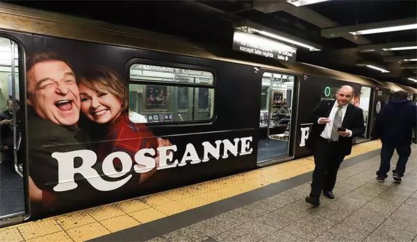
In the United States subway, the whole advertisement of the movie and TV drama “Roseanne Family Life” is laid out from the body to the inside of the car. The footage and characters in the movie and TV drama are used
Figure 8: AR game advertising in Taiwan subway (adapted from Wechat public account “Michi Technology”, 2023).
to pave the way on the body of the car. The inside of the car is arranged like Roseanne’s home, with patterned sofa seats, light green wallpaper, pic- ture frames on the wall and family photos. A variety of relevant elements surround the passengers to form “Rose Ann’s home”. In such a scene, the passengers receive various feelings and associations brought by the scene of home. Compared with simple advertising posters, this form of information presentation makes the passengers affected physically and psychologically, activates the cognitive desire, generates the desire and interest in the pro- paganda content, and makes the advertising play a substantive role. At the same time, it also stimulates the positive emotions of passengers and harvests a good ride experience (see Figure 9).
Figure 9: An all-inclusive advertising campaign for Roseanne family life (adapted from Wechat public account “Shuying DIGITALING”, 2023).
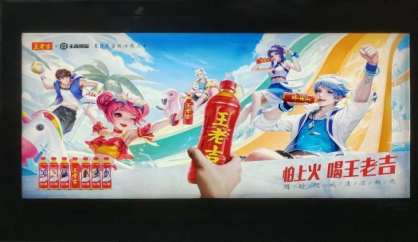
Advertising messages with cultural community attributes are more attrac- tive. The nature of advertising information is mostly commercial, and the appeal of purely commercial information to passengers is very limited. When it is also cultural, artistic and entertaining, its meaning to passengers becomes rich. The information of different social cultures plays a special role in stim- ulating the needs for cognition of different groups. For example, advertising the joint name of “King of Glory” mobile game and Wanglaoji Herbal tea in the tunnel has stimulated the needs for cognition of a large group of “King
A Method of Advertising Information Design in Subway Space 399
of Glory” mobile game players, and many of these groups will even start a game during the ride (see Figure 10).
Figure 10: AR game advertising in Taiwan subway (Wenyi Xu, 2023).
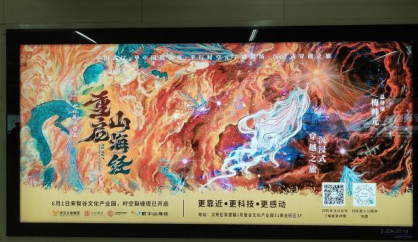
There are also some advertisements combining traditional culture and modern hot technology that can effectively stimulate the needs for cogni- tion of passengers, such as the advertisement of Sanhai Jing Meta-Universe Theater, which is the expression of traditional culture in the context of mod- ern technology and aesthetics. Young people pay attention to the hot spots of The Times, like the trend culture, but also understand the traditional culture, such advertising information in the subway space can meet the NFC of young people (see Figure 11).
Figure 11: AR game advertising in Taiwan subway (Wenyi Xu, 2023).
Reducing the interference and load of information is the basis of ensuring the quality cognitive experience of passengers. Modernist architect Mies van der Rohe said “less is more”, sometimes restrained expression will reduce unnecessary interference and load, create more space. Urban cultural pro- paganda, entertainment and financial information are the most artistic and complex types of visual information in subway spatial information, and also the types of information that are most likely to produce visual interference and load.
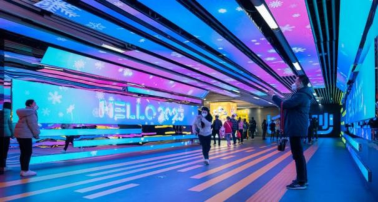
The most common visual load is too bright colors, too harsh lighting, too messy information arrangement. Although the above mentioned Changsha
digital media culture community trend gorgeous, but its too dazzling color and lighting has also been mocked by many passengers, some passengers think that “dazzling digital light wall produced light pollution, long-term in which the eyes can not stand”, excessive pursuit of sensory stimulation will bring bad experience. Therefore, subway information designers should appropriately seek restrained expression to pursue sensory balance, so as to create better cognitive experience for passengers (see Figure 12).
Figure 12: The brilliant light and shadow of Changsha digital media culture community (adapted from Wechat public account “Changsha Metro”, 2023).
When urban cultural propaganda, entertainment and financial informa- tion and instruction information or security warning information are close in space, the former may interfere with the realization of the basic functions of the latter two.
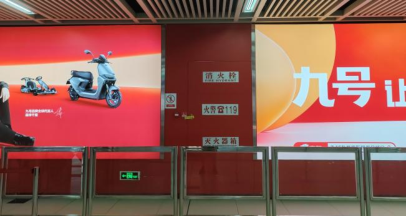
Fire hydrants as the most important safety emergency tools, in the event of a fire, the use of fire hydrants is a race against time. Information about its location should also be visible in the subway space. In the picture below, a fire hydrant at a subway station is located in the center of two advertising screens. The designer covered the wall with a red tone consistent with the advertiser’s color, leaving the shape of the fire hydrant door hidden, and only a less attractive white box for identification. As the visual center of this wall, the billboard also takes away the important safety warning status of the fire hydrant, which is difficult to attract the attention of passengers. It is more difficult for distant passengers to notice the fire hydrant in this position (see Figure 13).
Figure 13: The advertising wall in the subway is affecting the fire hydrants (Wenyi Xu, 2023).
A Method of Advertising Information Design in Subway Space 401
The advertising information in the above case is not useless for the safety warning information of the fire hydrant location. The advertising informa- tion can attract the attention of passengers, and at the same time make passengers pay attention to the location of the fire hydrant, and passengers who have passed through the station for a long time can even form a mem- ory of the fire hydrant location. But these mutual promotions are futile if the principle that security alerts are visually undisturbed is not observed.
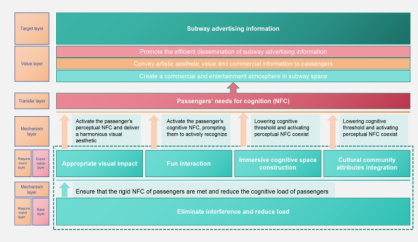
TO CONSTRUCT A SUBWAY ADVERTISING INFORMATION DESIGN METHOD BASED ON NFC OF PASSENGERS’ NEEDS FOR COGNITION The factors affecting user NFC in the above subway advertising informa- tion are the key information to be considered in the design and screening of subway advertising information. From the perspective of demand types in KANO model, the needs met by the first four belong to the attractive or expectant needs, while the last one satisfies the basic needs.
These factors acting on passenger NFC and their mechanisms are used as the core elements to build a subway advertising information design method based on passenger NFC (see Figure 14).
Figure 14: The advertising wall in the subway is affecting the fire hydrants (Wenyi Xu, 2023).
CONCLUSION
This study analyzes some typical problems existing in China’s subway adver- tising information, analyzes and summarizes from the perspective of pas- senger NFC, and comes up with a subway advertising information design method based on passenger needs for cognition. It can be used for reference by advertisers, subway officials and subway information designers. Due to the particularity and contradiction of advertising information, how to bal- ance the relationship between commercial publicity and passenger experience is the basic proposition of subway advertising information design. To give a better solution to this proposition, we need to have a deeper study and under- standing of the characteristics of The Times, user characteristics and scene characteristics, in order to create a better subway information environment.
REFERENCES
Fang Xing, Zhan Yusong, Zhang Zhipeng & Zhang Boyuan. (2022). Subway passenger advertising demand analysis from the perspective of user experience. Pack- aging Engineering (18), 178-183. doi: 10.19554/j.cnki.1001–3563.2022.18.022. Guan Y. (2021). The Dynamic construction of multimodal cognition in Guangzhou
Subway public service Advertisement. Journal of West Anhui University (06), 139-143. Hao Yarui, Lei Bin, Zhang Yuan & Sun Yingya. (2021). Subway guidance sign information optimization based on pedestrian cognitive law. Traffic Information and Safety (04), 99-107. Ian Leslie. (2017). Curiosity: Sustaining a Never-ending Passion for the Unknown.
Chinese and Foreign Management (Z1), 201. Liu Zhizhe & Sun Luo. (2022). Inspiration from London Subway advertising Experience to the development of subway advertising in China from the perspective of “Emotional Design”. Modern Advertising (08), 48-55+65. Lu Zhi. (2019). The influence of cognitive bias on design decision: A case study of
optimal design of London Underground Diagram. Art Technology (03), 206. Yao Wenfeng. (2022). Scene construction, context combination and Audience behavior Change of subway advertising from the perspective of media Context. Science and Technology Communication (15), 78-80. doi:10.16607/j.cnki.1674– 6708.2022.15.033. Zhang Ye & Fang Kaizhu. (2023). Research on Interactive Creativity of Regional
Culture Subway advertising. Art Education Research (06), 111-115. Zheng Longzhao. (2021). Research on the quality of subway advertising effect based on in-depth interview: A case study of NetEase Cloud Music Subway Music Review Train. Modern Advertising (02), 45–51.
LISTED IN THE AHFE DIGITAL BOOKSTORE CATALOGUE
Explore the complete digital volume
Human-Centered Design and User Experience
Read this individual research paper free through the original publisher, or explore the full digital proceedings book.
ISBN 978-1-958651-90-2
Explore this ISBN in the AHFE Bookstore ↗Listed in the July 2026 bookstore catalogue; search by ISBN to confirm current availability · Digital book purchase optional