Dimitrios Ziakkas, Neil Waterman (2023). Emerging Technologies in Transportation: The Simulated Air Traffic Control Environment (SATCE) case study. In: Human-Centered Design and User Experience. AHFE Open Access, vol. 114, pp. 626–633. https://doi.org/10.54941/ahfe1004282
Purdue University, School of Aviation and Transportation Technology, West Lafayette, IN 47907, USA, 2 500A Huntmar Park Drive, Herndon, VA 20170, USA ↗
SATCE (Simulated Air Traffic Control Environment) is a system that simulates air traffic control scenarios for training purposes and improves effective and efficient communication. SATCE implementation in aviation training provides a more realistic and immersive training environment (use of AI in communication needs of training with controlled traffic volume and events), offering Competency Based Training & Assessment (CBTA) features in phraseology and procedures. Purdue - ASTi research case study of SATCE enables aviation SMEs to enhance their knowledge and practice their skills in a realistic and immersive environment. Another potential use case for digital twins in SATCE is to simulate different aircraft types and scenarios. Purdue team projects aim to research the behavior and performance of different training scenarios under SATCE, design, test, and certify the implementation – use of different flight devices in existing airspace classification environment. Purdue – SATT approach for SATCE focuses on the potential to improve the effectiveness and efficiency of aviation training programs (CBTA globally) by providing a more realistic and immersive learning experience (lean process for training/certification, transition to AI - AAM environment). Moreover, this research focuses on mitigating residual risk in the 'AI black box', focusing on aviation ecosystem operations under SATCE – facilitating different aircraft types, airspace, and implementation of AAM. Results aim to analyze and evaluate the Artificial Intelligence (AI) certification and learning assurance challenges under the SATCE aspect.
Flight simulators at the highest level of fidelity have for the longest time aimed to replicate the precise experience for the trainee crew per the real- world aircraft, with a level of attention and detail that covers all of the human senses. State-of-the-art Full Flight Simulator (FFS) delivers an incred- ibly realistic representation of a real aircraft cockpit, with two exceptions.
Emerging Technologies in Transportation: The SATCE Case Study 627
The missing elements are ‘other traffic’ and Air Traffic Control (ATC). These deficiencies are both significant and related to each other. They are signifi- cant as both impose a workload on the crew, which should logically be part of all simulated flight training. Other traffic in the vicinity of the aircraft represents a significant and potentially fatal threat to safety, since any con- tact between aircraft, whether in-flight or on the ground, can lead to the destruction of one or both aircraft and potentially a great loss of life. In the infancy of aviation, there were few aircraft in the skies, but as air traffic increased, the possibility of a collision between aircraft became a reality, and the need for air traffic control, based on a system of rules controlling aircraft behaviors was established, utilizing radio communication between aircraft and ground-based controllers. Over time it became clear that standardizing on a single language (English), and the words and phrases used by aircraft and ATC, was necessary, and became more so as aviation expanded inter- nationally. From initial flight training any potential pilot will be taught the A-N-C triple, which represents the three priorities when in command of an aircraft: “Aviate, Navigate, and Communicate”. The top priority is to aviate, meaning to fly the aircraft using the aircraft controls and flight instruments. Secondly, to navigate, figuring out where you are and where you are going. Thirdly, communication allows other aircraft and ATC to understand your intentions and needs, and equally to understand what other aircraft in the near vicinity may be doing. Moreover, Communication provides situational awareness and helps in the decision-making process. The operation of ATC is a complex system that has many variables, but at the core, has the primary task of ensuring each aircraft has sufficient ‘space’ to safely aviate within The ATC environment isn’t a simple set of sequential pipe-lined actions, but something more akin to a 3-dimensional chess game, which, still controlled by rules, have many variables in the equation, with the solution needed within a constantly advancing timeline. Aircraft cannot pause while the controller figures out what to do next, and are limited by operational–human factors performance limitations, fuel quantity restrictions, and impacted by weather conditions and terrain obstacles.
Currently, state-of-the-art flight simulation devices, even at the highest level of certification, do not include any programmatic representation of the ATC environment and consequently do not include other traffic air- craft, other than in a very constrained and scripted manner, to meet very specific training requirements. The greatest extent of other traffic aircraft representations may include an intruder threat aircraft that will appear “out of nowhere” to trigger a TCAS event and an aircraft on the ground that can be triggered to trundle onto the runway, to create a runway incursion situa- tion. The issue with both of these scenarios is there is no associated real-life radio communication that would perhaps in the normal course of things alert the crew to the evolving situation.
Nowadays, the aviation industry, characterized by its intricate network of safety-critical operations and stringent regulatory standards, has witnessed a profound transformation through the infusion of Artificial Intelligence (AI) into several facets of its operations. An optimal example of this transfor- mation is the one found in the Simulated Air Traffic Control Environment
628 Ziakkas and Waterman
(SATCE), an innovative application of AI in addressing a gap in the commu- nication needs of aviation training in a populated active airspace (Papadopoli, 2017). Traditionally, aviation training for air traffic controllers and pilots has heavily relied on real-world scenarios and on-the-job experiences. How- ever, the complexity of modern aviation systems demands a more dynamic and immersive training environment that can efficiently replicate a diverse range of scenarios, including routine operations as well as rare but criti- cal events (Neto et al., 2023). This is where the SATCE has emerged as a groundbreaking solution.
The SATCE integrates cutting-edge AI technologies with high-fidelity sim- ulations to create a virtual air traffic control environment that provides parallel capabilities of real-world case scenarios that are designed to provide training for pilots with remarkable accuracy (Halldale Group, 2022).
A major core challenge in aviation training has been that of providing learners with exposure to controlled traffic volumes and unexpected events while ensuring a risk-free learning environment. AI plays a pivotal role in addressing this challenge by orchestrating dynamic scenarios, generating realistic traffic patterns, and mimicking diverse communication exchanges (Halldale Group, 2023). Through the incorporation of AI, SATCE enhances the training experience by simulating not only routine operations but also high-stress situations such as adverse weather conditions, technical failures, and sudden changes in flight plans. This enables trainees to develop critical decision-making skills, adaptability, and effective communication strategies under circumstances that would be difficult to replicate in a purely real-world setting (SIMTETIQ, 2021).
This paper is an inquiry into the profound implications of integrating AI into aviation training through the lens of the Purdue-ASTi SERA case study. ASTi’s SERA creates a dynamic, artificially intelligent environment filled with other aircraft and air traffic controllers. From pushback to shutdown, pilots receive and read back customized ATC interactions amid generated traffic, creating a realistic training experience on the ground and in the air.
We examine how AI-driven communication models in SATCE not only enhance the efficiency and efficacy of training but also contribute to overall aviation safety. By closely analyzing the AI-powered communication systems in the SATCE framework, we aim to present the advancements that have been made in overcoming the limitations of conventional training methodologies. Additionally, we explore the potential of SATCE to revolutionize the way aviation professionals are prepared to handle both routine operations and unforeseen events in a controlled and secure learning environment, following the CBTA Communication concept.
Through the exploration of the SATCE case study, we endeavour to contribute to the ongoing discourse on the transformative potential of AI- driven simulations in transportation, particularly within the domain of aviation training, where precision, adaptability, and safety are of paramount importance (Ziakkas et al., 2023).
Emerging Technologies in Transportation: The SATCE Case Study 629
METHODOLOGY
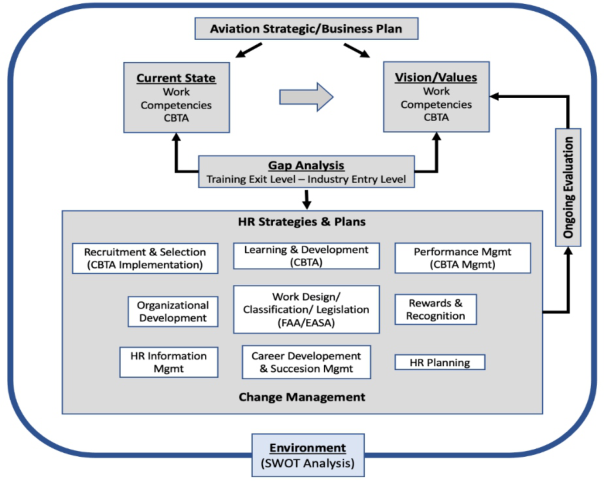
The proposed Asti SERA - Purdue research proposes both qualitative and quantitative methodologies to verify the efficacy of implementing Competency-Based Training Assessment in enhancing organizational perfor- mance within the framework of a well-defined change management strategy. The selected approach for this study is an inductive research method, which aims to examine the human–centered design approach in SATCE. This will be achieved by identifying communication, situation awareness, and decision- making personnel competencies that effectively affect performance gaps (Ziakkas, 2023).
Figure 1: Aviation HR Planning and Analysis Model as adapted from Paauwe and Farndale (2017).
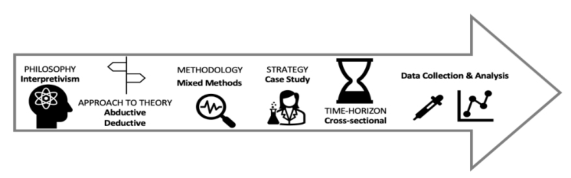
Furthermore, this study investigates the effects of implementing the human–centered design process and training on the operational expenses of the aviation ecosystem. The lean mindset is pertinent to research as it entails the elimination of unnecessary processes in the design procedure, hence facil- itating cost- and time-efficient testing - and qualification practices, reducing training expenses within potential SATCE operators. The use of Computer- Based Training and Assessment (CBTA) in aviation personnel planning is illustrated in Figure 2. This diagram is based on the Research Onion pro- posal, which has been developed from the work of Saunders, Lewis, and Thornhill (2019).
The primary focus of this study revolves around the application of a case study framework, which is widely used in the social sciences. This technique
630 Ziakkas and Waterman
Figure 2: CBTA Implementation in the human–centered design approach in SATCE based on the Research Onion proposal as adapted from Saunders, Lewis, and Thornhill (2019).
is favored for its capacity to offer a thorough and comprehensive analy- sis of a certain research topic or organization. The incorporation of a case study provides a valuable structure for the interpretivist paradigm, allowing researchers to gather qualitative insights from participants (Quinlan, 2019). This research would follow a case study approach to investigate through SATCE / ASTi SERA environment the aviation training - operation frame- work in Purdue /SATT - MPS A320 simulator device. This study’s primary data will be collected and analyzed from Purdue research team through ASTi SERA SATCE following identified research areas flown by subject matter experts (SMEs) who were purposefully selected for participation. The litera- ture research revealed four main topics after the thematic analysis, connecting competency-based training assessment, SATCE, AI technology roadmap ele- ments, and training/certification policies. Semi-structured interviews will be used as a data-gathering method, offering a compromise between the data collection process and allowing study participants to voice their thoughts and opinions (Bryman & Bell, 2015).
FINDINGS Following up on an extended literature review and an FAA CRADA request, ASTi and Purdue team concluded a research project aiming at the challenges of immersive technologies in aviation, focusing on SATCE. Recognizing the significant limitations of the role-playing instructor and the complete lack of other traffic in the state-of-the-art flight simulators, the industry addressed these deficiencies in the ICAO doc. 9625 edition 4, “Manual of Criteria for the Qualification of Flight Simulation Training Devices” published in 2015. This document defines “Environment ATC” as a desired capability of flight simulators and matches training tasks that require ATC and other traffic, to the identified features for all stages of flight training.
ASTi and the Purdue team agreed on the adoption of Line-Oriented Flight Training (LOFT) scenarios, which places emphasis on crew resource manage- ment (CRM). A LOFT session is intended to be representative of the standard line operations of an airline experienced on a daily basis but will include special emphasis on abnormal situations that involve communications, sit- uation awareness, and decision-making/leadership. Competency is a factor
Emerging Technologies in Transportation: The SATCE Case Study 631
of human performance that is used in the aviation sector to accurately pre- dict successful performance on the job. Behaviors that mobilize the necessary knowledge, abilities, and attitudes to do tasks or activities under prede- termined conditions are how competence is shown and observed. Further evolution of training methods, utilizing an approach known as Evidence- Based Training (EBT), will be followed in the SATCE research project, focusing on training and assessment of aviation ecosystem competencies (CBTA), focusing on Pilot Competencies, PC 2,5,6,7&8.
Table 1. The nine pilot competencies as followed by ASTi – Purdue research team.
Table available in the original PDF paper.
CBTA competencies Pilot competencies PC 0 Application of Knowledge PC 1 Application of Procedures and Compliance with Regulations PC 2 Communication PC 3 Aeroplane Flight Path Management, automation PC 4 Aeroplane Flight Path Management, manual control PC 5 Leadership & Teamwork PC 6 Problem Solving & Decision Making PC 7 Situation Awareness and Management of Information PC 8 Workload Management
Nowadays, an increased number of ATC Tower training system providers utilize speech recognition to understand trainee radio transmissions and implement synthetically modeled traffic aircraft that respond to the ATC voice commands, utilizing synthesized text-to-speech to create the aircraft radio response calls. ASTi SERA - Purdue research aims to minimize the exist- ing performance gap and present guidelines for the implementation of SATCE in aviation training.
ANALYSIS The Simulated ATC Environment (SATCE) however represents a 180-degree shift from the ATC Tower as we are now sitting in the cockpit looking out. The expert behavior of multiple controllers, as experienced through the duration of a flight, must now be replicated, in addition to sequencing and controlling other traffic aircraft. This increase in complexity elevates the controlling core significantly beyond the simple logic trees and flight behaviors required in tower simulators, and state-of-the-art SATCE solu- tions now utilize artificial intelligence to emulate ATC controllers and their decision-making.
Further consideration is given to the speech recognition requirements, since unlike ATC Tower simulators that emulate a fixed tower at a specific airport, a SATCE system may be deployed to a flight training center that supports flight crew from around the world. Consequently, the speech recognition solution must provide robust accent tolerance, while maintaining high recog- nition accuracy and utilize custom speech recognition solutions optimized for aviation English connecting with CBTA pilot competencies.
632 Ziakkas and Waterman
Finally, the generated speech, which represents both the ATC controllers and other traffic aircraft radio transmissions, must emulate the cadence of radio traffic as heard over the aviation frequencies. ASTi SERA environment provide many different voices and accents for this speech generation sub- system, since in the course of a typical flight, any given aircraft may interact with five or six different ATC controllers and will hear many different voices from other traffic aircraft over the radio. The monitoring and grading option of the Purdue team connects EBT scenarios with CBTA requirements.
CONCLUSION
For decision-makers without significant prior AI exposure or expertise, adap- tation of SATCE in aviation training faces several challenges. The goal of this research is to improve training effectiveness by incorporating immersive technologies in aviation training. The use of dynamic real-time visualization, automatic human profile assessment, and training system adaption tech- nologies has the potential to improve flight training’s overall efficacy and efficiency. This process of digitization includes a variety of immersive virtual technologies and synthetic learning environments. By using these technolo- gies, all persons participating in flight training will obtain a more complete insight of the participants’ performance, ultimately optimizing the training lifecycle.
The identified benefits are:
Reduced instructor hours
Competency-based training – simulator preparation
Training – scheduling flexibility
Improved System Knowledge
Faster Learning rate
Better knowledge retention
Reduced negative training.
To conclude, the ASTi SERA framework overcome problems and limita- tions inherent in human-provided communications instruction. The “Imple- mentation Guide for Artificial Intelligence in Aviation: A Human–Centric Guide for Practitioners and Organizations offers a step-by-step approach and facilitates certification and training syllabus – CBTA requirements (Ziakkas et al., 2023).
ACKNOWLEDGMENT
The authors thank faculty members of Purdue University and the ASTI research team for their invaluable feedback contributing to this work.
REFERENCES
Bryman, A., and Bell, E., 2015. Business research methods. (4th Ed) Oxford: Oxford University Press. Halldale Group (2022). “SATCE Closes the Fidelity Gap”. https://www.halldale.c
om/articles/19656-satce-closes-the-fidelity-gap
Emerging Technologies in Transportation: The SATCE Case Study 633
Halldale Group (2023). “Industry calls for mandatory adoption of SATCE in Pilot Training”. https://www.halldale.com/articles/21451-cat-industry-calls-for -mandatory-adoption-of-satce-in-pilot-training ICAO. (2015). Manual of Criteria for the Qualification of Flight Simulation Training
Devices - Volume I - Aeroplanes (9625-1) (4th ed., Vol. 1). International Civil Aviation Organization Paauwe, J., & Farndale, E. (2017). Strategy, HRM, and Performance: A Contextual Approach. Oxford University Press. Papadopoli, N. (2017). ATC simulation for flight training: The missing link. Interna-
tional Journal of Modeling, Simulation and Scientific Computing, 8(4), 1743001–. https://doi.org/10.1142/S1793962317430012 Pinto Neto, E. C., Baum, D. M., Almeida, J. R., Camargo, J. B., & Cugnasca, P. S.
(2023). Deep learning in air traffic management (ATM): A survey on applica- tions, opportunities, and open challenges. Aerospace, 10(4), 358. https://doi.org/ 10.3390/aerospace10040358 Quinlan, K. M. (2019). Emotion and moral purposes in higher education teaching: Poetic case examples of teacher experiences. Studies in Higher Education, 44(9), 1662–1675. https://doi.org/10.1080/03075079.2018.1458829 Saunders, M. N. K., Lewis, P., and Thornhill, A. (2019) Research Methods for
Business Students. Eighth Edition. New York: Pearson. SIMTHETIQ. (2021, August 31). SIMTHETIQ X2 VISUAL SYSTEM INTE- GRATED WITH ASTI SERA PRODUCT FOR SATCE-COMPLIANT FLIGHT TRAINING. https://www.simthetiq.com/news/x2-visual-system-integrated-with- asti-sera-satce-compliant-training/ Ziakkas, D., Pechlivanis, K., & Keller, J. (2023). The implementation of Artificial
Intelligence (AI) in Aviation Collegiate education: A simple to complex approach. Proceedings of the 6th International Conference on Intelligent Human Systems Integration (IHSI 2023) Integrating People and Intelligent Systems, February 22– 24, 2023, Venice, Italy. https://doi.org/10.54941/ahfe1002863 Ziakkas, D., Sarikaya, I., Natakusuma, H. C. (2023). EBT-CBTA in Aviation Training: The Turkish Airlines Case Study. In: Harris, D., Li, WC. (eds) Engineering Psychology and Cognitive Ergonomics. HCII 2023. Lecture Notes in Computer Science, vol 14018. Springer, Cham. https://doi.org/10.1007/978-3-031-35389- 5_14 Ziakkas, D., Vink, L.-S., Pechlivanis, K., & Flores, A. (2023). IMPLEMENTATION
GUIDE FOR ARTIFICIAL INTELLIGENCE IN AVIATION: A Human-Centric Guide for Practitioners and Organizations. In Amazon. Retrieved October 22, 2023, from https://www.amazon.com/IMPLEMENTATION-GUIDE-ARTIFI CIAL-INTELLIGENCE-AVIATION-ebook/dp/B0CL8H14TV/ref=sr_1_1?qid= 1697646031&refinements=p_27%3ADimitrios\protect$\relax+$Ziakkas&s=d igital-text&sr=1-1&text=Dimitrios\protect$\relax+$Ziakkas
LISTED IN THE AHFE DIGITAL BOOKSTORE CATALOGUE
Explore the complete digital volume
Human-Centered Design and User Experience
Read this individual research paper free through the original publisher, or explore the full digital proceedings book.
ISBN 978-1-958651-90-2
Explore this ISBN in the AHFE Bookstore ↗Listed in the July 2026 bookstore catalogue; search by ISBN to confirm current availability · Digital book purchase optional