Dimitrios Ziakkas, Gede Bagus Michael Kim, Dimitra - Eirini Synodinou (2024). Virtual Reality (VR) and Simulated Air Traffic Control Environment (SATCE) in flight training: The Purdue Case study. In: Human Interaction and Emerging Technologies (IHIET-AI 2024): Artificial Intelligence and Future Applications. AHFE Open Access, vol. 120, pp. 153–160. https://doi.org/10.54941/ahfe1004565
Adaptive learning capabilities based on Artificial Intelligence (AI) can provide learners with a personalized learning path. It is a capability that customizes the trainee’s learning experience to their identified learning style and preference while providing the quickest route through the pilot training program. To accomplish this, every training program should be integrated to provide context and relevance and improve performance by generating insights on the performance of learners or cohorts and the efficacy of associated content. The aviation industry seeks novel methods for pilot training that are more efficient. Competency-Based Training and Assessment (CBTA) is a method that proposes an assessment process that helps understand how a flight crew may be able to manage both foreseen and unforeseen incidents and uses this data to help the crew achieve a higher level of efficiency.With a centralized data capture process centered on the pilot’s information, a pilot profile can be created to provide personalized training and advanced insight into the pilot’s learning experience. New technologies like Virtual Reality (VR) training combined with biometric data like eye-tracking and facial tracking can be a powerful platform to obtain the required data. Describing the communication competency from a training perspective, an AI – VR training environment (Simulated Air Traffic Control Environment - SATCE) would allow the pilots to improve their communication skills, enable pilots to ask questions with a specifically trained Generative Pre-Trained (GPT) model, and receive a validated answer. The Purdue case study focuses on the cognitive aspects of flight training using emerging technologies. This research aims to improve training effectiveness by incorporating immersive technologies in aviation training. Dynamic real-time visualization, automatic human profile assessment, and training system adaption technologies can potentially improve flight training’s overall efficacy and efficiency. This digitization process includes various immersive virtual technologies and synthetic learning environments. By using these technologies, all persons participating in flight training will obtain a complete insight into the participants’ performance cognitive limitations, ultimately optimizing the training lifecycle.
Adaptive learning capabilities based on AI can provide learners with a per- sonalized learning path. It is a capability that customizes the trainee’s learning experience to their identified learning style and preference while providing the quickest route through the pilot training program. To accomplish this, every training program should be integrated to provide context and relevance and improve performance by generating insights on the performance of learners or cohorts and the efficacy of associated content. At its core, a recommenda- tion engine can support the decision-making process through a succession of contextualized recommendations based on the training program and learner performance. The aviation industry seeks novel methods for pilot training that are more efficient. Competency-Based Training and Assessment (CBTA) is a method that proposes an assessment process that helps understand how a flight crew may be able to manage both foreseen and unforeseen incidents and uses this data to help the crew achieve a higher level of efficiency (CBTA, Ziakkas et al., 2023b).
On the other hand, the Threat and Error Management (TEM) framework boosts safety by singling out activities likely to contribute to unfavorable conditions. Because of this, it is necessary to devise a reliable technique for evaluating technical and non-technical talents simultaneously. A pilot pro- file can be generated using a centralized data-capturing method based on the information pertaining to the pilot. AI allows the delivery of individualized instruction and advanced insight into the pilot’s learning experience. AI infer- ence algorithms can generate a digital twin of the pilot by merging several data sources, such as flight telemetry, biometry, psychometry, flight history, learner activity, and demographic information. Diverse profile qualities, such as a pilot’s performance profile, cognitive style, learning style, and aptitude profile, can provide a 360-degree perspective of the pilot. AI maximizes the use of both time and resources, making it possible to train pilots faster and at a lower overall cost. It is possible to provide lecturers with data-driven and actionable intelligence concerning the conduct of their students.
By training the pilots in a virtual environment, the instructors introduce evidence-based scenarios testing the pilot’s performance while collecting the required data. The biometric data allows for accurate training and assess- ment of pilot behaviors and performance (human performance parameters) in competencies like, but not limited to, application of procedures, proper use of automation, manual flying, communication, workload management, situation awareness, decision making, and resilience. The AI – biometric data enables accurate training and assessment of pilot behaviors and per- formance (human performance parameters) in a variety of competencies, including but not limited to the following: application of procedures, proper use of automation, manual flying, communication, workload management, situation awareness, decision making, and resilience (Ziakkas et al., 2023a).
METHODOLOGY
The Purdue SATT research approach uses the ADDIE (Analyse, Design, Develop, Implement, and Evaluate) instructional system design model
Virtual Reality (VR) and Simulated Air Traffic Control Environment 155
(Branch, 2009), which is recommended by the International Civil Avia- tion Organization (ICAO; 2015). Based on evidence-based training (EBT) database from airline customers implementing VR (all these could highly likely also apply to AI) in their training curriculum, the following steps have proven crucial to the successful implementation of VR and the broad acceptance of the new training devices/methods among trainees, instructors- examiners, and management:
Follow an “ADDIE” approach (Analyse, Design, Develop, Implement, and Evaluate).
Selection and training of instructors who will use VR during training ses- sions. Purdue implemented “road shows” where the instructors can get the opportunity to get comfortable with the new training devices, so they get a feeling of ownership. Ideally, these instructors will be ambassadors for the new training devices when introduced to the students.
Familiarization of students experiencing AI in a relaxed atmosphere.
Introduction of SATCE in Purdue A-320 MPS device.
A systematic framework is provided by the model that is advised for creating and developing a training system prototype and final product through a step-by-step procedure that takes into consideration pilots’ competencies.
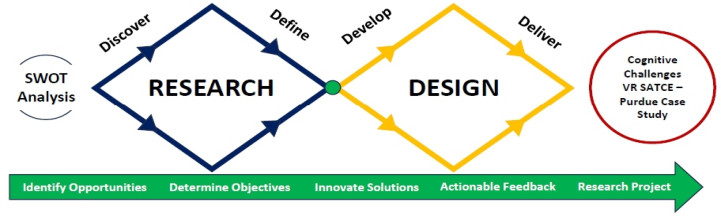
The strengths, limitations, possibilities, and risks posed by cognitive– immersive systems are evaluated during the analysis phase. This research study uses the Framework for Innovation Double-Diamond technique devel- oped by the British Design Council for the design phase. This methodology is depicted in Figure 1 (Design Council, 2023). This methodology is utilized in conjunction with the ADDIE framework. The Double-Diamond method provides a four-step framework to help designers approach an issue from a comprehensive and in-depth viewpoint (also known as divergent thinking) and then converge on a specific solution to suit design needs (Bell, 2015). This allows designers to meet design needs efficiently.
Figure 1: Double-diamond approach in AI training (Design Council, 2023).
According to Purdue research team protocol, the instructors will provide evidence-based scenarios to assess the pilots’ performance while gathering
the necessary data. This training will take place in Purdue A320 simulator - virtual environment. Purdue AI algorithms would generate a digital twin of the pilot by merging several data sources, such as flight telemetry, biometry, psychometry, flight history, learner activity, and demographic information. Diverse profile qualities, such as a pilot’s performance profile, cognitive style, learning style, and aptitude profile, can provide a 360-degree perspective of the pilot, allowing for essential information exclusive to the pilot profiling procedure to be incorporated into personalized training. Implementing AI would maximize the use of both time and resources, making it possible to train pilots in a shorter time and at a lower overall cost. It is possible to provide lecturers with data-driven and actionable intelligence concerning the conduct of their students (Ziakkas et al., 2023c).
Finally, the proposed Virtual instructor would update the training scenar- ios and correct the student instantly during the training session – in the same or better and safer way than an experienced Type Rating Instructor (TRI).
FINDINGS Virtual reality (VR) in the aviation industry has grown tremendously in pop- ularity over the past few years. VR may be applied in various ways, including for training, aircraft maintenance, and operational purposes. Purdue research team analysis focused on the following areas:
1. Virtual reality (VR) improves pilots’ training in flight simulators. Pilots can practice various scenarios, emergency procedures, and instrument oper- ations with the assistance of virtual reality headsets, which give a more immersive and realistic training environment. Purdue team aims to use VR to familiarize pilots with the normal–abnormal and emergencies in A320 and B-737. This makes it possible to conduct interactive training sessions and virtual walkthroughs of the cockpit’s instruments and controls.
2. Simulated Air Traffic Control Environment (SATCE) will be used to generate training scenarios that are as realistic as possible for air traffic con- trol training. In a simulated setting, air traffic controllers can hone their skills in emergency response management, communication protocols, and aviation traffic management.
3. Virtual Maintenance Training: This training is used to educate mainte- nance professionals on the aircraft’s many systems and components. Techni- cians are allowed to practice procedures and solve problems through virtual reality simulations, which provide hands-on training in a risk-free setting.
4. Emergency Procedures Training for Cabin Crew in Cabin Crew Train- ing: Virtual reality (VR) trains cabin crew personnel on emergency protocols such as evacuating passengers, administering first aid, and practicing fire drills.
5. Training for Customer Service: Virtual reality (VR) can be used to recre- ate in-flight scenarios, enabling cabin crew members to practice customer service interactions and improve their communication skills.
6. Evaluations and Assessments of the Pilots Training Program: Evalu- ation of Performance: VR is used to conduct performance evaluations of
Virtual Reality (VR) and Simulated Air Traffic Control Environment 157
pilots in various evidence-based training environments (EBT). Virtual real- ity simulations can potentially deliver objective data regarding a pilot’s decision-making ability, reaction time, and general proficiency.
7. Evaluation of Pilot Competencies: Virtual reality enables the evaluation of pilot competencies, including the ability to handle unexpected or emer- gencies following a Competency–Based Training and Assessment approach (CBTA).
ANALYSIS The preliminary findings of the Purdue research team analysis of the imple- mentation of VR -SATCE in aviation training, considering its benefits, and challenges are:
Benefits:
Immersive Learning Environment: VR - SATCE creates highly immersive and realistic environments, allow- ing trainees to experience scenarios simulating actual flight conditions or operational situations. Moreover, the trainees can better understand com- plex procedures, emergency responses, and critical decision-making in a controlled and safe virtual environment (Rostami, 2023).
Cost-Efficiency: VR -SATCE training reduces the need for extended hours on physical sim- ulators, aircraft, or dedicated training facilities, resulting in cost savings. As a result, airlines and training organizations can provide high-quality training without the significant costs associated with traditional training methods.
EBT Scenarios: VR enables the creation of EBT training scenarios, allowing trainees to practice specific maneuvers or emergency procedures following a CBTA approach.
Moreover, the trainees can hone their skills in specific areas, and instruc- tors can tailor training sessions to address individual needs. VR facilitates collaborative training sessions where multiple team members interact in a shared virtual space (Oberhauser, 2018).
Challenges: Acquiring high-quality VR hardware and software can be initially expensive.
Costs will likely decrease as technology advances, making VR more accessible to a broader range of aviation training programs.
Motion Sickness Concerns: Some individuals may experience motion sickness or discomfort during extended VR sessions. Ongoing research and development aim to reduce motion sickness through improved hardware, software optimization, and adaptive design.
Regulatory Compliance: Collaboration between industry stakeholders, regulators, and training organizations is essential to establish and update standards for VR-SATCE training.
Integration with Existing Training Programs: Gradual integration, clear regulatory guidelines, and collaboration with training organizations can help overcome this challenge.
Content Development and Standardization: Collaboration between industry experts, training organizations, and tech- nology developers can help establish content standards and best practices.
CONCLUSION
Based on the EASA Artificial Intelligence Roadmap (EASA, 2023a), it has been projected by industrial stakeholders that the early advancements in crew assistance/augmentation will likely occur during the timeframe of 2022 to 2025. While VR -SATCE offers substantial benefits, its implementa- tion in aviation faces many challenges, such as equipment cost, regulatory compliance, and resistance to change. Additionally, ongoing research and development are essential to enhance the realism and effectiveness of VR continually – SATCE applications in the aviation CBTA ecosystem.
Virtual Reality (VR) and Simulated Air Traffic Control Environment (SATCE) have significantly transformed flight training, offering immersive and realistic training environments. A notable case study in this field is the implementation at Purdue University, which illustrates the potential and effectiveness of these technologies in aviation education.
The Purdue SATT’s main conclusions regarding Virtual Reality in Flight Training are:
1. Immersive Experience: VR provides a fully immersive 3D environment, allowing trainees to experience a cockpit’s look and feel realistically. This includes visualizing flight instruments, gauges, and other critical flight data in a simulated environment. 2. Enhanced Learning: By simulating various CBTA flight scenarios, VR aids in the comprehensive training of pilots. It allows students to prac- tice maneuvers, understand complex flight dynamics, and respond to emergencies in a safe, controlled setting. 3. Cost-Effectiveness: VR reduces the need for actual flight hours, which are expensive and resource-intensive. This makes training more accessi- ble and affordable. 4. Customization and Flexibility: VR environments can be tailored to spe- cific training needs, enabling instructors to create scenarios relevant to the learner’s skill level and learning objectives.
Virtual Reality (VR) and Simulated Air Traffic Control Environment 159
Focusing on the Simulated Air Traffic Control Environment (SATCE) outcomes:
1. Realistic Interaction: SATCE simulates air traffic control communica- tions, providing trainees with realistic interactions. This is crucial for developing communication skills and understanding ATC procedures. 2. Enhanced Situational Awareness: Trainees learn to manage air traffic information, enhancing their situational awareness and decision-making skills. 3. Integration with VR: When combined with VR, SATCE provides a comprehensive simulation, offering both the visual and communicative aspects of flight.
In conclusion, integrating VR and SATCE in flight training, as exemplified by Purdue University, represents a significant advancement in aviation educa- tion. These technologies offer immersive, realistic, and cost-effective training solutions, enhancing the skill set of future pilots and reshaping the landscape of flight training globally.
As technology continues to advance, the integration of VR into aviation training and operations is likely to expand, providing an increasingly valuable tool for enhancing safety, efficiency, and overall performance in the aviation industry.
ACKNOWLEDGMENT
The authors thank faculty members of Purdue University and Human Factors analysts from HF Horizons, for their invaluable feedback contributing to this work.
REFERENCES
Branch, R. M. (2009). Instructional design: The ADDIE approach. New York, NY: Springer. https://doi.org/10.1007/978-0-387-09506-6 Bryman, A., and Bell, E., 2015. Business research methods (4th ed.). Oxford
University Press. Design Council. (2023). The Double Diamond. Retrieved from https://www.designcouncil.org.uk/our-resources/framework-for-innovation/ International Civil Aviation Organization (ICAO). (2015). Manual of criteria for the qualification of flight simulation training devices: Volume I - Aeroplanes (Doc 9625) (4th ed.). https://store.icao.int/en/manual-of-criteria-for-the-qualification- of-flight-simulation-training-devices-volume-i-aeroplanes-9625-1 Oberhauser, M., Dreyer, D., Braunstingl, R., and Koglbauer, I. (2018). What’s real
about virtual reality flight simulation? Aviation Psychology and Applied Human Factors, 8(1), 22–34. https://doi.org/10.1027/2192-0923/a000134 Rostami, M., Kamoonpuri, J., Pradhan, P., and Chung, J. (2023). Development and evaluation of an enhanced virtual-reality flight simulation tool for airships. Aerospace, 10(5), 457. https://doi.org/10.3390/aerospace10050457 Ziakkas, D., Pechlivanis, K., and Keller, J. (2023a). The implementation of Arti-
ficial Intelligence (AI) in aviation collegiate education: A simple to complex
approach. Intelligent Human Systems Integration (IHSI 2023): Integrating Peo- ple and Intelligent Systems, AHFE Open Access, 69. AHFE International, USA. https://doi.org/10.54941/ahfe1002863 Ziakkas, D., Sarikaya, I., and Natakusuma, H. C. (2023b). EBT-CBTA in aviation training: The Turkish Airlines case study. Engineering Psychology and Cognitive Ergonomics: HCII 2023 Lecture Notes in Computer Science, 14018, 188–199. https://doi.org/10.1007/978-3-031-35389-5_14 Ziakkas, D., and Vink, L.-S. (Eds.). (2023c). Implementation guide for artificial
intelligence in aviation: A human-centric guide for practitioners and organizations.
LISTED IN THE AHFE DIGITAL BOOKSTORE CATALOGUE
Explore the complete digital volume
Human Interaction and Emerging Technologies (IHIET-AI 2024): Artificial Intelligence and Future Applications
Read this individual research paper free through the original publisher, or explore the full digital proceedings book.
ISBN 978-1-958651-96-4
Explore this ISBN in the AHFE Bookstore ↗Listed in the July 2026 bookstore catalogue; search by ISBN to confirm current availability · Digital book purchase optional