Norbert Kukurowski, Marcin Mrugalski, Marcin Witczak, Justyna Patalas - Maliszewska (2023). Fault detection and estimation of a lithium-ion battery system using an adaptive observer. In: Human-Centered Design and User Experience. AHFE Open Access, vol. 114, pp. 727–734. https://doi.org/10.54941/ahfe1004293
Nowadays, we are dealing with the increasing complexity of industrial systems, which are often equipped with a large number of sensors and actuators. Industrial processes are usually complex and consequently vulnerable. The likelihood of multiple failures and resulting economic losses also increases. Therefore, fault estimation is gaining more and more attention from a practical point of view and is an important aspect in modern fault diagnosis (FD), which can provide knowledge about the detection, isolation and identification of the faults. In this paper a novel fault detection and estimation adaptive based observer approach for the Takagi-Sugeno (T-S) system is proposed.
Interruption of a process or a poor quality of the final product resulting from a system failure can cause serious economic losses, which are often many times greater than the costs of maintains of industrial system process and components (Jasiulewicz-Kaczmarek 2017, Jasiulewicz-Kaczmarek 2022). Moreover, with the onset of the Industry 4.0 era (Waszkowski 2022) and the increase in the degree of automation, robotisation and computerisation (Kiedrowicz 2016a, Kiedrowicz 2016b, Waszkowski 2016), there is a fur- ther increase in the number of system components, sensors and actuators. Such situation may increase the likelihood of simultaneous failure of vari- ous system components. Moreover, the high complexity of modern systems requires special support for the operators who manage them. The abundance of diagnostic information may cause decision-making errors, especially in the area of system control, which may lead to significant material losses. The design of modern technical systems often aims to either limit the impact of the human factor on a system/process or to design the system in such a way that it provides necessary and reliable information enabling decision-making by the system operator. This article develops a fault estimation method that pro- vides the operator precise information about the moment of occurrence and characteristics of fault. Fault detection and identification (FDI) (Chen 2017, Lan 2016, Mrugalski 2007) methods for fault diagnosis include standard
fault detection and location procedures, while fault estimation methods are additionally used to estimate the signals of the faults. In the literature, it can often find a combination of FDI and fault estimation (FE) (Zhirabok 2015, Rodrigues 2015) methods due to the fact that FDI schemes alone do not pro- vide estimation of real fault. In this case, we are dealing with a two-stage operation, where first the detection and location of fault takes place, and then the stage of fault estimation begins, i.e., the estimation of its course in time. Despite many publications on the problem of fault estimation, it seems that this issue is still an open research problem. Most research publications is focused on estimating only one type of fault, i.e., the actuator (Lan 2016, Paz- era 2020) or the sensor (Chen 2017, Zhang 2017, Zhang 2018). Although in the current literature there are results of research on observers that are able to detect simultaneous faults of actuators and sensors, the disadvantage of most of them is the assumption of a limited error rate, i.e., it is assumed that the error derivative is close to zero. Nevertheless, among the existing fault esti- mation strategies, those based on sliding observers (Xia 2017, Feng 2020) and the Kalman filter (Gou 2018) are of key interest. Considering the above, it is natural that the problem of simultaneous estimation of actuator and sen- sor faults is gaining more and more attention of the authors of numerous research papers (Liu 2018, Youssef 2017, Lan 2016, Chaves 2019). Nev- ertheless, these methods are mostly designed for linear systems, while the number of strategies capable of handling some classes of non-linear systems is rather limited. In order to solve this problem, a procedure for designing an adaptive observer for the Takagi-Sugeno system was developed in this paper. The Takagi-Sugeno (Takagi 1985) system takes into account the pos- sibility of fault to the actuator and sensor, as well as possible disturbances in the form of measurement and process uncertainty. The main feature of the proposed adaptive observer is its simple design procedure, where it consists of three separate estimations of the state, sensor and actuator faults with the application of its own gain matrices. As a consequence, the procedure for designing an adaptive observer boils down to the calculation of a linear matrix inequality and the calculation of three reinforcement matrices. The advantage of the developed observer is the simple implementation. Finally, the correctness and accuracy of the developed observer was validated in the work using a battery system whose Takagi-Sugeno model was developed on the basis of experimental data.
ADAPTIVE OBSERVER FOR T-S SYSTEMS The system in the form of T-S, taking into account the occurrence of fault and disturbances, can be defined as follows:
xf,k + B
uf,k + B
Equations and mathematical formulas are available in the original paper PDF.
f a,k + W1w1,k
pk
pk
pk i
h
hi
+ W1w1,k, (1)
pk
pk
pk
f a,k
Aixf,k + Bi
uf,k + Bi
Fault Detection and Estimation of a Lithium-Ion Battery System 729
and
M X
hi
hi
pk
where xf,k ∈X ⊂Rn, uf,k ∈Rr and yf,k ∈Rm are the state, input, and out- put vectors, respectively. The A, B, and C matrices are known system state, input, and output matrices, where Wm indicates the number of T-S models. Also, the symbols f a,k ∈Fa ⊂Rna and f s,k ∈Fs ⊂Rns denote actuator and sensor fault vectors. In addition, the Cf matrix points to the sensor failure distribution matrix, where rank(Cf) = ns and na + ns ≤m. This means that it is possible to estimate faults of the sensors and actuators only when their number does not exceed the number of measurable system outputs. Whereas, W1 and W2 are vector distribution matrices w1,k and w2,k, which represent external disturbances in the form of measurement uncertainty and process. Finally, the following notation is used throughout the rest of the subsection
Ai, (4)
hi
pk
In this paper, the following equations describing the state estimates, faults of actuators and sensors have been proposed:
uf,k + B
pk
pk
pk
bf a,k+
bxf,k + B
+W1w1,k+Kx
pk
Equations and mathematical formulas are available in the original paper PDF.
pk
yf,k −Cbxf,k −Cfbf s,k
The state estimation error can be described in the following concise form:
wk, (8) pk pk
ef,k + f W
where:
[Equation or mathematical symbol available in the original paper PDF]
[Equation or mathematical symbol available in the original paper PDF]
−Kf
pk
pk
pk
pk
eA
[Equation or mathematical symbol available in the original paper PDF]
[Equation or mathematical symbol available in the original paper PDF],
0 0 I 0 0 0 I
KT
KT
KT
Kx
pk
pk
pk
x a
pk
pk
pk
Equations and mathematical formulas are available in the original paper PDF.
f W2,
[Equation or mathematical symbol available in the original paper PDF]
[Equation or mathematical symbol available in the original paper PDF] W1 0 0 0
C 0 Cf
[Equation or mathematical symbol available in the original paper PDF]
Equations and mathematical formulas are available in the original paper PDF.
0 0 I 0 0 0 0 I
Therefore, the following theorem is proposed for the design of the observer: The system based on observer 8 is strictly quadratic bounded for
pk
all values ewk ∈Ew if there are matrices Pf>0 and Nf
as well as the value as well as the value α ∈(0, 1) such that the following condition is met: [Equation or mathematical symbol available in the original paper PDF][Equation or mathematical symbol available in the original paper PDF]
[Equation or mathematical symbol available in the original paper PDF]
[Equation or mathematical symbol available in the original paper PDF]< 0. (9)
−Nf
C PfW3 −Nf
W2 −Pf
pk
pk
pk
Finally, the procedure for designing the T-S adaptive observer developed in this chapter boils down to calculating the linear matrix inequality (9) and obtaining the following reinforcement matrices:
[Equation or mathematical symbol available in the original paper PDF]
Ka
Kf
pk
pk
pk
f −Nf [Equation or mathematical symbol available in the original paper PDF]
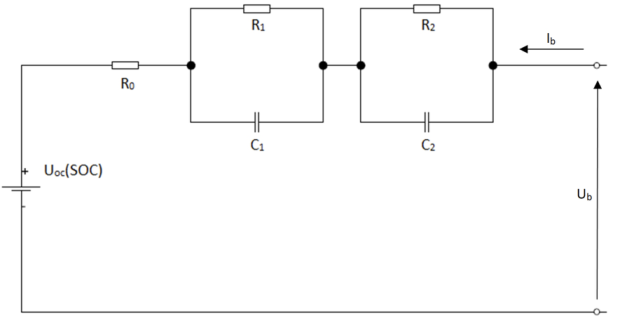
AN EXAMPLE OF FAULT ESTIMATION OF A LITHIUM-ION BATTERY SYSTEMS The purpose of this section is to present the efficiency of the developed adap- tive observer on the example of state and faults estimation of the lithium-ion battery system. To achieve this goal the following equivalent second-order resistor-capacitor circuit model is considered:
Equations and mathematical formulas are available in the original paper PDF.
where U1, R1, C1 and U2, R2, C2 are the voltage, resistance and capaci- tance variables of the first and second resistor-capacitor circuits, respectively. Moreover, the value Ib represents the system current and Cb represents the nominal capacity, which is Cb ≈2[Ah]. A graphical diagram of the resistor-capacitor circuit is shown in the Figure 1.
Figure 1: A graphical diagram of the second-order resistor-capacitor circuit.
Fault Detection and Estimation of a Lithium-Ion Battery System 731
The following faults scheme was proposed to verify the correctness and accuracy of the developed observer:
−0, 35 · uk a · ebj
Equations and mathematical formulas are available in the original paper PDF.
0, 13 · uk 0
Equations and mathematical formulas are available in the original paper PDF.
where yf,k −0, 01
[Equation or mathematical symbol available in the original paper PDF] along with the fault distribution matrix of current and voltage measurement:
[Equation or mathematical symbol available in the original paper PDF]
[Equation or mathematical symbol available in the original paper PDF]
Mm X
Bi
[Equation or mathematical symbol available in the original paper PDF]
Note that the voltage measurement fault distribution matrix contains either zeros or ones. One means that the fault affects the given measurement, and zero means the opposite.
Such a faults scenario allows to check the correctness and performance of the proposed observers in four cases:
Instantaneous permanent fault;
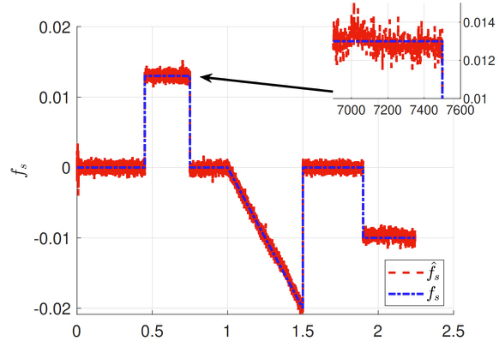
Linearly increasing fault for voltage measurement f s,k;
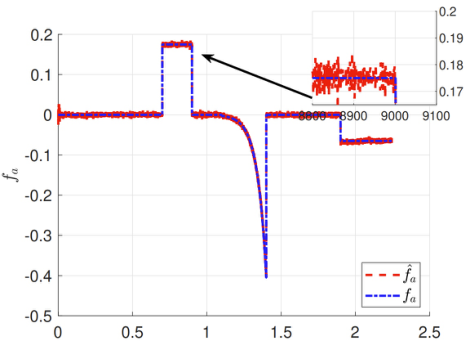
Exponential fault for current measurement f a,k;
Permanent fault of a fixed value.
Moreover, the disturbance distribution matrices in the form of measure- ment and process uncertainty are defined as follows: W1 = 1 · 10−6I, W2 = 1 · 10−2I. (15)
It should be noted that the interference distribution matrices were defined using experimental data and the general approach proposed in (Witczak 2015). In the proposed case, the failure of the voltage measurement f s,k corre- sponds to possible significant measurement inaccuracies. Similarly, the failure of the current measurement f a,k corresponds to a significant loss of battery performance related to its behaviour based on the discharge current. In addi- tion, you can see that positive and negative fault values are included in the faults scenario. Moreover, it is clear that the voltage measurement fault dis- tribution matrix Cf is defined on the basis of the C matrix of the (11) model. Furthermore, from the Cf matrix, it should be noted that the f s,k corruption
occurred in the U2 state of the system. Moreover, on the basis of the equa- tions (12)-(13) it is worth stating that the faults of the voltage and current measurement occurred simultaneously in the given moments of time.
Figures 2–3 show, respectively, voltage f s,k and current f a,k faults accord- ing to the fault scenario (12)-(13). The blue line shows the actual fault, while the red line shows its estimation. It can be seen that the quality of faults esti- mation is very good in both cases, despite the disturbances. In addition, an important aspect is that in both cases there are three types of fault, i.e., tem- porary, permanent and slowly increasing. In addition, it should be noted that at given moments of time, voltage and current measurement failures occur simultaneously, which is an additional difficulty in estimating their value.
Figure 2: Voltage measurement fault.Figure 3: Current measurement fault.
CONCLUSION
This paper presents the construction of an adaptive observer. The main fea- ture of the adaptive observer is its simple design procedure, where it consists of three separate estimations for estimating the condition and faults of the
Fault Detection and Estimation of a Lithium-Ion Battery System 733
sensor and actuator, each with its own gain matrix. As a consequence, the procedure for designing an adaptive observer boils down to the calcula- tion of a linear matrix inequality and the calculation of three reinforcement matrices. Therefore, the advantage of the developed observer is the pos- sibility of its simple implementation, however, the control system should have a relatively large computing power due to the number of gain matrixes and additional disturbances resulting from mathematical calculations. The designed observers for estimating the faults of the sensor and actuator pro- vides the operator precise information about the moment of occurrence and characteristics of fault.
REFERENCES
Chaves, E., André, F. and Maitelli, A. (2019). Robust observer-based actuator and sensor fault estimation for discrete-time systems, Journal of Control, Automation and Electrical Systems, pp. 1–10. Chen, H., Jiang, B., and Lu, N. (2017). Data-driven incipient sensor fault estima-
tion with application in inverter of high-speed railway, Mathematical Problems in Engineering, vol. 2017. Feng, X. and Wang, Y. (2020). Fault estimation based on sliding mode observer for takagi–sugeno fuzzy systems with digital communication constraints, Journal of the Franklin Institute, vol. 357, no. 1, pp. 569–588. Gou, L., Zhou, Z., Liang, A., Wang, L. and Liu, Z. (2018). Dynamic threshold design
based on Kalman filter in multiple fault diagnosis, in 2018 37th Chinese Control Conference (CCC), pp. 6105–6109, IEEE. Jasiulewicz-Kaczmarek, M. Waszkowski, R. Piechowski, M., Wyczółkowski, R.
(2018) “Implementing BPMN in Maintenance Process Modeling”, in: Informa- tion Systems Architecture and Technology: Proceedings of 38th International Conference on Information Systems Architecture and Technology – ISAT 2017, ´Swia˛tek, J., Borzemski, L., Wilimowska, Z. (Ed.). Volume 656, pp. 300–309. Jasiulewicz-Kaczmarek, M., Antosz, K., Zhang, Ch., and Waszkowski, R., (2022).
Assessing the Barriers to Industry 4.0 Implementation From a Maintenance Man- agement Perspective - Pilot Study Results, IFAC-Papersonline, Volume 55 No. 2, pp. 223–228. Kiedrowicz, M., Nowicki, T., Waszkowski, R., Wesołowski, Z., and Worwa, K., (2016a). Software simulator for property investigation of document management system with RFID tags. MATEC Web Conf. Vol. 76. Kiedrowicz, M., Nowicki, T., Waszkowski, R., Wesołowski, Z., and Worwa, K.,
(2016b). Method for assessing software reliability of the document management system using the RFID technology. MATEC Web Conf. Vol. 76. Lan, J. and Patton, R. (2016). A new strategy for integration of fault estimation within fault-tolerant control, Automatica, vol. 69, pp. 48–59. Li, J., Pan, K., and Su, Q. (2019). Sensor fault detection and estimation for switched
power electronics systems based on sliding mode observer, Applied Mathematics and Computation, vol. 353, pp. 282–294. Liu, X., Gao, Z. and Zhang, A. (2018). Robust fault tolerant control for discrete-time dynamic systems with applications to aero engineering systems, IEEE ACCESS, vol. 6, pp. 18832–18847. Mrugalski, M., and Korbicz, J. (2007). Least mean square vs. outer bounding ellip-
soid algorithm in confidence estimation of the GMDH neural networks, Lecture Notes in Computer Science: Adaptive and natural computing algorithms: 8th International Conference - ICANNGA 2007, Vol. 2, Vol. 4432, 19–26,
Pazera, M., Buciakowski, M., Witczak, M., Mrugalski M. (2020). A quadratic boundedness approach to a neural network-based simultaneous estimation of actuator and sensor faults, Neural Computing and Applications, Vol. 32, iss. 2, 379–389, ISSN: 0941-0643, eISSN: 1433-3058. Rodrigues, M., Hamdi, H., Theilliol, D., Mechmeche, C., and Braiek, N. B. H.
(2015). Actuator fault estimation based adaptive polytopic observer for a class of LPV descriptor systems, International Journal of Robust and Nonlinear Control, vol. 25, no. 5, pp. 673–688. Takagi, T. and Sugeno, M. (1985). Fuzzy identification of systems and its applications to modelling and control, IEEE Trans. Systems, Man and Cybernetics, vol. 15, no. 1, pp. 116–132. Waszkowski, R., and Bocewicz, G., (2022). Visibility Matrix: Efficient User Inter-
face Modelling for Low-Code Development Platforms. Sustainability. Volume 14, No. 13, p. 8103. Waszkowski, R., Kiedrowicz, M., Nowicki, T., Wesołowski, Z., and Worwa, K., (2016). Business processes in the RFID-equipped restricted access administrative office. MATEC Web Conf. Vol. 76. Witczak, M., Mrugalski, M., and Korbicz, J. (2015). Towards robust neural-
network-based sensor and actuator fault diagnosis: Application to a tunnel furnace, Neural Processing Letters : Special Issue: International Work-Conference on Artificial Neural Networks (IWANN), (2013), vol. Vol. 42, iss. 1, pp. 71–87. Xia J., Guo, Y., Dai, B. and Zhang, X. (2017). Sensor fault diagnosis and system reconfiguration approach for an electric traction PWM rectifier based on slid- ing mode observer, IEEE Transactions on Industry Applications, vol. 53, no. 5, pp. 4768–4778. Youssef, T., Chadli, M., Karimi, M., and Wang, R. (2017). Actuator and sensor faults
estimation based on proportional integral observer for T-S fuzzy model, Journal of the Franklin Institute, vol. 354, no. 6, pp. 2524–2542. Zhang H., Han, J., Wang, Y., and Liu, X. (2017). Sensor fault estimation of switched fuzzy systems with unknown input, IEEE Transactions on Fuzzy Systems, vol. 26, no. 3, pp. 1114–1124. Zhang, Q. (2018). Adaptive Kalman filter for actuator fault diagnosis, Automatica,
vol. 93, pp. 333–342. Zhirabok, A. and Shumsky, A. (2018). Fault diagnosis in nonlinear hybrid systems, International Journal of Applied Mathematics and Computer Science, vol. 28.
LISTED IN THE AHFE DIGITAL BOOKSTORE CATALOGUE
Explore the complete digital volume
Human-Centered Design and User Experience
Read this individual research paper free through the original publisher, or explore the full digital proceedings book.
ISBN 978-1-958651-90-2
Explore this ISBN in the AHFE Bookstore ↗Listed in the July 2026 bookstore catalogue; search by ISBN to confirm current availability · Digital book purchase optional