Justyna Patalas - Maliszewska, Marcin Mrugalski (2023). Improving sustainable production in the context of Industry 4.0 technologies adoption - Evidence from metalworking Industry. In: Application of Emerging Technologies. AHFE Open Access, vol. 115, pp. 303–309. https://doi.org/10.54941/ahfe1004327
Nowadays the industry places a greater focus on the integration of production and sustainable development and on improving the sustainability efficiency. It is still the research niche to understand the specific factors regarding the progress of activities towards sustainable production. This study has used literature analysis to describe sustainable production (SP), in terms of implication of the Industry 4.0 technologies and a questionnaire survey, which was conducted within 84 small and medium sized enterprises metalworking Industry in Europe, Poland. The questionnaire in this article considers the factors describing the level of SP in the enterprises of metalworking industry and also the level of the implementation of selected Industry 4.0 technologies, namely: cyber-physical systems (CPSs) and robots. Next, a statistical analysis was conducted using correlation coefficients. The highest correlation was observed in the case of applying CPS systems into SMEs company metalworking industry and improving the level of SP, respectively in the area: (1) environmental: considering implementation of climate governance/action strategies, (2) economic: in the aspect of increasing after-sales service, (3) social: in view of improving the customer satisfaction and implementation the continuous improvement process within a company. Also, a relatively good correlation was observed in the case of the analysis of the relationship between usage of robots in the company and factors describing SP level in the same areas as was discovered for the correlation between applying CPSs. The results indicated also that implementation of robots has a strong relationship with the SP factor in the social area, namely: accidents at work recorded. So, the research results show that for the SMEs metalworking Industry surveyed, the implementation of Industry 4.0 technology, namely robots and CPSs, increases the level of SP.
Industry 4.0 concept can be treated as the socio-technical approach to inte- grate cyber-physical systems (CPSs) into manufacturing (Mariani and Borghi,
2019). Also, it is stated that new manufacturing technologies are neces- sary for sustainable production (SP) (Kumar et al., 2020). The SP concept is defined mostly in the light of the three dimensions of the sustainable devel- opment (SD), namely: environmental, economic and social, but also in the six spaces: resources; environment; economic performance; community develop- ment and social justice; workers and products (Khanzode et al., 2021). It can be understood as the action which is not representing the threat for the future generations and is not carried out at the expense of future generations (Nizetic et al., 2019). The implementation of the selected Industry 4.0 technologies (such as the Internet of Things, Cloud Computing, CPSs, Additive Manufac- turing Technologies, Big Data analysis, Simulation, Cybersecurity, Robotics) into manufacturing can increase the level of efficiency, quality, flexibility and SP (Kaczmarek-Jasiulewicz et al., 2022), (Waszkowski and Bocewicz 2022). Moreover, the industrial sector is key to achieving the Climate and Energy Policy’s goal. Therefore, the main objective of this work is to model the rela- tionships between applying CPS systems and robots into small and medium sized enterprises (SMEs) metalworking Industry and improving the level of sustainable production (SP), respectively in the area: (1) environmental, (2) economic and (3) social.
When considering the role played by SP in SMEs development, then the expected new manufacturing technologies adoption, all point to the objective of this paper, which is to explore the following research questions (RQ):
RQ1. What key factors describing the level of SP in the three main areas: environmental, economic and social can be used to model the impact of applying CPS systems and robots into SMEs on the level of SP?
RQ2: How can be understand the relationships between the implementa- tion of the selected Industry 4.0 technologies and SP?
Therefore, in order to define the relationship between the I4.0 technologies implementation and the improving of the level of SP in SMEs metalwork- ing industry, firstly the research model is created. Next, based on the results of the literature research and our previous research results, by using the Fuzzy -Technique for Order of Preference by Similarity to Ideal Solution (F- TOPSIS) method (Patalas-Maliszewska et al., 2020), (Patalas-Maliszewska et al., 2022) it was possible to define the factors describing the level of SP in SMEs in the three main areas: environmental, economic and social, thus addressing RQ1. The next research question (RQ2) was investigated in the form of the analysis of the results from the empirical research, which was con- ducted within 84 small and medium sized enterprises metalworking Industry in Europe, Poland.
RESEARCH MODEL Based on the results of the literature research and our previous works (Patalas-Maliszewska et al., 2020), (Patalas-Maliszewska et al., 2022) the factors describing the level of SP for SMEs were defined (Table 1), they were included in the questionnaire used in this paper. The method of study- by-questionnaire makes it easier to conduct research among many research
Improving Sustainable Production in the Context of Industry 4.0 Technologies Adoption 305
objects and the empirical research results can be applied in the statistical analyses (Motyl et al., 2017).
Table 1. SP factors for SMEs.
Table available in the original PDF paper.
SP area Factors Abbr.
SDe1
environmental Use of renewable energy, own energy sources” (solar, wind, water) SDe3 Implementation of climate governance/action strategies SDe2 Utilization of hazardous substances/materials used in technological processes
SDc1
Control of greenhouse gas emissions SDe4 Recyclability of products after use or production waste SDe5 economic Electricity consumption per month [kWh] (the average obtained consumption values per employee) SDc3 Number of complaints (lower than 0.5%) SDc2 Re-use of production scrap/waste in production processes
Implementation of quality management audits SDc4 After-sales service SDc5 social Accidents at work recorded SDs1 Customer satisfaction assessment system SDs2 Continuous improvement process SDs3 Employee involvement in decision-making processes SDs4 Activities for good working atmosphere SDs5
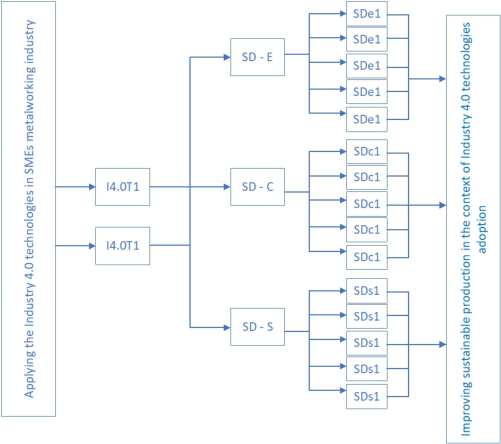
The questionnaire in this article considers the factors describing the level of SP in the enterprises of metalworking industry and also the level of the imple- mentation of selected Industry 4.0 technologies, namely: CPSs and robots (Figure 1).
In order to define the relationship (Figure 1) between the I4.0 technologies implementation and the improving of the level of SP in SMEs metalworking industry the correlation analysis based on the empirical research results is provided.
RESEARCH RESULTS The results of the empirical research were obtained from 100 European, Pol- ish companies metalworking industry in 2022, and for further analysis the empirical research results from 84 SMEs were considered. The analysed com- panies constituted 1% of the representative group in the western Poland region (based on data from the Polish Central Statistical Office in Poland (Statistical Yearbook of Industry – Poland, 2021). So, factors describing SD in the area environmental, in a Polish SMEs, metalworking industry, were based on feedback surveys and their sources are listed here:
The level of SP in the area environmental:
I know that the company uses of renewable energy, own energy sources” (solar, wind, water) - SDe1 is: factor0: no/factor1: yes.
306 Patalas-Maliszewska and Mrugalski
I know that the company implements of climate governance/action strate- gies - SDe2 is: factor0: no/factor1: yes.
I know that the company utilizes of hazardous substances/materials used in technological processes – Sde3 is: factor0: no/factor1: yes.
I know that the company implements the mechanism of control of green- house gas emissions of hazardous substances/materials in technological processes – Sde4 is: factor0: no/factor1: yes.
I know that the company recycles of products after use or production waste – Sde5 is: factor0: no/factor1: yes.
Figure 1: Research model.
The level of SP in the area economic:
I know that the in the company the electricity consumption per month [kWh] (the average obtained consumption values per employee) is lower as the reference value for this sector: - SDc1 is: factor0: no/factor1: yes.
I know that in the company number of complaints is lower than 0.5% - SDc2 is: factor0: no/factor1: yes.
I know that the company re- uses production scrap/waste in production processes – Sdc3 is: factor0: no/factor1: yes.
I know that the company implements quality management audits – Sdc4 is: factor0: no/factor1: yes.
I know that the company provides after-sales service – Sdc5 is: factor0: no/factor1: yes.
The level of SP in the area social:
I know that the number of aaccidents at work is lower than 1 per year: - SDs1 is: factor0: no/factor1: yes.
I know that the company implements customer satisfaction assessment system - SDs2 is: factor0: no/factor1: yes.
Improving Sustainable Production in the Context of Industry 4.0 Technologies Adoption 307
I know that the company implements continuous improvement process – Sds3 is: factor0: no/factor1: yes.
I know that the company involves employee in decision-making processes – Sds4 is: factor0: no/factor1: yes.
I know that the company provides activities for good working atmo- sphere – Sds5 is: factor0: no/factor1: yes.
The area of implementation of Industry 4.0 technology has been defined as:
I know that in the company the cyber-physical system is implemented: - I4.0T1 is: factor0: no/factor1: yes.
I know that in the company the more than 10 robots are used - I4.021 is: factor0: no/factor1: yes.
The correlation coefficient (r) taking values in the interval <-1;1>, where: -1 means that the relationship is strongly negative, 1 - the correlation is strongly positive, 0 – it is no linear correlation. The analysis in this study was carried out using Statistica ver. 13.3 (StatSoft Polska Sp. z o.o., Kraków, Poland).
The test results indicated the best correlation are presented in Tables 2-3, where: r2—coefficient of determination; t—the value of t statistics examining the significance of the correlation coefficient; p—probability value.
Table 2. The correlation between applying CPSs (I4.0T1) and factors describing SP level in SMEs.
Based on results, the highest correlation was observed in the case of apply- ing CPS systems into SMEs company metalworking industry and improving the level of SP, respectively in the area:
Environmental: in the context of implementation of climate gover- nance/action strategies.
Economic: in the aspect of increasing after-sales service.
308 Patalas-Maliszewska and Mrugalski
Social: in the context of improving the customer satisfaction and imple- mentation the continuous improvement process within a company.
Table 3. The correlation between applying and using robots (I4.0T2) and factors describing SP level in SMEs.
A relatively good correlation was observed in the case of the analysis of the relationship between usage of robots (I4.0T2) in the company and fac- tors describing SP level (Table 2) in the same areas as it was discovered for the correlation between applying CPS (I4.0T1) – Table 1. The results indi- cated also that implementation of robots has a strong relationship with the SP factor in the social area: accidents at work recorded.
CONCLUSION
Improving SP requires many changes in manufacturing, especially in SMEs. This article has investigated how the implementation of the selected Indus- try 4.0 technologies can influence on the SP level. The first finding is that it was observed the similar correlation between the applying CPSs and robots into SMEs metalworking industry and improving the level of SP, respec- tively in the area: (1) environmental: considering implementation of climate governance/action strategies, (2) economic: in the aspect of increasing after- sales service, (3) social: in view of improving the customer satisfaction and implementation the continuous improvement process within a company. It is known, that integrating new technologies into SMEs requires the use of specialised applications supporting managers in this process (Waszkowski et al., 2016), (Kiedrowicz et al., 2016), (Jasiulewicz-Kaczmarek et al., 2017). Therefore, in order to be able to improve SP thanks to the applied new tech- nology, managers should prepare and implement the strategies for continuous improvement of processes carried out in the enterprise and an information system for monitoring the effects of the improvements.
Improving Sustainable Production in the Context of Industry 4.0 Technologies Adoption 309
Secondly, in order to improve the level of SP in SMEs, activities related to conducting production according to the needs of a given customer should be developed. Therefore, further direction of work is directed at analysis the level of implementation of the mass customization (MC) strategy in the con- text of the Industry 4.0 implementation. MC is treated as production, tailored to individual client’s needs.
REFERENCES
Jasiulewicz-Kaczmarek, M. Waszkowski, R. Piechowski, M., Wyczółkowski, R.
(2018) “Implementing BPMN in Maintenance Process Modeling”, in: Informa- tion Systems Architecture and Technology: Proceedings of 38th International Conference on Information Systems Architecture and Technology – ISAT 2017, ´Swia˛tek, J., Borzemski, L., Wilimowska, Z. (Ed.). Volume 656, pp. 300–309. Jasiulewicz-Kaczmarek, Malgorzata. Antosz, Katarzyna. Zhang, Chao. Waszkowski,
Robert. (2022). Assessing the Barriers to Industry 4.0 Implementation From a Maintenance Management Perspective - Pilot Study Results, IFAC-Papersonline, Volume 55, No. 2, pp. 223–228. Khanzode, Akshay. Sarma, P. R. S., Mangla, Sachin Kumar. Yuan, Hongjun. (2021).
Modeling the industry 4.0 adoption for sustainable production in micro, small & medium enterprises. Journal Cleaner Production. Volume 279, pp. 123489. Kiedrowicz, Maciej. Nowicki, Tadeusz. Waszkowski, Robert. Wesołowski, Zbigniew. Worwa, Kazimierz. Software simulator for property investigation of document management system with RFID tags. MATEC Web Conf. Volume 76. Kumar, Shailendra. Suhaib, Mohd. Asjad, Mohammad and Salah, Bashir. (2022).
Industry 4.0 and Its Suitability in Post COVID-19. Journal of Industrial Integra- tion and Management, Volume 7, No. 1, pp. 1–20. Mariani, Marcello and Borghi, Matteo. (2019). Industry 4.0: A bibliometric review of its managerial intellectual structure and potential evolution in the service indus- tries. Technological Forecasting and Social Change, Volume 149, pp. 119752. Motyl, Barbara. Baronio, Gabriele. Uberti, Stefano. Speranza, Domenico. Filippi,
Stefano. (2017). How will Change the Future Engineers’ Skills in the Industry 4.0 Framework? A Questionnaire Survey. Procedia Manufacturing. Volume 11, pp. 1501–1509. Nizetic, Sandro. Djilali Nedjib., Papadopoulos, Agis. Rodrigues, Joel J. P. C. (2019).
Smart technologies for promotion of energy efficiency, utilization of sustainable resources and waste management. Journal of Cleaner Production, Volume 231, pp. 565–591. Patalas-Maliszewska, Justyna. Łosyk, Hanna. (2020). An Approach to Assessing Sustainability in the Development of a Manufacturing Company. Sustainability. Volume 12, pp. 8787. Patalas-Maliszewska, Justyna. Rehm, Matthias. Łosyk, Hanna. (2022). Manu-
facturing knowledge map for Sustainable Manufacturing: a case study. IFAC- Papersonline, Volume 55, pp. 217–222. Waszkowski, Robert. Kiedrowicz, Maciej. Nowicki, Tadeusz. Wesołowski, Zbigniew. Worwa, Kazimierz. (2016). Business processes in the RFID-equipped restricted access administrative office. MATEC Web Conf. Volume 76. Waszkowski, Robert. Bocewicz, Grzegorz. (2022). Visibility Matrix: Efficient
User Interface Modelling for Low-Code Development Platforms. Sustainability. Volume 14, No. 13, pp. 8103.
LISTED IN THE AHFE DIGITAL BOOKSTORE CATALOGUE
Explore the complete digital volume
Application of Emerging Technologies
Read this individual research paper free through the original publisher, or explore the full digital proceedings book.
ISBN 978-1-958651-91-9
Explore this ISBN in the AHFE Bookstore ↗Listed in the July 2026 bookstore catalogue; search by ISBN to confirm current availability · Digital book purchase optional