Yuxin Sheng, Tingmin Yan, Yanhao Geng, Zijing Dai, Yinan Li (2024). Establishing Sustainable Health Services for the Medication of Elderly Chronic Diseases : An Analysis Based on SAPAD. In: Human Interaction and Emerging Technologies (IHIET 2024). AHFE Open Access, vol. 157, pp. 582–592. https://doi.org/10.54941/ahfe1005518
Over 85% of elderly individuals suffer from one or more chronic diseases, with the primary treatment approach involving long-term use of targeted medications. The medication process for afflicted elderly individuals comprises three essential steps: medical evaluation, obtaining prescribed medication, and adhering to the prescribed regimen. Due to various factors such as environment.systems, and cognitive aspects, the average medication adherence rate among the elderly is below 45%, leading to significant loss in terms of both health and life and wastage of medical resources each year. As the aging population continues to grow, the need for sustainable and effective medication services becomes increasingly urgent. This study employs SAPAD analysis to establish touch points for sustainable health medication services. Starting from the behaviors of five typical elderly individuals with chronic diseases and employing quantitative research methods, objective issues within the service system are identified. In response to the identified issues, a design thinking approach is employed to construct sustainable health services for the medication of chronic diseases in the elderly. The aim is to mitigate the medical burden brought about by chronic diseases and actively leverage the roles of communities, pharmacies, online medical platforms, and the Internet of Things to enhance the healthcare experience for elderly individuals with chronic diseases, Furthermore, as an outcome of this research, the optimized strategies are applied to the practical design of the healthcare service system for elderly medication, with the goal of promoting sustainable well-being for the elderly and societal development.
With advancing age, elderly individuals often suffer from chronic underlying conditions, necessitating the intake of multiple types of medications on a regular basis. However, due to the decline in sensory perception and cognitive function associated with aging, as well as a reduction in memory capacity, the elderly frequently experience situations where they forget to take their medication or take it incorrectly. However, medication non- adherence remains an enduring and intricate issue (Liu and Varshney, 2020). Additionally, due to age-related physiological changes and susceptibility to various chronic underlying conditions among the elderly (Chiang-Hanisko
Establishing Sustainable Health Services for the Medication of Elderly Chronic Diseases 583
et al., 2014), they face a higher risk of medication non-adherence compared to younger counterparts. This can lead to exacerbated health conditions and a is proportionate surge in healthcare expenses (Lam and Fresco, 2015). Medication adherence stands as a significant health concern, posing considerable challenges to the sustainable development of an aging society (Faisal et al., 2021). Consequently, enhancing medication adherence is pivotal for improving health outcomes and effectively managing chronic diseases among the elderly.
Research predicts that the worldwide population comprising both the elderly and the young will live in smart homes, smart communities, and smart cities in the coming years (Thakur and Han, 2022). The advent of intelligent healthcare is driving the evolution of medical products, wherein intelligent medication adherence solutions utilize various connectivity methods to capture and transmit real- time medication intake data. This, in turn, enables the provision of smart medication services for the elderly (Faisal et al., 2021). Regrettably, despite the numerous design objectives proposed to address objective medication adherence challenges within the medical field (Jimmy and Jose, 2011), certain existing products fail to effectively translate these design goals into practical product requirements, often lacking a consideration of user experience. Existing medical research suggests that the development of optimal solutions involves utilizing new products, services, and experiences. Abookire (2020) proposed the application of design thinking to lead medical transformation. When compared to conventional problem-solving methods in healthcare and other public health-related fields, design thinking has the potential to yield more successful and sustainable intervention measures (Annweiler et al., 2023). Consequently, this article views design thinking as an effective problem- solving approach, aiming to transform objective clinical challenges into service designs driven by the principles of design and sustainability.
Therefore, the design of a medication service system requires a multi- layered and multidimensional approach. In our research, we introduce the SAPAD method, which stands for Semiotics Approach of Product Architecture Design. SAPAD is a model framework proposed by Hu (2013, 2015) that centers around solving practical problems with a user-centric approach. This model, combining product semiotics theory, delves into the deep meanings, values, and potential contradictions in the complex interaction among various components of systems, users, and stakeholders. Through multidimensional analysis and mapping of “behavior-meaning- object,” SAPAD reconstructs the elements and relationships within the service system, including software, hardware, and environmental factors (Hu et al., 2020 and Zhang et al., 2017). The application of SAPAD involves three main stages: behavioral observation and analysis, meaning analysis and construction, and service/product development and design. It spans various domains such as tangible products, information interaction, and service and system design. Yang and He (2023) proposed an SAPAD-based interactive product design method and applied it to the context of online education for international students; Liu and wan (2024) apply the SAPAD-AHP method to propose a systematic digital design for triage services for elderly patients.
In this study, by introducing the SAPAD model framework, we can map the existing medication process to medication behavior. Additionally, the model consists of multiple layers including the semantic layer, the experiential layer, and the syntactic layer. The syntactic layer involves constructing various systems from an objective existence perspective, the experiential layer pertains to the user’s software and hardware touchpoints in the process from a temporal dimension, and the semantic layer arises from the user’s actual medication needs from their viewpoint. This integration across interdisciplinary perspectives forms the foundation to effectively reconstruct and innovate the complex elderly intelligent medication service system. This is crucial for achieving efficiency and sustainability within the service system.
In this study, through the application of the SAPAD model and under the design-thinking driven integration of new technologies, we have explored an approach to optimize intelligent medication services for the elderly. These contributions collectively represent our effort to enhance the quality and effectiveness of medication services for the elderly, incorporating innovative methodologies and technologies, while also promoting sustainable health practices.
PARTICIPANTS Selection of Typical Samples
In the initial phase of optimizing and improving medication services for the elderly with chronic diseases, 20 elderly individuals within the community showed a positive attitude towards the research topic and were willing to provide details of their illnesses and medication journeys, thereby seeking welfare for their group.
We conducted a preliminary investigation of the medication-related contexts of chronic disease patients, summarizing and organizing the obtained information into primary data. Since relatives and attending physicians play an important role in the care process of patients, we conducted in-depth interviews with elderly chronic disease patients, their relatives, and attending physicians based on a preliminary understanding of the relevant care contexts.
To comprehensively understand the medication process of elderly chronic disease patients, we selected typical observational subjects based on the following criteria: (1) Suffering from common chronic diseases, such as diabetes, hypertension, stroke, etc., and requiring regular and timely medication; (2) The initial data can be corroborated by relatives and attending physicians; (3) The data and medication samples provided by the patients have a high degree of authenticity, and they are willing to discuss their true thoughts. Therefore, we selected five typical patients, A, B, C, D, and E: A, 67 years old, male, with hypertension, requiring daily timed antihypertensive medication; B, 78 years old, female, with diabetes, requiring daily medication and insulin injections; C, 75 years old, male, with stroke; D, female, with dual comorbidities, suffering from both hypertension and diabetes, requiring daily medication and insulin injections; E, with triple comorbidities, suffering from heart disease, kidney disease, and diabetes, requiring daily medication.
Establishing Sustainable Health Services for the Medication of Elderly Chronic Diseases 585
Confirmation of User Paths Approved by the Ethics Committee, the observational samples voluntarily joined the research topic, and with the consent of their family members, we conducted informal interviews with the five typical patients through field visits combined with non-participant observation and recording of medical behavior, pathways, and emotions. By tracking the medication process, we identified medication-related activities: seeking medical treatment, prescribing, obtaining medication/buying medication, payment, and taking medication.
Summary of Experimental Materials Based on the behavioral observation experiment, we discovered the following issues: during the medical check-up phase, elderly individuals faced challenges in physically queuing up at hospitals due to the inability to make online appointments. Complex department structures and building layouts further hindered efficient navigation. For patients undergoing check-ups, the registration, payment, and consultation processes were also cumbersome, with issues like repeated tests and difficulty in effective communication with doctors. Regarding medication acquisition, obtaining medication from hospitals was accompanied by lengthy commutes and intricate procedures. Community pharmacies, on the other hand, had problems related to prescription verification, limited medication options, and medication errors. For medication adherence, forgetfulness emerged as the primary reason for non-adherence, followed by high medication costs. Additionally, elderly individuals with conditions requiring short-acting medication expressed difficulty in obtaining their physiological data, such as hypertensive patients who couldn’t time their medication accurately. Problems in medication counting and replenishment were also observed.
From an industry and technology perspective, microelectronics and information technology have matured. Applying these technologies through design thinking can enhance medical efficiency and service quality in the realm of sustainable healthcare. Therefore, for sustainable health services in chronic disease medication, we identified opportunity points based on the above problems. These included navigation systems, electronic health records, medication management systems, emergency assistance systems, welfare systems, caring systems, and medication adherence systems. These points were analyzed for backend and hardware-software composition, service touchpoints, and key design considerations across the entire service process.
METHODS
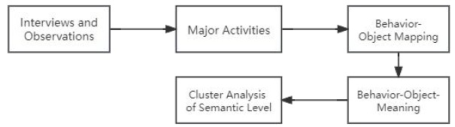
Based on interviews and observations with participants, this study summarizes and generalizes the major activities of medication use among the elderly with chronic diseases. Subsequently, these major activities are further subdivided and mapped against the physical objects associated with the activities. On this basis, the study delves into the significance of user behaviors, mapping them at the levels of syntax, experience, and semantics.
Following this, a cluster analysis is conducted to identify the core clusters of meaning of Semantic Level.
Figure 1: Flowchart of the study method.
Analysis of Behavior-Object Mapping The analysis of behavior-object mapping primarily pertains to intervention activities under the community and well-being context. Firstly, there are medical activities encompassing various online and offline healthcare services. Secondly, medication supply activities cover medication services provided by community hospitals, pharmacies, online deliveries, and more. Thirdly, there are social care and welfare actions, including medical insurance, disease subsidies, and assistance for vulnerable groups. Lastly, product services consist of a range of elderly care and rehabilitation products aimed at promoting the well-being of the elderly.
Table 1. Mapping of behavior to objects.
Table available in the original PDF paper.
Activity Environment Task Subtask Medical Activities Registration Counter Register Book appointment, Queue for registration, Wait for consultation Outpatient Department
Provide prescription, Pharmacist dispensing, Payment, Collect medication
Pharmacy/ Hospital Pharmacy Online Medication Delivery Provide prescription, Online payment, Medication preparation, Home delivery Social Care and Welfare
Financial Assistance
Medication subsidy, Disease subsidies, Medical insurance
Community Volunteering Day care, Personal care, Housekeeping, Emotional support Government and Social Assistance Organizations Product Services Home Smart Services Physiological monitoring, Medication reminders, Family supervision, Medication record- keeping, Medication management Outdoors Medication Assurance
Pill counting, Pharmacy map, Emergency call, Portable carrying Hospital Information Services Big data monitoring, Artificial intelligence analysis, Medication logistics management
Electronic card simulation, Synchronized medical records, Automated payment, Data provision Server Room Establish Medication Cloud
Establishing Sustainable Health Services for the Medication of Elderly Chronic Diseases 587
To deconstruct the common activities of medication among elderly individuals with chronic diseases, and to prepare for the mapping of meanings. As shown in Table I, the four major activities were further divided into 11 tasks and 40 subtasks.
Mapping of Behavior-Object-Meaning Conducting meaning mining and mapping analysis based on the deconstructed user behaviors is a pivotal step within the SAPAD theoretical framework. The meanings are divided into three levels: Syntax, Experience, and Semantics. Thus, we begin by mapping user behaviors to these three levels.
Syntax Level primarily deals with the interaction among various physical attributes and serves as a foundational component in constructing the service system. It encompasses seven meaning points: (1) Navigation System, (2) Electronic Health Records Cloud, (3) Medication Cloud, (4) Emergency Assistance System, (5) Welfare System, (6) Care System, and (7) Medication Adherence System.
Experience Level focuses on the interaction between users and products, as well as between users and stakeholders (on the production side) within the service system. The Experience Level comprises twenty-two meaning points: (1) Queue Algorithm, (2)Augmented Reality (AR) Navigation, (3) Path Planning, (4) Synchronized Medical Records, (5) Remote Analysis, (6) Electronic Prescription Issuance, (7) Logistic Deployment, (8) Medication Management, (9) Medication Records, (10) Prescription Verification, (11) Physiological Monitoring, (12) One-Touch Emergency Call, (13) Subsidy Disbursement, (14) Medical Insurance Coordination, (15) Fee Reduction, (16) Precise Assistance, (17) Family Supervision, (18) Disease Progress Tracking, (19) Caregiver Appointment, (20) Medication Reminder, (21) Adherence Assessment, and (22) Side Effect Management.
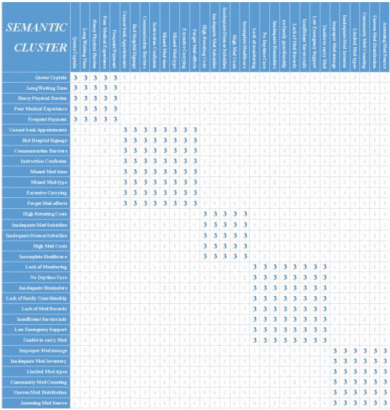
The Semantic level focuses on individual emotional factors and user experiences that span the entire elderly medication process. The Semantic level comprises 32 meaning points: (1) Queue Captain, (2) Long Waiting Time, (3) Heany Physical Burden, (4) Poor Medical Experience, (5)Frequent Payment, (6) Cannot book Appointments, (7) Bad Hospital Signage, (8) Communication Barriers, (9) Instruction Confusion, (10) Missed Med- time, (11) Missed Med-type, (12) Excessive Carrying, (13) Forget Med- effects, (14) High Retesting Costs, (15) Inadequate Med Subsidies, (16) Inadequate Disease Subsidies, (17) High Med Costs, (18) Incomplete Healthcare, (19)Lack of Monitoring, (20) No Daytime Care, (21) Inadequate Reminders, (22) Lack of family Guardianship, (23) Lack of Med Records, (24) Insufficient Service info, (25) Low Emergency Support, (26) Unable to carry Med, (27) Improper Med storage, (28) Inadequate Med Inventory, (29) Limited Med-types, (30) Community Med Counting, (31) Uneven Med Distribution, (32) Assessing Med Source.
Figure 2: Cluster matrix analysis of semantic level.
Cluster Analysis of Semantic Level Mapping at the semantic level is the final step in transforming problems into design practices. Therefore, clustering pain points can help designers summarize design key points. We employed Boolean logic algorithm matrices to perform cluster analysis on meanings. This involved merging meanings with strong correlations within the same level, creating groups based on relevant relationships. We defined the coefficient value range between meanings as [0, 3], with 0 denoting no correlation, 1 representing weak correlation, 2 denoting strong correlation, and 3 indicating core correlation.
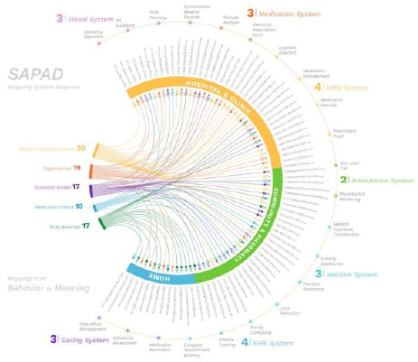
Figure 3: Cluster matrix analysis of semantic level.
Establishing Sustainable Health Services for the Medication of Elderly Chronic Diseases 589
The result is a symmetric cluster matrix, leading to the identification of meaning clusters. In the cluster analysis of the Syntax level, five meaning clusters were obtained: (1) Medicine collection process, (2) Cognitive Load, (3) Economic Burden, (4) Drug Resource, and (5) Medication contact.
Construction of the SAPAD Mapping Model for Elderly Medication Services System By employing the SAPAD model, we accomplished the mapping of the multi- level, multi-dimensional elderly medication service system (see Figure 3). This mapping process enabled us to extract the core meanings of the medication system, software and hardware touch points. The central circle represents the spatial distribution of the medication system. Progressing outward, we obtained the outer circle, which pertains to software and hardware touch points distributed over time, and the inner circle, which represents user medication requirements. Additionally, we conducted clustering on the medication requirements within the inner circle, yielding five meaning clusters.
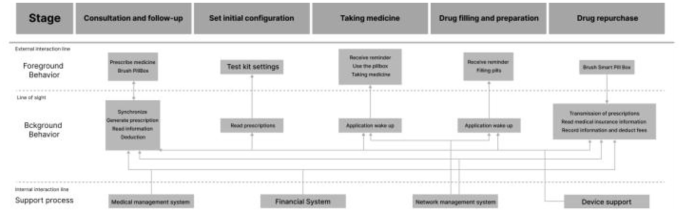
According to above behavior processes and five meaning clusters, operation of the service system can be expressed in the form of service blueprint, as shown in Figure 4.
Figure 4: Service blueprint of the elderly medication service system.Figure 5: Design of smart medicine box service system.
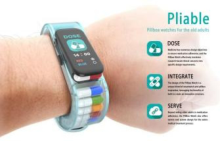
Design Example of Intelligent Medicine Box Based on the SAPAD mapping model, a smart medicine box wristwatch was designed, which was developed into a wearable device by integrating its intelligent module into a wristwatch.
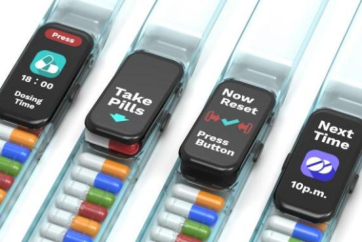
Medication reminders, synchronous doctor order prescriptions, and NFC- simulated medical insurance cards are the three characteristic functions of the smart pillbox watch in terms of intelligence and information (see Figure 5).
The wearable smart pillbox watch adopts a magazine-type loading structure. When taking medicine, the medicine-taking buttons on both sides are clicked, where after the dial opens and the pills in the magazine are automatically sent out by the spring. The user can press the “taking medicine button” to take medicine according to the number of medicines displayed on the dial.
The primary focus of this paper is to explore the optimization of intelligent drug treatment services to address medication adherence issues among elderly patients with chronic diseases. The study proposes a design thinking-driven method based on the SAPAD model, integrating services and experiences into drug services to establish a sustainable medical service system. Based on the aforementioned research, a design example of a wearable smart pillbox watch is proposed to optimize the behavior of the elderly during drug treatment.
In summary, the paper presents the following innovative points: In terms of research methodology, this paper employs the SAPAD model to extract precise and detailed optimization strategies from chaotic systems,
Establishing Sustainable Health Services for the Medication of Elderly Chronic Diseases 591
driving design thinking to integrate new technologies across disciplines into medication services and sustainable health industries; In terms of design practice, the paper demonstrates the potential of wearable technology to improve medication management among the elderly, and has preliminarily constructed a sustainable health service system for the chronic medication of the elderly, providing reference cases for future research and development in this field.
However, due to inherent limitations, the study presented in this paper has areas that necessitate further enhancement: a. A more comprehensive and extensive sample is required for observation and validation purposes. b. Design practices should concentrate on elderly individuals suffering from various chronic conditions and undertake targeted investigations. c. The proposed design methodology requires broader application and refinement across a range of practical cases to substantiate and elevate its applicability and generalizability.
Subsequent research will be conducted with the aim of refining and advancing upon this groundwork.
REFERENCES
Abdi, M. R., & Labib, A. W. (2003). A design strategy for reconfigurable manufacturing systems (RMSs) using analytical hierarchical process (AHP): A case study. International Journal of production research, 41(10), 2273–2299. Abookire, S., Plover, C., Frasso, R., & Ku, B. (2020). Health design thinking: An
innovative approach in public health to defining problems and finding solutions. Frontiers in public health, 8, 459. Annweiler, C., Noublanche, F., Boureau, A. & Berrut, G. (2023). Design thinking and clinical living labs: Two complementary approaches for addressing complex health challenges in geriatric medicine. Maturitas, 173, 121–122. Chiang-Hanisko, L., Tan, J. Y., & Chiang, L. C. (2014). Polypharmacy issues in older
adults. Hu li za zhi, 61(3), 97. Faisal, S., Ivo, J., & Patel, T. (2021). A review of features and haracteristics of smart medication adherence products. Canadian Pharmacists Journal/Revue des Pharmaciens du Canada, 154(5), 312–323. Hu, F., Li, J., Wang, W., & Sato, K. (2019, July). Meaningful experience in service
design for the elderly: SAPAD framework and its case study. In Proceedings of the Design Society: International Conference on Engineering Design (Vol. 1, No. 1, pp. 3081–3090). Cambridge University Press. Hu, F., Sato, K., Zhang, X., & Zhu, T. (2013). Semiotic basis for designing product architecture. In DS 75-4: Proceedings of the 19th International Conference on Engineering Design (ICED13), Design for Harmonies, Vol. 4: Product, Service and Systems Design, Seoul, Korea, 19-22.08. 2013. Hu, F., Zhang, X., Sato, K., Teeravarunyou, S., & Lin, H. (2015, October).
Human-centred Product Architecture from UPPA to SAPAD. In 2015 International Conference on Sustainable Energy and Environmental Engineering (pp. 112–115). Atlantis Press. Jimmy, B., & Jose, J. (2011). Patient medication adherence: Measures in daily practice. Oman medical journal, 26(3), 155.
Karayalcin, I. I. (1982). The analytic hierarchy process: Planning, priority setting, resource allocation: Thomas L. SAATY McGraw-Hill, New York, 1980, xiii+ 287 pages, £ 15.65. Lam, W. Y., & Fresco, P. (2015). Medication adherence measures: An overview.
BioMed research international, 2015. Lin, M. C., Wang, C. C., Chen, M. S., & Chang, C. A. (2008). Using AHP and TOPSIS approaches in customer-driven product design process. Computers in industry, 59(1), 17–31. Liu Yan & Wan Xuan. (2024) Design and Research of a Guided Medical
Consultation Service System to Alleviate Healthcare Anxiety among the Elderly. Packaging engineering 1–13. Liu, X., & Varshney, U. (2020). Mobile health: A carrot and stick intervention to improve medication adherence. Decision Support Systems, 128, 113165. Roebuck, J. (1979). When does “old age begin?”: The evolution of the English
definition. Journal of social history, 12(3), 416–428. Thakur, N.; Han, C. Y. (2022) A Simplistic and Cost-Effective Design for Real-World Development of an Ambient Assisted Living System for Fall Detection and Indoor Localization: Proof-of-Concept. Information, 13, 363. Vaidya, O. S., & Kumar, S. (2006). Analytic hierarchy process: An overview of
applications. European Journal of operational research, 169(1), 1–29. Yang, B., & He, R. (2023). Research on online learning interactive product design based on SAPAD and scenario-based thinking. Packaging Works (02), 167–179. doi: 10.19554/j.cnki.1001–3563.2023.02.019. Zhang, X., HU, F., Zhou, K., & Sato, K. (2017, July). Reflecting Meaning of
User Experience Semiotics Approach to Product Architecture Design. In Trans disciplinary Engineering: A Paradigm Shift: Proceedings of the 24th ISPE Inc. International Conference on Trans disciplinary Engineering, July 10–14, 2017 (Vol. 5, p. 329). IOS Press.
LISTED IN THE AHFE DIGITAL BOOKSTORE CATALOGUE
Explore the complete digital volume
Human Interaction and Emerging Technologies (IHIET 2024)
Read this individual research paper free through the original publisher, or explore the full digital proceedings book.
ISBN 978-1-964867-33-5
Explore this ISBN in the AHFE Bookstore ↗Listed in the July 2026 bookstore catalogue; search by ISBN to confirm current availability · Digital book purchase optional