Monica Santos, Suzana Dias (2023). The role of Information design in reducing dependence on health services. In: Human Dynamics and Design for the Development of Contemporary Societies. AHFE Open Access, vol. 81, pp. 75–83. https://doi.org/10.54941/ahfe1003535
The dependence and passivity on health services is due to the hegemonic model that stills prevail, inadequate literacy levels of the population, the construction of health messages based on assumptions, lack of interaction context between users and health providers, and despite existing government programs and measures related to changing health services from a model that reacts instead of prevent, people still see health care services as a consumption model instead of a way of life or a purpose. In order to change this situation (reduce people’s dependence on health care services and health care providers) it is necessary, among others things, to delivery health information to people outside the usual places like hospitals, health centers, pharmacy and others, to everyday life and routines, contributing to autonomy and behavior change. In health, knowledge is latent in users, dormant and suppressed by the traditional service delivery approach, in which professionals are still largely in control.The surplus of information doesn´t mean more knowledge. To make knowledge useful and effective, it is necessary for citizens to identify themselves with the information and be concerned about the topic, but often they avoid or reject it, mainly due three main reasons: it may require a change of belief, it may demande an unwanted action, and lastly because the information can cause unpleasant emotions or diminish pleasant emotions.The information must affirm the identity of the individual and the society in which he is included and not jeopardize values and principles, it must reveal how action make the difference and that the individual is capable of doing it, finally show how to incorporate actions into everyday life. To do so health messages should be adjusted to cognitive needs, to cultural level, to beliefs, to emotional, social and linguistic needs. However, they are designed without taking into account the needs of the citizen. Information design and the integrative character of design tools have a fundamental role placing key stakeholders in the center of the process and constructing messages with a strong sense of ownership and commitment. With this study we highlight the value of developing messages involving the different stakeholders, from the citizen to public health organizations, in a deep and continuous way enabling an innovative integrative approach and building spaces for favoring citizen autonomy and reducing the passive attitude related to health services and providers.
Currently, the watchword in health is “health literacy”. Health literacy equips individuals with skills that make them able to read and understand informa- tion and better manage their health (Nielsen-Bohlman et al., 2004), not only when adhering to therapies and treatments, but also when promoting health and preventing disease.
It is interesting to notice and reflect that, nowadays the access to infor- mation that we are all submitted, does not mean more knowledge. If that question was true, we would not witness so many unnecessary trips to health services, nor the exponential increase of non-communicable diseases, consequence of risky behaviors and unhealthy lifestyle habits.
Changing lifestyle habits is a difficult process that already contains obsta- cles that hinder change; so, if the tools and information resources developed to promote behavioral change are an additional obstacle, we will hardly see the desired change. It is essential that people recognize the value of informa- tion and knowledge and feel the need to integrate them into their daily lives. To do so, this information has to be perceived as a useful tool in the pursuit of health – as a resource, not as a purpose. In other words, information has to
be designed taking into account people’s specific informational needs, such as the ease of identifying and understanding it so that they are able to tran- sfer it into effective action, allowing them to recognize the impact that these changes can have on their lives (Fishbein & Cappella, 2006).
Through this research we will seek to relate the process of constructing health information messages with increased autonomy and decreased need for access to the National Health Service. In order to describe this, we will review a medical information document – the clinical analysis report – a docu- ment that the general population has access to and that can be used as a vehicle for information and knowledge.
THE RELEVANCE OF DESIGN IN THE CONSTRUCTION OF HEALTH KNOWLEDGE According to the World Health Organization (WHO), health communication is a complex social process, but it has the ability to contribute to health outco- mes. The potential of the development of health information communication strategies – to make users particularly active and receptive to behavioral change – is already recognized (Abraham & Kools, 2012).
Communication between doctor and patient in a consultation context is fundamental to all clinical practice and is achieved through verbal and nonverbal behaviors. Through communication it is possible to explore and value symptoms and feelings, to identify and model expectations, to give explanations and agree on therapeutic plans, to prevent accidents and errors.
On the other hand, the user, as a patient, must be empowered with the knowledge to be correctly involved in decision making, not only to corre- ctly manage the disease, but also to be able to communicate effectively with doctors and other health professionals.
Studies prove that patients who are part of decision making about their health, are more likely to have better health (Hibbard, 2003 cited by McCar- ron et al., 2019). Furthermore, about financial terms supported by the state, if a singular citizen has a counselor for nine months helping them prevent diabetes is much more beneficial than fifteen years of dependence on insulin injections and regular visits to the doctor.
Thus, in the context of health care, it is crucial to convey information as transparently as possible. To this end, the recognition of cultural and educational variables is determinant (Rosário, 2009), so it is important to create spaces for reflection, debate aspects and establish appropriate forms of communication, not only with patients, but also with family and friends.
Poor communication in health leads to patient dissatisfaction, errors in diagnosis and assessment, difficulty in achieving results, and a worsening of the physical and mental health status with the provision of ambiguous information leading to patients feeling misunderstood and sometimes ridicu- lous (Dinarés, 2009). These situations exacerbate the patient’s condition and contribute to the increased need to turn to health services.
Outside the clinical context, access to information is facilitated by the abundance of available means, both in terms of quantity and speed of access. However, inaccurate or excessive information can be harmful, promote error
The Role of Information Design in Reducing Dependence on Health services 77
and poor decisions, causing greater uncertainty and confusion. So, accuracy is mandatory and information has to be filtered to be useful, relevant to the purpose, clear and with the necessary degree of detail, organized, presented in the appropriate medium, accessible and flexible (Jacobson, 1999).
Although the content of existing information is usually relevant, it often fails because it does not consider the informational needs of the audience, their characteristics and literacy (Nielsen-Bohlman et al., 2004), and in the way it is presented.
Health messages that aim to change behaviors should include strategies on how to incorporate concrete actions into everyday life, such as identif- ying obstacles and suggesting solutions of how people can easily adapt to these actions in their lives, and whenever possible present the impact that this change will have on people’s lives (Stadler et al, 2010). To study this situ- ation, Stadler (2010) exposes two groups of women to information about the benefits of eating five pieces of vegetables and fruit daily. While one of the groups had contact only with the recommendations, the other group had access to the same recommendations but also to self-regulation techniques, that consisted in the recognition of their greatest desire regarding the diet, identifying the best result and the most critical obstacle. From the interaction with the second group they could design their intentions: when and where the obstacle occurs and how to overcome it; when and where occurs the opportunity to prevent the obstacle; and finally identify where is the oppor- tunity in order to achieve the goal. They observed that the first group was able to maintain this change during the first four months, while the second group continue to maintain their daily habit of eating five pieces of fruit and vegetables after two years.
The main challenges facing the developing of health messages are: on the one hand health messages have to compete with commercial messages that point in the exact opposite direction of health promotion messages (Jan- sen, 2017), but on the other hand they usually have a lexical complexity of information that makes difficult for the audience to access the message; thus resulting from the existence of several sources it makes difficult to perceive the credibility of the content; its presentation, organization and structure.
If to design health messages is a big challenge, creating messages that aim to change risk behaviors is an even greater challenge. To fulfill their purpose, those messages must promote the interest of the target audience, ensuring that it is understood, and to achieve this goal the content must take into account the diversity of the audience that comes from different back- grounds: ethnicity, beliefs, values, culture, identity, health literacy, among others. Thus, these messages must be constructed with awareness of the individual’s specific beliefs and values and not just in theory, translating abstract knowledge (cognition, emotion, and social process) into effective health messages. In this way they promote acceptance and reflection on the topic, contributing to its memorization and a greater likelihood of acting on problems.
It is expected from the field of information design that this task will be solved. Defined as the art of preparing information that can be used by
78 Santos and Dias
humans effectively, the main objective of design information is to develop documents that are understandable, quickly and recoverable, and easily translatable for effective action (Jacobson, 1999; IIID, 2007; Sless, 2009). This requires that information design considers the users of the information, understand and simplify complex relationships and, although these relation- ships are from disciplines other than design, it is essential that these messages are communicated in an appropriate way to the user.
THE IMPORTANCE OF HELTH LITERACY IN CLINICAL REPORTS Excessive access to information and use of content, which is delivered to the individual through different media and in a fragmented way – most of the time without the depth, scope and detail needed for critical and creative thinking – promotes passivity and reduced cognitive capacity (Hoogeveen, 1997). Moreover, a poorly literate individual, with low health literacy, in addition to having the most difficulty accessing knowledge, is usually the one who least recognizes the importance of literacy. Medical information documents often exceed the reading capacity of users, especially those with inadequate literacy levels.
Thus, although the population currently has access to a large amount of information about health in general and about their own health, they are not prepared to recognize and act upon it.
One of the information supports that we analyzed in our study was the clinical report. The choice of this instrument is due to the fact that people consider it as a proof of health, and a useful instrument to detect serious pro- blems by seeing these results as a diagnostic tool (Van Bokhoven et al., 2006). Medical information through this resource is highly valued, corresponding to one of the main ingredients to which patients have access, which encourages and facilitates greater involvement in decision-making and self-management of health.
When the patient is prepared to receive information about the state of health, through the visualization of clinical analysis results, he usually expe- riences a feeling of relief, satisfaction, and reduced anxiety. This preparation, which can be done by the doctor or the health professional reassures the pati- ent, teaches how to deal with the illness and reduces the associated stress and anxiety. In this way, a feeling of security is promoted and the psychological need is satisfied, which is favorable to better treatment adherence and a rapid recovery.
Otherwise, viewing the information in clinical reports can trigger a nega- tive emotional response, promoting an increased need to access health services, rejection of information and poor therapeutic adoption.
Health information material is released daily in different formats to edu- cate people, focusing on disease prevention and health promotion. However, several authors question whether the content is properly designed with the target audience profile in mind (Dinarés, 2009; Kascak et al., 2013), adding the issue of the lack of credibility of the information available online, which is often not scientifically validated (Espanha et al., 2013).
The Role of Information Design in Reducing Dependence on Health services 79
According to David Sless (2004), the document with medical information is mostly not thought and designed at the highest level, both due to lack of awareness and lack of skills in using appropriate communication methods.
Taking the example of the analytical reports that the general population has access to, we observe that it is designed in exactly the same way for both the health professional and the user, regardless of very different information needs and literacy skills.
The low levels of literacy and numeracy of most users represent a very significant barrier to understanding information, particularly in understan- ding its ‘reference values’ (Zikmund-Fisher et al., 2014). Through our resea- rch (Santos, 2020) we were able to observe that the user expresses difficulty in understanding whether these values are within or outside the reference parameters and even to know what their own reference values are, causing negative emotion when often the information itself is not. For example, the ‘reference values’ indicated in the report may vary according to the age, gen- der, ethnicity, pathologies of the user, but in general people tend to see the risk associated with their results in a dichotomous way, i.e., values within the reference parameters are “good” and values outside the parameters are “bad”. In this sense, an individual with a chronic illness, deals with an addi- tional barrier of difficulty in understanding and effectively using their results, as the pre-existing ‘reference values’ in the report are not, in fact, a reference for their own results.
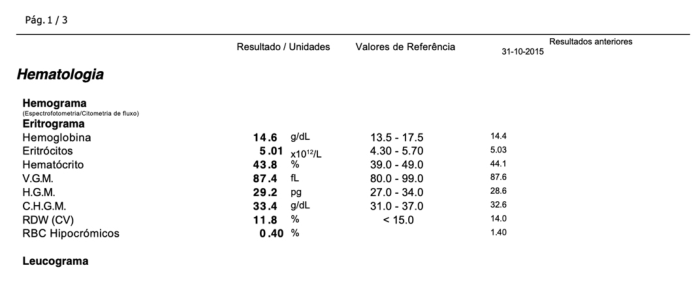
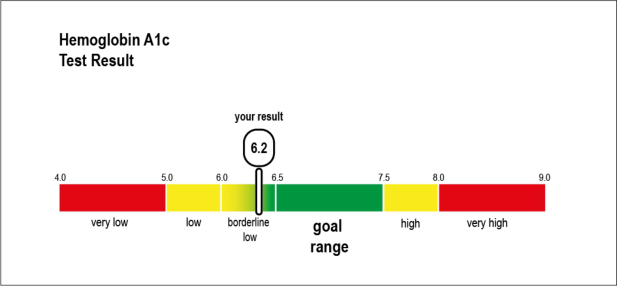
According to Scherer (2018), simply replacing the healthy population- based ‘reference values’ with ‘personalized values’ increases the understan- ding of the information and decreases the need to go to the doctor, at least on an urgent basis. In addition to the message regarding ‘reference values’ not being appropriate for the user, the format in which the reports are pre- sented changes the perception of urgency of accessing a health service. Usually the results are received in a table format (Fig. 1) leading to a wrong perce- ption of the numerical distance to the reference parameters. To correct this problem, Scherer proposes a visual presentation of results in graph format (Fig. 2) compared to table format, that significantly increase understanding of the information and help users distinguish between urgent and non-urgent laboratory results (Scherer et al., 2016).
Figure 1: Example of clinical analysis report in table format.
80 Santos and Dias
Figure 2: Example of clinical analysis report in graphical format (elaborated by the authors).
Co-Creation as an Inverted Approach to the Hegemonic Model Nowadays, the access to the health service still happens from a hegemo- nic model, in which information is designed based on assumptions and not on the real needs of health service users. In this model it is assumed that health is what doctors and hospitals deliver, so information is developed in a conservative and hierarchical approach.
People’s participation, on the other hand, has enabled a democratic invo- lvement of all stakeholders in the process of building solutions, which is fundamental in approaches to complex social problems. Co-creation is based on the premise that participation can lead to individual satisfaction (Czepiel, 1990), besides being a differentiating factor (Song & Adams, 1993) or a dominant logic of services (Vargo & Lush, 2008).
In the field of design, the term co-creation initially appears associated with human-centered design or participatory design, and is a form of user inte- gration in the design process, where their capabilities are transformed into resources. The profile - from end users with problems and needs - has chan- ged from ‘participants’ to ‘actors’ by bringing local knowledge, specific skills and ideas to the projects. Thus, in this model, users come to be seen as experts.
Participatory design is design “with a special focus on the participation of people in the design process as codesigners” (Ehn, 2008). By placing people at the center of product and service development (Tackara 2005, Papanek 1984, Brown 2009), we are enabling the generation of ideas through the sha- ring of knowledge and experiences, as well as a better understanding of the user. By repositioning people at the center of the whole process we promote collaborative creativity, increase and extend satisfaction with the service and consequently user loyalty and commitment (Auh et al., 2007). The adoption of codesign can thus contribute to health by increasing the sense of com- mitment and the possibility of changing behaviors, reinforcing the sense of inclusion and belonging that promote self-awareness and accountability. A method that highlights participatory medicine requires patients and users to participate in tasks traditionally reserved for health ‘providers’ (Keselman & Smith, 2012), regarding reading and understanding of medical documents. Change streamlined by co-creation, becomes more effective because it is more
The Role of Information Design in Reducing Dependence on Health services 81
understandable to those involved, it ensures a space for many to be heard and for diversity and desires (De Koning et al., 2016), opposed to change imposed by a top-down model, which grounds its inquiry in assumptions based on the individual professional’s view.
It is also important to note that the engagement space can vary in type of engagement (behavioral, emotional or cognitive), level of engagement (from uninvolved to highly engaged), and in duration (one-time, recurring, or continuous) (Frown et al., 2010).
This involvement can be realized through roundtables, participatory com- mittees, online information sharing, collaborative product development, physical spaces for knowledge exchange, websites, forums, among others.
In health information design, the use of co-creation provides the basis for developing better results, creating a strong sense of ownership of the ideas that result from the process, materializing through experience and contact between the intervening parties and moving away from the simple transaction of data. According to Edgar Dale (1969 cited by Anderson, n.a.) the practice and experience of contact with the object of study, favors knowledge.
CONCLUSION
The knowledge obtained through the messages conveyed by health informa- tion should not be done randomly or without the accompaniment of the health professional, otherwise it may create situations of greater anxiety, or even increase an incorrect perception of the urgent need for medical care. Thus, adjusting and personalizing health information allows reducing the inappropriate and repeated dependence on health services.
The traditional model of information still in use today, in which the solution lies only on the side of health professionals, leads to a strong hierarchization of health control and, consequently, to people’s individual irresponsibility and passivity. On the contrary, the adoption of a bottom-up methodology, as enabled by participation and co-creation models, puts peo- ple and the community at the center of the process, allowing them to have equal control of their information and to realize that health is not only in hospitals and health centers, but rather in their homes, schools, supermarkets, restaurants, etc.
Integrating people into the care of their own health and into processes of co-creation of informational materials, develops trust and willingness for self-control, which in turn can reinforce the adoption of healthy behaviors and the creation of messages that are more challenging and effective.
Furthermore, as demonstrated, an individual who takes control of the management of his or her own health greatly reduces state financial effort. Not feeling the need to go to hospitals and health centers frequently con- tributes directly to the sustainability of the National Health Service. This situation was recently verified with the pandemic context caused by the new coronavirus, whose impact was felt at a planetary level and with profound consequences for the next generations, both at the health, social and economic levels. This revealed the vulnerability of the health system, both by the reduced number of health professionals and by the lack of solutions to
82 Santos and Dias
communicate urgently and effectively with an increasingly aging population with inadequate literacy levels.
We can conclude that people’s participation in the process of building solu- tions for health information has two essential advantages: the first one is that the information design is based on people’s real and everyday contributions and experiences; and the second advantage is the notion of the user’s commi- tment to that information, showing a greater likelihood of retaining the most important information and applying it to manage their own health.
FUTURE PERPECTIVES We are concluding this research with the ambition of creating a health infor- mation design research process that will allow for the continuous and deeper adoption of these strategies. This includes the development of medical infor- mation design in electronic health records and the creation of educational materials that effectively reduce literacy barriers. We also emphasize the importance of making information design more relevant in design educa- tion curricula as a means of raising awareness among future designers of the integrative role of this aspect.
ACKNOWLEDGMENT
This work is financed by national funds through the FCT – Fundação para a Ciência e a Tecnologia, I.P., under the scope of the project UIDB/04057/2020.
REFERENCES
Anderson, H. M. (n.d.). Dale’s Cone of Experience. Queen’s University Teaching and Learning. Retrieved from https://www.queensu.ca/teachingandlearning/mod ules/active/documents/Dales_Cone_of_Experience_summary.pdf. (Adapted from Dale, E. (1969). Audio-visual methods in teaching. Dryden Press.) Christiano, A., & Neimand, A. (2018). The science of what makes people care. Stan-
ford Social Innovation Review, 16(4), 26–33. Retrieved from https://ssir.ebookho st.net/ssir/digital/56/ebook/1/download.pdf Dinarés, C. (2006). Comunicar.com Saúde: Análise da comunicação expressa nos folhetos de informação aos diabéticos. Universidade Aberta de Lisboa. Retrieved from https://repositorioaberto.uab.pt/bitstream/10400.2/1400/1/ TESECristinaDinarés.pdf Espanha, R. (2009). Saúde e comunicação numa sociedade em rede - o caso
português. Monitor. Fishbein, M., & Cappella, J. N. (2006). The role of theory in developing effective health communications. Journal of Communication, 56(S1), S1-S17. doi: 10.1111/j.1460–2466.2006.00280.x Jacobson, R. (Ed.). (1999). Information design. MIT Press. Jansen, C. (2017). Developing persuasive health campaign messages. In A. Black et al.
(Eds.), Information Design: Research and Practice (pp. 669-684). Routledge. Jones, P. (2013). Design for care: innovating healthcare experience. Rosenfeld Media.
ISBN 978-1-9338-2023-1.
The Role of Information Design in Reducing Dependence on Health services 83
Kascak, L., Lujan-Hernandez, J. R., Orellana-Rodriguez, C., & Arteaga- Mora, N. M. (2013). Icon design to improve communication of health infor- mation to older adults. Communication Design Quarterly, 2(1). doi: 10.1145/2559866.2559867 McCarron, T. L., Arora, N., Courneya, P., St-Pierre, I., & Elmoheen, A. (2019).
Understanding patient engagement in health system decision-making: A co- designed scoping review. Systematic Reviews, 8(1), 97. doi: 10.1186/s13643-019- 0994-8 Nielsen-Bohlman, L., Panzer, A. M., & Kindig, D. A. (Eds.). (2004). Health literacy: A prescription to end confusion. The National Academies Press, Institute of Medicine. ISBN 978-0-309-28332-8. Santos, M. (2020). The contribution of design to increase health literacy: Co-
creation project with National Institute Dr. Ricardo Jorge. Faculdade de Belas Artes – Universidade do Porto. Scherer, A. M., Schapira, M. M., & Kaplan, C. P. (2018). Improving the understanding of test results by substituting (not adding) goal ranges: Web-based between- subjects experiment. Journal of Medical Internet Research, 20(10), e11027. doi: 10.2196/11027 Schön, D. A. (1983). The reflective practitioner: How professionals think in action.
Basic Books. Sless, D. (2004). Designing public documents. Information Design Journal, 12, 24–35. https://doi.org/10.1075/idj-dd.12.1.04sle Stadler, G., Oettingen, G., & Gollwitzer, P. M. (2010). Intervention effects of infor-
mation and self-regulation on eating fruits and vegetables over two years. Health Psychology, 29(3), 274–283. https://doi.org/10.1037/a0018644 Sweeny, K., Melnyk, D., Miller, W., & Shepperd, J. A. (2010). Information avoidance: Who, what, when, and why. Review of General Psychology, 14(4), 340–353. https: //doi.org/10.1037/a0021288 Van Bokhoven, M. A., Koch, H., van der Weijden, T., Grol, R., & Bindels, P. J. E.
(2006). Why do patients want to have their blood tested? A qualitative study of patient expectations in general practice. BMC Family Practice, 7(1), 75. https: //doi.org/10.1186/1471-2296-7-75 Zikmund-Fisher, B. J., Exe, N. L., & Witteman, H. O. (2014). Numeracy and literacy independently predict patients’ ability to identify out-of-range test results. Journal of Medical Internet Research, 16(8), e187. https://doi.org/10.2196/jmir.3503
LISTED IN THE AHFE DIGITAL BOOKSTORE CATALOGUE
Explore the complete digital volume
Human Dynamics and Design for the Development of Contemporary Societies
Read this individual research paper free through the original publisher, or explore the full digital proceedings book.
ISBN 978-1-958651-57-5
Explore this ISBN in the AHFE Bookstore ↗Listed in the July 2026 bookstore catalogue; search by ISBN to confirm current availability · Digital book purchase optional