Xiaoli Fan, Hua Guo, Feng Wu, Shuyu Shao (2023). Effectiveness Evaluation of Video Evoked Target-Emotion Method. In: Human-Centered Design and User Experience. AHFE Open Access, vol. 114, pp. 735–744. https://doi.org/10.54941/ahfe1004294
This paper mainly evaluates and studies the effectiveness of video to induce five target emotions: happiness, sadness, relaxation, fear and neutrality, providing theoretical basis and guiding significance for better application of such methods in emotion-related research in the future. This study adopted the methods of desktop research, subjective self-evaluation and expert evaluation to collect and screen out 20 emotion-inducing video materials from major mainstream video websites. On this basis, a reasonable emotion-inducing experiment paradigm was designed: First, the guidance was presented, and then the video clips were played to induce the target emotions. After each video, the subjects were required to complete the evaluation of the perception and experience. In order to avoid the mutual influence of the emotional states of different video clips, the subjects were required to rest and recover during the interval before starting the next trial. As for the rules of subjective self-evaluation of emotions, referring to the report questionnaire containing multiple emotional dimensions used by Gross to evaluate movie clips, this paper selects 10 relevant dimensions to form a questionnaire, including happiness, arousal, fear, happiness, interest, pain, relaxation, sadness, surprise and tension, and finally collects the emotional dimensions induced by videos and the corresponding emotional intensity. The emotional intensity was scored by Likert 9-point scoring method. The subjective evaluation data of 68 subjects were collected in the formal experiment. The intensity and differentiation of target emotion were used as the evaluation indexes of the effectiveness of emotion induced by video materials in the paper. Emotional intensity refers to the score of emotional intensity of subjects in the subjective evaluation process, and the hit rate is used to represent the differentiation degree of emotional induction, specifically referring to the ratio of the number of subjects whose score difference of target emotion is higher than that of non-target emotion by ≥1 point to the total number of subjects. Taking the video clip with the most successful target emotion induction as an example, it is found that the target emotion evoked hit rate of these videos is greater than 50% through calculation, indicating that the target emotion evoked is relatively concentrated. In order to further test the effectiveness of emotional induction of video materials, the emotional dimension in the subjective evaluation data was taken as the independent variable, and the corresponding score value was taken as the dependent variable. One-way ANOVA and LSD post test were performed on the subjective score value of each target emotion-induced video material. The results showed that different video materials would produce higher intensity in several emotional dimensions (P<0.05) after emotional induction, but in contrast, the score of target emotion dimension was significantly higher than that of other emotional dimensions, indicating the effectiveness of video in inducing target emotion. This study has a certain reference value for the establishment of emotion database and the effective induction of laboratory emotion in the future emotional research.
Emotion is the reflection of people’s perception and cognition of various things, involving different components, including psychological and physio- logical changes, behavior expression, cognitive process, subjective experience and so on. Over the past few decades, there has been a gradual increase in research related to emotions across numerous fields of study, including psychology, medicine, history, society, and computer science (Huang, 2018). In these research fields, some experts use emotion as an independent variable to study the behaviors triggered by emotion, such as aggression and prosocial behavior (Zillman, 2017; Isen et al., 1987). Emotions also have an important impact on people’s cognitive process, including attention, memory, calcula- tion and other cognitive functions (Daum, 2018; Kim, 2014). For example, negative emotions tend to disintegrate and destroy cognition, while positive emotions tend to improve cognitive flexibility. Obviously, if emotional states have a negative impact on cognitive functions, safety accidents are easily caused by human mistakes. If we can identify the emotional state of human in the process of operation effectively and give early warning in time, we
can reduce the human error in the process of human-computer interaction effectively and ensure the safety of operation, which has important practical significance. Other studies have proved that emotions and health are closely related. Therefore, many scholars paid more attention to the relationship between emotions and health, hoping to understand people’s health status through emotion analysis (Hu, 2014; Pandey, 2010). In addition, Virtual Reality and Mobile Computing, Emotional Computing has become an impor- tant part of computer intelligence with the rapid development of the Internet, that is, emotion recognition research plays an important role in promoting the naturalization and intelligent development of human-computer interaction. At the same time, the theoretical framework of contemporary emotion psy- chology is also called to incorporate the psychological mechanism of human emotions into the theoretical process of emotion research as an independent variable of methodological nature, and it is called the basis point of quantita- tive emotion research (Wang, 1995). As an experiment method to explore the psychological mechanism of emotion directly, emotion induction method has been greatly developed, that is, how to evoke accurate and lasting emotions that meet the requirements, is very import for the well-development of the research.
There have been many various emotion induction methods (Zheng, 2016; Pauls, 2003). Presenting emotional stimuli, including pictures, music clips, sounds and videos, can evoke emotions effectively. Imagination is also used to evoke emotion. In addition, the interaction between the experimenter and the subjects is used to evoke emotions. Among these methods, presenting emo- tional stimuli has strong controllability and is widely used in many studies. A standardized emotional material library led by the International Emotional Picture System (IAPS) developed by Lang et al., was consisted by many pic- ture and sound stimuli for the studies of emotion and cognition. The films or videos are more complex than other materials, which are presented dynam- ically by audio-visual dual channels, with high ecological validity. However, there is lack of quantitative evaluation on similar inducing materials such as films or videos, and there is no standardized material selection procedure, which is not conducive to the comparison between different studies. Previ- ous studies have roughly divided emotions into two types (Ekman, 1992). One view is that the emotion is discrete, and the other opinion, is multi- dimensional, and these two views lead to a discrete emotion model and a dimensional emotion model respectively. The former considers emotion is composed of several fixed and independent basic emotions, while the latter maps emotion to multiple dimensions, and is a complex state described by these dimensions. The view of multidimensional model of emotion is most widely used in the current studies.
Five typical target emotions, such as happiness, sadness, relaxation, fear and neutrality, were studied in the study. Through the formulation of mate- rial screening and evaluation procedures, the effectiveness of target-emotions evoked by videos was evaluated from multiple dimensions by using subjective evaluation, which will provide methods and technical basis for the establish- ment of emotion database and the effective induction of laboratory emotions in future research.
Effectiveness Evaluation of Video Evoked Target-Emotion Method 737
METHOD
Subjects The selection of subjects is very important in the study. People of different ages, genders and cultural backgrounds have different emotional responses when watching the same video material. In order to facilitate sampling, col- lege students with similar educational level and educational background are selected as the recruitment scope. The subjects were firstly screened using the Beck Depression Inventory (BDI-2) and the Toronto Alexithymia Scale (TAS-20). Among them, the Baker Depression Scale (BDI-2) is the most widely used self-rating scale for depression at present (Wang, 2011; Beck, 1996), which can evaluate depression symptoms and their severity. It con- sists of 21 dimensions and is scored on a scale of 0-3, mainly composed of cognitive-emotional factors and physical symptoms, with the former cor- responding to 16 dimensions and the latter to 5 dimensions. The Toronto Alexithymia Scale (TAS-20) is mainly designed for ‘alexithymia’ or ‘inability to express emotions’ (Yao, 1991; Yao, 1992), with a total of 20 dimensions, graded at 1–5 levels, 12 of which are graded backward. The scale mainly includes three dimensions: IDifficulty in recognizing one’s own emotions; IIDifficulty describing their feelings; III Extroverted thinking. After the above two subjective self-assessments were conducted successively, a total of 70 sub- jects with BDI-2 scores ≤13 and TAS-20 scores ≥65 were finally selected as the official subjects of this experiment task. Among them, the male to female ratio was about 4:3, and the average age was 24.5±1.8 years. All subjects gave informed consent to the experiment tasks and procedures. In addition, they were also told that some emotion-evoked videos might cause personal physical discomfort during the experiment. If the experiment needs to be interrupted, they should inform the experimenter in time, and the psycholog- ical teacher should give appropriate emotional guidance. At the end of the experiment, the subjects can get corresponding rewards as encouragement.
Materials
In order to evoke the five target emotions: happiness, sadness, relaxation, fear and neutrality effectively, it is necessary to conduct extensive collection of video materials. The video materials in the study were collected mainly through the following ways: I By consulting the video evoked materials in the previous emotion research; II By searching for videos with tags of excitement, sadness, relief and fear through major video websites, such as Youku, IQIYI and Tudou; III By developing and issuing subjective questionnaires, videos of different emotional types were collected. A total of 66 video materials were obtained finally. Three psychology experts and three veteran film and television drama lovers were invited to watch these video materials repeat- edly, determine the video clips that may evoke the target emotions, and the software of VirtualDub V1.4.7 was used to edit these clips. Meanwhile the software Ulead VideoStudio 10.0 was used to edit the clips into video files in MPEG2 formats with resolutions of 1920×1080P. The principles of select- ing and editing emotion-evoked video clips include: I The plot of the video is easy to understand without additional explanation; II The scene causes a
single emotion, or the target emotion is significantly greater than other mixed emotions; III The duration is relatively short, and the duration is controlled within 3min. As shown in Table 1, there were a total of 20 video clips that could evoke five kinds of emotions. The main sources included movies, adver- tisements, news and short videos. Among them, silent scene videos were used to evoke neutral emotions.
Table 1. Video themes of different emotions.
Table available in the original PDF paper.
Happiness Sadness Relaxation Fear Neutrality Life of pets Calling Weather forecast National day parade Hope To Have A Home
A Corner of School
No-look My father is a liar Warm family A Wicked Ghost Classroom teaching Froze Train to Busan Lovely child The Eye A Corner of Park Ready Player One Aftershock Wireless scenery Close Your Eyes Before It’s Dark
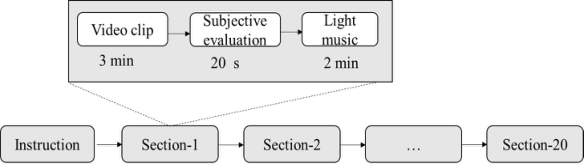
Experiment Paradigm The experiment paradigm of emotion induction is shown in Figure 1. After the experiment starts, the PC interface presents the instruction for 30 s firstly, and the subjects are required to understand the process and precautions. Then different video clips are displayed successively to evoke target-emotions, and each video clip lasts for 3 minutes, and a subjective self-evaluation interface is presented subsequently, during that time subjects are required to complete the evaluation. A total of 20 video clips consist of the experimental paradigm, and subjective self-evaluation scale includes 10 emotion dimensions by refer- ring to Gross’s method of evaluating movie clips (Gross, 1995), these are happiness, arousal, fear, weal, interest, pain, relaxation, sadness, surprise and tension. The emotional intensity is scored by Likert 9-point scoring method, from weak to strong, 0 means extremely calm and 9 means extremely excited. In order to avoid the mutual influence of different emotional states, after sub- jectively evaluating each emotion, light music was played for 2 minutes, so that subjects could recover from the emotion. The experimental software is programmed on VC++ platform.
Figure 1: Experiment paradigm of emotion induction.
Environment The experiment was arranged in a relatively quiet laboratory with temper- ature of about 20
C. Before the experiment, the indoor blackout curtains
Effectiveness Evaluation of Video Evoked Target-Emotion Method 739
should be opened, and all lights should be turned off to facilitate the partic- ipants to concentrate. The video display was 21 inches, with a resolution of 1920*1080, equipped with stereo headphones. During the experiment, the subjects were allowed to adjust the sitting position and angle of the display in order to reduce the influence of physical fatigue on the emotional induction effect.
Evaluation Index In this paper, the intensity and differentiation of target emotion are used as the evaluation indexes of the effectiveness of video material to evoke emotion. Emotional intensity refers to the score of emotional intensity of the subject in the subjective evaluation process. The higher the score, the stronger the emotion evoked. In the early screening process of video clips, although the emotional theme is clear, other emotion dimensions are also mixed. Therefore, in addition to analyzing the differences of emotions in dif- ferent dimensions, hit rate is also introduced to represent the differentiation degree of emotional induction. Specifically, it refers to the ratio of the number of subjects whose score on target emotion is higher than the score difference of non-target emotion (≥1) to the total number of subjects. The larger the ratio, the more concentrated and single the target emotion is evoked.
Result
The average emotional intensity and hit rate of target emotions evoked by 20 video clips during the experiment were calculated separately, and the two video clips that were most successfully evoked by each target emotion were selected, as shown in Table 2. Video materials of neutrality had no clear tar- get emotion, and the emotional intensity values were all small. As can be seen from Table 2, the target emotion-evoked hit rate of these 8 videos is greater than 50%, and the target emotion-evoked is relatively concentrated. The average of emotional differentiation: fear > happiness > sadness > relax- ation; Average emotional intensity: fear > happiness > Sadness = relaxation.
Table 2. Target emotion differentiation and intensity of video clips.
Table available in the original PDF paper.
Name Emotion Hit rate Intensity National day parade Hope To Have A Home Life of pets Calling National Day Parade Happiness-1 70.5% 6.6±1.7 Froze Happiness-2 63.9% 6.1±1.2 My father is a liar Sadness-1 68.0% 5.5±0.9 Aftershock Sadness-2 63.4% 5.7±2.0 Warm family Relaxation-1 58.7% 5.3±2.2 Life of pets Relaxation-2 57.4% 5.9±1.2 Close Your Eyes Before It’s Dark Fear-1 86.7% 7.8±2.1 The Eye Fear-2 67.3% 7.3±1.0
In order to verify the effectiveness of emotional induction of video mate- rials more deeply, the emotional dimension in the subjective evaluation data
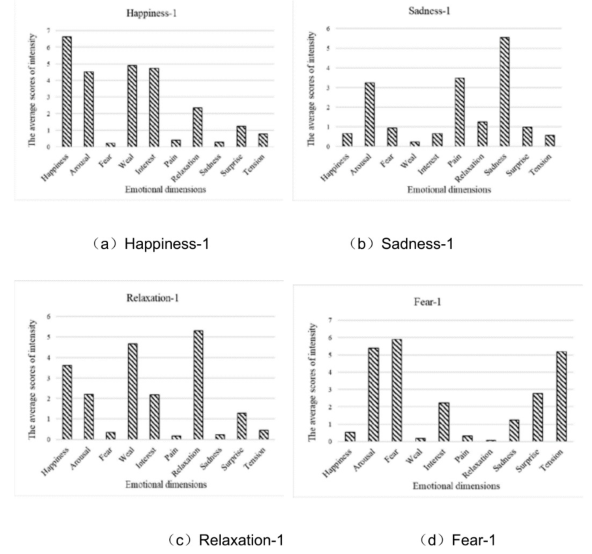
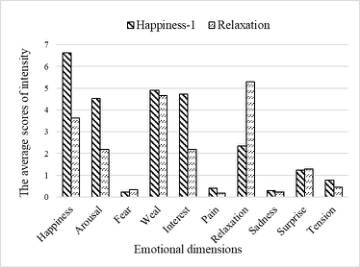
was taken as the independent variable, and the corresponding score value was taken as the dependent variable. One-way ANOVA was performed on the subjective score value of video materials evoked by each target emotion (happiness-1, sadness-1, relaxation-1, fear-1 for example). Table 3 showed the descriptive statistics and one-way ANOVA results of video-evoked emo- tion scores in each dimension. For happiness-1, scores of different emotion dimensions showed significant differences (F = 324.14, P<0.05), as shown in Fig. 2(a). Scores of happiness, arousal, weal, interest and relaxation were sig- nificantly higher than those of other emotion dimensions (all with P<0.05). The intensity of happiness dimension was obviously greater than that of arousal, happiness, interest and relaxation dimension. The analysis results of happiness-2 were the same as those of happiness-1, which indicated that the video clips of ‘National Day Parade’ and ‘Frozen’ could effectively evoke the target emotion, happiness; For sadness-1, scores of different emotion dimensions showed significant differences (F = 226.7, P<0.05), as shown in Fig. 2 (b), among which scores of arousal, pain and sadness were signifi- cantly higher than those of other emotion dimensions (all P<0.05). Multiple comparison tests of LSD showed that the intensity of sadness was signifi- cantly higher than that of arousal and pain. Similarly, for sadness-2, different from sadness-1, in addition to arousal, pain and sadness, the score of ten- sion was significantly higher than that of other emotion dimensions (all P<0.05), but the intensity of sadness dimension was still the most obvious. That was the analysis results fully showed that the video clips of ‘My Father is a liar’ and ‘Aftershock’ effectively evoke the target emotion, sadness; For relaxation-1, scores of different emotion dimensions showed significant dif- ferences (F = 102.98, P<0.05), as shown in Fig. 2 (c). Among them, scores of happiness, arousal, weal, interest and relaxation were significantly higher than those of other emotion dimensions (all with P<0.05). It was found through multiple comparison test of LSD, the intensity of relaxation was significantly greater than the intensities of happiness, arousal and interest. The analysis results of relaxation-2 were the same as those of relaxation-1, which indicated that video clips of ‘Warm family’ and ‘Life of pets’ could effectively evoke target emotions, relaxation. For fear-1, scores of different emotion dimensions showed significant differences (F = 478.53, P<0.05), as shown in Fig. 2(d), among which scores of arousal, fear, interest, surprise and tension were significantly higher than those of other emotion dimen- sions (all with P<0.05). It was found through LSD multiple comparison test that, the intensity of fear dimension was significantly greater than that of arousal, interest, surprise and tension dimension. The analysis result of fear-2 was the same as that of fear-1, which fully indicated that the video clips of ‘Close Your Eyes Before It’s Dark’ and ‘The Eye’ could effectively evoke the target emotion-fear. At the same time, as shown in Fig. 3, it could be seen from the results that the main emotion dimensions evoked by happiness and relaxation videos were the same, but compared with happiness, the inten- sity of relaxation was weaker in the dimensions of arousal, happiness and interest.
Effectiveness Evaluation of Video Evoked Target-Emotion Method 741
Table 3. The results of intensity scores of different emotion and the one-way ANOVA analysis.
Figure 2: The intensity scores of different emotion dimensions evoked by target- emotion videos.Figure 3: The comparison of emotion dimensions between Happiness-1 and Relaxation-1.
DISCUSSION
Video is a kind of audio-visual dual-sensory channel stimulation. Compared with single sensory channel induction such as pictures or music, it can enable subjects to better immerse themselves in specific situations and produce more intuitive subjective experience and physiological experience. Secondly, emo- tion is a potential expression form of emotion, and its induction process takes time, and the durations of videos can well satisfy the awakening of people’s potential emotions (Jin, 2009). Therefore, this paper mainly stud- ies the effectiveness of video to evoke emotion. In order to obtain effective target emotions, it is necessary to conduct a preliminary investigation and screening process of video materials. In this paper, video materials that may evoke target emotion are selected by consulting literature, mainstream video websites and issuing subjective questionnaires. On this basis, the method of expert evaluation is used for further evaluation and screening, and finally the selected materials are used as the experimental inducing material of the target emotion in this study. In order to reduce the impact of individual dif- ferences on the subjective evaluation results of video-evoked emotion, certain criteria were used in the screening of experimental subjects, mainly including age and cultural background, and the Baker Depression Scale (BDI-2) and Toronto Alexithymia Scale (TAS-20) were used to screen these subjects. At the same time, the experimental environment and experimental process were strictly controlled to reduce the interference caused by external environment, individual fatigue and emotional accumulation.
According to the analysis of the results of this subjective evaluation exper- iment, the selected videos evoked target emotion are effective. The previous research showed that emotion itself was a complex psychological process with multi-components, multi-dimensional structure and multi-level integra- tion. Therefore, this paper first evaluates the video materials of five target emotions from 10 dimensions, such as happiness, arousal, fear, weal, inter- est, pain and relaxation. The results of one-way ANOVA and LSD multiple comparison test showed that the video materials of each target emotion produced multi-dimensional emotional components during the experimental induction process. However, the intensity of the components corresponding to the target emotion was significantly greater than that of the other emo- tional components. Meanwhile, the statistical findings showed that the hit rates of the target emotions were all more than 50%, and the differentiation was high, indicating that the selected video materials had certain effective- ness in inducing the target emotion. In addition, judging from the results, the multidimensional emotional components evoked by the video materi- als were also reasonable, which fully demonstrated the scientific rationality of the screening process and research methods. Among them, the neutrality video materials were selected as daily scenes without stories, and the subjects had no obvious dimensional emotional component during the watching pro- cess. Due to the silent mode of the video, the subjects had weak confusion component during the receiving of information, but there was no signifi- cant difference with other emotional components. During the experiment, the video materials of happiness and relaxation evoked obvious intensity in
Effectiveness Evaluation of Video Evoked Target-Emotion Method 743
the five emotion dimensions of happiness, arousal, weal, interest and relax- ation, but the intensity of the former was significantly greater than that of the latter in the four dimensions of happiness, arousal, weal and interest. For sadness video materials, ‘My Father is a liar’ and ‘Aftershock’ both evoked obvious sadness, arousal and pain components, but the latter also evoked more obvious tension components; For fear video materials, while obviously inducing the target emotional components, they also comprehensively evoked arousal, interest, surprise and tension components. These emotional experi- ences conform to the description and basic characteristics of emotions, and also conform to the logic and evaluation views of daily people’s emotional experiences, so they have a certain scientific and reasonable.
CONCLUSION
The effectiveness evaluation of video-evoked target emotions were analyzed and studied from the aspects of material investigation and screening, sub- ject screening, experimental conditions and environmental control, especially the design of experimental paradigm, statistics and analysis methods. It has certain reference value for the establishment of emotion database and the effective induction of laboratory emotion in the future emotional research. However, there are still some shortcomings in the research process. For example, subjective evaluation method is mainly used here to evaluate its effectiveness, which is easily affected by individual differences, regional or cultural environment, subjectivity and other factors, thus affecting the accu- racy and objectivity of the results. If objective evaluation means can be combined in future research, such as facial expression, human behavior and posture, physiological electrical signals and other human data comprehensive evaluation and judgment, the results will be more accurate and convincing.
ACKNOWLEDGMENT
This research was funded by National Natural Science Fund (82102176) named ‘Research on VR Evoked Emotion Recognition Method Based on Multimodal Physiological Signal Fusion’.
REFERENCES
Beck, G., Steer, R., Brown, G. (1996). Manual for the Beck Depression Inventory-II, Psychological Corporation, San Antonio. Bharucha, J. J., Curtis, M., Paroo, K. (2006). Varieties of musical experience,
Cognition Volume 100 No. 1. Bradley, M. M., Lang, P. J. (2010). Affective reactions to acoustic stimuli, Psychophysiology Volume 37 No. 2. Clore, G. L., Huntsinger, J. R. (2016). How the Object of Affect Guides Its Impact,
Emotion Review Volume 1 No. 1. Consedine, N. S., Magai, C., Bonanno, G. A. (2002). Moderators of the Emotion Inhibition-Health Relationship: A Review and Research Agenda, Review of General Psychology Volume 6 No. 2.
Daum, S. O., Hecht, H., et al. (2018). Skating Down a Steeper Slope: Effects of symmetry, texture, and monocular viewing on geographical slant estimation, Consciousness and cognition Volume 37 No. 2. Duncan, S., Barrett, L. F. (2017). Affect Is a Form of Cognition: A Neurobiological
Analysis, Cognition and Emotion Volume 21 No. 6. Egger, M., Ley, M., Hanke, S. (2019). Emotion Recognition from Physiological Signal Analysis: A Review, Electronic Notes in Theoretical Computer Science Volume 343 No. 17. Ekman, P. (1992) An argument for basic emotions, Cognition and Emotion Volume 6
No. 34. Gross, J. J., Levenson, R. W. (1995). Emotion elicitation using films, Cognition and Emotion Volume 9 No. 1. Hu, T., Zhang, D., Wang, J., et al. (2014). Relation between Emotion Regulation
and Mental Health: A Meta-Analysis Review, Psychological Reports Volume 114 No. 2. Huang, J. M. (2018). Research on Emotion Recognition Based on EEG, Guangzhou: South China University of Technology. Huang, M. E., Guo, D. J. (2002). Cause regulation and response regulation of
emotional change process, Acta Psychologica Sinica Volume 34 No. 4. Isen, A. M., Daubman, K. A., Nowicki, G. P. (1987). Positive affect facilitates creative problem solving, Journal of Personality and Social Psychology Volume 29 No. 1. Jin, X., Deng, J. X., Deng, G. H. (2009). Evaluation of the effect of video material on
inducing emotion, Psychological Exploration Volume 29 No. 114. Kensinger, E. A., Garoff-Eaton, R. J., Schacter, D. L. (2016). Memory for Specific Visual Details Can Be Enhanced by Negative Arousing Content, Journal of Memory and Language Volume 54 No. 1. Kim, K. H., Bang, S. W., Kim, S. R. (2014). Emotion recognition system using short-
term monitoring of physiological signals, Medical & Biological Engineering & Computing Volume 42 No. 6. Mauro, R., Sato, K., Tucker, J. (1992). The role of appraisal in human emotions: a cross-cultural study, Journal of Personality and Social Psychology Volume 62 No. 2. Pandey, P. (2010). Emotion and Health: An overview, SIS Journal of Projective
Psychology and Mental Health Volume 17 No. 2. Pauls, C. A., Stemmler, G. (2003). Repressive and defensive coping during fear and anger, Emotion Volume 3 No. 3. Wang, P., Shu, Y. H. (1995). Experimental Induction of Emotion and Its Classification
System, Journal of Jishou University (Social Sciences Edition) Volume 16 No. 1. Wang, Z., Yuang, C. M., Huang, J. (2011). Reliability and Validity of Chinese Version of the Beck Depression inventory-II in Chinese Adolescents, Chinese Mental Health Journal Volume 25 No. 6. Yao, F. Z. (1991). Alexithymia, Foreign Medical Psychiatry Division Volume 18
No. 3. Yao, F. Z. (1992). A preliminary trial of the Toronto Alexithymia Scale, Chinese Mental Health Journal Volume 6 No. 5. Zheng, X. F. (2016). Priming effect of picture stimuli in different emotional modes,
Acta Psychol Sin Volume 35 No. 3. Zillman, D., Weaver, J. B. (2017). Effects of prolonged exposure to gratuitous media violence on provoked and unprovoked hostile behavior, Journal of Applied Social Psychology Volume 29 No. 1.
LISTED IN THE AHFE DIGITAL BOOKSTORE CATALOGUE
Explore the complete digital volume
Human-Centered Design and User Experience
Read this individual research paper free through the original publisher, or explore the full digital proceedings book.
ISBN 978-1-958651-90-2
Explore this ISBN in the AHFE Bookstore ↗Listed in the July 2026 bookstore catalogue; search by ISBN to confirm current availability · Digital book purchase optional