Haoyue Dai, ChengQi Xue (2023). The influence of background, layout and color elements on the beauty index of search engine interface. In: Intelligent Human Systems Integration (IHSI 2023): Integrating People and Intelligent Systems. AHFE Open Access, vol. 69, pp. 704–713. https://doi.org/10.54941/ahfe1002893
It is well known that the aesthetics of interface design are often evaluated in various qualitative or quantitative ways. As a quantitative index, interface beauty has been widely used in the evaluation of interface aesthetics. Search engines are the first choice for users to quickly obtain information. Improving their interface design based on quantitative evaluation can effectively enhance the aesthetics of the interface design and enhance the user experience. This paper selects six basic beauty indicators: sense of order, sense of association, simplicity, sense of union, intensity and sense of regularity, to evaluate the beauty of the layout and background elements of the search engine interface, and to study its impact on the influence of interface beauty. In addition, by introducing the colour balance index, the influence of background elements of different levels on the beauty of search engine interface under different colours is evaluated. The result shows that background pictures can improve the beauty of interface, and the lower the beauty without background, the higher the degree of improvement. There is no significant difference in the improvement of beauty between different backgrounds, indicating that the layout of elements has a greater impact on the beauty of the interface than the background image.
The value of current interface aesthetics is not only reflected in the beauty itself, but also has important contributions in the field of human-computer interaction and ergonomics. An interface with high aesthetics can not only achieve faster user visual search response time (Salimun et al., 2010) but also help users learn knowledge through the interface (Zain et al., 2011).
As a method of objectively evaluating the aesthetics of interface design, interface beauty calculation has been widely used in various types of inter- faces. Essentially, the search engine interface can be regarded as an interface with elements superimposed on the background, and it can also be evaluated by the method of beauty calculation.
Regarding interface beauty, Ngo et al. proposed a method to objectively measure interface beauty by combining user visual aesthetics with design feature elements (Ngo et al., 2003). There are a total of 14 beauty stan- dards in its calculation model, and their impact on the overall beauty has
The Influence of Background, Layout and Colour Elements on the Beauty Index 705
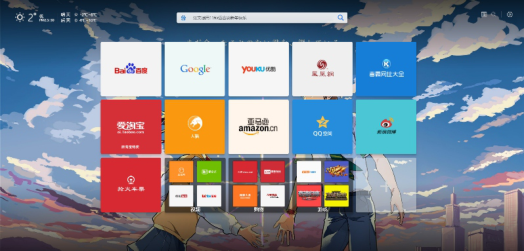
Figure 1: Search Engine Interface.
different priorities. Purchase et al. quantified the layout features of web pages according to fourteen different indicators, and proposed an aesthetic evalu- ation tool. The tool was used to evaluate a variety of web interfaces, and the results showed that users’ judgments of aesthetic appeal and perceived usability matched numerical measures (Purchase et al., 2011).
However, for interfaces of different natures, not all of the 14 beauty inde- xes are applicable. Therefore, in many studies of beauty calculation, different interface types are often evaluated by different types of beauty indexes. For example, Miniukovich et al. proposed 8 GUI beauty indicators that can be effectively and reliably applied to desktop web pages and mobile applica- tions(Miniukovich & Angeli, 2015). Six beauty indicators that affect the aesthetics of the interface, including proportion, simplicity, order, rhythm, density and balance, can be extracted by the factor analysis method, and constructe a computing system for the aesthetics of computer interface layout (L. Deng and Wang, G, 2020).
At the same time, the coverage of the 14 indicators in the Ngo model is limi- ted, and many researchers have also proposed new indicators of beauty. For example, the effect of colour on beauty is not considered in the Ngo model. In the study of Lai et al., a method of beauty calculation was proposed in terms of colour balance and symmetry (Lai et al., 2009). Tsai et al. propo- sed a computational model for calculating the beauty of text overlay images (Tsai et al., 2014). Combined with the above research, this paper proposes a method to calculate the beauty of elements superimposed on the background image by using the AHP method, and evaluates the selected search engine interfaces.
METHODOLOGY
In this study, according to the initial layout characteristics of the search engine interface, 6 of Ngo’s 14 beauty indexes are selected: sense of order, sense of association, sense of union, simplicity, density and sense of regularity. On this basis, the background is added to the interface, and the method of Lai et al. is used to calculate the interface colour balance when the interface elements have the same colour. The 7 indicators are quantitatively analysed by the analytic hierarchy process, the weight of each indicator is obtained, and the comprehensive beauty of each initial interface is calculated for analysis and comparison.
706 Dai and Xue
Measure of Sequence The sense of order refers to the arrangement of elements in the interface, and the arrangement should help the eyes to move in the displayed information. Therefore, the sense of order refers to the relationship between displayed information and human visual patterns. The calculation formula is:
Equations and mathematical formulas are available in the original paper PDF.
4 if wj is the biggest in w 3 if wj is the 2nd biggest in w 2 if wj is the 3rd biggest in w 1 if wj is the smallest in w
In the formula, UL, UR, LL, LR represent the upper left, upper right, lower left, and lower right areas of the interface, and weights are assigned to the visual importance of each area. Aij is the area of the interface element i in this quadrant j.
Measure of Cohesion The sense of association helps to partition the functions of different interface elements, and the reasonable function partition helps users locate quickly and improve the efficiency of interface operations. Similar aspect ratio can improve cohesion, and the calculation formula is:
1 cf1 otherwise
The Influence of Background, Layout and Colour Elements on the Beauty Index 707
The hi, bi, hlayout, blayout, hframe, and bframe in the formula represent the length and width of each layout element, including the length and width of the largest rectangular box containing all interface elements and the length and width of the outer border.
Measure of Unity After partitioning the functions through the sense of association, the ele- ments in each area are united together, resulting in a sense of union, making the overall interface layout orderly. The sense of unity refers to the degree to which screen elements belong to a whole, and its calculation formula is:
UMform
i ai
In the formula, alayout and aframe respectively represent the area of the lar- gest rectangular frame containing the entire interface element and the area of the product outline, nsize represents the number of dimensions used in the interface element, and ai represents the area of each component element in the interface.
Measure of Simplicity A concise interface can make the content of the interface easier to understand. The calculation formula is:
Among them, nvap and nhap represent the number of alignment points in the horizontal and vertical directions respectively, and n represents the number of elements in the entire interface layout.
Measure of Density Intensity refers to the extent to which the interface is covered by interface ele- ments, and is related to the area and number of interface elements. Intensity is achieved by limiting the screen density level to an optimal percentage. The calculation formula is:
i ai aframe
∈[0, 1]
708 Dai and Xue
where ai and aframe are the area of element i and the interface; n is the number of elements on the interface.
Measure of Regularity Regularity is the consistency of elements based on a certain principle or plan. By establishing standard, equally spaced horizontal and vertical ali- gnment points for screen elements, and minimizing the alignment points, the regularity of screen design can be achieved. The calculation formula is:
RMalignment
RMspacing
2 ∈[0, 1] (1)
2n otherwise (
Measure of Color Balance In interface design, all elements are arranged on the background of the page, regardless of whether the background is a solid colour or a picture. There- fore, the colour of the background contrasts with the elements and affects the beauty of the page. According to the research of Lai et al., the format of the picture can be converted to HSV, and the colour balance in the horizontal and vertical directions can be calculated on this basis. Calculated as follows: q 1C = 1 √ (V1 −V2)2 + (V1S1 cos H1 −V2S2 cos H2)2 + (V1S1 sin H1 −V2S2 sin H2)2
Calculate the vertical and horizontal colour balance xb and yb:
Pw
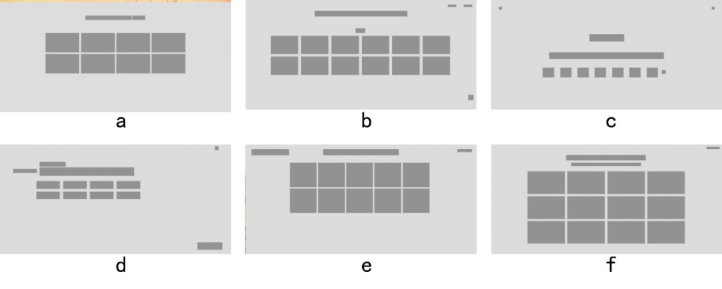
Sample Selection The sample selected is the search engine interface of several mainstream bro- wsers that are frequently used in the Windows, including IE, Cheetah, Sogou, Aoyou, 360, as shown in Figure 2.
Import the initial page into Adobe Illustrate and simplify the elements on the page into rectangles and outline the outline with vector tools. Use the
The Influence of Background, Layout and Colour Elements on the Beauty Index 709
Figure 2: Interface extraction map.
information reading tool in the software to obtain the data of the height and width of each rectangle and the relevant coordinate points required for calculation in pixels. The size of the page is 1920*910 px.
BEAUTY CALCULATION Calculation of Beauty Index Without Background
Substituting the coordinates in Table 1 into the beauty calculation code writ- ten by Matlab, the calculated values of 6 beauty indicators are shown in table 2.
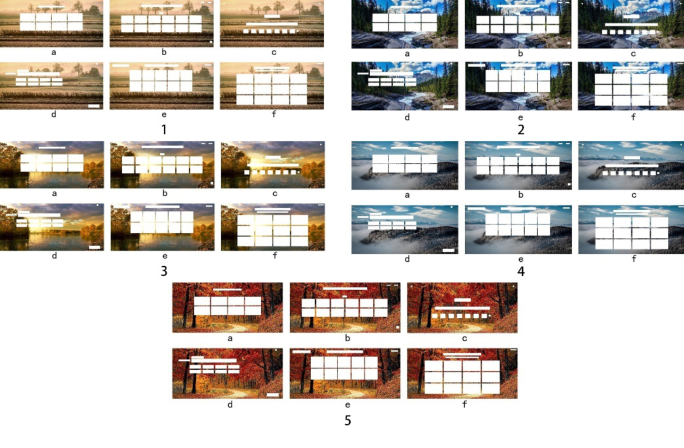
Calculation of Colour Balance Index As shown in Figure 3, add five different backgrounds for each interface and calculate the colour balance index. The calculation results are shown in Table 3.
AHP to Calculate Comprehensive Beauty Considering the first six beauty indicators except the background, the weight vector is [0.2105, 0.1053, 0.0526, 0.1579, 0.2105, 0.2632]. Then, the weight vector is sorted and checked for consistency. The result of the test is that the consistency index CI is close to 0, and there is satisfactory consistency; at the same time, the consistency ratio CR is less than 0.1, and the inconsistency of the paired comparison matrix is within the allowable range. The calculation results are shown in Table 5.
When including the background image and considering 7 beauty indica- tors, the weight vector is [0.1538, 0.0769, 0.0385, 0.1154, 0.1538, 0.1923]. Then, the weight vector is sorted and checked for consistency. The result of the test is that the consistency index CI is close to 0, and there is satisfactory consistency; at the same time, the consistency ratio CR is less than 0.1, and the inconsistency of the paired comparison matrix is within the allowable range. The calculation results are shown in Table 5.
In the case of no background addition, the search engine interface ranking of each browser is Cheetah, 360, Edge2, Aoyou, Sogou, Edge1. The number one is Cheetah, and the last one is Edge1. From the perspective of sense of
712 Dai and Xue
Figure 3: Background.Table 3. Color balance beauty (CBM).
order, Sogou and Edge1 have more elements in the lower half, which do not conform to the reading habits of human from upper left to lower right; Cheetah, Edge2 and 360, the element blocks in these interface are relatively similar, with a good sense of simplicity and regularity; Considering the cluster density, the coverage of elements in Edge1 interface is too small, while the coverage of elements in Sogou interface is too large, so they rank last.
The Influence of Background, Layout and Colour Elements on the Beauty Index 713
By adding background to calculate colour balance, the comprehensive beauty of each interface has been significantly improved. This shows that adding background can significantly improve the comprehensive beauty of the interface. In addition, the degree of beauty improvement of the interface with low beauty after adding background is more significant than that of the interface with high beauty. However, the ranking of search engine interface scores of each browser remains unchanged. At the same time, the scores of the same interface under different backgrounds are basically no significant difference. This indicates that the main factor determining the beauty of this type of interface is the arrangement of elements rather than the colour of the background. The reason for this result may be that when users use this type of interface, their main attention resources will be placed on the element block without paying too much attention to the background. The specific reasons need further exploration.
REFERENCES
Deng, L., & Wang, G. (2020). Quantitative Evaluation of Visual Aesthetics of Human-Machine Interaction Interface Layout. Computational Intelligence and Neuroscience, 2020. Lai, C., Chen, P., Shih, S., Liu, Y., & Hong, J. (2010). Computational models and
experimental investigations of effects of balance and symmetry on the aesthetics of text-overlaid images. Int. J. Hum. Comput. Stud., 68, 41–56. Miniukovich, A., & Angeli, A.D. (2015). Computation of Interface Aesthetics. Proceedings of the 33rd Annual ACM Conference on Human Factors in Computing Systems. Ngo, D.C., Teo, L.S., & Byrne, J.G. (2003). Modelling interface aesthetics. Inf. Sci.,
152, 25–46. Purchase, H.C., Hamer, J., Jamieson, A., & Ryan, O. (2011). Investigating Objective Measures of Web Page Aesthetics and Usability. AUIC. Salimun, C., Purchase, H.C., Simmons, D.R., & Brewster, S.A. (2010). The effect of
aesthetically pleasing composition on visual search performance. NordiCHI. Tsai, M., Wang, K., Liu, Y., & Hong, J. (2014). Perceived Visual Aesthetics of Text- Overlaid Images: Computational Models and Experimental Research for White- Space Fraction. International Journal of Human–Computer Interaction, 30, 1–23. Zain, J.M., Tey, M., & Goh, Y.S. (2011). Does Aesthetics of Web Page Interface
Matters to Mandarin Learning? ArXiv, abs/1101.1608.
LISTED IN THE AHFE DIGITAL BOOKSTORE CATALOGUE
Explore the complete digital volume
Intelligent Human Systems Integration (IHSI 2023): Integrating People and Intelligent Systems
Read this individual research paper free through the original publisher, or explore the full digital proceedings book.
ISBN 978-1-958651-45-2
Explore this ISBN in the AHFE Bookstore ↗Listed in the July 2026 bookstore catalogue; search by ISBN to confirm current availability · Digital book purchase optional