Comfort Olubukola Iyiola, Modupe Mewomo, Margaret Oyewole, Sina Makanjuola (2023). Circular Economy for Construction and Waste Demolition: A Bibliometric Review of Research Trends. In: Human-Centered Design and User Experience. AHFE Open Access, vol. 114, pp. 773–782. https://doi.org/10.54941/ahfe1004462
The construction sector is one of the largest contributors to global waste generation, posing significant environmental challenges. In response to this issue, the concept of circular economy (CE) has gained prominence as a sustainable framework for managing construction and demolition (C&D) waste. A bibliometric review analyzing the research trends in CE practices applied to C&D waste was elaborated in this study. The study utilizes a comprehensive dataset of scholarly publications in the Scopus database, spanning publications in the year 2014 to 2023, and employs bibliometric analysis using a two-step literature selection process to map the evolution of research in the field. The review identified key thematic areas, scholarly authors, prolific journals, and co-occurrence networks using VOSviewer software. The findings revealed a growing interest in circular economy approaches for C&D waste, with a surge in research output that focused on circularity in resource efficiency and material flow, life cycle assessment of materials, and circularity in material recovery and recycling. The insights derived from this study contributed to a comprehensive understanding of the current state of C&D waste and facilitated the identification of knowledge gaps within the circular economy framework. It also provided a roadmap for researchers, policymakers, and industry stakeholders to identify research gaps and sustainable solutions for managing C&D waste within the circular economy framework.
The building sector plays a pivotal role in global economic development and urbanization, contributing to infrastructure creation, job generation, and improved quality of life (Khan et al., 2014). However, this industry also generates significant amounts of waste, with construction and demolition (C &D) waste constituting a substantial portion of the overall waste stream (Gálvez-Martos et al., 2018). Sizirici et al. (2021) mentioned that construction waste generates around 40% of the world's waste, consumes up to 40% of its raw resources, and releases about 25% of its carbon dioxide emissions. This suggests that the sector is among the top global waste producers, which is an indicator of its unviability. As concerns about environmental sustainability, resource scarcity, and waste generation intensify, industries are increasingly exploring innovative strategies to transition towards more sustainable practices (Song et al., 2015). The linear consumption pattern prevalent in the construction sector involves extracting raw materials,
manufacturing products, utilizing them and ultimately disposing of them as waste (Illankoon & Vithanage, 2023), which is environmentally unsustainable and poses significant challenges to resource depletion and waste management. Lieder and Rashid (2016) mentioned that the limiting longevity of products is an important emphasis of the linear economy, which ignores the end of life for products. Government officials, business professionals, and decision-makers are very concerned about the need to find a long-term solution to avoid the negative environmental effects of resource use and waste generation due to the liner economy's compounding difficulties. In response to these challenges, the concept of a circular economy (CE) has emerged as a promising framework to transition from the linear “take-make-dispose” model to a more sustainable and resource- efficient approach (Akhimien et al., 2021).
The CE framework emphasizes the transformation of linear processes into closed-loop systems, where resources are retained in the economy for as long as possible through strategies such as recycling, reuse, and remanufacturing (Guerra et al., 2021). Also, a CE aims to decouple economic growth from resource consumption by promoting strategies that maximize the value of materials and products throughout their lifecycle (Suárez-Eiroa et al., 2019). Furthermore, the CE framework underscores the importance of extending the lifespan of materials to the maximum extent while diminishing waste generation, as highlighted by (Illankoon and Vithanage, 2023). Given that the construction industry remains a major consumer of natural resources and a notable producer of waste, inefficiency, and environmental harm associated with construction underscores the need to integrate CE principles. However, the construction sector is famously resistant to change, and the intricate nature of its products combined with limited digitalization has resulted in unparalleled challenges when it comes to implementing CE principles. This has rendered the shift to CE in construction a formidable task, requiring a focused effort to cultivate expertise and develop necessary tools to facilitate its adoption in the field. In light of this, the present study aims to conduct a bibliometric analysis to explore recent progress in applying CE to the management of construction and demolition (C&D) waste. This initiative aims to provide an all-encompassing comprehension of the current landscape of knowledge and assist in guiding initiatives aimed at bridging gaps in the application of CE practices to C&D waste.
RESEARCH METHODS Bibliometric analysis employs qualitative methods along with science mapping tools to visually represent tangible aspects of scientific studies and fields, while also delineating the organization of their subject areas (Malik et al., 2022). This approach was employed in the research to classify and investigate studies related to the management of C&D waste, potentially aiding researchers in shaping future research pathways. The bibliometric analysis was carried out using the VOSviewer software, encompassing parameters such as publication trends, source distribution, country-wise article dissemination, co-occurring keyword patterns, and citation assessments for pivotal publications and authors. The research effectively mapped the statistical bibliometric details of scientific articles within the realm of C&D waste between 2014 and 2023. The utilized bibliometric methods encompassed the utilization of specific approaches: Frequency assessment for the scrutiny of publications based on their type and origin, geographic distribution, and annual
Circular Economy for Construction and Demolition Waste: A Bibliometric Review of Research Trends 775
publication count. Additionally, the co-authorship investigation involved the exploration of author partnerships within the indexed document collection, both in terms of co-occurring authors and collaborative networks. Furthermore, a keyword co-occurrence analysis was conducted to detect correlated terms used in the literature concerning the themes of CE and construction waste.
Figure 1: Outline of research design
Figure available in the original PDF paper.
Search Strategy and Database Selection Before proceeding with the article review process, it's crucial to carefully choose an appropriate search strategy and the right databases (Snyder, 2019). Among the various options available, Scopus and Web of Science stand out as the most widely used. For this study, Scopus was favored over Web of Science due to two main factors. Firstly, Scopus contains a majority of the research articles in the construction field, making it a comprehensive resource. Secondly, it holds the distinction of being the largest citation database for peer-reviewed articles. The initial step involved a basic search, which was subsequently refined using prevalent keywords extracted from relevant articles. The refinement process was iterative, leading to the final search string: "circular economy" OR "circularity" OR "circular business" AND "waste" AND "construction and demolition" OR "project life cycle" OR "building project". The outcome of this search yielded a total of 356 articles, marking a significant advancement in the investigative process.
Inclusion and Exclusion Criteria The study's criteria for determining what to include and exclude were modeled after the approach outlined by Linnenluecke et al. (2020). In terms of what was included, the author considered research articles centered on circular economy (CE) or sustainability within the construction, building, or housing sector. The publication year was not a limiting factor. On the other hand, certain types of research were excluded: those solely addressing CE without relating to construction/building concerns, research articles focused solely on construction without mentioning CE, articles from fields unrelated to construction, as well as abstract-only articles, non-English language articles, and those lacking full-text availability. Following these criteria, 356 articles were identified for analysis in the VosViewer software for science mapping.
Content Analysis Content Analysis serves as a measurement approach employed to summarize and detect patterns, making it applicable to both inductive and deductive research. Consistent with the research conducted by Wu et al. (2019), this methodology was employed in the present study to elucidate the research findings. Furthermore, the articles collected for the current study were organized into clusters utilizing a data clustering technique.
Mapping of Selected Articles Several mapping tools are available, such as CiteSpace, VosViewer, and BibExcel but VosViewer stands out as the most widely used and user-friendly option, particularly in the context of construction-related research, as noted by Owojori et al. (2021). VosViewer, a text-mining tool, is exceptionally valuable for illustrating extensive networks. For this analysis, it was employed through a series of steps, including loading the dataset, visualization, computation, and data mining. Furthermore, it facilitated the examination of co-citation, keywords, journals, and the co-occurrence of countries.
RESULTS OF DATA ANALYSIS The examination of science mapping in this research was conducted using the subsequent categories: (i) publication trends, (ii) country distribution mapping, and the co-occurrence of keywords.
Publication Trend in CE and C & D Waste
Figure 1 illustrates the annual distribution of published papers concentrating on CE articles and C&D waste. Out of the 356 articles, the earliest research was conducted by Sansom and Avery (2014), indicating the emergence of the CE concept for C&D waste in that year. This initial study was followed by four articles in 2015, six in 2016, and three in 2017. The remaining papers were published between 2018 and 2023, indicating a noteworthy surge in CE research interest over the past five years. This discovery aligns with prior research highlighting CE's prominence in the construction field. The growing focus on CE can be attributed to the call for a transition from a linear approach to a more sustainable system, underscoring the increasing significance of CE in waste management within the global construction sector.
Figure 2: Annual Publication Distribution
Figure available in the original PDF paper.
Circular Economy for Construction and Demolition Waste: A Bibliometric Review of Research Trends 777
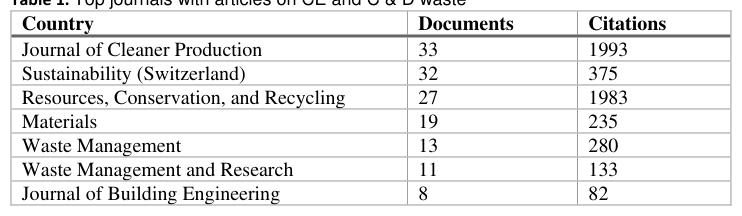
Source of Publication According to Figure 3, a combined count of 356 papers was released. This compilation comprises 309 articles from academic journals and 47 conference papers. The systematic review of literature emphasizes the academic interest in leading journals on CE and C & D waste regarding the highest number of published papers (Table 1). Among these, are the Journal of Cleaner Production (with 33 articles), Sustainability (Switzerland) (with 32 articles), and Resources, Conservation and Recycling (with 31 articles).
Table 1. Top journals with articles on CE and C & D waste Country Documents Citations Journal of Cleaner Production 33 1993 Sustainability (Switzerland) 32 375 Resources, Conservation, and Recycling 27 1983 Materials 19 235 Waste Management 13 280 Waste Management and Research 11 133 Journal of Building Engineering 8 82 The result corroborates with the findings of Negrete-Cardoso et al. (2022) on the concept of CE and waste management who establish a consensus in their findings that leading journals in this area are more pertinent in the Journal of Cleaner Production, Sustainability (Switzerland), and Resources, Conservation and Recycling. The most frequently cited papers considered to have the greatest impact in the field of study were identified. Out of the 356 examined documents from 124 sources and 348 authors, the 12 most cited papers were selected. (Table 1).
Journal of Environmental… Buildings Applied Science (switzerland)
Construction and Building… Environmental Science and… Journal of Building Engineering
Materials Waste Management Waste management and Research Sustainability (switzerland) Resources, Conservation and…
Journal of Cleaner production
0 5 10 15 20 25 30 35
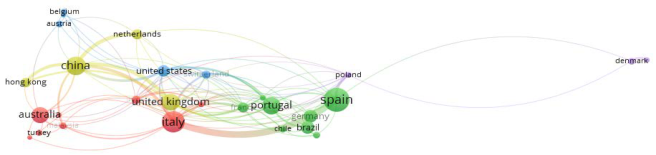
Figure 3: Source of Publication Article Distribution by Countries Figure 4 illustrates the representation of different countries through science mapping. The study employed specific search criteria encompassing analysis type and unit (co-authorship and country). The VOSviewer analytical function was utilized to collect data on citations and document count, with a requirement of at least 5 publications per country. Applying these parameters, out of the 70 countries initially considered, only 28 met the established criteria. Spain (50 documents,
Figure available in the original PDF paper.
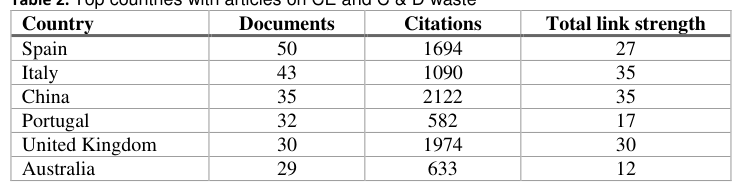
1694 citations), Italy (43 documents, 1090 citations), China (36 documents, 2122 citations), and the United Kingdom (30 documents, 1974 citations) emerged as the leaders in publication count, which could be attributed to their early embrace of CE compared to other regions. This result corroborated the findings of Negrete- Cardoso et al. (2022). Greater levels of affinity are represented by thicker lines, indicating stronger connections and associations among specific pairs of countries. Thicker lines connecting Spain and Italy, Italy and China, Hong Kong, and China, as well as the United Kingdom and China, underscore the heightened connection and affiliation between these pairs of countries. Table 1 revealed that the articles spanned across five continents, excluding Africa and Antarctica. This underscores the slower pace of discussions on CE in C&D waste within Africa and its early stages. The results emphasize the need for substantial efforts and increased awareness to promote the adoption of CE in C&D waste management across Africa. The outcome highlights these countries’ inclination toward promoting CE as a viable alternative for diminishing material consumption, reducing waste generation, and disconnecting the utilization of natural resources from economic growth, as a means to achieve a fair, environmentally friendly, and prosperous recovery. However, it also underscores the existing disparities between developed and developing nations in this regard.
Figure 4: Distribution of Publications by CountriesTable 2. Top countries with articles on CE and C & D waste Country Documents Citations Total link strength Spain 50 1694 27 Italy 43 1090 35 China 35 2122 35 Portugal 32 582 17 United Kingdom 30 1974 30 Australia 29 633 12
Source of Publication Keywords play a crucial role as significant terms, acting as reference points that aid in describing content and comprehending concepts within research papers (Liu et al., 2019). Consequently, the network of keywords holds the potential to represent a domain of knowledge shedding light on vital research subjects and their interconnected organization (Su and Lee, 2010). To generate a visualization map and superimpose a network depicting the simultaneous presence of research subjects, information from the Scopus database was brought into VOSviewer. Within this research, an analysis of co-occurrence was performed utilizing the specific keywords provided by the authors, with a particular focus on articles related to construction research. This approach effectively captures various research themes related to CE in C&D waste. The co-occurrence network was
Circular Economy for Construction and Demolition Waste: A Bibliometric Review of Research Trends 779
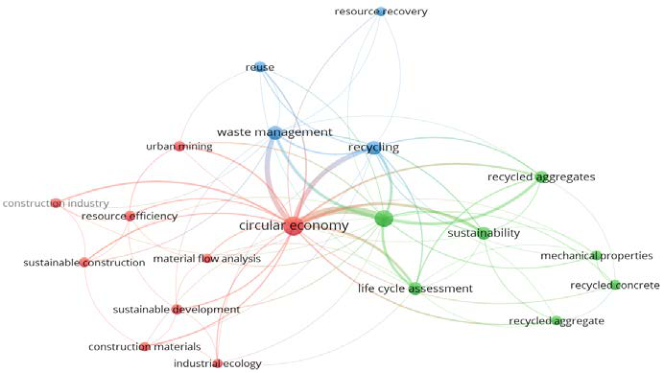
created using VOSviewer software, involving 1014 keywords, out of which 20 displayed co-occurrences. Notably, four significant clusters of keywords emerged, linked by 79 connections with a cumulative strength of 326. It's important to acknowledge the presence of analogous keywords and some redundancy in the analysis. To address this, a thesaurus file was employed to merge them in the network map, ensuring the alignment of similar terms. For instance, the term 'construction and demolition waste' was utilized to replace variations like 'construction and demolition waste (cdw)', 'construction waste', 'cdw', and 'waste', among others. Eliminating redundant keywords like 'China' and 'Australia' aimed to enhance the quality of outcomes. Through the process of filtering and combining similar phrases, a total of 21 co-occurrence keywords were identified, ultimately clustered into three distinct groups. These clusters, which are depicted in different colors in the distance-based visualization (see Fig. 5), represent the primary research themes concerning circular economy in C & D waste. The node sizes correspond to the frequency of keyword co-occurrence, while the line thickness signifies the strength of their connection. Notably, the robust link between 'circular economy' and 'construction and demolition waste' underlines a substantial relationship between these two keywords.
Figure 5: Cluster Visualisation Map for Co-occurring Keywords.
Cluster 1: Circularity in Resource Efficiency and Material Flow The keywords in this cluster labeled in red on the map include the built environment, CE, construction, construction materials, industrial ecology, material flow analysis, resource efficiency, sustainable construction, and urban mining. This research theme emphasizes the importance of adopting circular economy principles in construction and demolition activities. The concept of CE aims to minimize waste and optimize the use of resources by promoting the continuous circulation of materials and products within the economy. Therefore, construction demolition requires proper management of resources and construction materials in a way that seeks to extend their lifespan, reduce environmental impact, and extract maximum value. This will enhance sustainability in the built environment. Also, this research theme explains the flow of construction materials. In this context, the material flow system ensures that resources are utilized more efficiently and waste is minimized by keeping materials in circulation for as long as possible. It provides
insights into the sources, types, quantities, and fates of waste materials, which can inform waste reduction, recycling, and disposal strategies. Similarly, a well- designed material flow system helps to keep products and materials in use through strategies that extend the product lifetime, thereby reducing the amount of waste generated and minimizing environmental pollution. In addition, sustainable practices that are essential for the ecosystem will be enhanced. Cluster 2: Life Cycle Assessment of Materials The group located within the green area on the map consists of 7 elements related to topics like C&D waste, recycled aggregate, life cycle assessment, mechanical properties, recycled concrete, and sustainability. The primary area of study within this theme revolves around conducting a circular life cycle analysis of construction materials. This analysis encompasses the evaluation of how these materials impact the environment from the moment they are produced, through their usage within a building, until their eventual demolition. Gaining a comprehensive grasp of the material's life stages during manufacturing, application, and removal is essential for a precise evaluation of its ecological consequences. The map highlights that C&D waste along with recycled aggregate hold significant importance in this cluster, evident from their larger representation. This suggests that more emphasis has been placed on these areas compared to others in the cluster. While most studies concentrate on evaluating the life cycle of construction materials within a circular economy framework, there is still limited research on indicators for minimizing construction waste. As a result, there is a need for future investigation into establishing a comprehensive indicator framework for addressing C&D waste within a circular economy context. Cluster 3: Circularity in Material Recovery and Recycling This cluster is represented in blue and has 4 items with keywords such as recycling, resource recovery, reuse, and waste management. This cluster can be seen to contain keywords relating to “Material Recovery and Recycling”. These CE strategies are aimed at reducing waste generation, conserving resources, and minimizing environmental impacts. These strategies work together to create a more sustainable and efficient approach to managing materials and products throughout their lifecycle. For example, recycling C & D waste involves collecting and processing building materials from demolished buildings and construction sites. For example, crushed concrete can be used as aggregate for new concrete, while reclaimed wood can be used for interior finishes which conserves energy, and minimizes the environmental impact of construction. In the same vein, resource recovery focuses on extracting valuable components and materials from waste streams. These recovered resources can be refurbished and incorporated into new projects, extending their lifecycle and reducing the need for new production. In addition, instead of discarding construction materials, these items can be carefully dismantled, refurbished, and integrated into new projects. Therefore, waste management plans should include strategies to promote recycling, reuse, and recovery of resources. ROADMAP FOR FUTURE RESEARCH Despite the focus on CE concerning the management of C&D waste, there are specific areas necessitating deeper exploration. These areas include the expansion
Circular Economy for Construction and Demolition Waste: A Bibliometric Review of Research Trends 781
of business models to encompass various stakeholders and the integration of innovative circular approaches during different stages of the building lifecycle. While research on lifecycle assessment of construction waste is prevalent in existing literature, there is a scarcity of efforts that connect these assessment indicators to CE for buildings. Understanding these indicators could serve to assess the circular performance of construction materials at different lifecycle stages. Furthermore, the utilization of digital technologies in CE for minimizing C&D waste remains limited, both in terms of application and research efforts. These technologies can effectively amalgamate data collection and analytic tools to bolster CE endeavors. Research gaps existed in identifying and evaluating these emerging technologies, as well as understanding their accessibility, adaptability, and potential barriers to adoption. Therefore, introducing digital technologies into CE for C&D waste, throughout the building lifecycle, emerges as a potent strategy for enhancing sustainability. In the meantime, the adoption of circular practices is not solely dependent on technical solutions; social and cultural factors also play a significant role. Research gaps existed in understanding the attitudes, beliefs, and motivations of different stakeholders, including construction professionals, policymakers, and consumers, towards embracing CE principles. More research is needed to explore how circularity could be integrated into urban development strategies, zoning regulations, and infrastructure planning to create more sustainable and resilient cities. It is of paramount importance to explore future avenues of research that prioritize the decoupling of economic growth from resource consumption, thereby promoting efficient resource utilization in the pursuit of a clean and circular economy. This entails conducting comprehensive assessments of how circular economy initiatives contribute to sustainable development, establishing a legal framework that supports Circular Economy (CE), and updating waste management regulations. Additionally, there should be a strong emphasis on research concerning policy interventions and the enforcement of regulatory measures by authorities to facilitate the transition to a circular economy.
CONCLUSION
The notion of circular economy (CE) applied to construction and demolition (C&D) waste has garnered significant attention. The review highlights a noticeable uptick in research concerning circular practices in the management of C&D waste. The investigation undertook a thorough bibliometric analysis of pertinent publications sourced from the Scopus database, offering insights into the publication trends such as annual distribution, sources, countries, and co-occurring keywords. Through cluster analysis, the study delineated the evolution of research themes, furnishing researchers with a roadmap for prospective studies in C&D waste circularity. The findings from this study have set the path for future studies by providing future research directions in CE & C and D waste management which would be a valuable reference point for practitioners to understand the suitability of the CE approach. The research trends identified in the study signify a promising shift towards a more sustainable and circular approach to managing C & D waste. A future where waste is minimized, resources are conserved, and the construction industry become a driving force for environmental stewardship and sustainability can be enhanced by building upon the insights gained from this study.
REFERENCES
Akhimien, N. G., Latif, E., & Hou, S. S. (2021). Application of circular economy principles in buildings: A systematic review. Journal of Building Engineering, 38, 102041. Gálvez-Martos, J.-L., Styles, D., Schoenberger, H., & Zeschmar-Lahl, B. (2018).
Construction and demolition waste best management practice in Europe. Resources, conservation and recycling, 136, 166-178. Guerra, B. C., Shahi, S., Mollaei, A., Skaf, N., Weber, O., Leite, F., & Haas, C. (2021).
Circular economy applications in the construction industry: A global scan of trends and opportunities. Journal of cleaner production, 324, 129125. Illankoon, C., & Vithanage, S. C. (2023). Closing the loop in the construction industry: A systematic literature review on the development of circular economy. Journal of Building Engineering, 107362. Khan, R. A., Liew, M. S., & Ghazali, Z. B. (2014). Malaysian construction sector and
Malaysia vision 2020: Developed nation status. Procedia-social and behavioral sciences, 109, 507-513. Lieder, M., & Rashid, A. (2016). Towards circular economy implementation: a comprehensive review in the context of the manufacturing industry. Journal of Cleaner Production, 115, 36-51. Linnenluecke, M. K., Marrone, M., & Singh, A. K. (2020). Conducting systematic
literature reviews and bibliometric analyses. Australian Journal of Management, 45(2), 175-194. Liu, Z., Lu, Y., & Peh, L. C. (2019). A review and scientometric analysis of global building information modeling (BIM) research in the architecture, engineering, and construction (AEC) industry. Buildings, 9(10), 210. Malik, R., Visvizi, A., Troisi, O., & Grimaldi, M. (2022). Smart services in smart cities:
insights from science mapping analysis. Sustainability, 14(11), 6506. Negrete-Cardoso, M., Rosano-Ortega, G., Álvarez-Aros, E. L., Tavera-Cortés, M. E., Vega-Lebrún, C. A., & Sánchez-Ruíz, F. J. (2022). Circular economy strategy and waste management: A bibliometric analysis in its contribution to sustainable development, toward a post-COVID-19 era. Environmental Science and Pollution Research, 29(41), 61729-61746. Owojori, O. M., Okoro, C. S., & Chileshe, N. (2021). Current status and emerging trends
on the adaptive reuse of buildings: A bibliometric analysis. Sustainability, 13(21), 11646. Sansom, M., & Avery, N. (2014). Briefing: Reuse and recycling rates of UK steel demolition arisings. Proceedings of the Institution of Civil Engineers-Engineering Sustainability, Sizirici, B., Fseha, Y., Cho, C.S., Yildiz, I., & Byon, Y.J. (2021). A review of carbon
footprint reduction in the construction industry, from design to operation. Materials, 14(20), 6094. Snyder, H. (2019). Literature review as a research methodology: An overview and guidelines. Journal of Business Research, 104, 333-339. Song, Q., Li, J., & Zeng, X. (2015). Minimizing the increasing solid waste through a zero-
waste strategy. Journal of Cleaner Production, 104, 199-210. Su, H.-N., & Lee, P.-C. (2010). Mapping knowledge structure by keyword co-occurrence: A first look at journal papers in Technology Foresight. scientometrics, 85(1), 65- 79. Suárez-Eiroa, B., Fernández, E., Méndez-Martínez, G., & Soto-Oñate, D. (2019).
Operational principles of circular economy for sustainable development: Linking theory and practice. Journal of Cleaner Production, 214, 952-961. Wu, H., Zuo, J., Zillante, G., Wang, J., & Yuan, H. (2019). Construction and demolition waste research: a bibliometric analysis. Architectural Science Review, 62(4), 354- 365.
LISTED IN THE AHFE DIGITAL BOOKSTORE CATALOGUE
Explore the complete digital volume
Human-Centered Design and User Experience
Read this individual research paper free through the original publisher, or explore the full digital proceedings book.
ISBN 978-1-958651-90-2
Explore this ISBN in the AHFE Bookstore ↗Listed in the July 2026 bookstore catalogue; search by ISBN to confirm current availability · Digital book purchase optional