Modupe Mewomo, Comfort Olubukola Iyiola (2023). Benefits of Implementing Value Management Practices on The Performance of Construction Projects. In: Human-Centered Design and User Experience. AHFE Open Access, vol. 114, pp. 762–772. https://doi.org/10.54941/ahfe1004461
The construction sector contributes significantly to the economy, and its activities are essential to achieving a nation's societal strategic priorities of fostering housing, infrastructure, and improved livelihood. However, compared to expectations, the current construction projects are undergoing significant changes. The complexity and difficulty of completing construction projects timely continue to be a major problem and delivering construction projects is more difficult in recent times due to increased design iterations, cost, and time overrun, and enormous wastes, among others. Therefore, defining value in terms of social, economic, and environmental issues, even when the clients' criteria are met becomes a major challenge. Consequent to this, the establishment of value management (VM) practices was advocated to ensure the successful completion and delivery of construction projects. However, there is limited research on implementing value management practices for the completion of construction projects especially in developing nations and the concept of doing so isn't yet comprehended. Therefore, this study examined the benefits of applying VM techniques to the successful delivery of construction projects. Based on current research trends, a systematic literature study was done, looking at articles from the year 2010 to 2023. The insights derived from this study contributed to a comprehensive understanding of the benefits of adopting VM practices and facilitated the identification of knowledge gaps within the value management study. It also provided a roadmap for researchers, clients, project stakeholders, and policymakers to identify the benefit of this research implications as they establish and enhance value requirements on construction projects.
Benefits of Implementing Value Management Practices on the Performance of Construction Projects 763
management of all construction projects (Lin et al., 2011). As sustainable building projects are developed, more emphasis has been paid to strategies to increase the financial performance of construction projects and the life-cycle project value (Powmya & Abidin, 2014). When the clients' objectives are accomplished, there is value; however, defining value in terms of social, economic, and environmental issues is challenging for the project stakeholders (Olanipekun et al., 2018). If this is to be fully handled, a dramatic shift in the way construction projects are delivered is required, while the use of a variety of technologies to assist in managing and delivering construction project projects sustainably is of utmost importance (Liyanage & Rupasinghe, 2020). As a result, there has been advocacy to incorporate value management (VM) for the effective execution of sustainability of construction projects (Aghimien & Oke, 2015; Kim et al., 2016; Kineber et al., 2022; Ojo et al., 2021; Othman et al., 2021; Perera et al., 2011). The goal of VM is to ensure that clients of construction projects may constantly use investment principles and accomplish both their investment goals and the full life-cycle worth after the project (Othman et al., 2021). According to Kineber, Othman, Oke, Chileshe, and Buniya (2021), VM can enable the construction industry the ability to be more sustainable by encouraging measures that reduce construction costs. This is also in line with the assertion of Zainul-Abidin (2008) that the roles of VM include enhancing sustainability and performance while reducing waste in the execution of building projects. The adoption of the VM technique has proved to be beneficial in achieving building development goals, such as improving project design, construction, and cost-effectiveness (Iyiola & Mewomo (2022a) Hwang et al., 2015). However, the concept of VM practices is still at the inception stage, especially in developing countries, and is still confronted with numerous challenges and barriers (Iyiola & Mewomo, 2022b). The extent of understanding of VM and its capacity to offer sustainable buildings among construction professionals might be one of the reasons behind this. As a result, the benefit of VM practices on the performance of green construction projects is highlighted in this study.
RESEARCH METHODS Based on the methodology, a systematic literature review for this study was conducted. To identify knowledge gaps and suggest areas for more research, systematic literature reviews evaluate, interpret, and synthesize all existing research pertinent to a given research subject. A pool of similar papers was generated using a two-stage process. Using the pre-established search strings and keywords, a list of construction management journals was initially examined. Only 10 of the 35 construction management journals listed, according to the stage's results, were pertinent to the goal of this paper. The second stage involved a desktop study that evaluated papers using a few search engines, such as Google Scholar, Web of Science, and Scopus. A second collection of publications was generated by using keyword searches in databases like Google Scholar and Scopus. From the reviewed articles' citations and reference lists, additional literature publications were found. The specified search terms and phrases shown in Table 1 show the foundation for the database retrieval. This research produced a cluster of 106 papers, each of which has a source listed under the heading "Initial Number of Papers." The identification of 73 studies for in-depth study followed the removal of duplicate research. Additional research was done on the 73 papers to determine
whether the articles met the inclusion and exclusion criteria as well as quality standards. A more thorough review of the paper reduced the number of pertinent publications to 32 papers, which were then analyzed. The phrase "Final number of papers" refers to the total number of screened publications in this section.
Table 1. Top search strings and keywords Country Documents 1 “VM” OR “Value management” OR “Construction projects” AND “benefit” OR “performance” 2 “VM” OR “Value management” OR “Value Analysis” AND “adoption” OR “implementation”
THE VALUE MANAGEMENT PROCESS VM helps to improve efficiency and performance without compromising product value or overall performance, as well as maximize functional value and decrease project life cycle costs by minimizing needless costs (Kineber, Othman, Oke, Chileshe, & Zayed, 2021; Ncube & Rwelamila, 2017). VM task plan provides direction for properly managing issues that may develop throughout a building's existence. The task plan commonly known as the VM job plan according to Kineber et al. (2022) is categorized into different phases ranging from five to eight phases. The six stages of VM practices as categorized by Madushika et al. (2020) were the information phase, function analysis, creativity phase, evaluation, development phase, and presentation phase. This assertion was also supported by the studies of Tanko et al. (2017). The schedule and location are set at the pre- study/workshop stage, and basic project documentation and background documents (such as technical, and expert statements, records, and pertinent problems) are sent out to ensure that the desired stakeholders can participate. Participants are given a process briefing to ensure that they have a good knowledge of the projects. A procedure brief is given to team members to ensure participants are well-informed about the initiatives. The majority of the value study's information phase is addressed in this preparatory step. A work plan created during the workshop or study phase offers a systematic and structured method for designing and comparing solutions that will enable the project to be finished with the most worth (such as enormous productivity, economic growth, quality, and the least amount of delay).
APPLICATION OF VM IN THE CONSTRUCTION INDUSTRY Although VM originated in the manufacturing sector, it has also been adopted in building firms due to the changes in the competitive environment of the construction industry (Ojo et al., 2021), the concept has existed for over a century, and its application has remained confined (Alshehri, 2020). The ability and implementation of VM to offer sustainability in building projects in industrialized countries have been the subject of numerous research. Its successful implementation in US public construction projects was noted by Luvara and Mwemezi (2017). Additionally, government parastatals in most developed nations, including the USA, the UK, Hong Kong, China, and Australia, have implemented VM to enhance infrastructure works and maximize investment returns (Kissi et al.,
Benefits of Implementing Value Management Practices on the Performance of Construction Projects 765
BENEFITS OF IMPLEMENTING VALUE MANAGEMENT The significant benefits of implementing VM practices in building projects have also been drawn from the literature.
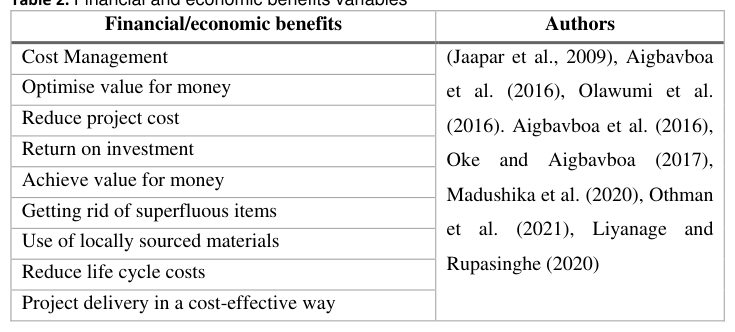
Financial and Economic Benefits Aigbavboa et al. (2016) found that in South African construction, VM maximizes value for money while simultaneously focusing on the project's goals and working toward a more efficient design. VM detects excessive expenses in a construction project and evaluates alternate options without jeopardizing productivity efficiency, aesthetics, or security, benefiting the project's timeline and overall existence (Jaapar et al., 2009). Aigbavboa et al. (2016) noted that, as a cost management tool, VM is critical in the construction sector because it emphasizes all the concepts that would ensure that projects are executed at the lowest feasible cost while ensuring functionality. The adoption of VM on building projects, according to Olawumi et al. (2016) can assist in detecting excessive expenses. In the process, waste on the job site, duplication of effort, and wasteful spending are reduced through value analysis, which includes providing alternative ideas, reducing, or deleting superfluous products, and utilizing creative ideas. According to Olawumi et al. (2016), VM aids in comprehending what value means to the project's owners and users, as well as providing a functional method and strategic planning for assessing value by considering monetary and non-monetary advantages, i.e., a good approach to evaluate value for money. The relevance of VM in building project performance prompted several countries to guarantee that VM was adapted to fit their construction procedures. Othman et al. (2021) mentioned that using VM in building projects would increase performance, design, constructability, functionality, and quality while lowering costs. As a result, VM may be considered a dependable instrument for developing sustainable goods.
Table 2. Financial and economic benefits variables Financial/economic benefits Authors Cost Management (Jaapar et al., 2009), Aigbavboa
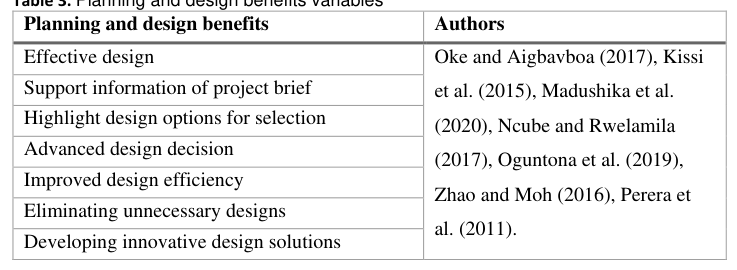
To suit the needs of their clients, VM ensures that all project stakeholders are aware of the project brief (Oke & Aghimien, 2018). The VM framework offers a decision- making process so that involved parties can evaluate and analyze data. A VM task plan is a method that enables team members and stakeholders to consider each methodology individually before making decisions. It varies depending on the project's timeline and study scope (Madushika et al., 2020). According to Oke and Aigbavboa (2017), VM improves construction value, improves design efficiency and quality, maximizes value for money, and helps designers make better choices. According to Olawumi et al. (2016), VM is critical for the early detection of problems in a project, with the large increase in the value obtained greatly outweighing the time and effort required. The author said that when utilized at the idea development and first design stages, a large positive impact would be obtained, with the capacity to meaningfully affect final project results rapidly declining as the project continues through the design development stage. It also reduces the cost spent on a building project by identifying extra expenses, increasing customer engagement, providing a system for the project stakeholders to work collaboratively, advancing design decisions by highlighting various design options for selection, increasing design efficiency, and providing a credible review of the project. VM enables improved design and performance in a collaborative environment, and it also serves as the foundation for enhancing the work plan, which reflects the sponsors' goals and expectations represented as a function (Kissi et al., 2015).
Table 3. Planning and design benefits variables Planning and design benefits Authors Effective design Oke and Aigbavboa (2017), Kissi
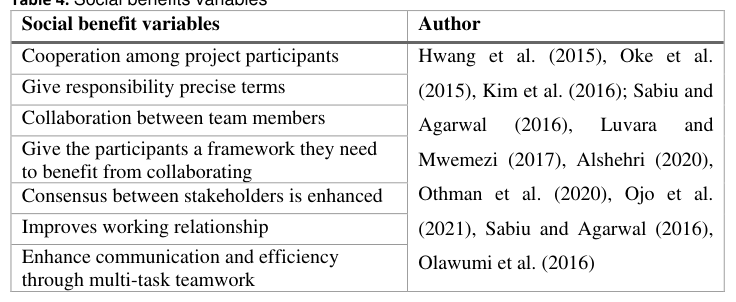
Developing innovative design solutions Social Benefits VM boosts team morale by improving team and client interactions; owing to interdisciplinary and multitasking teamwork, more productivity may be attained (Othman et al., 2021). VM also confronts some of the project stakeholders existing beliefs and private agendas to increase customer engagement throughout the development stages of the project, as well as shared ownership of ideas and adherence to successful implementation (Luvara & Mwemezi, 2017), VM offers the system for the team to collaborate and take advantage of collaborative relationships; shared agreement and ensures that cooperation among relevant parties is improved; the professional team's ability to collaborate effectively and sustain a sense of teamwork guarantees that the client's other goals are achieved (e.g., a project that is delivered on time, meets the business plan, etc.), duties and functions are well defined. It enables better communication so that all stakeholders
Benefits of Implementing Value Management Practices on the Performance of Construction Projects 767
are aware of the limits, restrictions, and requirements for making suitable trade- offs, as well as a way of maximizing the balance between the demands and aspirations of multiple stakeholders (Luvara & Mwemezi, 2017). Aghimien and Oke (2015) stated that collaboration in the form of cross-joint effort is of extreme significance to optimizing the productivity and execution of building projects in construction firms through VM. (Sabiu & Agarwal, 2016) said that VM offers a space for team members to communicate and work together.
Table 4. Social benefits variables Social benefit variables Author Cooperation among project participants Hwang et al. (2015), Oke et al.Table 5. Project development benefits Project development benefits Authors Creates a better focus on the project goal Jaapar et al. (2009), Oke and
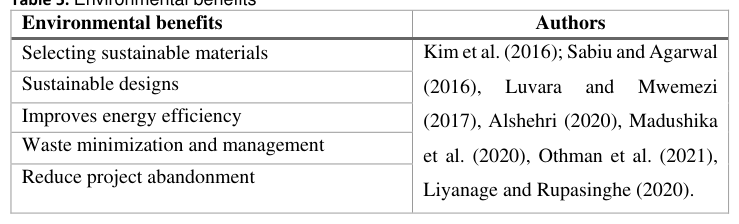
Environmental Benefits of VM Additionally, it gives project participants the chance to improve the built environment and, as a result, promote specialized development (Aigbavboa et al., 2016). Environmental considerations can be included through a variety of methods, including sustainable materials, design strategies, and energy-efficient technologies (Edwards et al., 2019). To provide the best value for the stakeholders throughout the project, the work plan focuses on option evaluation and the design process after identifying and developing a balancing of goals among stakeholders. The overall quality and long-term viability of construction projects are improved by undertaken VM (Kissi et al., 2015). Additionally, it has benefits like a shorter time to market, higher quality, lower environmental impact, and lower lifespan costs. According to Bennett and Mayouf (2021), VM will identify potential issues before they become big ones, get rid of pointless ideas, reduce waste, and make sure the project is finished as cheaply as possible.
Table 5. Environmental benefits Environmental benefits Authors Selecting sustainable materials Kim et al. (2016); Sabiu and Agarwal
DISCUSSION OF FINDINGS The literature showed that VM adoption continues to be haphazard due to inadequate VM implementation in most underdeveloped countries and some adoption hurdles like lack of awareness, poor communication, and interaction, lack of VM experts, understanding about VM, poor planning and schedule, among others which are affecting the sustainability of construction projects according to (Kim et al., 2016). The paper revealed that these barriers can be mitigated by considering the benefits that will be acquired when an effective VM is implemented. These benefits are financial/economic benefits; planning and design benefits; social benefits; project development benefits; and environmental benefits. These benefits will enhance sustainability and improve the performance of construction projects. The worldwide construction sector currently prioritizes
Benefits of Implementing Value Management Practices on the Performance of Construction Projects 769
sustainable development that strikes a balance between social, economic, and environmental agendas (Jaapar et al., 2009). The process of selecting a good site location, sustainable materials, determining excellent design features, and ensuring sustainable construction practices is an essential attribute of VM and it helps to minimize environmental and social damage Additionally, the attributes of VM encourage strong involvement, information exchange, and efficiency by facilitating the collaborative efforts of professionals with a variety of skills and competencies. A few advantages of VM include better business decisions, increased productivity, better products and services, enhanced communication processes, cooperation, stakeholder involvement, and actions that can be supported by all participants. There are various advantages to VM, but they can only be realized if it is embraced, proper individuals are involved, and the study's recommendations are followed. Given this, clients and other construction professionals should embrace these commitments.
CONCLUSION
This study concludes that applying VM practices in construction projects will considerably increase the likelihood of achieving sustainability in building projects. The research is projected to alleviate the long-standing problem of low knowledge of the functions of VM among construction stakeholders as it will also serve as a foundation for promoting VM practices to achieve project sustainability. It is paramount to implement novel concepts and solutions that work for the construction sector to optimize the usage of VM for improved project performance. Furthermore, because all construction professionals are prospective VM team members, great communication skills are required, and more data collection is required to better understand efficient ways of implementing VM. It is also vital to have legislation that can be approved, put into effect, and oversee VM activities.
REFERENCES
Aghimien, D. O., & Oke, A. E. (2015). Application of Value Management to Selected Construction Projects in Nigeria. Developing Country Studies, 5(17), 8- 14. Aigbavboa, C. O., Oke, A. E., & Mojele, S. (2016). Contribution of Value Management to Construction Projects in South Africa. In Conference Proceedings of the 5th Construction Management Conference held at Nelson Mandela Metropolitan University, Port Elizabeth, 226-234. Alshehri, A. (2020). Value management practices in the construction industry: An analytical review [Review]. Open Civil Engineering Journal, 14(1), 10-19. https://doi.org/10.2174/1874149502014010010 Bennett, K., & Mayouf, M. (2021). Value management integration for whole life cycle: Post covid-19 strategy for the UK construction industry. Sustainability (Switzerland), 13(16), Article 9274. https://doi.org/10.3390/su13169274 Edwards, R. E., Lou, E., Bataw, A., Kamaruzzaman, S. N., & Johnson, C. (2019). Sustainability-led design: Feasibility of incorporating whole-life cycle energy assessment into BIM for refurbishment projects. Journal of Building Engineering, 24, 100697.
Hwang, B. G., Zhao, X. B., & Ong, S. Y. (2015). Value Management in Singaporean Building Projects: Implementation Status, Critical Success Factors, and Risk Factors Journal of Management in Engineering, 31(6), 10, Article 4014094. https://doi.org/10.1061/(ASCE)me.1943-5479.0000342 Iyiola, C. O. & Mewomo M. C. (2022a), “Key indicators for successful value management performance in the built environment (A literature review)”, In proceedings, The 12th International Conference on Construction in the 21st Century (CITC – 12), Amman, Jordan, May 16-19, 2022, 248-256 Iyiola, C. O. & Mewomo M. C. (2022b), “Corporate culture and value management integration: a contingency and configuration approach” In Proceedings, CIDB 12th Postgraduate Conference held at International Convention Centre, East London, South Africa on 10 – 12 July 2022 Jaapar, A., Endut, I. R., Ahmad Bari, N. A., & Takim, R. (2009). The impact of value management implementation in Malaysia. Journal of Sustainable Development, 2(2), 210-219. Kim, S. Y., Lee, Y. S., Nguyen, V. T., & Luu, V. T. (2016). Barriers to applying value management in the Vietnamese construction industry. Journal of Construction in Developing Countries, 21(2), 55-80. https://doi.org/10.21315/jcdc2016.21.2.4 Kineber, A. F., Othman, I., Oke, A. E., Chileshe, N., & Buniya, M. K. (2021). Impact of Value Management on Building Projects Success: Structural Equation Modeling Approach. Journal of Construction Engineering and Management, 147(4), 04021011. https://doi.org/10.1061/(ASCE)CO.1943-7862.0002026 Kineber, A. F., Othman, I., Oke, A. E., Chileshe, N., & Zayed, T. (2021). Value management implementation barriers for sustainable building: A bibliometric analysis and partial least square structural equation modeling. Construction Innovation. https://doi.org/10.1108/CI-05-2021-0103 Kineber, A. F., Siddharth, S., Chileshe, N., Alsolami, B., & Hamed, M. M. (2022). Addressing Value Management Implementation Barriers within the Indian Construction Industry: A PLS-SEM Approach. Sustainability, 14(24), 16602. Kineber, A. F., Bin Othman, I., Oke, A. E., & Chileshe, N. (2021). Modelling the relationship between value management's activities and critical success factors for sustainable buildings [Article; Early Access]. Journal of Engineering Design and Technology, 22. https://doi.org/10.1108/jedt-03-2021-0159 Kissi, E., Boateng, E., & Adjei-Kumi, T. (2015). Strategies for implementing value management in the construction industry of Ghana. Proceedings of the DII-2015 Conference on Infrastructure Development and Investment Strategies for Africa, Livingstone, Zambia, Lin, G., Shen, G. Q., Sun, M., & Kelly, J. (2011). Identification of key performance indicators for measuring the performance of value management studies in construction. Journal of Construction Engineering and Management, 137(9), 698- 706. Liyanage, K., & Rupasinghe, A. (2020). Achieving Value for Money in Sri Lankan Construction Industry: A Study of Implementation Issues of Value Engineering Concept. Luvara, V. G. M., & Mwemezi, B. (2017). Obstacles against value management practice in building projects of Dar es Salaam Tanzania. International Journal of Construction Engineering and Management, 6(1), 13-21.
Benefits of Implementing Value Management Practices on the Performance of Construction Projects 771
Madushika, W. H. S., Perera, B. A. K. S., Ekanayake, B. J., & Shen, G. Q. P. (2020). Key performance indicators of value management in the Sri Lankan construction industry. International Journal of Construction Management, 20(2), 157-168. https://doi.org/10.1080/15623599.2018.1484556 Oguntona, O., Akinradewo, O., Ramorwalo, D., Aigbavboa, C., & Thwala, W. (2019). Benefits and drivers of implementing green building projects in South Africa. Journal of Physics: Conference Series, Ojo, L. D., Ogunsemi, D. R., & Ogunsina, O. (2021). Conceptual framework of value management adoption in the Nigerian construction industry. Construction Innovation. https://doi.org/10.1108/CI-02-2021-0017 Oke, A. E., & Aghimien, D. O. (2018). Drivers of value management in the Nigerian construction industry. Journal of Engineering, Design and Technology, 16(2), 270-284. https://doi.org/10.1108/JEDT-02-2017-0012 Oke, E. A., Aghimien, D. O., & Olatunji, O. S. (2015). Implementation of Value Management as an Economic Sustainability Tool for Building Construction in Nigeria. International Journal of Managing Value and Supply Chains, 6(4), 55-64. https://doi.org/10.5121/ijmvsc.2015.6405 Olanipekun, A. O., Xia, B., Hon, C., & Darko, A. (2018). Effect of Motivation and Owner Commitment on the Delivery Performance of Green Building Projects Journal of Management in Engineering, 34(1), 14, 04017039. https://doi.org/10.1061/(asce)me.1943-5479.0000559 Olawumi, T. O., Akinrata, E. B., & Arijeloye, B. T. (2016). Value management– Creating functional value for a construction project: An exploratory study. World Scientific News, 54, 40-59. Othman, I., Kineber, A., Oke, A., Khalil, N., & Buniya, M. (2020). Drivers of value management implementation in building projects in developing countries. Journal of Physics: Conference Series, Othman, I., Kineber, A. F., Oke, A. E., Zayed, T., & Buniya, M. K. (2021). Barriers to value management implementation for building projects in the Egyptian construction industry. Ain Shams Engineering Journal, 12(1), 21-30. https://doi.org/10.1016/j.asej.2020.08.004 Perera, S., Hayles, C. S., & Kerlin, S. (2011). An analysis of value management in practice: The case of Northern Ireland's construction industry. Journal of Financial Management of Property and Construction, 16(2), 94-110. https://doi.org/10.1108/13664381111153097 Powmya, A., & Abidin, N. Z. (2014). The challenges of green construction in Oman. International journal of sustainable construction engineering and technology, 5(1), 33-41. Sabiu, B., & Agarwal, V. (2016). Minimizing the factors hindering the practice of value management in the Nigerian construction industry. International Journal of Science, Engineering and Technology Research, 5(10), 2974-2978. Tanko, B. L., Abdullah, F., Ramly, Z. M., & Enegbuma, W. I. (2017). Confirmatory factor analysis of value management current practice in the Nigerian construction industry. Journal of Advanced Research in Applied Sciences and Engineering Technology, 9(1), 32-41. Zainul-Abidin, N. (2008). Achieving sustainability through value management: a passing opportunity? International Journal of Construction Management, 8(2), 79- 91.
Zhao, R.J., & Moh, W. H. (2016). Value management practices on major construction projects and green building. Frontiers of Engineering Management, 3(2), 147-157.
LISTED IN THE AHFE DIGITAL BOOKSTORE CATALOGUE
Explore the complete digital volume
Human-Centered Design and User Experience
Read this individual research paper free through the original publisher, or explore the full digital proceedings book.
ISBN 978-1-958651-90-2
Explore this ISBN in the AHFE Bookstore ↗Listed in the July 2026 bookstore catalogue; search by ISBN to confirm current availability · Digital book purchase optional