Jorge Dos Reis (2023). Computer mimetics in visible performance: the late work of the Portuguese experimental poet Ernesto Melo e Castro. In: Human-Centered Design and User Experience. AHFE Open Access, vol. 114, pp. 33–40. https://doi.org/10.54941/ahfe1004219
Ernesto Melo e Castro, Covilhã 1932–202, is a textile engineer and Portuguese artist, trained in Bradford. He dedicated is life to textile design and to the technical direction of textile engineering companies. At the same time, he developed research in the field of Brazilian concrete poetry and Portuguese experimental poetry; being a fundamental and very innovative author that used the computer in the last phase of its journey as an artist.His work is based on an ideographic structure where the visual composition, which uses exclusively typography, is based on the principle of the ideogram, where the general graphics of the piece provide the idea for the visual piece. Melo e Castro makes use of lyrics, lines, arrows and various symbols that depart from the conventional music agenda, approaching the notation practices of the authors of American experimental music.His later works, particularly ‘Interactive Sound Poetry’ makes use of a typeface not printed but drawn. Melo e Castro elaborates a capital letter register that mimics the homogeneity of typography. The gestural character of the lyrics shows a phonetic intensity that can be inferred from the writing itself, fixed in the score, where the rapidity of the gesture and the erasure are dominant characteristics. This score is based on a computer interactive creation around phonetics and sound, making use of a computer, keyboard and synthesizer with words amplified and where the user performs poetic sequences randomly as he presses the keys. The observer is faced with a set of words: 'freedom', 'love', 'action', 'chance' and 'peace', within a circle, functioning as reading pivots, providing combinations of graphically noted words.The user makes associations and sequences, learns as a musician learns a piece of computer music, producing conceptual chains of words and the associations will not necessarily be logical or grammatical, and can be casual and therefore produce new and unexpected meanings in the sound and conceptual plane. This piece, being neither singing nor speaking, fits within a mediation between singing and speaking, a technique systematized by Arnold Schoenberg, which constitutes one of the most important criteria in the sound character of the work, starting from a study of the basic phonetics of Portuguese.To confirm this research we are now carrying out an observation around the work ‘Negative Music’ that is not developed as in the works of John Cage in an appreciation of musical silence, although this fact seems at first sight evident. It is a piece for the eyes and not for the ears. The computer game of silence represents first of all a response to the paternal authority of Melo e Castro and a metaphor against the Salazar dictatorship in Portugal. With this in mind, it is first of all a semiotic poem of conceptual visuality; In a second analysis this poem becomes a performative interpretation. In addition to its functional aspect, Melo e Castro’s notation presents a strong graphic and typographic bent, with a notorious concern to produce an object of visual characteristics where there is a balance between its constituents.
Ernesto Melo e Castro (1932-2020) develops an intense creative and research activity in the field of Brazilian concrete poetry and then in Portuguese exper- imental poetry, becoming one of the most focused and important names of these two areas.
In 1962 he published Ideogramas, which would become the first Por- tuguese edition framed in the programmatic ideals of Brazilian concrete poetry, however the work of Melo e Castro stands out in relation to this movement in Brazil and finds a very particular path, in the supper of Por- tuguese experimental poetry, using various intertextual links, in an intense activity of forty years of dissemination of this activity abroad.
His work is recorded in the numerous books of experimental poetry pub- lished, of which stands out Vision/Vision of 1972 and Visual Vision of 1994 where his work is revealed extensively. His exhibitions include Poe- mas Cinética at Gallery 111 in 1965, which is one of the first exhibitions of experimental poetry held in Portugal; after this exhibition, Melo e Castro would carry out a wide and intense set of individual and collective exhibi- tions concluding in the retrospective of his work held in 2006 at the Serralves Museum, entitled O Caminho do Leve.
INTERLOCUTORS OF THE WORK OF MELO E CASTRO Although disseminated with some apparatus, the work of Melo e Castro has not been commented and analyzed in detail, taking into account that, in gen- eral, the most important authors of Portuguese experimental poetry would also end up being evidenced by the way they rescued a reflective thought around their own works. Ana Hatherly and Salette Tavares, two Portuguese poets, are examples of this attitude as they produced their poetry and simul- taneously decoded it for a wide audience, formulating a solid theory that diffused their thinking.
Mendes de Sousa and Eunice Ribeiro state that “it is significant that, in recent decades, attention has been repeatedly drawn to the discrepancy between the procedural nature of all experience and the theory understood as an explanatory and defining system of a horizon of possibilities” (Sousa, 2004, 28). By projecting itself beyond the boundaries of language and into an “immense semiotic galaxy”, Melo e Castro’s poetry became “progres- sively non-theorizable” (Sousa, 2004, 28). Mendes de Sousa and Eunice Ribeiro turn to Harry Polkinhorn in order to formulate a disbelief in the the- ory, proposing “in turn an innovative theoretical orientation of erotic-sexual inspiration – which he calls hyperotics – and which promotes the expan- sive vocation and the rhythm of self-preservation of experimental practices” (Sousa, 2004, 28).
TYPOGRAPHIC STRATEGIES FOR THE VISUAL POEMS OF MELO E CASTRO Melo e Castro’s strategy is based on the conception of the drawing of the letter, the choice of the typographic font for the poem and its combination on the page, facing the letter in isolation, within a word or within a text.
Computer Mimetics in Visible Performance 35
The typographic poetry of Melo e Castro is based on an ideographic struc- ture where the visual composition, which uses exclusively letters, is based on the principle of the ideogram, where the general graphics of the piece provide the idea and the poem is worth it.
The letter and the word are not only detailed in the rules of alphabetic writing in the West, taking into account that in the work of Melo e Castro there is a double principle of typography: changing the drawings of the letters through their purposeful bad impression, when the letter is stamped, and changing the reading directions, taking into account that the letter is not in the place agreed by the syntax. This author starts from the apparently obvious principle that the brain will be able to connect the elements that form the ideogram present on the page, where the operational planning is carried out at the level of the letter, to build that same ideogram.
The typographic poetry of Melo e Castro evidences a materialist position in that it uses typography and works with this matter, consisting of letters, words and signs. The materialism of those who work with textuality para- doxically leads to the production of a side effect based on the contagious character of the typography and the expressive capacities of the design of each typeface.
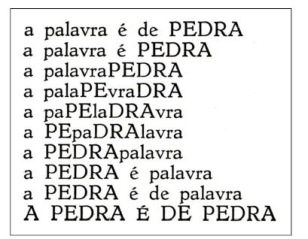
THE VISUAL COMPOSITION AND THE EXCLUSIVE USE OF TYPOGRAPHY The set of poems Corpos Radiantes (Radiant Bodies) register great contrast in their constructive strategies (Figure 1). An important fact in these two poems is the way in which uppercase and lowercase letters play different roles for visibility and for the understanding of the meaning of the poem, taking into account that these two options serve to demarcate two different territories, one characterized by the systematic use of capitals and the other by lowercase.
Figure 1: Melo e Castro, Corpos Radiantes (1982). Letterpress typographic poem printed on paper. A5 paper format.
The word ‘PEDRA’ (stone) runs through the word ‘palavra’ (word) throughout the poem; the first line reveals that the word is made of stone; this stone will cross diagonally the ten verses to, in the last line, reconstitute itself; a kind of conclusion is made in the last verse when the sense is formed and it is revealed that after all the stone is of stone.
36 Reis
This piece records an interweaving of words in the middle of the poem, where one word crosses an atmosphere formed by another word. In this typo- graphic poem the use of upper and lower case is fundamental to differentiate the thrown object from the physical space where that same throw takes place.
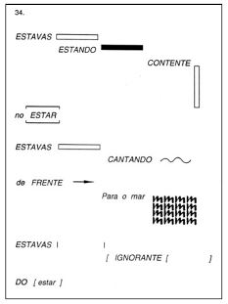
PRINTING THE INTERACTION STRUCTURE, ARROWS AND LETTERS In the nineties there is a set of poems extremely delicate and detailed in their typographic and spatial construction. The set of poems ‘Equanto jatos e Hiatos’ (While Jets and Hiatus) already corresponds to a remarkable devel- opment and sophistication in the poetic path of Melo e Castro, where we find a careful planning of white space and a phonetic dimension clearly assumed at the outset (Figure 2).
In these poems the author resorts to white space as silence in the line of reading, as well as to a diverse set of typographic signs: punctuation marks, parentheses, arrows and graphic signs invented with precise semiotic values that phonetically modify the intentionality of the discourse. To achieve this goal, Melo e Castro builds a diagrammatic structure that leads the reader through a winding and complex path made of comings and goings, voices and constant silences.
Figure 2: Melo e Castro, Enquanto Jactos e Hiatos (1994). Letterpress typographic poem printed on paper. A5 paper Format.
Indebted to the use of typographic space of Mallarmé and to a structure in a system of notation of Kurt Schwiters’ Ursonate, this poem is linked to orality and to a reading aloud marked by silences and signs of notation taken from the universe of semiotics: The arrows have the function of finding direc- tions in the free path of the poem. The use of several undulating curves mark a desire for pitch/height in the voice that reads, the invented symbols mark precise sound moments of the poem.
COMPUTER MIMETICS IN ‘INTERACTIVE SOUND POETRY’ The next works under analysis transport the letter into the field of typo- graphic notation. In their scores, Melo e Castro makes use of lyrics, lines,
Computer Mimetics in Visible Performance 37
arrows and various symbols that depart from the conventional music agenda, approaching the notation practices of the authors of American experimental music.
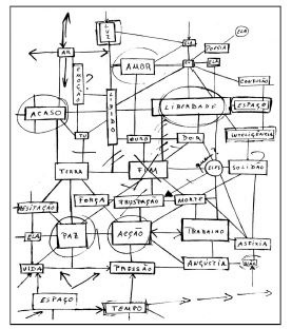
The typographic score of ‘Poesia Sonora Interactiva’ (Interactive Sound Poetry) makes use of a typeface not printed but drawn. Melo e Castro elab- orates a capital letter register that mimics the homogeneity of typography in the computer. The gestural character of the lyrics evidences a phonetic inten- sity that emerges from the writing itself, fixed in the score, where the rapidity of the gesture and the erasure are dominant characteristics (Figure 3).
This score is based on an interactive creation around phonetics and sound, making use of a computer synthesizer keyboard with words amplified and where the user performs poetic sequences randomly as he presses the keys. The observer is faced with a set of words: ‘liberdade’ (freedom), ‘amor’ (love), ‘acção’ (action), ‘acaso’ (chance) and ‘paz’ (peace), within a circle, function- ing as reading pivots, providing computer combinations of graphically noted words.
Figure 3: Melo e Castro, Poesia Sonora Interactiva (2005). Hand drawing with Fountain pen on paper. A4 paper format.
The user makes computer associations and sequences, as Joaquim Pedro Jacobetty says, “learns as a musician learns a piece of music, producing con- ceptual chains of words” and the “associations will not necessarily be logical or grammatical, and may be casual and therefore produce new and unex- pected meanings” in the “sound and conceptual” plane (Jacobetty, 2006, 109), adding that the “creative virtuosity of the user will thus be stimulated in the creation of verbal sequences of a synthetic and unusual orality of high aesthetic value and playful enjoyment” (Jacobetty, 2006, 109).
This piece is, as Melo e Castro says, between “poetry, writing and music” (Melo e Castro, 2006, 108) that being neither singing nor speaking fits within a mediation between singing and speaking, a technique systematized by Schoenberg, which constitutes one of the most important criteria in the sound character of the work. Starting from a study of the basic phonet- ics of Portuguese this piece is “used to produce a synthetic speech” where
38 Reis
phonemes are “subject to two transformative processes: one musical and the other visual” (Melo e Castro, 2006, 109).
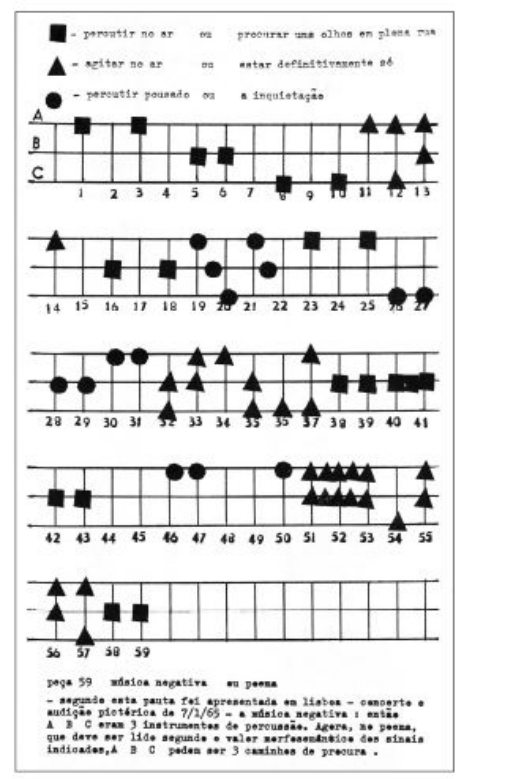
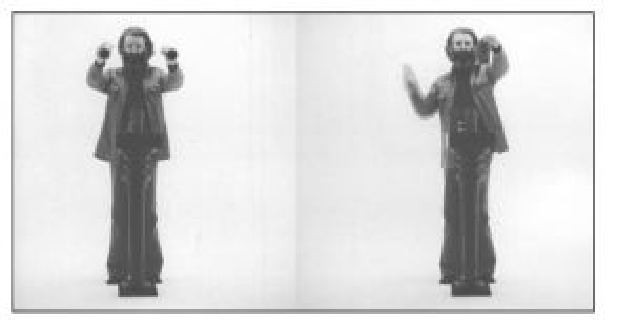
Analysis of ‘Negative Music’ as a score The score ‘Música Negativa’ (Negative Music) also presents different princi- ples from traditional musical notation, where the performer – Melo e Castro himself – rings a bell, a rattle without a clapper, in three different ways, when- ever the score so indicates (Figure 4). These indications are carried out by an alphabet of symbols (square, triangle, circle), each of which defines an action and is based along the three lines of the score. The poet uses the typewriter to make the text of this score, complemented by the graphic structure of notation, forming a set of great plastic richness.
Figure 4: Melo e Castro, Música Negativa (1965). Handmade score using a typewriter machine and producing pictographic drawings, to function as notation system for the individual performance of the piece, in front of an audience.
Computer Mimetics in Visible Performance 39
In Negative Music (Figure 5) there is not, as in Cage’s works, an appreci- ation of musical silence, although this fact seems at first sight evident. Being a piece for the eyes and not for the ears it has to do, as Melo e Castro says, with the “absence of sound, of the physical vibration of sound existing as psychovisual vibrations” (Melo e Castro, 2006, 208).
The game of silence represents, in the first place, a response to the pater- nal authority of Melo e Castro, during the dictatorship of Salazar, and a metaphor “against the imposture of silence and Salazar censorship” (Melo e Castro, 2006, 208). With this in mind, it is first of all a semiotic poem of conceptual visuality; In a second analysis this poem becomes a score of performative interpretation.
Figure 5: Melo e Castro, Música Negativa (1965). Photograph of the author performing the piece for an audience in Galeria Quadrum, Lisboa.
In addition to its functional aspect, Melo e Castro’s notation presents a strong graphic and typographic bent, with a notorious concern to pro- duce an object of visual characteristics where there is a balance between its constituents. The instrumental aspect of a notation has the primary func- tion of providing fundamental data for interpretation, without the aesthetic dimension being a priority for the realization of the agenda.
CONCLUSION
In the typographic poetry of Melo e Castro the letter is an object of drawing, of ideographic construction, through legible lines of text that corroborate the meaning of the poem. By reducing the typography to a pencil to draw, the poet constructs images that, being formed by letters, could likewise be con- stituted by other types of signs, taking into account the summary and direct character of the text. It is in the field of graphic notation that Melo e Cas- tro produces his best typographic poetry through the computer mimetics and constructing guidelines of various physiognomies, using stamps or the type- writer, recording sound and phonetics through innovative structures, placing the interpreter – Melo e Castro himself – before new challenges.
40 Reis
REFERENCES
Coles, A. Defert, A. (1998). The Anxiety of Interdisciplinarity. London: Black dog. Derrida, J. (1998). Of Grammatology. Baltimore, London: The John Hopkins University Press; 1998. Ellen Solt, M. (1968). A World Look at Concrete Poetry; in: Artes Hispanicas,
Hispanic Arts; Vol. 1, Nr. 3, 4. Ellen Solt, M. (1970). Concrete Poetry: A Worl View; Blooming and London; Indiana University Press. Heller, S. (2004). The Education of a Typographer. New York: Allworth Press. Heller, S. Meggs, P. (Ed.) (2001). Texts on Type. New York: Allworth Press. Jacobetty, J. (2006). Poesia Sonora Interactiva 2; Porto; Museu de Serralves. Kinross, R. (1992). Modern Typography. London: Hyphen. Melo e Castro, E. (1962). Ideogramas; Lisboa; Guimarães Editores. Melo e Castro, E. (1977). Cara lh amas; Lisboa; Assírio & Alvim. Melo e Castro, E. (1982). Corpos Radiantes; Lisboa; & etc. Melo e Castro, E. (1988). Poética dos Meios a Arte High Tech; Lisboa; Vega; 1988.
p. 14. Melo e Castro, E. (1993). Visão Visual; Rio de Janeiro; Francisco Alves. Melo e Castro, E. (1994). Enquanto Jactos e Hiatos; São Paulo; Com Arte Editora, USP; 1994. Melo e Castro, E. (2006). O Caminho do Leve; Porto; Museu de Serralves. Rée, J. (1999). I See a Voice. London: Flamingo. Sousa, C. Ribeiro, E. (2004); Antologia da Poesia Experimental Portuguesa; Coim-
bra; Angelus Novus; 2004. Spencer, H. (1968). The Visible Word. London: Royal College of Art. Tracy, W. (1996). Letters of Credit – A View of Type Design. Massachusets: David R. Godine. Weingart, W. (2000). My Way to Typography. Basel: Lars Müller.
LISTED IN THE AHFE DIGITAL BOOKSTORE CATALOGUE
Explore the complete digital volume
Human-Centered Design and User Experience
Read this individual research paper free through the original publisher, or explore the full digital proceedings book.
ISBN 978-1-958651-90-2
Explore this ISBN in the AHFE Bookstore ↗Listed in the July 2026 bookstore catalogue; search by ISBN to confirm current availability · Digital book purchase optional