Paula Escudeiro, Márcia Campos Gouveia, Nuno Escudeiro, Francisca Escudeiro (2024). A serious game for the cognitive stimulation of seniors. In: Intelligent Human Systems Integration (IHSI 2024): Integrating People and Intelligent Systems. AHFE Open Access, vol. 119, pp. 154–164. https://doi.org/10.54941/ahfe1004479
With the increasing number of elderly individuals in the Portuguese population and the consequent rise in cognitive decline associated with normal aging, there is a growing need to invest in mental health. This investment can be realized through the promotion of active aging and cognitive stimulation. Developing interactive tools that provide stimulation and motivation for everyday activities proves to be an effective strategy in slowing down cognitive decline. These tools aim to simulate familiar everyday scenarios for end-users, thereby encouraging regular use. This project focuses on the design and implementation of a platform to assist in evaluating and training the cognitive capacities of adults. The platform facilitates early awareness of cognitive deficiencies and stimulates users with pre-clinical symptoms, eliminating the need for visits to a medical office. It presents an innovative alternative to traditional tests conducted in clinical environments. Specifically, the platform recreates scenarios encountered during appointments with psychologists, transforming them into a game consisting of minigames. These minigames mimic real-world tasks, enabling a seamless integration of users' daily life results and enhancing their interaction with the environment. This approach aims to prevent the stress often associated with traditional cognitive stimulation programs and yield more accurate results without the pressure of a clinical setting. The primary goal is to develop a serious game that efficiently links simulation results to the daily activities of the targeted audience. This game adapts a scientifically validated cognitive training program to an Information Technology (IT) platform. The most significant outcome of this work is the cognitive stimulation of users and the effective integration of stimulation results. Through this serious game, the project strives to promote active aging, cognitive stimulation, and mental health using an interactive platform tailored to individual everyday life and activities.
The European population is experiencing a significant demographic shift, with Eurostat reporting that over one-fifth of the EU population was aged 65 and above in 2020. This aging trend is expected to continue, with the share of individuals aged 80 and above projected to increase two-and-a-half- fold by 2100. Addressing cognitive decline within this aging demographic is paramount (Glisky, 2007).
A Serious Game for the Cognitive Stimulation of Seniors 155
This project focuses on developing a serious game that not only assesses cognitive abilities but also provides effective stimulation to promote active aging through engaging real-life scenarios. In an initial phase, a platform was developed to allow psychologists to perform the assessment of their patients in-office, through a computer game that older adults had to play as an alternative to traditional tests (i.e., questionnaires). The goal was to allow for a more effective cognitive stimulation isolated from the emo- tional stress that commonly arises when the execution of such programs is made in a clinical environment. Neurocognitive assessment is carried out through minigames, specifically created for this purpose. The decision to use minigames was based on the experience and knowledge of the psychologists working with the team, to properly respond to the cognitive needs of users. These minigames are based on clinical diagnostic tests, capable of assessing the capacities of the subjects in different cognitive areas, such as memory, attention, language, among others. The exercises implemented are adapted and based on three of the most recognized clinical diagnostic tests cur- rently used, namely the Montreal Cognitive Assessment (MoCA), the Mini- Mental State Examination (MMSE), and finally the Addenbrooke’s Cognitive Assessment.
The serious game was developed to enable the cognitive stimulation and training of people with symptoms of cognitive decline and adapted to be used at home. The game remained desktop-based to improve the user experience and avoid lack of aptitude when it comes to the use of a mobile phone. Simul- taneously, this approach enhances the allocation of the stimulation results through scenarios idealized for the game. It is up to a specialist to diagnose and scientifically validate these results.
This serious game is established on the practices currently used for neu- rocognitive assessment and stimulation. The mini games are designed and implemented following the guidelines by experts in these fields of psychol- ogy. The purpose is to bring adults that might not be familiar with the use of mobile equipment, into an accessible setting they can use for cognitive stim- ulation. The game places the player in scenarios that were designed by the psychologists in the team to promote transferability to real life; they simulate common situations in adults’ daily life that they can experience in a famil- iar and relaxed environment. The players’ reward is based on the score they receive when tasks are completed, as well as the encouraging messages to complete each minigame.
The objectives of this work include: (1) promoting cognitive stimulation, by creating scenarios and minigames that allow constant user activity so that the allocation of results is more precise and efficient; (2) enhancing the alloca- tion of stimulation results, by facilitating the allocation of cognitive capacities stimulated and acquired in the game to the activities that individuals carry out in daily life; and (3) promoting the automatic readjustment of the game diffi- culty, by creating a Dynamic Difficulty Adjustment (DDA) component, which will allow the difficulty to be adjusted according to the user’s performance throughout the game (Oostendorp et al., 2014).
BRAIN AGING: ITS HEALTH AND FUNCTION AND THE NEED FOR STIMULATION With the growing number of older adults’ people in the Portuguese popula- tion, it is of utmost importance to invest in the promotion and prevention of mental health. Since cognitive decline is part of the aging process, it is of interest to reflect on the importance of cognitive stimulation.
According to Glisky (2007), changes in brain structure and function and cognitive function are ultimately related and occur with normal human aging. As such, cognitive stimulation makes it possible to promote and maintain existing cognitive abilities, delaying cognitive decline and contributing to their care.
To better understand cognitive stimulation and its purpose, we must com- prehend cognitive abilities as one of the most psychological functions affected by age (Glisky, 2007). For that reason, cognitive stimulation, as a way of intervention, shows positive results in reducing symptoms of brain diseases and improving quality of life (Niu et al., 2010). As for the project where this work is integrated, cognitive stimulation is understood as the solution to a better therapeutic process, by improving cognitive abilities (Wolinsky et al., 2006), after identifying the impairment – attention and memory are usually the most affected cognitive functions (Glisky, 2007).
Since age-related changes are not uniform and might vary among different individuals, a diagnostic to assess people’s cognitive function and ability is necessary to better assess and respond to their needs.
Serious Games: A Tool for Cognitive Stimulation Brain health represents a major challenge within the aging population, being necessary to develop mechanisms to assess and diagnose brain diseases and their progression, as well as to improve its treatment, and possible cognitive stimulation (Robert et al., 2014). As such, video games are now extended to realms of healthcare and therapy (Zohaib, 2018). Research is being devel- oped towards using video games for assessment mechanisms, rehabilitative mechanisms, and predictive mechanisms. This means that serious games are being developed for diagnosis and improvement of cognitive function, relying on in-game mechanisms to promote brain development (Kazmi et al., 2014).
Video games that are more than entertaining are categorized as serious games. These games “allow the players to ≪assume realistic roles, face prob- lems, formulate strategies, make decisions, and get fast feedback on the consequences of their actions≫– all without the cost of real-world con- sequences or errors” (Michael & Chen, 2006). They have the potential to improve cognitive ability, brain function and brain structure, by relying on specific neurocognitive demands (Fissler et al., 2015). Some researchers even suggest that video games can improve overall cognitive abilities, such as eye-hand coordination, spatial ability and problem-solving, even with no intention to (Egenfeldt-Nielsen et al., 2008).
Thus, research has shown that “people respond to games in many of the same ways that they respond to real-life events” (Michael & Chen, 2006), facilitating the allocation of the game experience to the real-world
A Serious Game for the Cognitive Stimulation of Seniors 157
(also related to ecological validity and real-life in-game scenarios further explored). Thus, “serious games for healthcare are more likely to be sim- ulations” (Michael & Chen, 2006).
Serious games allow for an assessment process as complete as possible and the conceptualization of an individualized intervention plan, emphasizing the subject’s limitations and respective symptoms. They can also be an engag- ing and sustainable method for the cognitive, sensory-motor, psychosocial and emotional stimulation of the older adults’ (Anguera et al., 2013). “But beyond being important for assessment, [games and technologies] can also play a key role in the patients’ treatment, stimulation, and rehabilitation” (Robert et al., 2014).
The ability of virtual reality to create dynamic and stimulating envi- ronments aimed at recovering cognitive functions, in which all behavioral responses can be recorded, offers testing and training options that are not pos- sible through traditional psychological methods (Wiemeyer & Kliem, 2011). Thus, the highest benefit known of virtual reality is the contact and stim- uli of the patient with environments and real-life scenarios that wouldn’t be practicable in a doctor’s office situation (Segal et al., 2011).
An Inclusive Serious Game The aim of our work is to promote inclusion of individuals with incidence of cognitive decline. A serious game that allows the training and stimulation of brain health is of added value since it offers a new solution towards cog- nitive stimulation and inclusion of individuals with different brain abilities. The idea of this digital game is to include every individual, by adapting the game itself to their own capacities and knowledge (Oostendorp et al., 2014). By doing so, it is possible to create an environment where every older individ- ual can have the opportunity to access modern content to promote its brain health and active aging.
Games have become recognized for enhancing inclusivity and in this case, it can foster inclusiveness of older adults’ by providing an opportunity to overcome a possible late diagnosis and the stress that arises from personal consultations, since a serious game can provide new opportunities that cannot be found in conventional brain health tests (Escudeiro et al., 2015).
RELATED WORK
Recent research is now focusing on serious games to enhance health con- ditions. With the growing number of elderly and the cognitive decline associated with age, it is imperative that continual research is made avail- able regarding cognitive stimulation and brain health. VIRTRA-EL, a 3D serious game, is the contribute of Rodríguez-Fórtiz et. al to the use of serious games in health promotion. This game allows users to train and stimulate their cognitive skills in 3D virtual scenarios, based on their daily life, that allows for ecological validity and transfer of results to real-life activities (Rodríguez-Fórtiz et al., 2016).
Research by Chin et al. introduces a serious game called “Smart Thinker”. To enhance cognitive skills of elderly, they created this game specialized on
memory and attention skills. Their focus was to fight cognitive impairment – a condition when concentration, memory and decision-making becomes a challenge for the elderly individual – while also strengthening brain health (Chi et al., 2017).
Another study by Lin et al. (2018) focused on older adults’ cognitive and physical stimulation. It concerns the eye-hand coordination, memory and processing speed that decline with age. For that reason, they developed a seri- ous game that consists of a “motion-sensing controller, a rhythm game and a cognitive skills evaluation approach”. More focused on physical actions, the main goal of this study is to make older adults more physically independent and cognitive stimulated.
METHODOLOGY
The idea of creating an innovative mechanism of assessment and stimula- tion has led to the development of an automatic stimulation and cognitive assessment platform. We aim to enhance older individuals’ quality of life by supporting cognitive stimulation and training, to delay cognitive decline asso- ciated to normal human aging. The outcomes of our work are expected to promote brain health of adults and value the healthcare industry.
Concept This project is set in the specialty of scientific computing and neuropsycho- logical intervention and consists of the creation and implementation of a platform scientifically validated for cognitive assessment and training, which will allow early signaling of high cognitive deficits or of a possible specific clinical condition (e.g., Alzheimer’s symptoms). It also aims to promote the stimulation of users with pre-clinical symptoms.
We intend to create a serious game for the Windows operating system, which will enhance ecological validity, by providing scenarios referring to real life, allowing the efficient allocation of stimulation results to activities that the target audience performs in everyday life (e.g., going shopping).
In this way, the allocation of the stimulation results becomes more efficient, due to users recognizing the usefulness of the game and entering a relaxation mode (FlowZone). Minigames will be inserted as part of the implementation of these scenarios. The purpose of inserting the minigames into the main game is for them to be used as tests to evaluate the cognitive capacity of the users. Different users can opt for different activities according to their preferences. This concept goes against the monotony of traditional tests and is one of the innovative factors present in this project. It intends to demonstrate the importance of this variable in the mentioned tests, as well as its positive contribution in improving the results obtained.
Objectives The main objective of our work is to create a serious game that promotes cognitive stimulation in older adults’, whose age is between 45 and 65 years old, by simulating the execution of tasks that people perform in everyday life (ecological validity) and training the cognitive processes of the subjects
A Serious Game for the Cognitive Stimulation of Seniors 159
(e.g., attention). Although the main task was to create a serious game, there are several secondary objectives associated to assure the overall functioning of the project outcomes and the robustness of the game, such as:
Promote cognitive stimulation: creating scenarios and minigames that allow constant user activity, so that the allocation of results is more efficient.
Enhance the allocation of stimulation results: facilitating the allocation of cognitive abilities stimulated and acquired in the game to the tasks that individuals carry out in their daily lives.
Promote the automatic readjustment of the game difficulty: creating a Dynamic Difficulty Adjustment component, which will allow the diffi- culty to be adjusted to the abilities of the user, according to his or her performance throughout the game.
These objectives translate, in a general way, the basic components of the project associated with the game itself, such as the scenarios, the minigames, the communication and the DDA.
Game Architecture The project consists of the game development (e.g., idealized scenarios), its components (e.g., DDA) and the export and communication of results. For each area, different technologies were used.
The platform was implemented on the development environment of Visual- Studio for programming the scripts to be used and implemented in the game. This is a flexible and efficient development platform, used to create all kinds of games or interactive 3D and 2D experiences, in multiplatform. It is also a complete system that enables the development of projects with advanced and complex content. Mono, an open-source implementation of the.NET Framework, is the basis for building the game engine, so it is possible to use UnityScript (a language like JavaScript) and C# Script in the creation of the game scripts. The construction of the final solution is based on the use of the C# language, as the global language for the technical development of the project, and the use of 3D models. The use of the three-dimensional model is due to the possibility of testing areas other than memory and attention (e.g., spatial orientation) and to the importance of ecological validity. All 3D mod- els were built from scratch or requested from external domains that provide freely accessible models.
Regarding the extraction and communication of the results, a temporary methodology was implemented by exporting the information to text files, located on the device where the game is running. Due to the complexity of the project, and the fact that the export and communication of data is a non- functional requirement as far as the stimulation program is concerned for this phase, it was decided to give total priority to the process of cognitive stimu- lation and evaluation, so the main thing will be to keep the game complete, functional, and ready to be implemented in clinical institutions. However, the process of extracting results is a fundamental step, so it will only be necessary to build the external server, a new communication mechanism with it and, finally, redirect the game data to the new destination site.
SOLUTION DESIGN During the project planning phase, constructed schematics allowed for a bet- ter orientation during the development phase. These consisted in designating each stage of the project, identify the essential components for the functioning of the final solution and schematize how the latter interrelate.
Conceptual Design
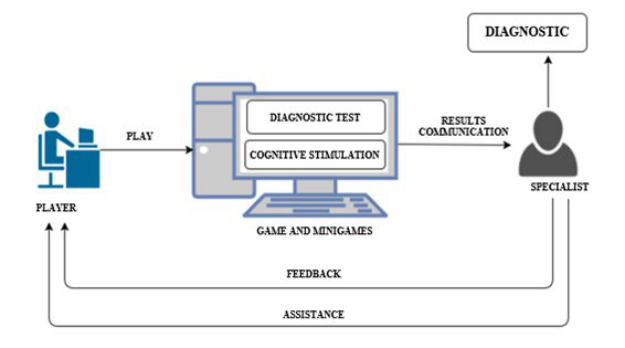
Figure 1 aims to explain how the project will be developed towards cognitive stimulation. It is possible to visualize the proposed model, representing the interaction between the project participants and the activities and functions that are intended to be performed and evaluated by the specialist.
The player will perform the cognitive stimulation program through dis- crete tasks present in the game. The results are communicated to the special- ist, for appropriate diagnosis. Both the programmer and the specialist will assist the players in case doubts related to the activities they need to perform exist.
Figure 1: Concept design.
Solution Architecture Considering the essential components of the implemented solution, i.e., the game, the scenarios, the minigames, the DDA and the internal database, it is necessary to demonstrate how they interact with each other and how their roles meet the desired requirements of the solution.
As mentioned, the game is responsible for performing the main task of the project, i.e., cognitive stimulation. This is composed of several tasks that aim to replace the tasks of traditional tests performed on paper. Within the game, two secondary components were implemented as introductory factors. These components concern the initial tutorial and the diagnostic test, adapted from existing assessment tests. Each minigame, inserted in the game component, records the player’s activities, and inserts them in an external text file, for specialists’ access.
A Serious Game for the Cognitive Stimulation of Seniors 161
The DDA responds to the demands of the game, controlling the system and working as a server (Zohaib, 2018). This component also controls the calculations to be made, the next minigame and the difficulty in which it must be executed. To execute these tasks, the DDA needs access to data. This access is made through an interface (decoupler). The interface has the responsibility of storing the data in the internal database (e.g., next game or current resources status), and providing the data to the DDA, so that it can calculate the information necessary to calculate the next game or difficulty (Oostendorp et al., 2014).
The main task of the internal database is to store any data crucial to the game (e.g., player resources), as well as its status. This database also aims to provide information to the DDA, so that it can perform the necessary tasks.
Solution Framework Based on the previous architectural model, it was necessary to build a framework responsible for fulfilling the requirements of the problem and, consequently, to build a complete and organized solution. To develop each component, specific categories were created to meet the needs of the intended solution.
Although all categories play a key role in the overall processing of the solu- tion, Barra De Estados, Dynamic Difficulty Adjustment (DDA) and Message are considered the base categories of the project.
BarraDeEstados is the category that contains the user’s money and energy throughout the game execution. The status bar is updated upon accom- plishment of the minigames and is responsible for keeping this information updated and visible to the player.
The DDA is a component which presents only one connection with the IGame interface. It is also a component which must determine which is the next game to execute and which is the next difficulty to implement. Thus, the DDA is the component responsible for controlling the entire sequence of exe- cution of the game (Oostendorp et al., 2014), based only on the information passed by the instances of the categories that implement the IGame interface.
Lastly, the Message category, though non-functional, plays a pivotal role in streamlining the game development process. It simplifies user interaction by dynamically adapting game outputs based on text length. This process is achieved by accessing the current minigame through the IGame interface and utilizing the getStatusActual() method to automatically adjust all game outputs, eliminating concerns about on-screen presentation, thus simplifying the minigame development process.
The architectural model outlines the primary tasks of each component, illustrating the sequence of events during minigame processing. Players receive context-appropriate notifications, access minigames, complete tasks, and achieve a final score, with the status bar reflecting asset changes.
Internal Database Regarding the recording of game results, as well as the safeguarding of player data, an internal mechanism was built to perform database functions. This
mechanism is based on an internal Unity repository known as PlayerPre- fabs 3. It allows to save the status of the user’s resources (money and energy), the last position of the character, the status of the game, the next minigame or task to perform, among other essential data to continue playing.
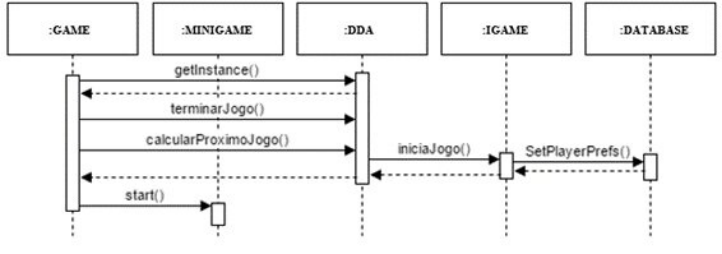
With the use of this methodology, the player can continue to move forward in the game later, saving the progress before exiting the game. If the player wants to continue the game, the results are written in a text file where will be added new data analysis as the game proceeds for the specialist to evaluate. The sequence diagram in Figure 2 exemplifies the implemented mechanism.
Figure 2: Sequence diagram - Calculating the next game.
The process starts with the game using the only command of the DDA created, so that the latter can perform its functions. The DDA calculates the next game, and the interface registers it in the database via PlayerPrefabs. After the player is redirected to the scenario where he was before the last minigame played, the system invokes the DDA to move towards the next task.
CONCLUSION
Despite the complexity of the project, a successful first version was built and delivered, meeting its primary requirements. A key contributing factor to this success was the implementation of the pair programming methodology.
The developed project offers an innovative alternative to the traditional tests performed in clinical environments. More specifically, it recreates sce- narios from consultations (e.g., diagnostic tests using symbols, numbers, and words), and aggregates them in the game in the form of minigames, while promoting ecological validity. This approach connects the tasks in the game to real-world experiences, facilitating the allocation of results to daily activities. Consequently, it improves user interaction with their envi- ronment, preventing the typical stress associated with conventional cognitive stimulation programs and yielding more accurate results.
The solution effectively addresses the problem’s needs by offering a novel strategy based on traditional tests, adapted individually for each user through automatic difficulty adjustment. Experiment results indicate that users,
A Serious Game for the Cognitive Stimulation of Seniors 163
including those without technical computer knowledge, were able to accom- plish tasks and interact seamlessly with the game. This suggests the platform’s accessibility and user-friendliness.
Above all, the importance of ecological validity was evident in the implementation of scenarios. Players predominantly focused on their tasks, demonstrating immediate recognition of scenarios and abstraction from their surroundings. This abstraction led to heightened concentration, resulting in the successful completion of a greater number of tasks and a more compre- hensive stimulation training. However, further experiments and evaluation phases are necessary to ensure accuracy and reliability.
The undertaken work successfully achieves its primary objective – creat- ing a serious game for cognitive stimulation while prioritizing the ecological validity factor. Additionally, it incorporates secondary components like auto- matic game difficulty readjustment, enhancing the overall user experience.
ACKNOWLEDGMENT
This work was developed at the research group GILT from IPP, with the sup- port of FCT/MCTES (UIDB/05627/2020, UIDB/05627/2020, 950/2019) and of EACEA (101004096-ATHENA EAC-A02-2.
REFERENCES
Anguera, J. A. et al., 2013. Video game training enhances cognitive control in older adults. Nature, Volume 501, pp. 97–101. Chi, H., Agama, E. & Prodanoff, Z. G., 2017. Developing serious games to promote
cognitive abilities for the elderly. Perth, IEEE. Egenfeldt-Nielsen, S., Smith, J. H. & Tosca, S. P., 2008. Serious Games- When entertainment is not enough. In: S. Egenfeldt-Nielsen, J. H. Smith & S. P. Tosca, eds. Understanding Video Games: the essential introduction. New York: Routledge, pp. 205–222. Escudeiro, P., Escudeiro, N., Norberto, M. & Lopes, J., 2015. VirtualSign in Serious
Games. Novedrate, Springer. Fissler, P., Kolassa, I.-T. & Schrader, C., 2015. Educational games for brain health: revealing their unexplored potential through a neurocognitive approach. Frontiers in Psychology, Volume 6. Glisky, E. L., 2007. Changes in Cognitive Function in Human Aging. In: D. R. Rid-
dle, ed. Brain Aging: Models, Methods, and Mechanisms. Florida: CRC Press, pp. 3–20. Kazmi, S., Ugail, H., Lesk, V. & Palmer, I., 2014. Interactive Digital Serious Games for the Assessment, Rehabilitation, and Prediction of Dementia. International Journal of Computer Games Technology, Volume 2014. Lin, Y.-H., Mao, H.-F., Tsai, Y.-C. & Chou, J.-J., 2018. Developing a serious game
for the elderly to do physical and cognitive hybrid activities. Vienna, IEEE. Michael, D. & Chen, S., 2006. Serious Games: Games that Educate, Train, and Inform. Canada: Thomson Course Technology PTR. Niu, Y.-X., Guan, J.-Q., Zhang, Z.-Q. & Wang, L.-N., 2010. Cognitive stimulation
therapy in the treatment of neuropsychiatric symptoms in Alzheimer’s disease: a randomized controlled trial. Clinical rehabilitation, 24(12), pp. 1102–1111.
Oostendorp, H. v., van der Spek, E. D. & Linssen, J., 2014. Adapting the Complexity Level of a Serious Game to the Proficiency of Players. EAI Endorsed Transactions on Serious Games, 1(2), pp. 1–8. Robert, P. H. et al., 2014. Recommendations for the use of Serious Games in peo-
ple with Alzheimer’s Disease, related disorders and frailty. Frontiers in Aging Neuroscience, 6(54). Rodríguez-Fórtiz, M. et al., 2016. Serious games for the cognitive stimulation of elderly people. Orlando, IEEE. Segal, R., Bhatia, M. & Drapeau, M., 2011. Therapists’ Perception of Benefits and
Costs of Using Virtual Reality Treatments. Cyberpsychology, Behavior, and Social Networking, Volume 14, pp. 29–34. Wiemeyer, J. & Kliem, A., 2011. Serious games in prevention and rehabilitation—a new panacea for elderly people?. European Review of Aging and Physical Activity volume, Volume 9, pp. 41–50. Wolinsky, F. D. et al., 2006. The effects of the ACTIVE cognitive training trial on
clinically relevant declines in health-related quality of life. Journal of Gerontology: SOCIAL SCIENCES, 61B (5), pp. S281–S287. Zohaib, M., 2018. Dynamic Difficulty Adjustment (DDA) in Computer Games: A Review. Advances in Human-Computer Interaction, Volume 2018.
LISTED IN THE AHFE DIGITAL BOOKSTORE CATALOGUE
Explore the complete digital volume
Intelligent Human Systems Integration (IHSI 2024): Integrating People and Intelligent Systems
Read this individual research paper free through the original publisher, or explore the full digital proceedings book.
ISBN 978-1-958651-95-7
Explore this ISBN in the AHFE Bookstore ↗Listed in the July 2026 bookstore catalogue; search by ISBN to confirm current availability · Digital book purchase optional