Jonas Andersson, Mikael Söderman (2024). Navigating the challenges of remote operations of automated road vehicles: A socio-technical perspective. In: Intelligent Human Systems Integration (IHSI 2024): Integrating People and Intelligent Systems. AHFE Open Access, vol. 119, pp. 19–26. https://doi.org/10.54941/ahfe1004466
The advent of automated driving systems introduces a paradigm shift with the possibility to revolutionize transportation systems on our roads. Benefits of improved safety, and operational efficiency is foreseen by actors in the business and the hopes of fully automated vehicles without the need for human intervention is high. However, for a foreseeable future the human still has an important role to play in monitoring and control of vehicles where the technology still is not sufficiently capable to handle all situations – the role of remote operator. This paper explores the human factors of remote operations of road vehicles from a socio-technical systems perspective. The paper points out six socio-technical dimensions of remote operation and discusses the challenges that needs to be considered in human-automation systems design to achieve safety and efficiency in the remote vehicle operations of tomorrow. The paper explores the multidimensional challenge of socio-technical systems design in the remote operation context. To do so, the six key human factors dimensions of remote operation are explained and elaborated. The interrelations between the dimensions are also explored to underline the need to establish a systems thinking approach for remote operation challenges. The goal of the paper is to contribute to, and foster an integrated approach to human-systems interaction in remote operation of road vehicles, acknowledging the complexity and interdependence of elements in this new era of transportation.
The remote operation of automated vehicles is an emerging field that blends the use of automation with the judgment of human oversight to enable safe and efficient operations. Remote operations of vehicles make use of advanced communication technologies to allow operators to monitor, assist, or fully control vehicles from remote locations, addressing situations that autonomous systems may not be equipped to handle alone. As autonomous vehicle technology advances, the role of remote operators becomes crucial in ensuring safety, reliability, and public trust in these systems. Implementing a remote operation capability introduces complex socio-technical challenges, necessitating careful consideration of human factors, system design, and the seamless integration of operator-vehicle interactions. This expanding field
represents a critical intersection of human expertise and machine autonomy, offering a collaborative solution to the demands of modern transportation networks.
Complex socio-technical systems (STS) represent an integrative framework that examines the interplay between social and technical elements within technological and organizational domains (Trist and Bamforth, 1951). Such systems embody the mutual relationships that exist between human actors and the technical infrastructure within which they operate (Emery and Trist, 1960). Central to the discourse on STS is the recognition that technical effi- cacy and social well-being are not mutually exclusive but rather reciprocal components of system success (Pasmore, 1988). The advent of digital trans- formation across sectors, from automated vehicles to smart healthcare, has accentuated the interdependencies inherent in these systems, spotlighting the need for a holistic analysis that goes across disciplinary boundaries (Norman and Stappers, 2015; Ropohl, 1999).
Remote operation of automated vehicles is a socio-technical challenge because it intersects complex human factors, advanced technological systems, societal implications, and regulatory requirements. Human factors affect the remote interaction with vehicles, where operators must use indirect con- trol mechanisms, impacting their situational awareness and decision-making capabilities (Endsley, 1995). The technological complexity of these systems requires advanced, reliable sensors, control algorithms, and communication networks, which are subject to rigorous safety standards. Thus, regulatory frameworks must evolve alongside these technologies to ensure safety and privacy while fostering innovation (Marchant and Lindor, 2012). There is also the potential for job transformation and economic impacts, as roles shift from manual control to system monitoring, possibly affecting employment within the transportation sector (Groshen et al., 2018).
Drawing experience from remote vehicle operation research projects (see acknowledgment section) including expert peer workshops and discussions, seven key socio-technical system dimensions were chosen for further elabo- ration and exemplification of a socio-technical analysis of remote operation. In the paper, the seven dimensions are used to provide a non-exhaustive representation of the socio-technical challenges of remote operation. The pur- pose of the paper is to describe how this set of seven key dimensions and their interrelations can aid systems thinking in design of remote operation human-machine systems from the socio-technical perspective.
SOCIO-TECHNICAL DIMENSIONS OF REMOTE OPERATION Remote operation of automated vehicles introduces complex layers of human-automation interaction with intricate dynamic that necessitates a profound understanding of the socio-technical systems that govern the effi- ciency and safety of these operations. Operators at the “sharp-end” (Reason, 1990) of remote operations must navigate a milieu where human factors intertwine with advanced technical systems, requiring a seamless integra- tion of cognitive, social, and technical competences. The Operational Design Domain (ODD) emerges as a critical socio-technical component, delineating
Navigating the Challenges of Remote Operations of Automated Road Vehicles 21
the operational parameters within which automated systems can function reliably, and beyond which human intervention becomes necessary. Socio- technical considerations also extend to the design of human-machine inter- action (HMI), which must facilitate intuitive interactions and interfaces and balance the cognitive load on operators to prevent fatigue and maintain alert- ness. Furthermore, the remote operation of automated vehicles is not merely an individual job but a coordinated activity that demands efficient teamwork and communication within the organizational structure. Thus, the paper argues for a socio-technical systems approach to remote operation systems design, that encompasses both the technicalities of remote operation and the complex human factors at play. Addressing the socio-technical dimensions of remote operation is imperative for developing robust systems that not only advance technological capabilities but also harmonize with the human elements of operation.
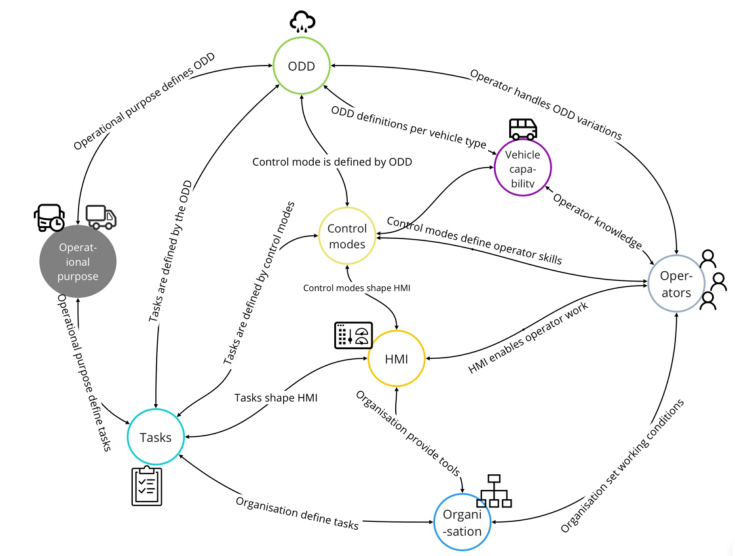
SIX DIMENSIONS OF REMOTE OPERATION AND THEIR RECIPROCAL RELATIONSHIPS The remote operation of automated vehicles (AVs) is underpinned by a web of reciprocal interdependencies that govern system performance and its success or failure to achieve its intended purpose. To fully describe these interdepen- dencies is a daunting task. Nevertheless is it important to understand it on a systems level to avoid problems of safety and performance that may occur from considering parts of the system separately. In this paper we suggest seven key “dimensions”of remote operation that are of importance to under- stand system performance, namely: Vehicle capability, Control modes, the Operational Design Domain (ODD), Task requirements, Human-Machine Interaction (HMI), Operators, and Organizational factors (bold font cor- responds to the terms used in Figure 1). Each of these components both influences and is influenced by the others in reciprocal relationships.
Vehicle Capability Vehicle capability is the range of functionalities and performance character- istics that a (automated) vehicle possess. Understanding vehicle capability is crucial for ensuring safe and efficient operation within the socio-technical sys- tem. The vehicle’s ability to interpret and respond to environmental variables is critical, as limitations in sensory or processing capabilities can significantly impact decision-making for both the human operator and the control system. Accurately assessing vehicle capability in relation to the operational design domain where the vehicle acts is essential for determining the level of human intervention required, especially in complex or unpredictable environments. The integration of remote human operators with automated vehicle systems necessitates a clear understanding of the vehicle’s capabilities to facilitate effective collaboration and prevent over-reliance on automation (Lee and See, 2004). Furthermore, considering vehicle capability is crucial for developing robust training protocols for remote operators, ensuring they are adequately prepared to handle the vehicle’s specific strengths and weaknesses in various operational contexts.
22 Andersson and Söderman
Control Modes Remote monitoring, remote assistance and remote driving are three control modes that are frequently considered in remote support of automated vehi- cles (Amador et al., 2022). Transitions between modes is a recurrent challenge that will have an big impact on operator work, associated HMI:s and tasks. The frequency of transitions depends on the reliability of the automation, where the operator to vehicle ratio will be highly dependent on the tran- sition frequency and the time needed to assist vehicles that have lost their autonomous capability. Vehicle capabilities, including sensing, computation, and actuation systems, set the stage for what is possible in remote operation. The sophistication of onboard systems determines how effectively a vehicle can navigate its environment and respond to unexpected events. These capa- bilities, in turn, are defined by the tasks they are expected to perform and are limited by the ODD—the specific conditions under which the vehicle is designed to operate (e.g., weather conditions, types of roads).
ODD Operational Design Domain of automated vehicles and the potential gap between the vehicle’s ODD and the driving context will create situations where the operator may need to step in and assist vehicles, either tactically or operationally, by assistance or remote driving. Defining and describing the ODD for mutual understanding between human actors and automation is key for efficient handling of deviating situations. The ODD is a critical factor as it describes the operating conditions for AVs and is defined in syn- chronization with vehicle’s capabilities. It describe the environmental and contextual boundaries within which the AV can function safely. The ODD can be described in terms of scenery elements (e.g. road infrastructures), environmental conditions (e.g. weather, connectivity) and dynamic elements (e.g. other actors in traffic) (International Organization for Standardization, 2023).
Tasks Operator tasks are shaped by the vehicle and remote control system capability in terms of perception, analysis, decisions and actions of both the vehi- cles and the fleet management system. From the human factors perspective, the operator tasks need to be balanced to retain operator competence and decision-making capability without creating fatigue, nor boredom, that may lead to inefficient management of critical situations. The specific tasks that AVs are required to perform—ranging from simple routine tasks to complex emergency manoeuvres—demand certain vehicle capabilities in the specific ODD. Simultaneously, the nature of these tasks impacts the design of HMI systems, as different tasks may require different levels and types of human intervention and oversight.
Human-Machine Interaction The interaction between the operator and the vehicles is mediated by user interfaces and visualizations in the remote operator vehicle and fleet
Navigating the Challenges of Remote Operations of Automated Road Vehicles 23
management system, and is a key aspect of safe and efficient operations. The design and functionality of HMI systems are inherently tied to vehicle capabilities and the tasks they are expected to perform. It must account for the ODD, as certain environments may require more nuanced control and feedback. Effective HMI design is crucial for ensuring that operators can maintain situational awareness and make informed decisions, which in turn affects the safety and reliability of vehicle operations. However, the operator- vehicle interaction it is only a part of the whole work system. Interactions also include human-human communication and coordination. Since interac- tions emerge as a results of overall system design and its interaction with the environment, appropriate HMI needs to be designed based on overall work requirements and interactions in the socio-technical system of remote operation.
Operators The operator is the person monitoring assisting and controlling the vehi- cles, on a fleet, group or individual level. Depending on how the work is organized, operators can be expected to be involved in (mostly) monitoring, (sometimes) assistance and (rarely) driving, and need adequate competence in relation to their task. Human-centric automation aspects and issues such as e.g. trust, responsibility, automation surprises and vigilance will be shaped by several of the socio-technical dimensions. Operators are at the core of this socio-technical system. Their skills, training, and capabilities need to be aligned with overall system purpose and requirements. The opera- tors’ ability to understand and interact with the AV influences how vehicle capabilities are utilized. In addition, the organizational context in which operators work will determine the protocols for remote operation and the support they receive, impacting their performance and the overall system’s efficacy.
Organization From our experience, current human-automation interaction research often give less attention to organizational aspects. Operator cognition, interac- tion with advanced technologies and the ability to handle emergencies are often considered from a single operator perspective. However, operator work is frequently a teamwork that involves collaboration to achieve safe and efficient problem solving. The team working aspect needs to be considered from the beginning in human-automation systems design. The organization encompasses the policies, procedures, culture, and structures that govern the use of AVs. It establishes the frameworks within which operators work and how HMI is designed and implemented. Organizational factors deter- mine the resources allocated to training, the prioritization of certain vehicle capabilities over others, and the scope of the ODD by setting safety stan- dards and performance benchmarks. These decisions reciprocally influence the tasks AVs are intended to perform and the level of operator involvement required.
24 Andersson and Söderman
THE RECIPROCAL RELATIONSHIP BETWEEN SOCIO-TECHNICAL SYSTEM DIMENSIONS The interplay of these dimensions in remote operation of automated vehicles is a characteristic of a socio-technical system, where the technical aspects can- not be disentangled from the cognitive, social and organisational elements. Vehicle capabilities influence and are influenced by the ODD, which shapes the tasks operators have to perform. These tasks dictate the design and func- tionality of HMI, which must be tailored to the operators’ abilities and the organizational context in which they are situated. Each dimension is thus in a continuous state of reciprocal dynamic interaction, responding to and shaping the conditions of the others.
Figure 1: A socio-technical system representation of remote operation.
Visualizing such a complex and dynamic system is a challenging task. Figure 1 shows an example of how the dimensions described in the paper can be depicted as a high-level representation of a socio-technical system for remote operation with some of the main interactions outlined. The repre- sentation shows the dimensions and in addition a node for the operational purpose. The operational purpose would define the business objectives, ser- vices and the overall reason for running the operations, and is needed to set the context for the work system. This type of vizualisation has proven useful as a platform for joint understanding and common ground for discussion in multidisciplinary project teams.
Navigating the Challenges of Remote Operations of Automated Road Vehicles 25
DISCUSSION & CONCLUSION The paper describes seven interdependent dimensions that together consti- tute a socio-technical system-of-systems capturing some of the main aspects of remote operation of automated vehicles. The definition of these seven dimensions in particular (vehicle capability, control modes, ODD, tasks, HMI, operators and organization), does not claim to be an exhaustive sys- tem representation. Rather, the model has proven its worth in practical use as an effective mediator to explain human factors related challenges in socio- technical systems design for remote operation of automated vehicles. Our experience is that it can facilitate reaching more initiated discussions on how different aspects influence each other, and how decisions in the design pro- cess may have unforeseen consequences without using systems thinking as a foundation in design. In other words, specifying one part of the system in great detail without a holistic view may cause other parts of the sys- tem having to compensate for deficiencies. For example, designing vehicle capabilities without considering the resulting operator tasks, or simply using “left-over” task allocation strategies, may leave the operator having to com- pensate for incompetent automation (in relation to the designated ODD), which in turn will have effects on work organisation and job satisfaction. In this way design decisions may propagate across the web of socio-technical interdependencies causing unexpected effects on a system level. In conclusion, the interdependencies among the socio-technical dimensions exemplified in this paper illustrate the need for a systems thinking approach in the design of remote vehicle operations. Such an approach ensures that changes or advancements in one area are harmonized with the rest of the system, main- taining the balance between technological capabilities and human factors to achieve safe and efficient human-automation systems. Future work on this approach include elaboration of how to systematically describe and define each dimension suggested in the paper. It also remains for the seven dimen- sions to be stress tested in system engineering design across remote operation domains. The current approach was mainly developed in the road vehi- cle domain, other needs and aspects may have to be considered for other domains, such as e.g. maritime or aerial drone operations.
ACKNOWLEDGMENT
The authors would like to acknowledge the Swedish Innovation Agency Vin- nova and grants 2020–02953 (HAVOC-project) and 2022–01647 (REDO2- project) which has made this research possible.
REFERENCES
Amador, O., Aramrattana, M., Vinel, A., 2022. A Survey on Remote Operation of Road Vehicles. IEEE Access 10, 130135–130154. Emery, F. E., Trist, E. L., 1960. Socio-technical systems. Management science, models
and techniques 2, 83–97. Endsley, M. R., 1995. Toward a Theory of Situation Awareness in Dynamic Systems.
Groshen, E. L., Helper, S., MacDuffie, J. P., Carson, C., 2018. Preparing U. S. Workers and Employers for an Autonomous Vehicle Future. W. E. Upjohn Institute. https: //doi.org/10.17848/tr19-036 International Organization for Standardization, 2023. ISO 34503:2023 Road Vehi-
cles — Test scenarios for automated driving systems — Specification for opera- tional design domain. Lee, J. D., See, K. A., 2004. Trust in automation: Designing for appropriate reliance.
Human Factors 46, 50–80. Marchant, G. E., Lindor, R. A., 2012. The coming collision between autonomous vehicles and the liability system. Santa Clara L. Rev. 52, 1321. Norman, D. A., Stappers, P. J., 2015. DesignX: Complex Sociotechnical Systems. She
Ji: The Journal of Design, Economics, and Innovation 1, 83–106. https://doi.org/ 10.1016/j.sheji.2016.01.002 Pasmore, W. A., 1988. Designing effective organizations: The sociotechnical systems perspective. (No Title). Reason, J., 1990. Human error. Cambridge Univ. Press, Cambridge. Ropohl, G., 1999. Philosophy of socio-technical systems. Society for Philosophy and
Technology Quarterly Electronic Journal 4, 186–194. Trist, E. L., Bamforth, K. W., 1951. Some Social and Psychological Consequences of the Longwall Method of Coal-Getting: An Examination of the Psychological Situation and Defences of a Work Group in Relation to the Social Structure and Technological Content of the Work System. Human Relations 4, 3–38. https://do i.org/10.1177/001872675100400101
LISTED IN THE AHFE DIGITAL BOOKSTORE CATALOGUE
Explore the complete digital volume
Intelligent Human Systems Integration (IHSI 2024): Integrating People and Intelligent Systems
Read this individual research paper free through the original publisher, or explore the full digital proceedings book.
ISBN 978-1-958651-95-7
Explore this ISBN in the AHFE Bookstore ↗Listed in the July 2026 bookstore catalogue; search by ISBN to confirm current availability · Digital book purchase optional