Daban Rizgary, Niklas Strand, Jonas Andersson (2023). Proving ground evaluation of enhanced ADAS: context understanding ADAS. In: Human Factors in Transportation. AHFE Open Access, vol. 95, pp. 270–280. https://doi.org/10.54941/ahfe1003812
Advanced driver assistance systems (ADAS) are developed to increase safety and provide a more efficient and comfortable experience when traveling by car. ADAS are reliant upon sensors to provide the intended assistance for the driver, and the driver is reliant upon an HMI interface to interact with the feature at hand. A prototype ADAS, including a human machine interface (HMI) and enhanced ADAS functionality, was developed and then evaluated on proving ground. The purpose of the study was to evaluate how the enhanced ADAS performed as compared to baseline in terms of trust, acceptance, efficiency, and perceived situation awareness. The evaluation of the full prototype was conducted with 24 participants (13 men and 11 women) who drove a Lincoln MKZ equipped with longitudinal and lateral ADAS support (SAE Level 2) at the AstaZero proving ground facilities in Sweden. In total the participants drove four laps (familiarization lap, baseline lap, gaze-related functionality lap, active ADAS functionality lap) on the proving ground. The gaze-related functionalities tracked the gaze to assure blind spot gaze and correct turning gaze behavior and provided support for this. The active ADAS functionalities included that the system was able to override the time gap setting of the longitudinal control system to provide the driver with more time to react as the feature was triggered in the presence of driver distraction, as well as a system that alerted the driver about upcoming situations in which the longitudinal and lateral assist systems were unable to support the driver due to exceeding of the operational design domain (ODD). Gaze-related functionalities were associated with a significant increase in usefulness and satisfaction compared to baseline, and active ADAS functionalities were associated with a significant increase in satisfaction compared to baseline.
ADAS systems such as Adaptive Cruise Control (ACC), Lane Departure Warning (LDW), Lane Centering Assist (LCA), Forward Collision Warning (FCW) and Blind Spot Detection (BSD) are introduced in many vehicles today. As technology advances, the capabilities of ADAS systems improve. Forecasts indicate a growing market for ADAS (Strategic Market Research, 2021).
ADAS use an array of environmental sensors (stereo cameras, long- and short-range radars, lidars, ultrasonic), actuators, control units and softw- are. These components are used to create awareness of vehicle surroundings. Thus the ADAS systems can assist drivers in recognizing and interpreting
Proving Ground Evaluation of Enhanced ADAS: Context Understanding ADAS 271
traffic situations by displaying warnings and/or controlling the vehicle to mitigate dangerous traffic situations. ADAS have been shown to bring signi- ficant safety and efficiency benefits (Kyriakidis, Weijer, Arem & Happee, 2015). When properly used, such systems could potentially prevent millions of crashes per year (AAA, 2019).
A major challenge, however, is to achieve driver confidence and accepta- nce. Several studies show that drivers tend to avoid using ADAS, mainly because of insufficient performance and drivers poor understanding of ADAS functions (IHS, 2019; AAA, 2018; McKinsey, 2016; JDpower, 2019). The reason for this can be attributed to both technical limitations as well as poor driver-vehicle interaction design (Brookhuis, de Waard, & Janssen, 2001; Hancock et al., 2020).
On the technical side, ADAS rely on information from environmental sensors and vehicle movements, but in many situations this information is insufficient (Orlovska et al., 2020). One of the challenges is to develop systems that have a broader context awareness of the traffic environment, taking into account variables such as the traffic scenario, weather, traffic congestion, and driver state. This type of functionality would require data types such as driver monitoring data, high definition map data and weather data, along with visual sensor data. Another challenge for future ADAS is to introduce functions that monitor driver behaviour and state, e.g. to assess the driver’s awareness of upcoming situations, the driver’s sleepiness, and so forth, to inform, warn and even intervene accordingly to avoid incidents and accidents. Current driver monitoring systems are not integrated with ADAS for situation assessment. For example, When ADAS deactivates it does not take into account if the driver is distracted or not. Considering the above description of ADAS, and that the current ADAS lacks sufficient information from sensors (JDpower, 2019; Marti, de Miguel, & Perez, 2019; Sun et al., 2019) there is room to provide the ADAS with more information, and there is also room to create a better interaction between the subsystems by integra- ting the data sources. This results in more reliable information for the ADAS and the driver to base decision and planning strategies on. The solution is for ADAS to be better aware of its environment even in complex traffic environ- ments such as intersections, roadworks and crossings, and then to transfer this improved context awareness to the driver.
The aim of this research, which was part of a three-year project conducted by RISE Research Institutes of Sweden together with industry partners Aptiv and Smarteye, was to develop an ADAS prototype that integrate a camera- based driver monitoring system, map data, external sensors (camera, radar and ultrasonic sensors) into a joint data source. This can enable enhanced function such as: sensor- and map data contributing to a joint view where both infrastructural features such as road curvature, as well as objects that are detected in closer proximity such as other vehicles are shown in the HMI,with the main purpose to provide the driver with a better understanding of what the ADAS perceives. Another example of a function could be that the ADAS knows through map data that the vehicle is approaching an intersection and can use the driver-vehicle interface to highlight certain scenario-specific criti- cal elements in the environment, and subsequently verify whether the driver
Table 1. Table with an overview of laps and conditions.
Table available in the original PDF paper.
Laps Conditions Familiarization lap - Baseline lap 1 Baseline condition Gaze-relation functionality lap (latin square balanced)
3a Take-over 3b Time gap
2a Intersection 2b Lane change Active ADAS functionality lap (latin square balanced)
has acknowledged said elements by means of the driver monitoring system. Another example is that the ADAS has information about an upcoming sce- nario, by means of map data, that is outside of the operational design domain (ODD) and can thus provide a sufficient time budget for the driver to pre- pare for a deactivation of ACC and LCA. Lastly, it is also possible to adapt ADAS parameters such as lead vehicle time gap of the ACC, for example by increasing time gap when driver distraction is detected, in order to adopt a safer distance to compensate for lost reaction time in case of emergency.
METHOD
Participants In this study an evaluation of a prototype was conducted with 24 participants including 13 men and 11 women with a mean age of 42 years old (SD = 15.9). 17 of the participants reported that they drive daily whilst 6 responded that they drive a few times per week, and 1 reported driving a few times per year. When asked—on a 1–7 point rating scale—whether they had experience with ADAS, answers revealed that they had some prior experience (M = 3.75, SD = 2.13). Their experience of ADAS was also reflected in the answers on a question about their knowledge on ADAS which yielded similar scores using the same scale (M = 3.79, SD = 1.72).
Prototype and Experimental Procedure Participants were recruited through ads on the social media platform Meta. They were booked in for the experiment and upon arrival all participants filled out the necessary paperwork to enter the proving ground facilities and participate in the study. Subsequently, an introduction was given about the controls of the vehicle and the functionality, including the HMI, of the ADAS. All participants got to drive the same vehicle, a Lincoln MKZ year model 2018 equipped with longitudinal and lateral driving support (equivalent to SAE level 2) on the AstaZero proving ground in Sweden. The participants drove a total of four laps, each lap consisting of 5.7 kilometres along a rural road with a driving speed of 70 km/h. The first lap was intended for the participants to familiarise themselves with the car. The following three laps (balance order using latin square design) were: (1) a base line lap, (2) a gaze-related functionality lap, and (3) an active ADAS functionality lap. The baseline lap consisted of a baseline condition (1) with functionality including ACC and LCA which has been modified but corresponds to the functionality
Proving Ground Evaluation of Enhanced ADAS: Context Understanding ADAS 273
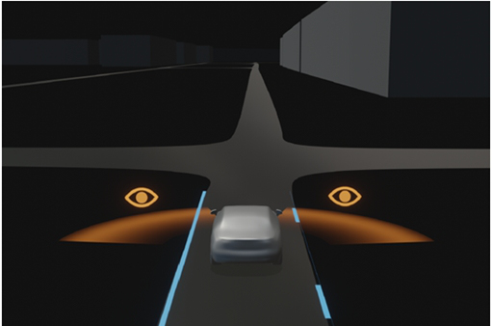
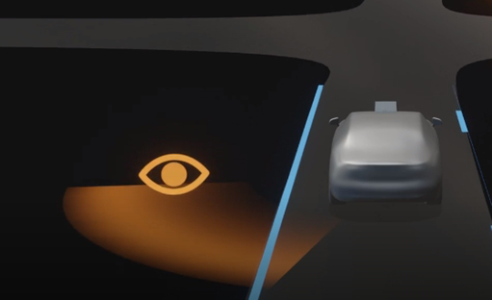
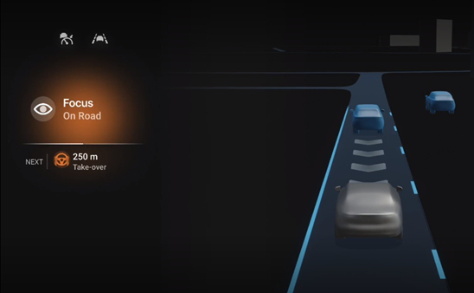
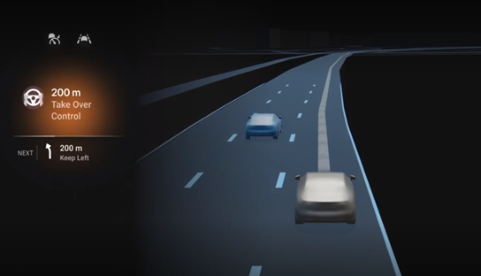
of a presently widely available ADAS. In the gaze-related functionality lap the technical system had capability to track the gaze of the driver to ensure that the driver performed correct and safe gaze behavior at an intersection (condition 2a) and at a lane change (condition 2b). The active ADAS functi- onality lap included capability to increase the distance gap to a lead vehicle in the ACC when driver distraction was detected by the driver monitoring system (condition 3a). As well as functionality that warned the driver of an upcoming road work scenario in which the longitudinal and lateral assistance systems could no longer support the driver (condition 3b), i.e. exceeding the ODD and asking the driver to take full mechanical control of the vehicle. For conditions 2a, 2b, 3a, and 3b a HMI prototype (see Figures 1-4) was used to enable the previously described enhanced functionality in each condition. In addition to the HMI elements that relate to the mentioned conditions, the HMI had a view where sensor- and map data was merged. In other words, the drivers were able to see the features of the road ahead, as well as objects in the environment such as other vehicles, and this feature was enabled in both gaze-relation functionality lap as well as active ADAS functionality lap but not in the baseline lap. The participants were given instructions about what they were to experience in each lap with a description of the enhanced ADAS functionality of the prototype in the beginning of each lap, moreover they were asked to stop at the end of each lap to fill out questionnaires.
Measures and Analysis The study included dependent variables in the form of a few standalone que- stions on a 1–10 rating scale (1 – not at all, and 10 – completely) with items for trust (“How much do you trust the ADAS”), perceived situation aware- ness (“The ADAS helped me understand my environment better”), preference (“I am convinced that ADAS should work this way”), efficiency (“How clear was the ADAS in its communication to you regarding what it perceived
Figure 1: HMI of gaze-related functionality (condition 2a) reminding the driver to look both left and right in an intersection with the orange cones and eye icon. These signals deactivate when the correct behavior is detected by the driver monitoring system.Figure 2: HMI of gaze-related functionality (condition 2b) reminding driver to look in left blindspot in an intersection with the orange cones and eye icon. The signal deactivates when the correct behavior is detected by the driver monitoring system.Figure 3: HMI of active ADAS functionality (condition 3a) that is triggered by driver distraction. a warning to focus on the road is issued, time gap to lead vehicle is increased and shown to driver by adding arrows between lead and ego vehicle.Figure 4: HMI of active ADAS functionality (condition 3b) that is triggered when appro- aching a scenario outside of the odd. a deactivation of acc and lca request is issued to the driver with a distance countdown.
Proving Ground Evaluation of Enhanced ADAS: Context Understanding ADAS 275
and did?”). Moreover, the Van Der Laan acceptance scale (Van Der Laan, Heino, & de Waard, 1997) was used to assess acceptance. The full set of questionnaires was filled out after each lap of driving. An analysis of the data was conducted using descriptive statistics (mean values and standard deviations) and inferential statistics (pairwise T-tests) for all measures. A significance level of.05 was used for the analysis. The hypothesis was that the gaze-related functionality (2a & 2b) and active ADAS functionality (3a & 3b) would yield an increased trust, perceived situation awareness, preference, efficiency and acceptance compared to the baseline condition.
RESULTS AND DISCUSSION
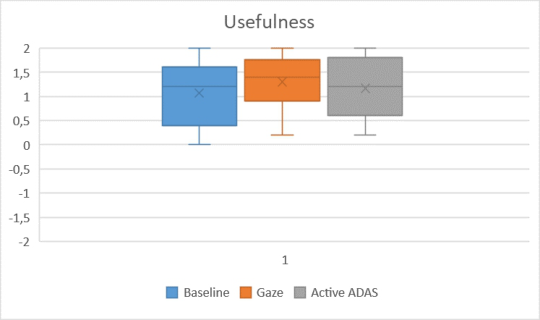
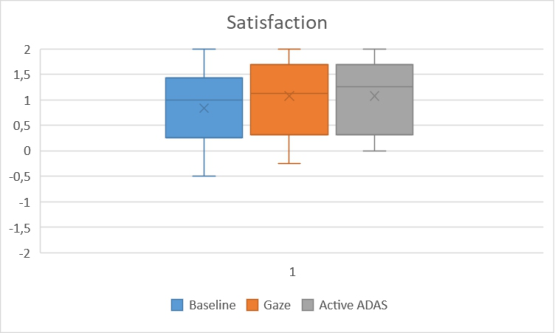
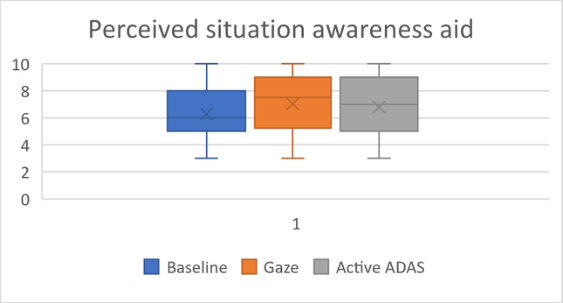
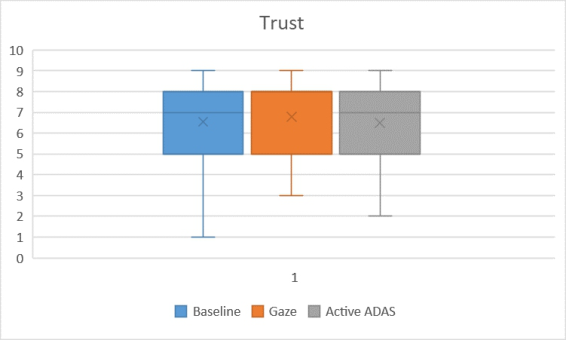
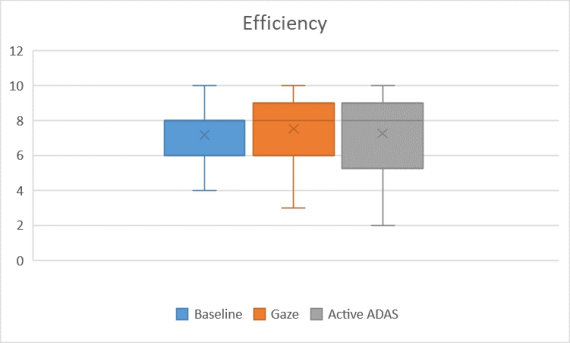
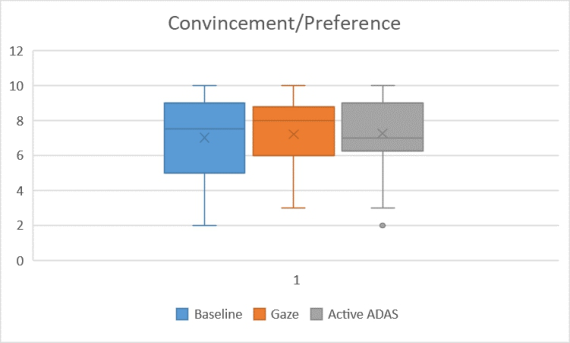
The descriptive and inferential statistics that was carried out on all the data showed significant differences with small effect sizes in few instances related to the acceptance scale. See Figures 5–10 for more details shown with box plots. In these figures the (x) represents the mean, the horizontal line inside the boxes represent the median, the bottom and top of the box represents the medians of the lower and upper quartile, the bottom and top vertical lines represent the minimum and maximum values.
Significant differences with small effect sizes were found in favour of the hypotheses within the acceptance subscales, with the exception for between Active ADAS functionality and baseline in the usefulness subscale, where no significant difference was detected. In the other measures, which include trust, efficiency, perceived situation awareness, and preference, there were no significant differences between the conditions.
The analysis of the data thus suggests that the gaze-related functionality was considered more useful and satisfactory than the baseline, and secondly
Figure 5: The graph shows scores on the Van Der Laan scale (n = 24) within the ‘use- fulness’ subscale where the gaze-related functionality conditions (M = 1.3, SD = 0.55) differs from the baseline condition (M = 1.07, SD = 0.63) with a higher mean score, pai- red T-test: t(23) = 1.714, p = 0.042, effect size: d = 0.389, alpha = .05. while the active ADAS functionality conditions (M = 1.17, SD = 0.57) and the baseline condition have no significant difference, paired T-test: t(23) = 1.714, p = 0.191, effect size: d = 0.167, alpha = .05.Figure 6: Results from the second dimension of the Van Der Laan scale (n = 24), ‘satisfaction’, indicate a difference in mean score between gaze-related functionality conditions (M = 1.07, SD = 0.72) and the baseline condition (M = 0.83, SD = 0.75), paired T-test: t(23) = 1,714, p = 0.036, effect size: d = 0.326, alpha = .05, and the active ADAS functionality conditions (M = 1.07, SD = 0.69) compared to the baseline condition paired T-test: t(23) = 1.714, p = 0.041, effect size: d = 0.333, alpha = .05, with the baseline condition receiving a lower rating in both cases.Figure 7: Results from the perceived situation awareness query shows that gaze- related functionality conditions (M = 7.04, SD = 2.14) and the baseline condition (M = 6.29, SD = 1.9) shows no significant difference in mean, and the same goes for the difference in mean between the baseline condition and the active ADAS functionality conditions (M = 6.79, SD = 2.17).
that the functionality that was evaluated can be further explored, as they were generally accepted by the participants in the study. Some of the results within the measures that did not yield any differences between the conditions could be attributed to the lack of complexity in the driving environment. Most of the drive consisted of no events, and only in one of the conditions (3a) there was another vehicle present on the road, and differences in trust and perceived situation awareness should thus perhaps not have been expected. A signi- ficant improvement compared to baseline on the acceptance measurements
Proving Ground Evaluation of Enhanced ADAS: Context Understanding ADAS 277
Figure 8: Results from the trust query shows that gaze-related functionality conditions (M = 6.79, SD = 1.93) and the baseline condition (M = 6.54, SD = 2.19) shows no signi- ficant difference in mean, and the same goes for the difference in mean between the baseline condition and the active ADAS functionality conditions (M = 6.5, SD = 1.93).Figure 9: Results from the efficiency query shows that gaze-related functionality con- ditions (M = 7,17, SD = 1.63) and the baseline condition (M = 7.5, SD = 2.02) shows no significant difference in mean, and the same goes for the difference in mean betw- een the baseline condition and the active ADAS functionality conditions (M = 7.25, SD = 2.13).
coupled with no significant difference in preference measurement could sug- gest that something in the enhanced functionalities were missing, since they were considered more useful and satisfactory, but no more convincing of how an ADAS should be than the baseline. Also, no significant differences between the conditions in the efficiency measurement could imply that the participants did not find the HMI to add any further clarity to the ADAS than the baseline. Lastly, although the participants scored similarly in most metrics between the conditions, it can still be noted that the scores were generally high in most metrics. This indicates that the prototype was found to be as trustable, effi- cient, preferable, and helpful in terms of situation awareness, as the baseline
Figure 10: Results from the efficiency query shows that gaze-related functionality con- ditions (M = 7.2, SD = 2.02) and the baseline condition (M = 7, SD = 2.3) shows no significant difference in mean, and the same goes for the difference in mean betw- een the baseline condition and the active ADAS functionality conditions (M = 7.25, SD = 2.3).
ADAS. Given the slightly higher acceptance of the gaze-related functionality, it could be interesting to conduct further studies on the track of gaze directa- bility by also including eye tracking metrics in the analysis, similar to what has been done in Clark, Stanton and Revell (2019).
CONCLUSION AND FUTURE RESEARCH The present study was able to demonstrate and evaluate an enhanced ADAS proof-of-concept that was based on the notion of integrating data sources such as external sensors, map data and driver monitoring data. The functi- onality that was evaluated i.e. the gaze-related functionality and the active ADAS functionality that emerged from this mentioned notion showed some promise. In the present study, similar functionalities were clustered (2a & 2b) and (3a & 3b), and each condition consisted of two aspects namely the functi- onality itself, as well as the HMI design (visual elements and sound) of the HMI elements that relate to each functionality. The advantages of this appro- ach is that the functionality is evaluated holistically, and thus the results can better reflect the use of such a prototype outside of the experimental setting. Nevertheless, future research can be focused on isolating certain elements of the functionality in this study to conduct more in-depth evaluations as a complement to the current approach. In the next phase of this research it is planned to investigate eye tracking metrics from the driver monitoring system to evaluate the effects of the gaze-related functionality on safe gaze behavior and directability.
ACKNOWLEDGMENT
This work has been carried out in association with SAFER – Vehicle and Traffic Safety Centre at Chalmers, Sweden. The work was supported by the
Proving Ground Evaluation of Enhanced ADAS: Context Understanding ADAS 279
Swedish Innovation agency Vinnova. We would also like to acknowledge Erik Larsson at Aptiv and Victor Brandt at Smarteye for their contribution to the project.
REFERENCES
AAA, (2019) Advanced Driver Assistance Systems. AAA Exchange. https://exchange.aaa.com/automotive/automotive-testing/advanced-driver- assistancesystems/#. XvOeVi2w1Z2. Brookhuis, K. A., de Waard, D., & Janssen, W. H. (2001). Behavioural impacts of advanced driver assistance systems – An overview. European Journal of Transport and Infrastructure Research, 1(3), 245–253. https://doi.org/10.18757/ejtir.2001. 1.3.3667. Choi, S., Thalmayr, F., Wee, D., & Weig, F. (2016). Advanced driver- assistance systems: Challenges and opportunities ahead. [Online]. Availa- ble: https://www.mckinsey.com/industries/semiconductors/our-insights/advanced -driver-assistance-systems-challenges-and-opportunities-ahead. Clark, J. R, Stanton, N. A., & Revell, K. M. A. (2019). Directability, eye-gaze,
and the usage of visual displays during an automated vehicle handover task. Transportation Research Part F: Traffic Psychology and Behaviour, 67, 29–42, https://doi.org/10.1016/j.trf.2019.10.005. Hancock, P. A., Kessler, T. T., Kaplan, A. D., Brill, J. C., & Szalma, J. L.
(2021). Evolving Trust in Robots: Specification Through Sequential and Com- parative Meta-Analyses. Human Factors, 63(7), 1196–1229. https://doi.org/10. 1177/0018720820922080. IIHS. (2019). New studies highlight driver confusion about automated systems.
https://www.iihs.org/news/detail/new-studies-highlight-driver-confusion-about- automated-systems. J. D. Power. (2019) Customer Demand for Safety Technology Threatened by Overbearing Alerts, J. D. Power Finds. https://www.prnewswire.com/news-releas es/customer-demand-for-safety-technology-threatened-by-overbearing-alerts-jd -power-finds-300907115.html. Kyriakidis, M., Weijer, C., Arem, B., & Happee, R. (2015). The Deployment of
Advanced Driver Assistance Systems in Europe. SSRN Electron. J. https://dx.doi .org/10.2139/ssrn.2559034. Marti, E., de Miguel, M. A., Garcia, F., & Perez, J. (2019). A review of sensor technologies for perception in automated driving. IEEE Intelligent Transportation Magazines, 11(4), 94–108. https://doi.org/10.1109/MITS.2019.2907630. McDonald, A., Carney, C., & McGehee, D. V., (2018). Vehicle owners’experiences
with and reactions to advanced driver assistance systems. AAA Foundation for Traffic Safety (Tech. Report). Orlovska, J., Novakazi, B. F., Bligård, L-O., Karlsson, M., Wickman, C., & Söderberg, R. (2020). Effects of the driving context on the usage of automated driver assistance systems (ADAS) - Naturalistic driving study for ADAS evaluation. Tran- sportation Research Interdisciplinary Perspectives, 4, 100093. https://doi.org/10. 1016/j.trip.2020.100093. Strategic Market Research. (2021). Advanced Driver Assistance Systems Market Size,
Growth 2030. Market Research Report. https://www.strategicmarketresearch.co m/market-report/adas-market. Sun, Q., Zhang, H., Li, Z., Wang, C., & Du, K. (2019). ADAS Acceptability Improvement Based on Self-Learning of Individual Driving Characteristics: A
Case Study of Lane Change Warning System. IEEE Access, 7, 81370–81381. https://doi.org/10.1109/ACCESS.2019.2923822. Van der Laan, J. D., Heino, A., & De Waard, D. (1997). A simple procedure for the assessment of acceptance of advanced transport telematics. Transportation Research - Part C: Emerging Technologies, 5(1), 1–10. https://doi.org/10.1016/ S0968-090X (96)00025-3.
LISTED IN THE AHFE DIGITAL BOOKSTORE CATALOGUE
Explore the complete digital volume
Human Factors in Transportation
Read this individual research paper free through the original publisher, or explore the full digital proceedings book.
ISBN 978-1-958651-71-1
Explore this ISBN in the AHFE Bookstore ↗Listed in the July 2026 bookstore catalogue; search by ISBN to confirm current availability · Digital book purchase optional