Dongyuan Wang, Pingying Zhang, Xiaohan Wu (2026). Assessing Technician Capacity for ADAS Services in the Collision Repair Industry. In: Human Systems Engineering and Design (IHSED2026): Future Trends and Applications. AHFE Open Access, vol. 237, pp. 745–756. https://doi.org/10.54941/ahfe1008213
Advanced Driver Assistance Systems (ADAS) are increasingly essential to modern vehicle safety, yet their rapid growth has introduced significant workforce, training, and operational challenges within the auto collision repair industry. This study investigates the capacity of U.S. collision repair shops to diagnose and calibrate ADAS technologies, with emphasis on technician proficiency, service delivery models, and the industry’s heavy reliance on outsourced calibration. Using a survey of 304 collision repair businesses nationwide, the findings show that the market is dominated by small, single-location operations employing ten or fewer technicians, most of which employ technicians who lack specialized ADAS training. Only 72 shops reported having dedicated ADAS technicians, and 42 of these had received formal Original Equipment Manufacturer (OEM) instruction. Shops overwhelmingly perform pre- and post-repair scans in-house but rely heavily on sublet providers for ADAS calibration due to the technical complexity, equipment requirements, and brand-specific expertise these procedures demand. Nearly two third of surveyed businesses reported difficulty recruiting and retaining qualified ADAS technicians or reported relying on sublet services to make up for the lack of in-house expertise, reflecting a significant workforce gap. Correlation analysis shows that shops treat in-house and sublet services as substitutes rather than complementary approaches, and perceptions of cross-brand feasibility strongly influence whether calibration is outsourced. As ADAS-equipped vehicles continue to proliferate, these workforce shortages and fragmented training pathways pose risks to repair quality and consumer safety. The study highlights an urgent need for expanded technician training, clearer calibration standards, and further research into the quality and safety implications of outsourced ADAS services.
Advanced Driver Assistance Systems (ADAS) are now a central component of contemporary automotive safety strategies. Designed to mitigate human error, these systems encompass technologies such as automatic emergency braking, lane keeping assistance, blind spot monitoring, and forward collision warning. Industry and market analyses indicate that ADAS adoption has expanded across mainstream vehicle segments and is associated with reductions in both crash frequency and severity (AAA, 2023; Arora, 2025). At the same time, the increasing integration of sensors, software, and Received April 21, 2026 Revised June 20, 2026 Accepted July 3, 2026 Available online September 25, 2026
electronic control units has transferred a portion of the safety burden from the roadway to the repair environment, where restoring ADAS functionality following a collision introduces additional technical and economic challenges (AAA, 2023).
Calibration represents a key source of this complexity. ADAS calibration involves the precise alignment and verification of cameras, radar, ultrasonic sensors, and related components that support system perception and decision-making. Importantly, calibration is frequently required even in the absence of visible sensor damage. Routine repairs affecting windshields, bumpers, mirrors, or structural components can alter sensor mounting positions, making recalibration necessary to maintain safety-critical accuracy (McCarthy and Deans, 2023). These requirements generate uncertainty for collision repair shops, insurers, and vehicle owners regarding the need for specialized labor, dedicated facilities, and additional repair line items (AAA, 2023; McCarthy and Deans, 2023). Cost analyses underscore the magnitude of these effects: for many latemodel vehicles, ADAS-related parts, labor, aiming, and calibration account for more than one-third of total repair costs across common collision scenarios, including frontal impacts, minor rear collisions, and windshield replacement (AAA, 2023).
As a result, improving the efficiency and quality of ADAS calibration has become a pressing operational concern for collision repair networks and service providers. Revv’s (2025) State of ADAS Calibration: Industry Benchmark Report indicates that while most repair facilities now perform at least some calibrations inhouse, only a minority characterize their processes as fully optimized. Reported barriers include high capital investment in equipment, technician training costs, ongoing subscription and tooling expenses, and frequent challenges in securing insurer reimbursement for calibration procedures. Addressing these barriers requires substantial technical proficiency. Technicians must execute manufacturer-specific static and dynamic calibration procedures, follow diagnostic workflows, and conduct verification test drives, often under tightly controlled environmental conditions (I-CAR, 2024; Gotter, 2025). Maintaining compliance is further complicated by the fragmented nature of original equipment manufacturer (OEM) documentation, which is distributed across service manuals, technical service bulletins, and position statements that are frequently updated and not always consolidated (Gotter, 2025).
The consequences of calibration accuracy are significant. Experimental and engineering studies demonstrate that miscalibrated sensors can degrade the performance of systems such as lane departure warning, forward collision warning, automatic emergency braking, and pedestrian detection, increasing the likelihood of system failure in safety-critical scenarios. In contrast, calibrations conducted in accordance with OEM specifications restore expected system behaviour under controlled conditions (Ascential, 2025). Standardization efforts are challenged, however, by the diversity of the ADAS ecosystem. The U.S. vehicle market includes more than 30 Original Equipment Manufacturers (OEMs) and hundreds of vehicle models, each with distinct and often proprietary calibration protocols, which increases the learning burden for repair technicians and complicates cross-brand
Assessing Technician Capacity for ADAS Services in the Collision Repair Industry 747 consistency (AAA, 2023; KPMG, 2025). Research further indicates that even minor changes in vehicle geometry, such as ride height or mounting tolerances, may necessitate recalibration to preserve sensor accuracy, underscoring the sensitivity of ADAS performance to small deviations (McCarthy and Deans, 2023; Kiebach and Beese, 2018). As vehicles continue to evolve toward greater sensor density, software reliance, and over-the-air updates, the importance of standardized, repeatable, and well-documented post-repair procedures becomes increasingly pronounced (Ascential, 2025).
The present study examines how collision repair shops manage ADAS diagnostics and calibration as an increasingly integral element of modern vehicle repair. Limited transparency and inconsistent practices have contributed to information asymmetries between repair professionals and consumers, frequently resulting in confusion, variable service quality, and diminished trust (AAA, 2023; MEMA, 2024; Mueller et al., 2024). Building on prior research, this study seeks to provide insights into workforce constraints and prevailing industry practices related to ADAS services within collision repair settings.
METHOD This study employed a survey method conducted in three stages: (1) defining the target market, (2) developing the survey questionnaire, and (3) collecting survey responses. The target population consisted of firms specializing in automobile body repair and painting, identified using the Standard Industrial Classification (SIC) code 753201. These businesses typically repair vehicle bodies, fix dents, replace panels, and offer painting services following collisions or other types of damage. They often operate under names such as Auto Body Repair Shops, Collision Repair Centers, Paint and Body Shops, or Dent Repair Services.
A random sample of 5,000 shops was acquired from Data Axle USA. Shops were selected based on the following criteria: a primary industry classification of SIC 753201, a complete business profile (including a postal address or phone number), and operation by an owner or manager. The sample was further structured to reflect the distribution of business categories within the industry: approximately 50% independent shops, 20% national multi- shop operators (MSOs), and the remainder consisting of franchises, dealer body shops, and regional MSOs. Survey administration was conducted with the assistance of TenPoint Complete, a U.S.-based firm specializing in customer satisfaction measurement and consumer research. TenPoint Complete collaborated in developing the survey questionnaire. The final survey consisted of 11 questions. To collect responses, TenPoint Complete conducted phone interviews with firms from the purchased list, yielding 304 usable responses. The distribution of business categories among these responses closely mirrored that of the broader automobile body repair and painting market, as detailed in the following section. Consequently, the 304 responses are considered representative of the market. Each interview took approximately six minutes to complete the 11-question survey. Respondents were either managers or shop owners.
RESULTS
Body Shop Demographics. Most respondents represent small shops with fewer than 10 technicians. Half the respondents are independent shops, though national MSOs also represent a substantial share. About 43% hold no OEM certifications; however, a notable segment (approximately 16%) holds six or more.
Original Equipment Manufacturers (OEM) Certifications
6+ OEMs 47
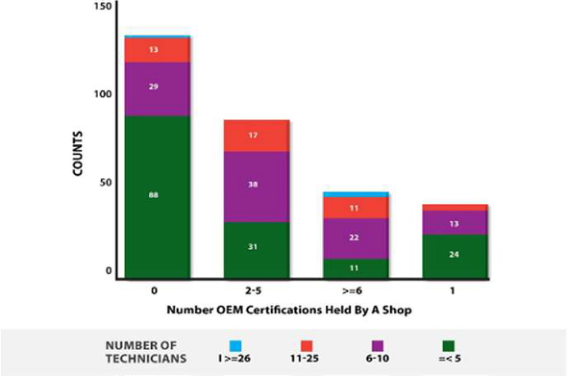
ADAS Workforce Technicians who specialize in ADAS represent a distinct subgroup within the industry, focusing on diagnostics and repairs related to these complex systems. To ensure service quality, certifications from original equipment manufacturers (OEMs) are needed. This study revealed that nearly 130 businesses, approximately 43% of those surveyed, do not hold any OEM certifications, and among these, 88 are small operations employing five or fewer technicians (see Figure 1). To better assess technician capabilities in the auto collision repair market, respondents were asked whether any technician—ADAS specialist or not—could realistically service ADAS systems across 30 different vehicle brands, which is a typical range in the U.S. collision repair industry, the vast majority—213 or 70%, believed this was infeasible. This underscores both the complexity of ADAS work and the specialized, brand-specific expertise it often demands.
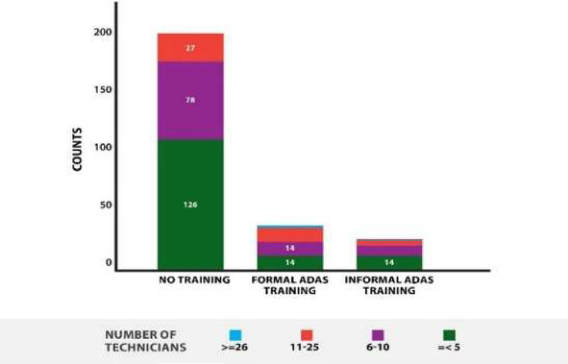
Figure 1: Technician levels across OEM certification groups.Figure 2: Comparing technician staffing across training levels.
The study also assessed the level of training among ADAS technicians. Training types included formal instruction from original equipment manufacturers (OEMs), informal on-the-job learning, or no training at all. Out of 304 businesses surveyed, only 72 reported employing technicians with some training (see Figure 2). Of those, 42 had technicians who received formal OEM training, while others relied on informal training methods. Further analysis alongside technician staffing levels shows that only 14 businesses with OEM-trained specialists were small operations employing five or fewer technicians. Overall, the findings indicate that formal and even informal training for ADAS technicians remains uncommon in the auto repair and paint industry.
Approaches to ADAS Services Given the evident lack of specialized ADAS technicians, survey respondents were asked to share their views on the difficulty of finding and retaining such specialists. Of the 304 respondents, only 81 reported no difficulty, suggesting they can hire qualified ADAS technicians when needed—though they represent a minority in the industry. About one-third (105 respondents) indicated that recruitment and retention are challenging. While they did not elaborate on how they address these challenges, it is reasonable to infer that overcoming them requires significant effort. The remaining 118 respondents reported relying on sublet services to make up for the lack of in-house expertise. These findings further highlight the widespread shortage of ADAS-trained technicians. To bridge this gap, sublet services appear to be a common solution, raising broader concerns about the industry’s growing dependence on outsourced ADAS services and the ability to deliver brand- specific calibration. This issue is explored in greater depth in the following section on ADAS service delivery models
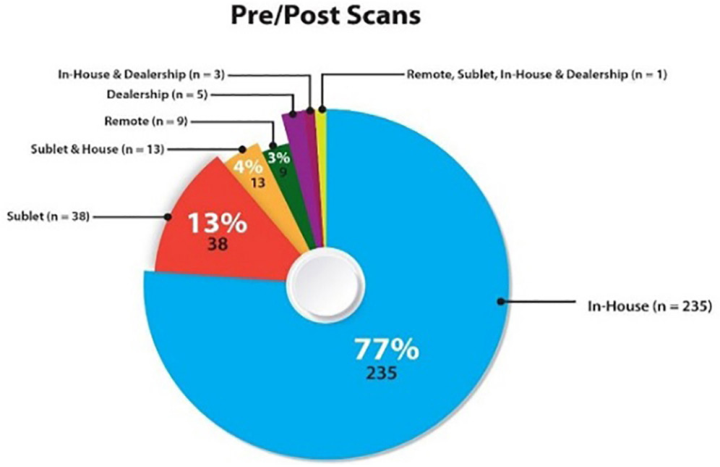
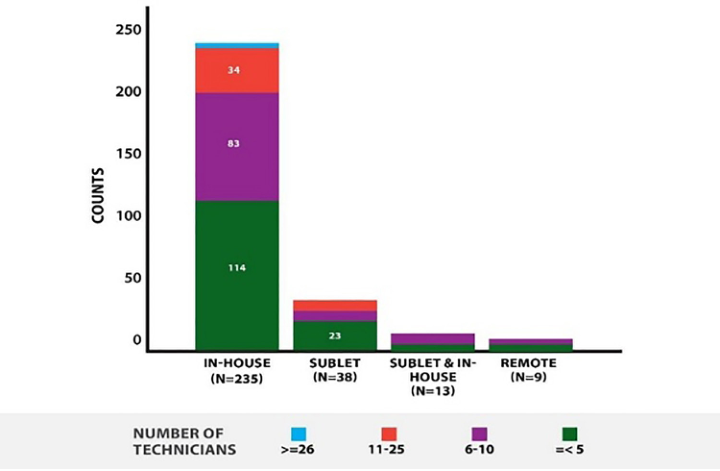
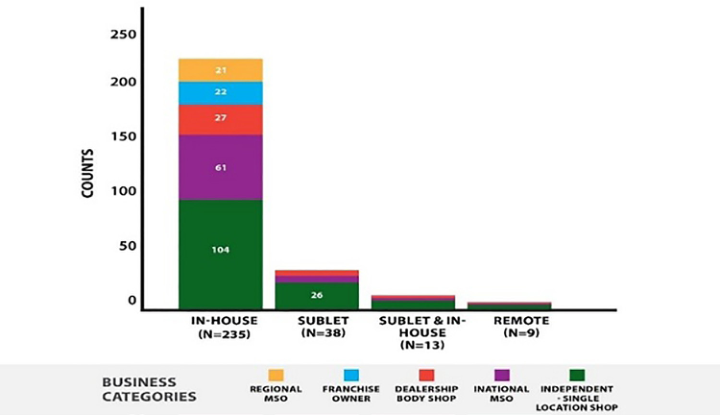
ADAS Services In this study, ADAS services are categorized into two distinct areas: scanning/ diagnostics and ADAS calibration. The survey identified four common delivery approaches: in-house, developing internal technician teams; sublet, contracting external vendors for on-site services; remote, engaging remote providers with in-house employee assistance; and dealership, relying on services from dealership-affiliated body shops. The findings reveal that most pre/post scans (235 cases, or 77%) are conducted by in-house technicians, followed by services performed through sublet arrangements (Figure 3). It should be noted that this does not address the accuracy of scans or diagnostics performed by body shop personnel. While some businesses reported using multiple service providers, these instances are relatively uncommon. The most notable exception is the combination of in-house and sublet providers, which accounts for 13 cases (4.3%). In-house pre/post scans are primarily handled by smaller businesses: of the 235 businesses using in-house technicians, 114 shops (49%) employ five or fewer technicians, while another 83 (35%) fall within the six-to-ten technician range (Figure 4). By business type, 104 independent single-location shops (44%) perform pre/post scans in-house (Figure 5).
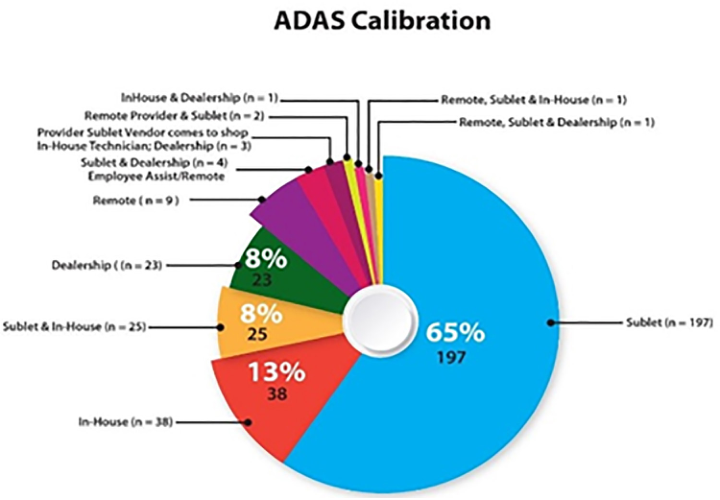
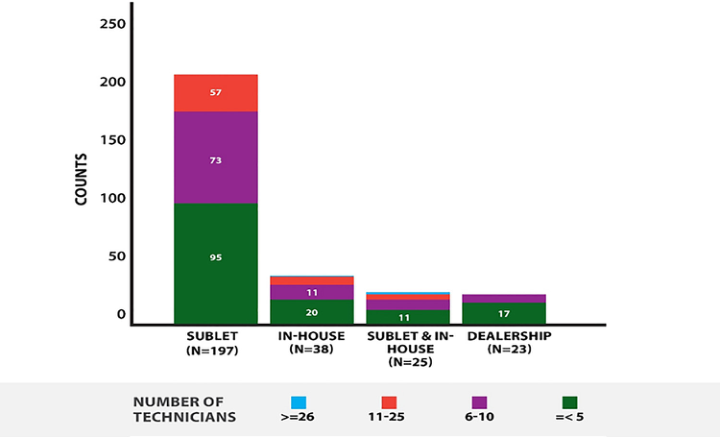
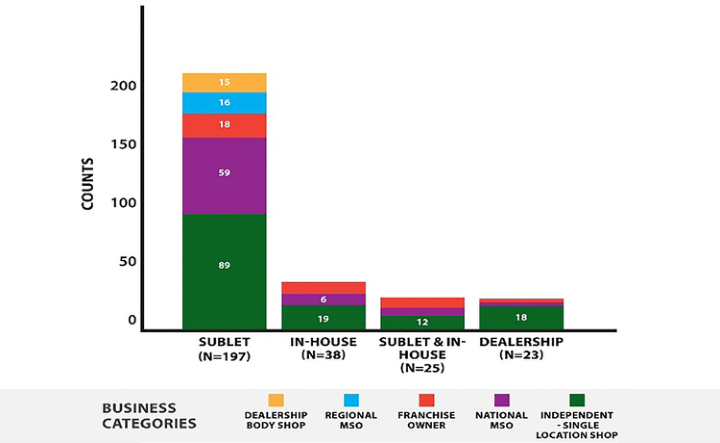
In contrast to pre/post scans, a significantly larger proportion of businesses, 197 cases (65%), rely on sublet services for ADAS calibration (Figure 6), highlighting a notable difference in service delivery between these two areas. Of the 304 businesses surveyed, only 38 (12.5%) perform ADAS calibration in-house, with the remainder relying on sublet arrangements (Figures 7 and 8).
Figure 3: Pre/post scan performers.Figure 4: Technicians staffing levels across pre/post scan.Figure 5: Business categories across pre/post scan performers.Figure 6: ADAS calibration.Figure 7: Technicians staffing levels across calibration performers.Figure 8: Business categories cross ADAS calibration performers.
To explore the relationships among key factors regarding sublet and in-house service approaches, a bivariate correlation was conducted among variables including ADAS scans, ADAS calibration, the perceived feasibility of a single technician handling ADAS services across 30 vehicle brands, and the difficulty of hiring and retaining ADAS technicians. The results indicate that repair shops performing services in-house are unlikely to outsource them, while those that cannot perform in-house rely on sublet services, r(302) = −.675 and r(302) = −.444. Results further suggest that shops
performing pre/post scans in-house are more likely to also perform calibration in-house, r(302) = .139, and conversely, shops that sublet scans also tend to sublet calibration services, r(302) = .130. When respondents believed it was feasible to service 30 different vehicle brands, ADAS calibration was more likely to be performed in-house, r(302) = .201, and less likely to be sublet, r(302) = −.160.
Table 2: Correlations among ADAS scans, ADAD calibration, the perceived, and the difficulty of hiring and retraining ADAS technicians.
Note. ** p < .01. * p < .05. Table 2 also shows that hiring difficulty is not significantly associated with either in-house or sublet approaches for both pre- and post-scans and ADAS calibration. Despite a well- documented shortage of qualified ADAS technicians, repair shops appear to have mitigated this constraint by turning to sublet services, suggesting that perceived hiring difficulty does not function as a limiting factor in current service delivery models.
CONCLUSION
In summary, the auto repair and body paint market is predominantly composed of small operations. Out of 304 businesses surveyed, 256 businesses reported having fewer than 10 technicians, with 137 of these operating from a single location. Collectively, these small businesses represent a substantial portion of the auto repair industry, underscoring their critical role in the ADAS service landscape.
Given the dominance of small operations, the quality and capability of technicians in these businesses are a key concern. A significant number of repair shops operate without a dedicated ADAS technician due to a shortage of skilled labour. Of the 304 businesses surveyed, 232 shops (76%) reported having no dedicated ADAS specialist, with 125 of these (54%) being small operations with five or fewer technicians on staff. Moreover, access to formal ADAS training is limited among small businesses. Of the 256 businesses with fewer than 10 technicians, only 28 shops (11%) reported having technicians who received formal ADAS training. This persistent skill gap contributes directly to the hiring challenges faced across the industry which raises concerns about the overall readiness of the sector to deliver consistent, high- quality, safe ADAS services.
Assessing Technician Capacity for ADAS Services in the Collision Repair Industry 755 Small operations address the skill shortage in ADAS services through two primary strategies: performing pre- and post-repair scans in-house and relying on sublet arrangements for ADAS calibration. While these approaches reflect practical, reactive adaptations to workforce constraints, it remains uncertain whether sublet services represent an optimal or sustainable long- term solution, a question that warrants further investigation.
The industry’s heavy dependence on sublet services reflects its broader challenge: an inability to internally support the technical demands of servicing a wide array of ADAS systems across up to 30 vehicle brands in the U.S. market, compounded by the lack of consistent standards among sublet providers. This complexity imposes significant operational burdens on small businesses, many of which lack the resources, training, and brand- specific expertise required to manage ADAS diagnostics and calibration independently.
The need for pre- and post-repair scans and ADAS calibration is expected to grow with the increasing integration of electronic safety components in modern vehicles. Compounding this, many ADAS systems are proprietary, making it extraordinarily difficult, if not impossible, for a single technician to remain proficient across such a wide range of vehicle brands and systems. At the same time, this complexity creates a significant business opportunity. The growing need for specialized diagnostics, calibration, and brandspecific expertise is driving demand for dedicated ADAS service providers, advanced training programs, and centralized calibration centers. Repair facilities that invest in specialized equipment, continuous technician training, or strategic partnerships can differentiate themselves in the market and capture new revenue streams as ADAS-related services become an essential component of modern vehicle repair.
ACKNOWLEDGMENT
We thank Michael Quinn and Fred Iantorno of AirPro Diagnostics LLC for providing contextual understanding and industry insights.
REFERENCES
AAA (2023) Cost of Advanced Driver Assistance Systems (ADAS) Repairs. AAA Automotive Engineering Report. Available at: https://newsroom.aaa.com/ wp-content/uploads/2023/11/Report_Cost-of-ADAS-Repairs-FINAL-23.pdf (Accessed: 13 April 2026). Arora, N. (2025) ‘How is ADAS influencing collision frequency and repair needs?’,
S&P Global, 21 August. Available at: https://www.spglobal.com/automotive- insights/en/blogs/2025/08/adas-vehicles-influencing-collision-frequency (Accessed: 13 April 2026). Ascential Test & Measurement (2025) The Importance of ADAS Calibration for Collision Prevention and Road Safety [White Paper]. Available at: https:// testandmeasure.ascentialtech.com/wp-content/uploads/2025/07/ADAS-Collision- Prevention-Whitepaper_V3-1.pdf (Accessed: 13 April 2026). Dufkis, J. and Fenzel, K. (2024) ‘ADAS calibrations: part of a proper, complete
repair’, I-CAR Collision Reporter, 1 May. Available at: https://info.i-car.com/ collisionreporter/onlinejournal/adas_calibrations (Accessed: 13 April 2026).
Gotter, A. (2025) ‘Why OEM documentation matters for ADAS calibration’, Revv, 1 July. Available at: https://www.revvhq.com/blog/importance-of-oem- documentation-adas-calibration (Accessed: 13 April 2026). I-CAR Repairability Technical Support (RTS) Portal (no date) OEM Calibration
Requirements Search. Available at: https://rts.i-car.com/oem-calibration- requirements-search.html (Accessed: 13 April 2026). Kiebach, H. and Beese, G-A. (2018) ‘Influence of advanced driver assistance systems (ADAS) on damages and repair costs’, in Isermann, R. (ed.) Fahrerassistenzsysteme 2016. Springer Vieweg, pp. 31–40. Available at: https://doi.org/10.1007/978-3- 658-21444-9_3 KPMG Corporate Finance LLC (2025) From Niche to Necessity: The Rise of ADAS
Calibration in the U.S. Available at: https://corporatefinance.kpmg.com/kpmg-us/ content/dam/kpmg/corporatefinance/pdfs/2025/from-niche-to-necessity-the-rise- of-adas-calibration-in-the-us.pdf (Accessed: 13 April 2026). McCarthy, M. and Deans, A. (2023) Calibration of Advanced Driver-Assistance Systems (ADASs) on Modified Vehicles. NZ Transport Agency Waka Kotahi Research Report 719. TRL Limited. Available at: https://www.trl.co.uk/uploads/ trl/documents/XPR125_calibration-of-advanced-driver-assistance-systems-on- modified-vehicles.pdf (Accessed: 13 April 2026). MEMA Aftermarket Suppliers (2024) ADAS: Defined, Growth, Concerns,
Recommendations. October. Available at: https://www.mema.org/research-and- insights/adas-defined-growth-concerns-recommendations (Accessed: 13 April 2026). Mueller, A., Cicchino, J., Zuby, D. and Calvanelli, J. (2024) ‘Consumer experiences with crash avoidance feature repairs’, Journal of Safety Research, 88, pp. 8–15. Available at: https://doi.org/10.1016/j.jsr.2023.10.003 Revv (2025) The State of ADAS Calibration: Industry Benchmark Report. Available
at: https://go.revvhq.com/rs/577-QPG-537/images/The_State%20_of%20ADAS_ Calibration_Industry_%20Benchmark_Report_2025.pdf (Accessed: 13 April 2026).
FIND THE COMPLETE VOLUME IN THE AHFE DIGITAL BOOKSTORE
Explore the complete digital volume
Human Systems Engineering and Design (IHSED2026): Future Trends and Applications
Read this individual research paper free through the original publisher, or explore the full digital proceedings book.