Faezeh Salehi, Moein Razavi, Mason Smith, Manish Dixit (2024). Integrated Eye-Tracking and EEG Data Collection and Synchronization for Virtual Reality-Based Spatial Ability Assessments. In: Intelligent Human Systems Integration (IHSI 2024): Integrating People and Intelligent Systems. AHFE Open Access, vol. 119, pp. 348–360. https://doi.org/10.54941/ahfe1004499
In the realm of virtual reality (VR) research, the synergy of methodological advancements, technical innovation, and novel applications is paramount. Our work encapsulates these facets in the context of spatial ability assessments conducted within a VR environment. This paper presents a comprehensive and integrated framework of VR, eye-tracking, and electroencephalography (EEG), which seamlessly combines measuring participants’ behavioral performance and simultaneously collecting time-stamped eye tracking and EEG data to enable understanding how spatial ability is impacted in certain conditions and if such conditions demand increased attention and mental allocation. This framework encompasses the measurement of participants’ gaze pattern (e.g., fixation and saccades), EEG data (e.g., Alpha, Beta, Gamma, and Theta wave patterns), and psychometric and behavioral test performance. On the technical front, we utilized the Unity 3D game engine as the core for running our spatial ability tasks by simulating altered conditions of space exploration. We simulated two types of space exploration conditions: (1) microgravity condition in which participants’ idiotropic (body) axis is in statically and dynamically misaligned with their visual axis; and (2) conditions of Martian terrain that offers a visual frame of reference (FOR) but with limited and unfamiliar landmarks objects. We specifically targeted assessing human spatial ability and spatial perception. To assess spatial ability, we digitalized behavioral tests of Purdue Spatial Visualization Test: Rotations (PSVT: R), the Mental Cutting Test (MCT), and the Perspective Taking Ability (PTA) test and integrated them into the VR settings to evaluate participants’ spatial visualization, spatial relations, and spatial orientation ability, respectively. For spatial perception, we applied digitalized versions of size and distance perception tests to measure participants’ subjective perception of size and distance. A suite of C# scripts orchestrated the VR experience, enabling real-time data collection and synchronization. This technical innovation includes the integration of data streams from diverse sources, such as VIVE controllers, eye-tracking devices, and EEG hardware, to ensure a cohesive and comprehensive dataset. A pivotal challenge in our research was synchronizing data from EEG, eye tracking, and VR tasks to facilitate comprehensive analysis. To address this challenge, we employed the Unity interface of the OpenSync library, a tool designed to unify disparate data sources in the fields of psychology and neuroscience. This approach ensures that all collected measures share a common time reference, enabling meaningful analysis of participant performance, gaze behavior, and EEG activity. The Unity-based system seamlessly incorporates task parameters, participant data, and VIVE controller inputs, providing a versatile platform for conducting assessments in diverse domains. Finally, we were able to collect synchronized measurements of participants’ scores on the behavioral tests of spatial ability and spatial perception, their gaze data and EEG data. In this paper, we present the whole process of combining the eye-tracking and EEG workflows into the VR settings and collecting relevant measurements. We believe that our work not only advances the state-of-the-art in spatial ability assessments but also underscores the potential of virtual reality as a versatile tool in cognitive research, therapy, and rehabilitation.
Integrated Eye-Tracking and EEG Data Collection and Synchronization 349
Finally, we were able to collect synchronized measurements of participants’ scores on the behavioral tests of spatial ability and spatial perception, their gaze data and EEG data. In this paper, we present the whole process of combining the eye-tracking and EEG workflows into the VR settings and col- lecting relevant measurements. We believe that our work not only advances the state-of-the-art in spatial ability assessments but also underscores the potential of virtual reality as a versatile tool in cognitive research, therapy, and rehabilitation.
BACKGROUND
Spatial ability, a critical component of cognitive functioning, plays a funda- mental role in various aspects of daily life, from navigation and wayfinding to problem-solving and STEM-related professions (Clément et al., 2013; Du et al., 2015). Spatial perception involves the interpretation and awareness of spatial information in the environment, such as judging distances, per- ceiving object sizes, and understanding spatial relationships between objects (Henry & Furness, 1993). Assessing spatial ability and spatial perception has long been of interest to researchers, educators, and clinicians, as it helps in identifying cognitive deficits, improving educational methodolo- gies, and developing therapeutic interventions (Harle & Towns, 2011). One widely recognized framework for the assessment is based on the differenti- ation between spatial visualization, spatial relations, and spatial orientation (Lohman, 1979; Lunneborg & Lunneborg, 1986). The Purdue Spatial Visu- alization Tests (PSVT) developed by Guay and Voyer (2010) assess spatial visualization, while spatial relations and spatial orientation are evaluated by tests such as the Mental Cutting Test (MCT) and the Perspective Taking Ability (PTA) test (Plumert et al., 2005; Shepard & Metzler, 1971).
Traditional methods of spatial ability assessment typically involve paper- and-pencil tests and two-dimensional representations (Cho & Suh, 2019; Ho et al., 2006). While these methods have provided valuable insights into spatial cognition, they have limitations in capturing the full range of spatial abilities, as they lack the immersive and interactive qualities of real-world spatial tasks (Huk, 2006). The advent of Virtual Reality (VR) technology has opened up new possibilities for spatial ability assessments by offering more realistic and ecologically valid environments (Salehi et al., 2023b). Some studies demonstrated the advantages of using VR for assessing spa- tial cognition, showing that VR-based tasks can better replicate real-world scenarios, thereby improving the ecological validity of spatial assessments (Kozhevnikov et al., 2005).
On the other hand, eye-tracking technology has been instrumental in inves- tigating the visual aspects of spatial perception and cognition. There are many studies that have shown that eye-tracking can be used to analyze gaze patterns, including fixations and saccades, during spatial tasks (Quiroga & Pedreira, 2011; Rensink & Enns, 1995; Rogers et al., 2018). Eye-tracking data can offer a more nuanced understanding of human spatial cognition by revealing spatial cognition strategies applied by subjects. This is impor- tant because spatial tests may measure how subjects performed on a task,
whereas eye-tracking data may explain why they performed in certain ways. This technology has been used to uncover the influence of gaze behavior on cognitive processes and spatial memory (Gidlöf et al., 2013).
EEG (Electroencephalography) is a non-invasive neuroimaging technique that measures electrical activity in the brain (Cohen, 2017). It involves placing electrodes on the scalp to record the brain’s electrical signals. These signals are typically represented as brainwaves, which are rhythmic patterns of neural activity (Cohen, 2017). Brainwaves are categorized into different frequency bands, including Alpha, Beta, Gamma, and Theta waves, each associated with specific mental states and cognitive functions. EEG and brainwaves pro- vide valuable insights into brain function and can be used in various research and clinical applications (Cohen, 2017). EEG has been widely employed to explore cognitive processes related to spatial ability (Ba¸sar et al., 1999; Keskin et al., 2020).
Research by (Klimesch, 1999) has revealed the role of different EEG fre- quency bands, such as Alpha, Beta, Gamma, and Theta, in cognitive tasks. EEG provides insights into the brain’s electrical activity during cognitive pro- cesses, including spatial perception, memory, and problem-solving (Klimesch, 2000). The integration of VR, eye-tracking, and EEG technologies represents a natural progression in spatial ability assessment (Zhu et al., 2022). The syn- ergy of these three methods allows for a more holistic understanding of how the brain and the visual system interact in immersive spatial environments. Studies like Lachat et al. (2012) have shown the feasibility of combining VR, eye-tracking, and EEG to study navigation in complex virtual environments.
Virtual Reality (VR) combines computer graphics with sensory inputs to create immersive, naturalistic experiences. It has been utilized in studies to simulate physical conditions and assess spatial cognition (Clément, 2011; Gunawardana et al., 2023; Harris et al., 2017). In one study, VR was used to examine spatial ability, revealing gender-related differences in interaction times (Guzsvinecz et al., 2022). VR is particularly useful for simulating chal- lenging environments, such as space stations (Shebilske et al., 2006), scuba diving (Jain et al., 2016), and extreme conditions like microgravity (Miiro, 2017). It offers a cost-effective and safer training alternative for astronauts (Kanas & Manzey, 2008).
Synchronizing data from various sources, such as VR tasks, eye-tracking devices, and EEG hardware, is a fundamental aspect of research aimed at integrating these technologies to advance our understanding of human spatial cognition (López-Gil et al., 2016). The necessity for precise synchronization arises from the fact that each of these data streams operates independently and records information at distinct timescales. Ensuring that all collected data shares a common time reference is paramount for conducting meaningful analysis and interpretation of the amassed information (Siboska et al., 2014).
One noteworthy approach that has been employed to tackle the synchro- nization challenge can be found in the work of Wu et al. (2020). Their research showcases the implementation of the OpenSync library, a software tool that unifies disparate data sources and enables real-time synchronization within the domains of psychology and neuroscience research. By incorporat- ing the OpenSync library into their research, Wu et al. (2020) demonstrated
Integrated Eye-Tracking and EEG Data Collection and Synchronization 351
the capacity to harmonize data obtained from diverse sensors and devices. This capability allowed them to explore the temporal relationships between eye movements, brain activity, and VR task performance. Wu et al. (2020) employed the OpenSync library in their study. Their investigation highlighted the critical role of synchronization by exploring the consequences of temporal misalignment in the analysis of eye-tracking and EEG data within a VR con- text. underscored the imperative need for accurate data alignment to ensure the validity and reliability of research findings (Wu et al., 2020). Likewise, Razavi et al. (2022) applied OpenSync to collect synchronized multimodal data at different sampling rates.
METHODS
Our primary research goal was to investigate the impact of altered spatial conditions within Virtual Reality (VR) environments on participants’ spatial ability and perception. By utilizing the Unity 3D game engine and integrating eye-tracking and EEG data collection, we aimed at comprehensively assess- ing how individuals’ spatial ability and spatial perception were influenced by altered spatial conditions. This involved delving into the intricate interplay between altered spatial conditions and participants’ cognitive performance, drawing insights from synchronized eye-tracking and EEG data to enhance our understanding of spatial cognition. Our research objectives emphasized the integration and synchronization of data, facilitated by the OpenSync library within Unity, providing a robust foundation for the comprehensive evaluation of spatial abilities and perceptions across diverse experimental conditions.
Research Objective Our research endeavors aimed to meticulously assess participants’ spatial abilities within the immersive realms of VR environments generated using Unity 3D. More specifically, we simulated microgravity conditions in which our body axis does not align with the visual axis. We also modeled environ- ments of other planets such as Mars and deep space to simulate the lack of familiar landmarks offering crucial visuospatial cues. To study spatial ability and spatial perception, we must integrate digitalized behavioral tests into the VR settings and combine eye-tracking and EEG data flow to capture time- referenced spatial performance scores, gaze data, and EEG data. The goal was to understand gaze behavior and cognitive efforts when subjects were working on spatial tasks. To do this, the main research objectives included creating a workflow of VR, eye-tracking, and EEG apparatus to gather time- referenced study data of participants’ performance on spatial tests along with their gaze and cognitive behavior. For optimal performance assessment, we strategically incorporated EEG data collection by employing the LiveAmp device to study participants’ cognitive processes during spatial tasks. How- ever, seamlessly synchronizing data from VR, eye-tracking, and EEG sources demanded the development of a robust technical framework. Leveraging the Unity interface of the OpenSync library, we successfully unified data streams, establishing a common time reference. This innovative approach not only
addressed synchronization challenges but also facilitated a coherent and inte- grated analysis of data drawn from multiple sources, solidifying the scientific rigor of our exploration into the impact of altered spatial conditions on individuals’ spatial abilities and perceptions within VR environments.
Study Environment In the experimental setup, Unity 3D game engine was a central tool for the study, allowing the creation of Virtual Reality (VR) environments to assess spatial ability and spatial perception. In the first part, spatial ability assess- ment, Unity 3D was used to generate VR environments representing three distinct conditions. The control group (CG) experienced an earth-like set- ting with aligned visual and body (idiotropic) axes. In contrast, the two experiment groups (EG1 and EG2) encountered microgravity conditions with misaligned axes, either statically or dynamically (see Figure 1). Participants were seated in swivel chairs, with the VR environment rotating around them to simulate these conditions. Each group engaged in specific spatial tasks, preventing repetition of tests across the conditions.
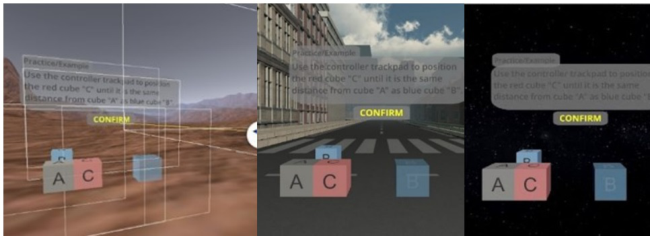
Moving to the next part, which focused on spatial perception assessment, Unity 3D was once again employed to create VR environments to depict con- trol and experiment conditions. The control group experienced a cityscape environment rich in familiar landmarks and visual and gravitational frames of reference. Experimental conditions included an alien planet/moon setting with limited spatial cues and an outer space environment with no spatial cues (see Figure 2). Participants completed size perception and distance perception tests in each of these three environments to assess their ability to accurately perceive object sizes and spatial relationships. Unity 3D’s scripting capabili- ties allowed for customization of interactions and environments to meet the specific requirements of the study. Both parts of the study utilized Unity 3D to create immersive VR environments, enabling a comprehensive assessment of spatial ability and spatial perception in different experimental conditions (Salehi et al., 2023a).
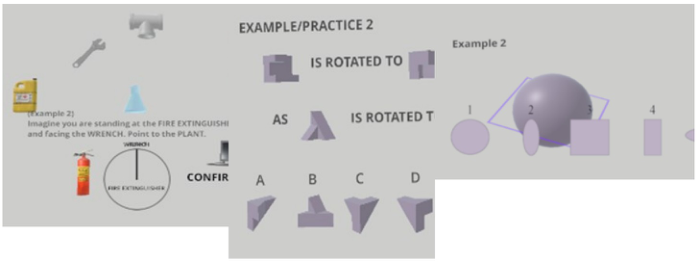
Figure 1: Digitalized tests sample for PTA, PSVTR, and MCT tests, respectively from left to right.
Integrated Eye-Tracking and EEG Data Collection and Synchronization 353
Figure 2: Study environments for digitalized tests for distance and size perception.
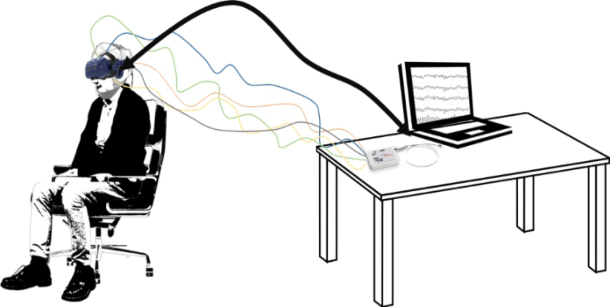
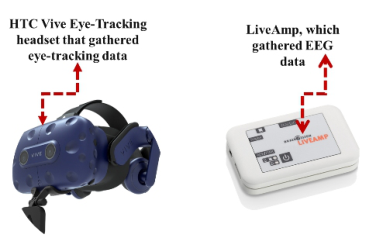
EEG and Eye-Tracking Data Acquisition Continuous EEG recording was executed through a LiveAmp 16-Ch wire- less system, powered by a portable battery unit (Brain Products, Gilching, Germany). The 24-bit amplifier, featuring an integrated 3-axis accelerome- ter, was strategically affixed to the participant’s chair, ensuring unhindered freedom of motion. Lab Streaming Layer (LSL) served as the recording mechanism, seamlessly capturing a spectrum of data including behavioral information, EEG data, Unity-based environmental data, and eye tracking data. The versatility of LSL enabled simultaneous recording with varying sampling rates, with EEG data specifically captured at a rate of 500 Hz. Strin- gent impedance control measures were implemented, maintaining impedance levels below 30 k throughout the recording process. Participants wore an HTC Vive Pro Eye head mounted display (HMD) to immerse themselves in the VR settings. This headset is installed with integrated Tobii eye-tracker that provides gaze data at a certain frequency level (Figures 3 and 4). To collect time-referenced data, eye-tracking and EEG data flow must be synchronized for frequency as well as time.
Figure 3: Experimental configuration for EEG and eye-tracking data collection.Figure 4: EEG amplifier and eye-tracking headset setup.
RESULTS
Our results offer a detailed exploration of spatial cognition within Vir- tual Reality (VR) environments. By leveraging Unity 3D, eye-tracking, and EEG technology, we are able to assess the influence of altered spatial con- ditions on participants’ cognitive processes. Synchronized measurements from behavioral tests, gaze data, and EEG recordings provided a more detailed understanding of the dynamic relationship between virtual environ- ments and spatial abilities. These findings not only advance spatial cognition research but also highlight the transformative role of VR in shaping cognitive assessments.
Technical Aspects of Environment Design in Unity
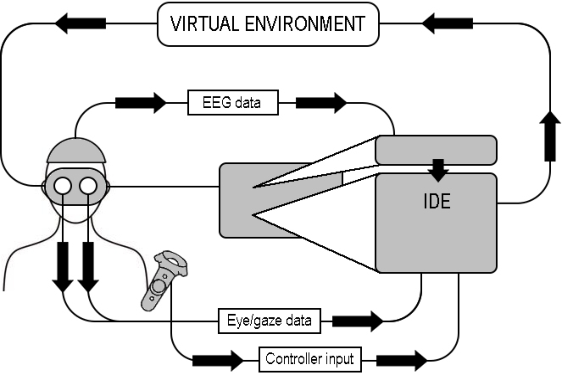
Figure 5: Diagram depicting the experiment and the collaboration of each part of the process.
Participants’ task performance, eye tracking, and EEG data are collected from the Unity game engine, which served as a data platform. Unity is an integrated development environment (IDE) through which the virtual
Integrated Eye-Tracking and EEG Data Collection and Synchronization 355
reality-mediated spatial ability tasks are run. A collection of scripts in the C# programming language work together to give the IDE instructions on what to display and how to collect the data (figure 5). The most important of these scripts controls the proceedings of the study as they are displayed in the HMD. This controller script operates during program runtime and exe- cutes a sequence of functions based on inputs by the study personnel and participants. The primary inputs that the controller script accepts are task parameters, VIVE controller input, and participant data (table 1). The con- troller script executes as follows once the study personnel start up the virtual environment via the IDE.
Task Parameters Input and Setup Upon startup, the controller script accepts the task parameters given by the study personnel and creates a personalized directory for the current par- ticipant’s data. It then initializes files for participant data and opens them for writing. Next, it reads the task parameters and loads the corresponding task and conditions. As the participant proceeds through the task, the con- troller script accepts VIVE controller input to interpret trial answer selection, advancement through task trials, and other interactions. While the partici- pant is working on a trial, the script tracks the time elapsed in milliseconds. It also temporarily stores the following participant gaze data for each runtime cycle:
Data sample timestamp
Cartesian coordinates of participant gaze collision
Difference in game units between current gaze collision position and the previous sample’s
3D vector of participant gaze angle
Difference in degrees between current gaze angle and the previous sam- ple’s.
Table 1. Types of input of the controller script.
Table available in the original PDF paper.
Types of Controller Script Input Examples Task parameters Participant ID, session, name of task, special task conditions (e.g., Frame of Reference (FoR) rotation) VIVE controller input Pointing at object in VE, trigger press/release, trackpad button press Participant data Correct/incorrect trial answers, time elapsed per trial, gaze tracking, EEG data
Additionally, the participant’s runtime EEG data is passed from the exter- nal program and temporarily stored by the IDE controller script. This data is recorded continuously during the task. Once the participant selects the answer to a trial, that answer is recorded along with the elapsed time for that trial in the trial performance data file. The gaze data file finishes writing and
is closed. Flags are written to the EEG data file with unique numerical values specifying task, task conditions, trial number, and correct/incorrect answers.
Post-Task Procedures Upon the completion of the task, the handler script finishes writing the EEG data file with embedded flags and closes the file. All participant data files are organized into a directory unique to that task and added to the participant’s session directory. The handler script informs the participant that the task is completed and waits for the study personnel to close down the virtual environment through the IDE.
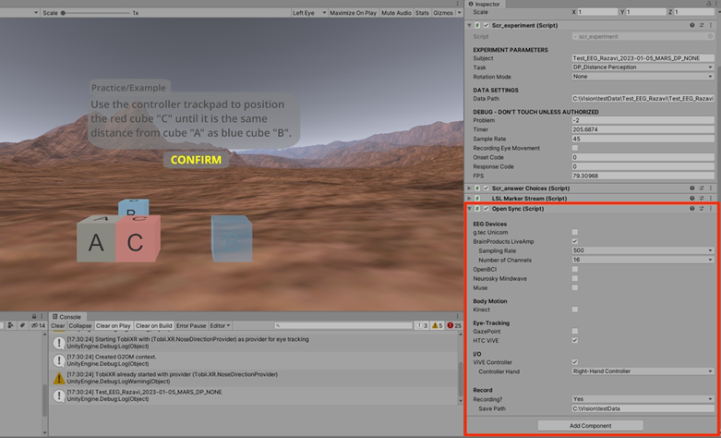
Data Synchronization In this study, Brainproducts LiveAmp was utilized to collect EEG data, and the HTC Vive device, coupled with an embedded Tobii eye-tracking device, was employed to simulate space environments using virtual reality technol- ogy. These devices operated concurrently, collecting data while participants engaged in PTA,PSVT-R,MCT,DP,and SP tasks. An integral challenge during data collection involved synchronizing measures from the three devices with the markers elicited from VR tasks to enable unified analysis. To address this issue, the Unity interface of the OpenSync library was employed (figure 6). OpenSync, an open-source software package, facilitates the automatic inte- gration, synchronization, and recording of physiological measures (e.g., EEG, GSR), user responses (e.g., mouse, keyboard), and task-related information (stimulus markers) in psychology and neuroscience research.
Figure 6: Using OpenSync library in the project to synchronize VR markers with user response, EEG and eye-tracking data.
Integrated Eye-Tracking and EEG Data Collection and Synchronization 357
OpenSync comprises two primary modules—Synchronizer and Recorder— accompanied by submodules for I/O devices, Sensors, Controller, and Marker. The Controller, utilizing Lab Streaming Layer (LSL), initiates and synchro- nizes data streams and communicates with the Recorder module. The I/O module processes user response data, the Markers module captures addi- tional information, and the Sensors module streams data from various biological sensors. The Recorder module records all streams in a single file with the Extensible Data Format (.xdf extension) (Razavi et al., 2022).
DISCUSSION
Our study makes a significant contribution to the field of spatial cognition research by employing a multimodal approach that integrates virtual reality (VR), eye-tracking, and electroencephalography (EEG). The technical inte- gration of these methodologies through the Unity 3D game engine allowed us to create immersive VR environments, simulating altered spatial conditions, and conducting spatial ability assessments. One of the pivotal challenges in our study was the synchronization of data streams from EEG, eye-tracking, and VR tasks. To overcome this obstacle, we leveraged the Unity interface of the OpenSync library, showcasing its efficacy in unifying disparate data sources. OpenSync’s modular design, featuring Synchronizer and Recorder modules, facilitated seamless integration, synchronization, and recording of physiological measures, user responses, and task-related information. This approach not only addressed synchronization challenges but also laid the groundwork for a comprehensive analysis of our collected data, ensuring a cohesive dataset for meaningful interpretation. The synchronized measure- ments of participants’ scores on behavioral tests, gaze data, and EEG data provide a holistic understanding of the intricate relationship between altered spatial conditions and cognitive processes. This workflow integrating VR, eye-tracking and EEG platforms can be scaled and built upon to study several human cognition aspects.
CONCLUSION
Our research aimed at unraveling the intricate interplay between altered spa- tial conditions within Virtual Reality (VR) environments and participants’ spatial ability and perception. Through the strategic integration of the Unity 3D game engine, eye-tracking, and EEG devices, we were able to explore human spatial cognition, pushing the boundaries of traditional assessments. The success of our study lies not only in the meticulous assessment of spatial abilities but also in the synchronization of diverse data streams. The seam- less integration of VR, eye-tracking, and EEG data through the OpenSync library within Unity not only addressed the challenges of data integration but also provided a robust foundation for evaluating spatial abilities across varied experimental conditions. This technical innovation allowed us to col- lect synchronized measurements of participants’ scores on behavioral tests, gaze data, and EEG data, offering a holistic understanding of their spatial performance. The challenges we encountered and overcame, particularly in
synchronizing data from EEG, eye-tracking, and VR tasks, have enhanced the scientific rigor of our study. Looking forward, our study lays the groundwork for future investigations into altered spatial conditions and their implications on cognitive processes. The comprehensive dataset and innovative method- ologies presented in this research serve as a valuable resource for researchers delving into the complexities of human spatial abilities within immersive VR environments.
ACKNOWLEDGMENT
The presented work has been supported by the U.S. National Science Founda- tion (NSF) through grant CNS 1928695. The authors gratefully acknowledge the support from the NSF. Any opinions, findings, conclusions, and rec- ommendations expressed in this paper are those of the authors and do not necessarily represent those of the NSF.
REFERENCES
Ba¸sar, E., Ba¸sar-Ero˘glu, C., Karaka¸s, S., & Schürmann, M. (1999). Are cognitive processes manifested in event-related gamma, alpha, theta and delta oscillations in the EEG? Neuroscience letters, 259(3), 165–168. Cho, J. Y., & Suh, J. (2019). Understanding spatial ability in interior design educa-
tion: 2D–to–3D visualization proficiency as a predictor of design performance. Journal of Interior Design, 44(3), 141–159. Clément, G. (2011). Fundamentals of space medicine (Vol. 23). Springer Science & Business Media. Clément, G., Skinner, A., & Lathan, C. (2013). Distance and Size Perception
in Astronauts during Long-Duration Spaceflight. Life (Basel), 3(4), 524–537. https://doi.org/10.3390/life3040524 Cohen, M. X. (2017). Where does EEG come from and what does it mean? Trends in neurosciences, 40(4), 208–218. Du, X., Zhang, Y., Tian, Y., Huang, W., Wu, B., & Zhang, J. (2015). The influence
of spatial ability and experience on performance during spaceship rendezvous and docking. Frontiers in Psychology, 6, 955. Gidlöf, K., Wallin, A., Dewhurst, R., & Holmqvist, K. (2013). Using eye tracking to trace a cognitive process: Gaze behaviour during decision making in a natural environment. Journal of eye movement research, 6(1). Gunawardana, D., Wang, X., Mahdaviarab, A., McCubbins, O. P., Landaverde, R.,
& Liu, Z. (2023). Virtual Reality Videos for Delivery of Extension Educational Materials on Manure and Mortality Management: A Pilot-Study. In Preprints: Preprints. Guzsvinecz, T., Orbán-Mihálykó, É., Sik-Lányi, C., & Perge, E. (2022). Investigation of spatial ability test completion times in virtual reality using a desktop display and the Gear VR. Virtual Reality, 1–14. Harle, M., & Towns, M. (2011). A review of spatial ability literature, its connection
to chemistry, and implications for instruction. Journal of Chemical Education, 88(3), 351–360. Harris, L. R., Jenkin, M., Jenkin, H., Zacher, J. E., & Dyde, R. T. (2017). The effect of long-term exposure to microgravity on the perception of upright. npj Microgravity, 3(1), 3.
Integrated Eye-Tracking and EEG Data Collection and Synchronization 359
Henry, D., & Furness, T. (1993). Spatial perception in virtual environments: Evaluating an architectural application. Proceedings of IEEE virtual reality annual international symposium. Ho, C.-H., Eastman, C., & Catrambone, R. (2006). An investigation of 2D and 3D
spatial and mathematical abilities. Design Studies, 27(4), 505–524. Huk, T. (2006). Who benefits from learning with 3D models? The case of spatial ability. Journal of computer assisted learning, 22(6), 392–404. Jain, D., Sra, M., Guo, J., Marques, R., Wu, R., Chiu, J., & Schmandt, C. (2016).
Immersive scuba diving simulator using virtual reality. Proceedings of the 29th Annual Symposium on User Interface Software and Technology. Kanas, N., & Manzey, D. (2008). Space psychology and psychiatry (Vol. 16).
Springer. Keskin, M., Ooms, K., Dogru, A. O., & De Maeyer, P. (2020). Exploring the cognitive load of expert and novice map users using EEG and eye tracking. ISPRS International Journal of Geo-Information, 9(7), 429. Klimesch, W. (1999). EEG alpha and theta oscillations reflect cognitive and memory
performance: a review and analysis. Brain Research Reviews, 29(2-3), 169–195. Klimesch, W. (2000). EEG alpha and cognitive processes. In Time and the Brain (pp. 252–277). CRC Press. Kozhevnikov, M., Kosslyn, S., & Shephard, J. (2005). Spatial versus object visualiz-
ers: A new characterization of visual cognitive style. Memory & cognition, 33(4), 710–726. Lachat, F., Farroni, T., & George, N. (2012). Watch out! Magnetoencephalographic evidence for early modulation of attention orienting by fearful gaze cueing. PLoS One, 7(11), e50499. Lohman, D. F. (1979). Spatial ability: A review and reanalysis of the correlational
literature (Vol. 8). School of education, Stanford university Stanford, CA. López-Gil, J.-M., Virgili-Gomá, J., Gil, R., Guilera, T., Batalla, I., Soler-González, J., & García, R. (2016). Method for improving EEG based emotion recognition by combining it with synchronized biometric and eye tracking technologies in a non- invasive and low cost way. Frontiers in computational neuroscience, 10, 85. Lunneborg, P. W., & Lunneborg, C. E. (1986). Everyday spatial activities test
for studying differential spatial experience and vocational behavior. Journal of Vocational Behavior, 28(2), 135–141. Miiro, S. (2017). The Issues and Complexities Surrounding the Future of Long Duration Spaceflight. Plumert, J. M., Kearney, J. K., Cremer, J. F., & Recker, K. (2005). Distance perception
in real and virtual environments. ACM Transactions on Applied Perception (TAP), 2(3), 216–233. Quiroga, R. Q., & Pedreira, C. (2011). How do we see art: An eye-tracker study.
Frontiers in human neuroscience, 5, 98. Razavi, M., Janfaza, V., Yamauchi, T., Leontyev, A., Longmire-Monford, S., & Orr, J.
(2022). OpenSync: An open-source platform for synchronizing multiple measures in neuroscience experiments. Journal of neuroscience methods, 369, 109458. Rensink, R. A., & Enns, J. T. (1995). Preemption effects in visual search: Evidence for low-level grouping. Psychological review, 102(1), 101. Rogers, S. L., Speelman, C. P., Guidetti, O., & Longmuir, M. (2018). Using dual
eye tracking to uncover personal gaze patterns during social interaction. Scientific Reports, 8(1), 4271. Salehi, F., Pariafsai, F., & Dixit, M. K. (2023a). How Human Spatial Ability is Affected by the Misalignment of Idiotropic and Visual Axes. International Conference on Human-Computer Interaction.
Salehi, F., Pariafsai, F., & Dixit, M. K. (2023b). The impact of misaligned idiotropic and visual axes on spatial ability under altered visuospatial conditions. Virtual Reality, 1–15. Shebilske, W. L., Tubré, T., Tubré, A. H., Oman, C. M., & Richards, J. T. (2006).
Three-dimensional spatial skill training in a simulated space station: Random vs. blocked designs. Aviat Space Environ Med, 77(4), 404–409. Shepard, R. N., & Metzler, J. (1971). Mental rotation of three-dimensional objects.
Science, 171(3972), 701–703. Siboska, D., Karstoft, H., & Pedersen, H. (2014). Synchronization of electroencephalography and eye tracking using global illumination changes. International Conference on Bio-inspired Systems and Signal Processing. Wu, F., Thomas, J., Chinnola, S., & Rosenberg, E. S. (2020). Exploring communica-
tion modalities to support collaborative guidance in virtual reality. 2020 IEEE conference on virtual reality and 3D user interfaces abstracts and workshops (VRW). Zhu, S., Qi, J., Hu, J., & Hao, S. (2022). A new approach for product evaluation based on integration of EEG and eye-tracking. Advanced Engineering Informatics, 52, 101601.
LISTED IN THE AHFE DIGITAL BOOKSTORE CATALOGUE
Explore the complete digital volume
Intelligent Human Systems Integration (IHSI 2024): Integrating People and Intelligent Systems
Read this individual research paper free through the original publisher, or explore the full digital proceedings book.
ISBN 978-1-958651-95-7
Explore this ISBN in the AHFE Bookstore ↗Listed in the July 2026 bookstore catalogue; search by ISBN to confirm current availability · Digital book purchase optional