Faezeh Salehi, Manish Dixit, Vahideh Karimimansoob (2024). How age relate to spatial orientation ability under simulated microgravity environments?. In: Human Factors in Virtual Environments and Game Design. AHFE Open Access, vol. 137, pp. 70–79. https://doi.org/10.54941/ahfe1004988
Spatial cognitive processing is a crucial element of human cognition, intricately influencing our understanding of spatial environments. Despite varying definitions, researchers concur that spatial ability encompasses skills like generating, visualizing, memorizing, and transforming visual information—a fundamental aptitude for tasks requiring visual and spatial acumen. Spatial orientation is one such ability that utilizes egocentric spatial encoding and contributes to human spatial ability. This study focuses on the evaluation of spatial orientation ability through the Perspective-Taking Ability (PTA) test. This test gauges participants' capacity to envision a view from an alternative. Stimuli include 5-6 routine objects placed on the perimeter of a circle, and participants are asked to mentally position themselves at one object facing another object and point to a third object. Scores depend on the degree of deviation from the correct direction in sexagesimal degrees. This nuanced evaluation explores spatial orientation and comprehension of an environment from diverse viewpoints. The PTA test was digitalized and integrated into Virtual Reality (VR) environments created in Unity 3D to depict three scenarios. The first scenario was the control group that included an earth-like setting in which the gravitation vertical, idiotropic axis of a participant, and the visual axis are aligned. The second scenario of experiment group 1 simulated spatial conditions of microgravity in space, which lacks gravitational vertical and has statically misaligned visual and idiotropic axes. In the third scenario, the misalignment is dynamic in that it is constantly changing around X, Y, and Z axes over the test session. The three study conditions were administered to 230 participants through HTC Vive Pro Eye head-mounted displays (HMDs). Participants’ responses were collected using a programming script and analyzed to understand how participants’ performance on the PTA test tasks varied between the three conditions and how their age moderated this influence. Participants were categorized into age groups: 18-22, 23-27, 28-32, 33-37, and 38+. The Mann-Whitney U test indicated a significant difference in response accuracy of the participants aged 23-27, 33-37, and 38 and above, indicating distinctive performance between the three study conditions. This means that static and dynamic misalignment influenced spatial orientation performance. Conversely, participants aged 28-32 showed no significant difference between the three conditions, indicating no impacts of the misaligned idiotropic and visual axes. Based on the Kruskal-Wallis test results, the age groups of 18-22 and 38+ revealed significant accuracy differences, whereas the age group 23-27 had highly significant differences. Conversely, the age group 28-32 showed no significant accuracy difference, suggesting comparable performance, whereas the age group 33-37 showed a significant accuracy difference. Results indicate a statistically significant accuracy difference among age groups, suggesting age group moderating the influence of misaligned axes on PTA scores. The pairwise age group comparisons using the Dunn's Post Hoc Test showed significant differences in accuracy for the 23-27 age group compared to the 18-22, 28-32, and 33-37 age groups, revealing age-related variations in spatial accuracy. In conclusion, our research unveiled a profound connection between age and accuracy, demonstrating pronounced differences among age groups.
How Age Relate to Spatial Orientation Ability Under Simulated Microgravity Environments? 71
BACKGROUND
In today’s dynamic work landscape, emerging technologies propel explo- ration into challenging realms such as deep space, polar regions, and deep oceans, posing safety and productivity challenges (He et al., 2021; Staple- ton et al., 2016; Salehi, Pariafsai and Dixit, 2023). Spatial ability, crucial for daily activities, involves visualization, orientation, and relations, impacting object perception and manipulation (Lin and Suh, 2021; French, Ekstrom, and Price, 1963). Despite extensive spatial cognition research, understand- ing spatial ability in extreme conditions remains elusive (Lohman, 1979; Oman, 2007; Jain, Sra et al., 2016; Miiro, 2017; He et al., 2021). This study delves into spatial cognitive processing, focusing on spatial orienta- tion in Virtual Reality (VR), assessed through the Perspective Taking Ability (PTA) test (Salehi, Pariafsai, and Dixit, 2023). Crucial for mental positioning, PTA evaluates participants’ ability to visualize scenes from alternate view- points (Pellegrino et al., 1984; Tian et al., 2021). Introduced in 2007 for astronauts’ spatial assessment during space tasks (Brandan, 2007), PTA in VR gauges proficiency in nuanced spatial orientation (Kozhevnikov et al., 2000; Lohman et al., 1979; Coxon, Kelly and Page, 2016; Molina-Carmona, Pertegal-Felices et al., 2018). VR technology, immersing users in challenging scenarios, assesses spatial cognition (Coxon, Kelly and Page, 2016; Carmona et al., 2018; Lowrie et al., 2019). This integrated approach explores spa- tial orientation in VR, providing insights into cognitive processes in extreme conditions (Salehi, Pariafsai, and Dixit, 2023). A 2013 study underscores Virtual Reality Perspective-Taking Ability (VR-PTA) as a potent predictor of navigational performance (Lun et al., 2013). The Perspective Taking Ability (PTA) test is indispensable for assessing spatial cognitive processing, espe- cially in VR and altered spatial conditions (Ebersbach, Stiehler and Asmus, 2011; Tian, Luo et al., 2021; Salehi, Pariafsai and Dixit, 2024). The fusion of VR and PTA unveils individual perceptions in technologically influenced environments, illuminating the intricate PTA-spatial orientation relationship (Merchant, Goetz et al., 2013; Lochhead, Hedley et al., 2022).
METHODS
The main goal of this paper is to examine how the non-alignment of idiotropic and visual axes influence human spatial orientation ability. To reach this goal, the following research objectives are pursued:
Examine the impact of altered spatial conditions: Investigate how spatial orientation abilities are affected by altered spatial conditions, specifi- cally the static and dynamic misalignment of visual and idiotropic axes in simulated scenarios of microgravity within VR environments.
Explore age-related variances: Analyse how different age groups respond to spatial orientation tasks under various altered conditions, aiming to identify age-related patterns and variations in performance.
Digitalization of PTA test: Assess the effectiveness of digitalizing the Perspective-Taking Ability (PTA) test and integrating it into VR envi- ronments, exploring the potential benefits and challenges of utilizing technology to evaluate spatial orientation.
To achieve the three research objectives, the following tasks are completed:
1. Create VR environments and integrate digital PTA test tasks: Successfully integrate and implement the PTA test within VR environments created in Unity 3D, representing distinct spatial scenarios including a control group with an earth-like setting and two experiment groups indicating micro- gravity conditions with static and dynamic misalignments of idiotropic and visual axes. 2. Evaluate participants’ performance: Administer the digital PTA tests under the simulated control and experiment conditions to participants and measure and analyze their responses to the digitalized PTA test tasks, focusing on understanding variations in performance across different spatial conditions. 3. Assess influence of age on spatial orientation: Utilize statistical analyses, including the Mann-Whitney U test, Kruskal-Wallis test, and Dunn’s Post Hoc Test, to assess the influence of age on spatial orientation accuracy under varied spatial conditions. 4. Identify significant age-condition interactions: Specifically, determine whether specific age groups exhibit more pronounced differences in spa- tial orientation accuracy under certain spatial conditions, emphasizing the interaction between age and misaligned axes.
These tasks contribute profoundly to our current understanding of spa- tial orientation ability under microgravity offering valuable insights into the intricate relationship between age and spatial orientation and the impact of misaligned axes on PTA scores. The findings aim to enhance our broader understanding of human spatial cognition in altered environments.
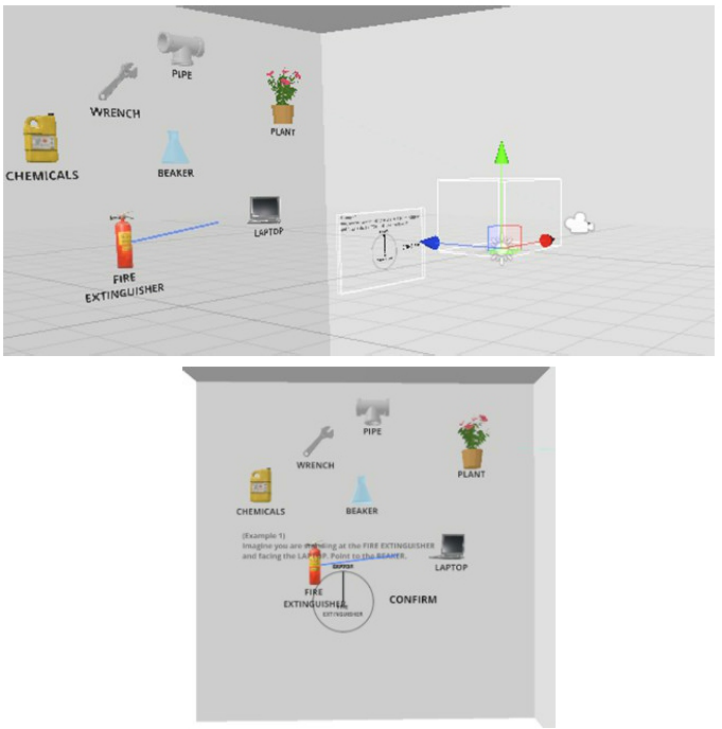
STUDY ENVIRONMENT The VR environments in this study were developed using the Unity 3D game engine, depicting three distinct study conditions (Figure 1). The first condi- tion of the control group represented an earth-like setting with participants’ body (idiotropic) axis aligned vertically and in line with the visual frame of reference. In the second condition of experiment group I, the idiotropic axis was statically misaligned at a random angle in the X, Y, or Z axis. In the third condition of experiment group II, this misalignment was dynamic, changing randomly because of the spatial environment rotating randomly around the X, Y, or Z axis.
Participants in the control group (CG) experienced aligned axes, while those in experiment group I (EG 1) and experiment group II (EG2) encoun- tered static and dynamic misalignments, respectively. The participants, seated on swivel chairs, engaged with stimuli and spatial environments that rotated either statically or dynamically in VR. The experiment involved spatial orien- tation tasks with participants randomly assigned to the control or experiment groups to ensure they do not repeat a particular condition to avoid learning effect. The participants were exposed to the virtual environments using an HTC VIVE Pro Eye Head-Mounted Display (HMD) and asked to complete PTA tasks and register their responses by choosing from given options using a
How Age Relate to Spatial Orientation Ability Under Simulated Microgravity Environments? 73
hand-held VR controller. Correct/incorrect answers and response times were automatically recorded along with participants’ responses to pre and post-test surveys that collected demographic information. The experimental proce- dures were carefully conducted to ensure participants’ familiarity with the tests, apparatus, and experiment instructions.
Figure 1: VR environment for PTA test.
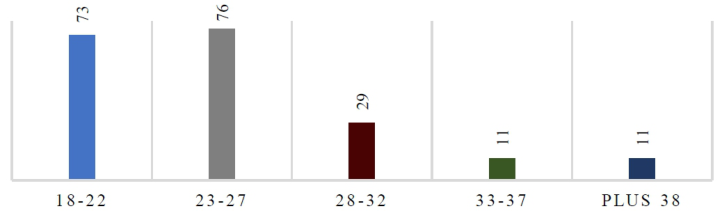
PARTICIPANTS After getting approval from the university Institutional Review Board, we recruited participants from the university student and staff populations. Our study finally enlisted a diverse cohort of 230 participants, featuring a well- balanced gender distribution (70% male, 30% female). With an average age of 27.79, all participants were in optimal health, and their vision was either naturally good or corrected (Figure 2). This diverse demographic enriched the generalizability of our findings, providing comprehensive insights into the spatial orientation abilities of a varied and healthy population.
Figure 2: Frequency of participants in each age range bin.
Data analysis Analysing data for this study involved rigorous statistical tests. The Mann- Whitney U test pinpointed significant accuracy differences among age groups. The Kruskal-Wallis test provided a broader view of accuracy variations across ages. For detailed insights, Dunn’s Post Hoc test elucidated significant dif- ferences between specific age groups. These analyses collectively deepened our understanding of the nuanced relationship between accuracy and age in spatial cognitive tasks.
RESULTS
In examining the PTA scores under distinct age groups, our analysis revealed noteworthy variations in accuracy levels. The Mann-Whitney U test demon- strated statistically significant differences for participants aged 38 and above, 23-27, and 18-22, indicating unique performance within these age brack- ets (see Table 1). The Kruskal-Wallis test further supported these findings, suggesting an overall significant difference in accuracy among age groups. Dunn’s Post Hoc Test highlighted specific pairwise comparisons, emphasizing significant distinctions in accuracy for the 23–27 and 38+ age groups com- pared to others. Overall, misalignment appears to have produced discernible changes in PTA scores, with age exerting a notable influence on performance.
Table 1. Results from Mann-Whitney U test.
Table available in the original PDF paper.
Age Group P Value Statistical Interpretation +38 p = 0.0394 Statistical significance indicated distinctive accuracy levels for participants aged 38 and above, setting them apart from other age groups. 33–37 p = 1.38e−09 A highly significant difference underscored performance distinctions for participants aged 33–37 relative to other age groups. 28–32 p = 0.3713 No significant difference suggested comparable accuracy for participants aged 28–32 compared to other age groups. 23–27 p = 0.00098 Highly significant results highlighted unique performance for participants aged 23–27 compared to their counterparts. 18–22 p = 7.84e−07 Significant differences indicated unique performance for participants aged 18–22 compared to their counterparts.
How Age Relate to Spatial Orientation Ability Under Simulated Microgravity Environments? 75
In this study, our focus centered on examining the intricate relationship between age and spatial orientation accuracy within the framework of three distinct conditions: a control group and two experiment groups (Experiment Group 1 and Experiment Group 2). Leveraging the Mann-Whitney U test for pairwise comparisons and the Kruskal-Wallis test for overall assessment, we meticulously analyzed Psychomotor Test A (PTA) scores across various age groups. Our findings not only revealed noteworthy variations in accuracy lev- els among participants aged 38 and above, 23–27, and 18–22, as previously highlighted, but also prompted an exploration into the specific differences between the control group and the two experiment groups. The Mann- Whitney U test, evaluating each age category individually, demonstrated significant differences within the control group compared to Experiment Group 1 and Experiment Group 2, shedding light on unique performance characteristics associated with each condition. These results contribute to a comprehensive understanding of how age and experimental conditions collectively influence spatial orientation accuracy, with subsequent sections delving into a detailed interpretation of the nuanced relationships among these variables. The Mann-Whitney U test evaluated the impact of different age groups on accuracy. Notable findings emerged for specific age categories.
The Mann-Whitney U test is used for pairwise comparisons between each age group, while the Kruskal-Wallis test assesses overall differences among all age groups. Both tests yielded similar p-values (Table 2).
Table 2. Results from the Kruskal-Wallis test.
Table available in the original PDF paper.
Age Group P Value Statistical Interpretation +38 p = 0.0394 Statistical significance (p = 0.0394) hinted at variations in accuracy among participants aged 38 and above 33–37 p = 1.38e−09 An extremely low p-value (p = 1.38e−09) underscored significant accuracy differences for participants aged 33–37 28–32 p = 0.3713 Non-significant p-value (p = 0.3713) suggested comparable accuracy for participants aged 28–32 23–27 p = 0.00098 Highly significant results (p = 0.00098) indicated notable accuracy differences within the 23–27 age range 18–22 p = 7.84e−07 Extremely low p-value (p = 7.84e-07) highlighted significant accuracy differences within the 18–22 age group
The Dunn’s Post Hoc Test facilitated pairwise comparisons (Table 3 and 4), unveiling specific differences. In-depth analyses confirm age’s impact on spa- tial orientation accuracy, revealing distinct variations among age groups. Dunn’s Post Hoc Test precisely identifies age pairs with significant differ- ences, providing valuable insights into the relationship between age and spatial orientation performance.
Table 3. Age group differences.
Table available in the original PDF paper.
Age Group Differences 18–22 No significant difference with any other age group 23–27 Significant differences with the 18–22, 28–32, and 33–37 age groups. 28–32 No significant difference with the 18–22 and 38+ age groups. 33–37 Significant differences with the 18–22 and 28–32 age groups. +38 Significant differences with the 18–22, 28-32, and 33–37 age groups.
In the rapidly evolving landscape of work environments influenced by emerg- ing technologies, the study delves into the pivotal domain of spatial cognitive processing. The exploration of spatial abilities, particularly spatial orienta- tion, becomes imperative for individuals engaged in remote and challenging environments, such as deep space or deep oceans. Understanding how spatial abilities adapt to altered conditions is essential for optimizing performance and safety in these demanding settings (He et al., 2021; Stapleton et al., 2016). Spatial ability, encompassing visualization, orientation, and relations, plays a crucial role in daily tasks and contributes to understanding object features and movements. Despite extensive research in various fields, there is a significant gap in comprehending spatial abilities in challenging work con- ditions like space and deep oceans. The Perspective Taking Ability (PTA) test emerges as a focal point in this study, serving as a reliable metric to evalu- ate participants’ spatial orientation in diverse and technologically influenced work environments (Salehi, Pariafsai, & Dixit, 2023). This study pioneers the integration of the PTA test into Virtual Reality (VR) environments, uti- lizing Unity 3D to simulate scenarios with varying spatial conditions. The digitalization of the PTA test opens avenues for exploring spatial orientation in novel ways, providing a bridge between traditional cognitive assessments and cutting-edge technological advancements. VR technology, widely used in astronaut training and educational settings, proves to be an innovative tool for understanding how individuals mentally align themselves within spatial settings (Coxon et al., 2016; Lee, Wong, & Fung, 2009; Torner, Alpiste, & Brigos, 2016). The study reveals significant differences in spatial orientation performance under altered conditions, specifically static and dynamic mis- alignments of visual and idiotropic axes. Participants aged 23–27, 33–37, and 38 and above demonstrated distinctive responses, indicating susceptibility to the influence of misaligned axes. Conversely, the age group 28–32 exhib- ited comparable performance across different spatial conditions, suggesting
How Age Relate to Spatial Orientation Ability Under Simulated Microgravity Environments? 77
a potential resilience to misalignment impacts. This means that individu- als must be given proper training to equip them with high spatial ability, particularly in altered spatial conditions for ensuring their safety and work productivity. The Mann-Whitney U test and Kruskal-Wallis test shed light on age-related variations in spatial accuracy. Notably, participants aged 23–27 displayed highly significant differences in accuracy, emphasizing a critical age range where spatial orientation performance is notably influenced by misalignment conditions. The Dunn’s Post Hoc Test further identified spe- cific age group pairs with significant accuracy differences, offering nuanced insights into the interplay between age and spatial performance.
CONCLUSIONS
In conclusion, this research unravels a profound connection between age and spatial orientation accuracy, showcasing pronounced differences among age groups. The age-related variations in spatial accuracy underscore the need for tailored approaches in training and adapting work environments, espe- cially for individuals in the crucial age range of 23-27. The results prompt a re-evaluation of spatial training protocols, emphasizing personalized strate- gies for different age cohorts. As the workforce increasingly engages with technologically influenced environments, the study’s findings have implica- tions for the design of spatial tasks and training programs. Tailoring spatial training interventions based on age-related dynamics and susceptibility to misalignment conditions can enhance overall spatial orientation proficiency, contributing to safer and more efficient operations in challenging work set- tings. The integration of the PTA test into VR environments opens avenues for future research. Exploring the specific cognitive processes underlying age-related differences in spatial orientation under misalignment conditions could provide deeper insights. Additionally, investigating the adaptability of spatial abilities over time and the potential for age-specific interventions offers promising directions for further exploration. In essence, this study not only expands our understanding of human spatial cognition in altered environments but also propels future inquiries into personalized training methodologies, ensuring individuals of different age groups navigate and comprehend spatial settings with optimal accuracy and efficiency.
ACKNOWLEDGMENT
This work is supported by the U.S. National Science Foundation (NSF) through grant CNS 1928695. Any opinions, findings, conclusions, and rec- ommendations expressed in this paper are those of the authors and do not necessarily represent those of the NSF.
REFERENCES
Brandan, M. A. M. (2007). Influence of spatial orientation and spatial visualization abilities on space teleoperation performance, Massachusetts Institute of Technology, Department of Aeronautics.
Contero, M., et al. (2005). “Improving visualization skills in engineering education.”
IEEE Computer Graphics and Applications 25(5): 24–31. Coxon, M., et al. (2016). “Individual differences in virtual reality: Are spatial presence and spatial ability linked?” Virtual Reality 20: 203–212. Ebersbach, M., et al. (2011). “On the relationship between children’s perspective
taking in complex scenes and their spatial drawing ability.” British Journal of Developmental Psychology 29(3): 455–474. Ettekal, I. and M. Mohammadi (2020). “Co-occurring trajectories of direct aggression and prosocial behaviors in childhood: longitudinal associations with peer acceptance.” Frontiers in psychology 11: 581192. French, J. W., et al. (1963). “Manual for kit of reference tests for cognitive factors
(revised 1963).” Princeton, NJ: Educational Testing Service. He, X., Li, T., Turel, O., Kuang, Y., Zhao, H., & He, Q. (2021). The impact of stem education on mathematical development in children aged 5–6 years. International Journal of Educational Research, 109, 101795. Hegarty, M. and D. Waller (2004). “A dissociation between mental rotation and
perspective-taking spatial abilities.” Intelligence 32(2): 175–191. Jain, D., et al. (2016). Immersive scuba diving simulator using virtual reality.
Proceedings of the 29th Annual Symposium on User Interface Software and Technology. Jones, S. and G. Burnett (2008). “Spatial ability and learning to program.” Human Technology: An Interdisciplinary Journal on Humans in ICT Environments. Kozhevnikov, M. and M. Hegarty (2001). “A dissociation between object manip-
ulation spatial ability and spatial orientation ability.” Memory & cognition 29: 745–756. Lee, E. A.-L., et al. (2009). “Educational values of virtual reality: The case of spatial ability.” International Journal of Educational and Pedagogical Sciences 3(6): 934–938. Lin, Y. and A. Suh (2021). The role of spatial ability in learning with virtual real-
ity: a literature review. 54th Hawaii International Conference on System Sciences (HICSS 2021). Liu, A. M., et al. (2013). “Predicting space telerobotic operator training performance from human spatial ability assessment.” Acta Astronautica 92(1): 38–47. Lochhead, I., et al. (2022). “The immersive mental rotations test: Evaluating spatial
ability in virtual reality.” Frontiers in Virtual Reality 3: 820237. Lohman, D. F., et al. (1979). Spatial ability : a review and reanalysis of the correlational literature. Stanford, California, Stanford University School of Education Stanford, California. Lowrie, T., et al. (2019). “The influence of spatial visualization training on stu-
dents’ spatial reasoning and mathematics performance.” Journal of Cognition and Development 20(5): 729–751. Lun, W., et al. (2013). The role of spatial skills and processes in navigation performance, Undergraduate honor’s thesis. National University of Singapore, Singapore. Merchant, Z., et al. (2013). “Exploring 3-D virtual reality technology for spatial
ability and chemistry achievement.” Journal of Computer Assisted Learning 29(6): 579–590. Miiro, S. (2017). “The Issues and Complexities Surrounding the Future of Long Duration Spaceflight.” Molina-Carmona, R., et al. (2018). “Virtual reality learning activities for multimedia
students to enhance spatial ability.” Sustainability 10(4): 1074.
How Age Relate to Spatial Orientation Ability Under Simulated Microgravity Environments? 79
Oman, C. (2007). “Spatial orientation and navigation in microgravity.” Spatial processing in navigation, imagery and perception: 209–247. Pellegrino, J. W., et al. (1984). “Understanding spatial ability.” Educational psychol-
ogist 19(4): 239–253. Salehi, F., et al. (2023). How Human Spatial Ability is Affected by the Misalignment of Idiotropic and Visual Axes. International Conference on Human-Computer Interaction, Springer. Salehi, F., et al. (2023). “The impact of misaligned idiotropic and visual axes
on spatial ability under altered visuospatial conditions.” Virtual Reality 27(4): 3633–3647. Salehi, F., et al. (2024). “The impact of visuospatial cues on human spatial perception abilities.” Tian, M., et al. (2021). “Spatial ability and theory of mind: A mediating role of visual
perspective taking.” Child Development 92(4): 1590–1604. Torner, J., et al. (2016). “Virtual Reality application to improve spatial ability of engineering students.”
LISTED IN THE AHFE DIGITAL BOOKSTORE CATALOGUE
Explore the complete digital volume
Human Factors in Virtual Environments and Game Design
Read this individual research paper free through the original publisher, or explore the full digital proceedings book.
ISBN 978-1-964867-13-7
Explore this ISBN in the AHFE Bookstore ↗Listed in the July 2026 bookstore catalogue; search by ISBN to confirm current availability · Digital book purchase optional