Alexander Streicher, Kolja Bauer (2024). Cognitive User Modeling for Adaptivity in Serious Games. In: Intelligent Human Systems Integration (IHSI 2024): Integrating People and Intelligent Systems. AHFE Open Access, vol. 119, pp. 88–98. https://doi.org/10.54941/ahfe1004472
Accurate user models that capture information such as needs and knowledge levels are a central part of adaptive e-learning systems, which is all the more important in a post-pandemic world with more individualized learning. In this article, we report on the application of a Bayesian cognitive state modeling approach to adaptive educational serious games. Adaptivity needs information on the users as control variables, e.g., high or low cognitive load. Typically, this information is encoded in user models. One approach to building user models is to use tools from cognitive sciences such as Bayesian cognitive state modeling. However, cognitive modeling tools for adaptivity are sparse and can be difficult to implement. The main research question of this work is how to apply cognitive modeling tools to serious games to control adaptivity. The contribution of this article is the concept of how to implement cognitive modeling for adaptive serious games. Our approach makes use of standardized Experience API (xAPI) tracking data to facilitate applicability. We investigate how to compute quantitative measures of user performance to control adaptive responses. The implemented system has been evaluated in a user study with a serious game for image interpretation. The study results show a moderate correlation between self-assessed and computed variables.
Application of A.I. to Adaptive Educational Systems (AES) can be accom- plished at various stages of an adaptive cycle in the sense of feedback control systems. One model of such a cycle is the 4-phased adaptivity cycle by (Shute and Zapata-Rivera, 2012). The focus of this article is on the analysis phase and its connected user model. A key question for AES is when adaptability should actually occur, i.e., at what point a learner should best be supported. This also concerns serious games, i.e., (digital) games with the characteris- tic goal of educating rather than merely entertaining (Dörner et al., 2016). The challenge in AES is to infer user needs by observing how users interact with the systems. AES could determine users’ cognitive states to trigger the right adaptive responses (Seyderhelm et al., 2019; Tadlaoui et al., 2018). For example, an adaptive system could respond when attention wanes, cogni- tive load increases, or when the user seems to be in a repetitive cycle with no apparent progress, or when there are signs of forgetting (Heinath et al.,
Cognitive User Modeling for Adaptivity in Serious Games 89
2007). To detect such changes, AES need to collect data on user activity. This data can be observations or tracking data. In the e-learning domain one com- monly used tracking specification is the Experience API (xAPI). This de-facto standard is related to the W3C Activity Streams specification, and it produces tracking observations encoded as actor-verb-object triples.
The main research question of this work is how to apply cognitive mod- eling tools to serious games to control adaptivity. The research gap in this context is the lack of comprehensive exploration and understanding of how to effectively apply cognitive modeling tools to AES, and how to use standard- ized input modalities such as W3C Activity Streams. The latter in particular holds potential for research innovation, as it enables broader applicability.
The contribution of this work is the concept of how to apply a cogni- tive modeling tool for adaptivity in serious games. The primary objective is to leverage this cognitive modeling approach to make inferences about users’ cognitive states while they engage with the serious game. The model generates probability distributions that provide insights into the model’s parameters and associated uncertainties. These inferences about users’ cogni- tive attributes are intended to inform the adaptive system’s decision-making process, enabling it to dynamically adjust the gameplay experience based on the observed cognitive states of the users.
We have implemented our concept for an image interpretation seri- ous game. In a user study, the users played two game levels and filled out self-assessments on their cognitive attributes. By comparing the infer- ences to users’ self-assessments, it was investigated whether the computed (inferred) latent variables actually correspond to the users’ subjective cogni- tive attributes.
RELATED WORK
A user or learner model (Woolf, 2009) is a technical representation which allows to store cognitive states, i.e., statements about their mental actions and processes that deal with knowledge acquisition and understanding. In the adaptivity cycle the learner model builds a connection between the cap- tured user data and the presented learning material that is suitable for the learner. The learner model should allow for a dynamic assessment of the learner’s current cognitive state (Conati and MacLaren, 2009). The model’s knowledge about the learner can be leveraged to guide the player through the problem space towards a goal state while avoiding states that are detrimen- tal for the player. User modeling and adaptivity go hand in hand. (Hallifax et al., 2019) analyzed the effect of combining several learner models to guide the adaptation strategy. They showed that adaptation is more effective when tailored to both player type and motivation, which could improve the intrin- sic motivation to engage with the content. (Tadlaoui et al., 2018) realized a probabilistic and dynamic learner model in adaptive hypermedia educational systems based on multi-entity Bayesian networks. The model can represent the different actions that the learner can take during their learning path. One classical example of using dynamic Bayesian networks to model the causes and effects of emotional reactions was given by (Conati and MacLaren,
90 Streicher and Bauer
2009). Their diagnostic model targets affect and how emotions are caused by the users’ appraisal.
van Rijn et al., 2011 describe techniques for gathering information about individual users, and they describe applications including adaptivity or intel- ligent tutors. Further cognitive user modeling tools are HTAmap or SimTrA (Heinath et al., 2007) or the CUMAPH environment for adaptive presen- tation (Tarpin-Bernard and Habieb-Mammar, 2005). Conati et al., 2020 investigated the usage of interaction data as an information source to pre- dict cognitive abilities. Similar to our approach, they studied the predictive performance for cognitive abilities using only interaction data, eye-tracking data and both interaction and eye-tracking data.
Related to our approach is the work by (Seyderhelm et al., 2019). They also apply cognitive modeling to serious games, and they propose a Cognitive Adaptive Serious Game Framework (CASG-F), that combines performance measures and cognitive load to adapt the in-game tasks. They suggest using a real-time, virtual detection-response task embedded in serious games to measure cognitive load and provide an adaptation template for six different combinations of performance and cognitive load measures. Jovanovi´c et al., 2019 provided study participants with a frontend to rate their perceived task difficulty. In their study, they found a significant association between trace-based measures of examined learning constructs - cognitive load and self-efficacy - with some indicators of the students’ engagement with learn- ing activities and the final exam score. The review of literature available so far shows a gap in the application of cognitive modeling especially in the utilization of standardized tracking data such as xAPI specifically.
CONCEPT FOR APPLICATION OF COGNITIVE USER MODELING FOR ADAPTIVE SERIOUS GAMES Our concept makes use of standardized xAPI tracking data as input to our cognitive user modeling tool. In the following we describe the background on cognitive user modeling, how the usage scenario is, and how general xAPI feature are designed.
Cognitive Modeling. Instead of a complex cognitive modeling framework (Kotseruba and Tsotsos, 2018) which demands a lot of domain and task mod- eling effort but cannot directly offer inferences about the cognitive state of the learner, we decided to choose a different approach: to build a proba- bilistic statistical model of the data that only specifies what is really needed for the user modeling task (Streicher and Aydinbas, 2022). This Bayesian modeling approach allows for control and flexibility as the model can be as general or as complex as needed. Bayesian models are directly built in a way to infer the state of latent, non-observable variables from observable vari- ables. The model takes as input predefined prior distributions for each model parameter and observations, and it calculates the posterior distributions for all parameters. The latent parameters are variables that can be interpreted as cognitive variables such as motivation or the perceived difficulty. Our cog- nitive modeling approach, with special focus on adaptive e-learning, is the Cognitive Intelligent User Modeling (CogIUM) tool (Streicher and Aydinbas,
Cognitive User Modeling for Adaptivity in Serious Games 91
2022). It is based on Hierarchical Bayesian Models (HBM), and it utilizes the established Cognitive Load Theory (CLT), and its software design considers activity stream data as input.
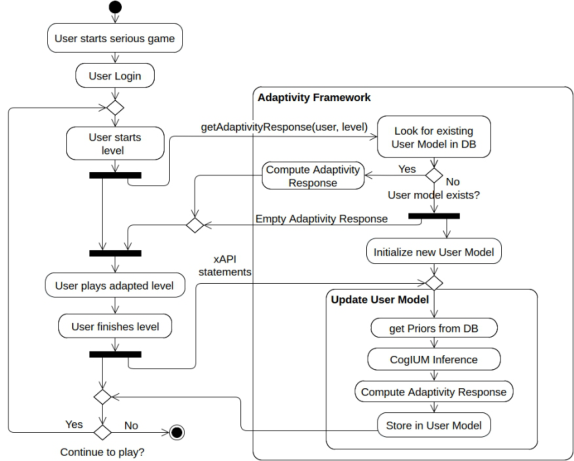
Usage Scenario. Figure 1 depicts the generalized usage scenario, which is explained in the following. After an initial log-in with a unique user identifier (e.g., e-mail address), the serious game requests adaptivity information (here called Adaptivity Response, AR) from an adaptivity framework (Streicher et al., 2021). If no user model has been stored yet, a new one is generated: in the HBM, the prior distributions are initialized to their average default val- ues. Next, the user starts and plays a level. For learning-relevant user actions, the serious game generates an xAPI statement. When a user finishes a level the corresponding xAPI data for that session is retrieved, as well as the earlier computed prior distributions. If an inference for that user has been computed before, those prior distributions are taken from the past inference. If not, the prior distributions will be uninformative and the newly available xAPI data is analyzed to obtain the observed variables. With the prior distributions and the observed variables, a new inference is performed. This means sampling the posterior distribution of all latent cognitive variables to obtain an approx- imation of the posterior distribution’s shape. Once the posterior distributions become available, a new adaptivity response is generated. This information is stored in the user model and provided to the serious game for its adaptive adjustments, e.g., select the next best learning pathway, or to dynamically adjust the difficulty settings to match the user’s performance.
Figure 1: Usage scenario and application setting.
Features based on xAPI Activities. The data basis of our approach is xAPI activity streams, formatted as actor-verb-activity triples. For example, when a user starts a new level, actor is a user identifier (e.g., e-mail or user name),
92 Streicher and Bauer
verb is (or semantically similar), and activity is a game level or context iden- tifier (e.g., URI). From this activities stream, we can extract the observable variables as input and infer the conditional probability densities of the latent cognitive variables. One of the main guidelines for our modeling concept approach has been interoperability and its generic character. This is, it should work with arbitrary educational serious games and with generally typical variables. Therefore, we chose to model the following five generic observable variables (Table 1):
Table 1. Generic observable variables for serious games.
Table available in the original PDF paper.
Variable Name Variable Type Domain task success k binary {0,1} level score s continuous [0, 1] level time t continuous R≥0 required attempts nrnd discrete [1, ..., maxrounds] detours ndet discrete [0, ...]
Task Success: Binary variable indicating whether the user completed a level successfully (given by xAPI’s result-field, sent at the end of each level).
Level Score: Normalized numerical value quantifying the user’s perfor- mance, computed by the serious game, sent via xAPI (similar to task success).
Level Time: Duration, i.e., elapsed time between starting and finishing a level (xAPI timestamp difference between start- and end-statement).
Required Attempts: Serious games often feature subtasks that the user can try multiple times (trial-and-error principle). The number of subtask attempts is extracted from the xAPI stream by comparing all xAPI statements belong- ing to such subtasks to the correct answers of the subtasks. For instance, in our application example users can undertake multiple attempts to answer multiple-choice questions about images or find hidden objects within an image.
Detours: Typically, users have to follow certain learning pathways, i.e., pre-defined sequences of interactions to reach learning objectives. Detours occur when users perform actions outside of the defined learning paths. One way to identify detours is by comparing the actual usage paths to reference paths.
User Model Posteriors as Adaptivity Responses: To control adaptations within serious games, the adaptivity framework needs to respond with con- trol variables, akin to a feedback control system. We call such a variable an Adaptivity Response (AR). An updated response can be computed after the model has updated its state using the latest observations. Our AR is a vec- tor containing normalized numeric variables including values on Assistance Level AC and Skill Level SC. Skill Level SC is represented as the latent cogni- tive variable prior knowledge. Thus, we output the corresponding posterior distribution’s mean as the predicted skill level. Assistance Level AC is modeled as the weighted linear sum of multiple latent cognitive variables’ posterior distributions’ mean values. For the computation of a user i’s assistance level,
Cognitive User Modeling for Adaptivity in Serious Games 93
we use the four cognitive variables cognitive load cli, intrinsic cognitive load icli, extrinsic cognitive load ecli, and prior knowledge ψi. Given inferred mean values for the cognitive variables and ground truth assistance levels ali, the weights α1, ..., α5 can be determined by minimizing the residual of an overdetermined equation system: [Equation or mathematical symbol available in the original paper PDF]
[Equation or mathematical symbol available in the original paper PDF]
[Equation or mathematical symbol available in the original paper PDF]
[Equation or mathematical symbol available in the original paper PDF]
[Equation or mathematical symbol available in the original paper PDF]
Equations and mathematical formulas are available in the original paper PDF.
[Equation or mathematical symbol available in the original paper PDF] cl1 icl1 ecl1 ψ1 1
al1 al2
α1 α2
Equations and mathematical formulas are available in the original paper PDF.
α1,...,α5
Equations and mathematical formulas are available in the original paper PDF.
... ... ... ... ... cln icln ecln ψn 1
... alm
... α5
Optimal weights α = (α1, ..., α5) can be found by solving the normal equation AT·A·α = AT·al, where A is the matrix of cognitive variables’ mean values and al denotes the vector of assistance levels. After finding optimal α1, ..., α5 that minimize the term above, we obtain the assistance score Xi as: Xi = α1 · cli + α2 · icli + α3 · ecli + α4 · ψi + α5
From the user study, we got 44 linear equations: each of the 22 users played two levels. For each of those levels, the tool calculated posterior mean val- ues for the cognitive variables cognitive load cl, intrinsic cognitive load icl, extrinsic cognitive load ecl, and prior knowledge ψ. Additionally, the user’s reported a perceived need for assistance in the self-assessment survey for each level. Performing linear compensation to retrieve optimal values α1, ..., α5 yields the following results (application specific): α1 = 0.45, α2 = 0.93, α3 = −0.93, α4 = −0.96, and α5 = 0.35. Therefore, the assistance level AC of user i is: Xi = 0.45 · cli + 0.93 · icli −0.93 · ecli −0.96 · ψi + 0.35
Equations and mathematical formulas are available in the original paper PDF.
0, if Xi < 0 Xi, if 0 ≤Xi ≤1 1, else [Equation or mathematical symbol available in the original paper PDF]
Although the values α1, ..., α5 have been calculated mathematically to min- imize the residual of the overdetermined equation system, they can also be interpreted with regards to their semantic meaning: α2 is the largest posi- tive α value and is the weight that corresponds to intrinsic cognitive load icl. Accordingly, intrinsic cognitive load has a positive linear influence on the assistance level: the higher the intrinsic complexity of a level, the higher the user’s need for assistance. α1 is the second-highest positive α value and determines the influence of total cognitive load cl on the user’s assistance level. Again, the relationship is positive and linear, meaning that higher val- ues for a user’s total cognitive load lead to a higher assistance level. Prior knowledge ψ has the largest negative linear influence on the assistance level. Accordingly, a higher level of prior knowledge results in a lower predicted assistance level. Extrinsic cognitive load ecl also has a negative linear on the assistance level. Hence, the weights and their meaning are in line with the expected semantic relationships: users with high prior knowledge will likely
94 Streicher and Bauer
not need any assistance. When a task is highly complex (high icl), users are more likely to need assistance. A highly complex task often causes users to experience a high total cognitive load. Therefore, it is to be expected that a high cognitive load also leads to a higher assistance level. Since the calculated weights α1, ..., α5 were derived from the user study data, future work needs to validate them.
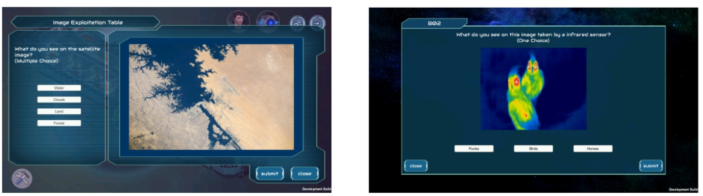
Figure 2: Screenshots of an image exploitation serious game and its typical tasks.
Application Setting: Our application platform is a serious game from the domain of professional image interpretation for reconnaissance. This includes the identification and analysis of structures and objects by experts (image interpreters) according to a given task. Sound and correct image inter- pretation can be a challenging task, it needs training and experience, in particular for non-intuitive sensor data such as radar images. The web-based game is turn-based and uses a genre combination of 4X-strategy and adven- ture. Simplified examples of image exploitation questions are displayed in Figure 2.
EVALUATION OF THE APPLIED COGNITIVE MODELING CONCEPT The methodology involves combining data from participants’ interactions with the serious game, applying the cognitive modeling tool to compute inferences, and comparing those inferences to participants’ self-assessments.
Study Design: To obtain real-world data on non-directly measurable latent variables within a realistic context, the only viable approach is to rely on user self-assessments. Consequently, a questionnaire is employed to gather users’ self-assessments for the aforementioned variables. To assess cognitive load, we integrated the NASA TLX questionnaire. Regarding the variables motivation and prior knowledge, the questionnaire directly asked the user for a 7-point rating. The study also investigated the users’ responses to the model’s inferences about them, with a specific emphasis on the accuracy of their ratings. The users were asked to rate visualizations of these inferences using a 5-point Likert scale. We visualized the inferred mean values for the latent cognitive variables motivation, prior knowledge, cognitive load, and free working memory capacity (inverse of cognitive load). To ensure a valid comparison, the study design incorporates a control group. The experimen- tal group was presented with visualizations of the computed inference data,
Cognitive User Modeling for Adaptivity in Serious Games 95
while the control group was shown visualizations of randomly sampled but still plausible values.
Two hypotheses were postulated: (1) There is a correlation between the inferred values of the model and the users’ self-assessment of cognitive load, motivation, and prior knowledge. (2) Users from the experimental group rate their inference results as more accurate than users from the control group.
Execution: We conducted a guided online user study where participants were required to alternate between playing the serious game and answering self-assessment questions. The choice of participants was not limited to image interpreters; instead, anyone could participate, including non-experts. We modified the serious game so that simple image analysis tasks and questions were posed, which could be understood and answered by laymen. To address technical inquiries, a guided format was selected for the study. For it was carried out during the COVID-19 pandemic, an online format ensured the safety of all participants.
The procedure for a study run was as follows: (1) the users received a brief introduction to the user study’s topic and our research project. (2) Next, they were asked to start the game and play the first level. (3) Once they com- pleted the level, they were asked to fill out the self-assessment questionnaire concerning level one. (4) After a signal that the questionnaire has been com- pleted, the users were asked to play level two, and (5) after that to fill out the same questionnaire again (now regarding level two). About 30 minutes after the study run (when the computation has been done), the users were asked to rate the results on the computed variables on a 5-point Likert scale ranging from to “very accurate” to “very inaccurate”.
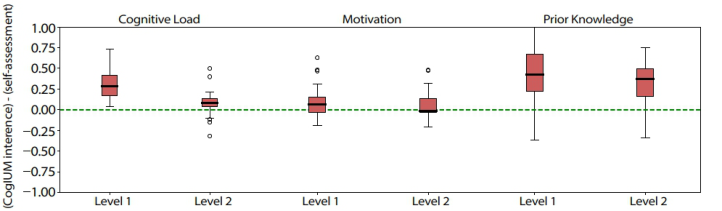
Figure 3: Differences between prediction and self-assessment for cognitive load, motivation and prior knowledge. Values > 0 mean the prediction was higher than self-assessment.
Results & Discussion: Regarding the 1st level, our model’s predicted cog- nitive load is on average higher than the users’ self-assessment. There is a weak to moderate correlation (Pearson r = 0.382) between inferences and self-assessments. For the 2nd level, the cognitive load inferences and the users’ self-assessments are congruent with r = 0.516 and the p-value below α = 0.05, hence a significant moderate correlation. The results indicate the model’s capability to infer a user’s cognitive load solely from tracking data. A similar result has been reported by (Jovanovi´c et al., 2019). One possible
96 Streicher and Bauer
explanation for the weaker correlation in the 1st level is a cold-start prob- lem: users do not know what to expect and are unfamiliar with the game’s interface.
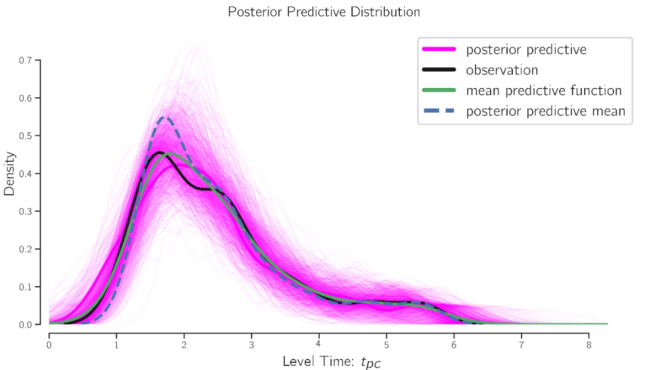
Figure 4: Posterior predictive check for the variable time. Observations are displayed as a kernel density estimate.
For the second hypothesis, we compared the assessments of users in both the experimental and control group. The answers were distributed within a similar range (1-5), indicating no significant difference between the two groups in terms of their assessments (experimental group: 2.82, control group 3.36). The results confirmed a correlation between the system’s inferences and users’ self-assessments for the variable cognitive load. However, no signifi- cant correlation could be determined for the variables motivation and prior knowledge.
To investigate our model’s expressiveness, we verified the model’s ability to capture the structure of the observed data. As shown in Figure 4, the model is able to fit the observable variable level time’s distribution sufficiently well. This is also the case for the four other observable variables. As a result, we conclude that the model’s mathematical structure is adequate in the sense that it enables a reasonably good fitting of the observed data. The model was able to reproduce the key data features from the user study data for all five observable variables task success, score, level time, required attempts, and detours. Accurate posterior predictive mean distributions were found for level time and level score.
CONCLUSION & OUTLOOK The contribution of this article is the concept of how to apply cognitive user modeling for adaptivity in serious games. We investigate how to compute quantitative measures of user performance to control adaptive responses. We follow a flexible cognitive user modeling approach which is based on Hierar- chical Bayesian Models (HBM) and which has a generic set of serious game
Cognitive User Modeling for Adaptivity in Serious Games 97
features to be generally applicable. The concept for these features is oriented at available data from the established e-learning specification Experience API (xAPI). The features include variables on task success, result scores, duration or required attempts. A complete processing chain that takes user interac- tion data (xAPI) as input and outputs adaptivity scores was implemented. A user study (n = 22) was conducted to evaluate the implemented system in a serious game. The results indicate a correlation between the cognitive load variables calculated by the system and the cognitive load variables assessed by the participants themselves. The theoretical implications of the article lie in advancing the theoretical understanding of cognitive user modeling for adaptivity, while the practical implications revolve around the development of adaptable tools, cross-domain adaptivity, improved learning outcomes, and evidence-based instructional design practices.
Additional research opportunities are in assessing the long-term learning effects, specifically investigating the evidence of sustained learning success. Further investigation of the model’s structure and limitations are indicated, in particular regarding prediction of prior knowledge and motivation. Future work could also incorporate more objectively measurable variables, such as data obtained from eye-tracking or physiological sensors.
REFERENCES
Chown, E., 2004. Cognitive Modeling, in: Tucker, A. (Ed.), Computer Science Handbook. CRC Press. Conati, C., Lallé, S., Rahman, M. A., Toker, D., 2020. Comparing and Combin-
ing Interaction Data and Eye-Tracking Data for the Real-Time Prediction of User Cognitive Abilities in Visualization Tasks. ACM Trans. Interact. Intell. Syst. 10. Conati, C., MacLaren, H., 2009. Empirically building and evaluating a probabilistic model of user affect. User Modeling and User-Adapted Interaction. Dörner, R., Göbel, S., Effelsberg, W., Wiemeyer, J., 2016. Serious Games -
Foundations, Concepts and Practice. Springer International Publishing, Cham. Hallifax, S., Serna, A., Marty, J.-C., Lavoué, É., 2019. Adaptive Gamification in Education: A Literature Review of Current Trends and Developments, in: Scheffel, M., Broisin, J., Pammer-Schindler, V., Ioannou, A., Schneider, J. (Eds.), Transform- ing Learning with Meaningful Technologies, Lecture Notes in Computer Science. Springer International Publishing, Cham, pp. 294–307. https://doi.org/10/ggj83t Heinath, M., Dzaack, J., Wiesner, A., Urbas, L., 2007. Applications for Cognitive
User Modeling, in: Conati, C., McCoy, K., Paliouras, G. (Eds.), User Mod- eling 2007, Lecture Notes in Computer Science. Springer, Berlin, Heidelberg, pp. 127–136. Jovanovi´c, J., Gaševi´c, D., Pardo, A., Dawson, S., Whitelock-Wainwright, A., 2019.
Introducing Meaning to Clicks: Towards Traced-Measures of Self-Efficacy and Cognitive Load, in: Proceedings of the 9th International Conference on Learning Analytics & Knowledge, LAK19. Association for Computing Machinery. Kotseruba, I., Tsotsos, J. K., 2018. 40 years of cognitive architectures: core cognitive abilities and practical applications. Artificial Intelligence Review. Seyderhelm, A. J. A., Blackmore, K. L., Nesbitt, K., 2019. Towards Cognitive Adap-
tive Serious Games: A Conceptual Framework, in: van der Spek, E., Göbel, S., Do, E. Y.-L., Clua, E., Baalsrud Hauge, J. (Eds.), Entertainment Computing and Serious Games, Lecture Notes in Computer Science. Springer, Cham, pp. 331–338.
98 Streicher and Bauer
Shute, V., Zapata-Rivera, D., 2012. Adaptive Educational Systems. Adaptive technologies for training and education 7, 1–35. Streicher, A., Aydinbas, M., 2022. Bayesian Cognitive State Modeling for Adap-
tive Serious Games, in: Sottilare, R. A., Schwarz, J. (Eds.), Adaptive Instructional Systems, Lecture Notes in Computer Science. Springer, Cham, pp. 14–25. Streicher, A., Roller, W., 2017. Interoperable Adaptivity and Learning Analytics for Serious Games in Image Interpretation, in: Lavoué É., H., D., K., V., J., B., M., P.-S. (Eds.), Data Driven Approaches in Digital Education: 12th European Con- ference on Technology Enhanced Learning, EC-TEL 2017, Proceedings. Springer International Publishing, Tallinn, Estonia, pp. 598–601. Streicher, A., Schönbein, R., Pickl, S. W., 2021. A General Framework and Con-
trol Theoretic Approach for Adaptive Interactive Learning Environments, in: Kotsireas, I. S., Nagurney, A., Pardalos, P. M. (Eds.), Dynamics of Disasters: Algorithmic Approaches and Applications. Springer International Publishing, Cham. Tadlaoui, M. A., Carvalho, R. N., Khaldi, M., 2018. A learner model based on multi-entity Bayesian networks and artificial intelligence in adaptive hypermedia educational systems. Int. Journal of Advanced Computer Research 8, 148–160. Tarpin-Bernard, F., Habieb-Mammar, H., 2005. Modeling Elementary Cognitive
Abilities for Adaptive Hypermedia Presentation. User Model User-Adap Inter 15, 459–495. van Rijn, H., Johnson, A., Taatgen, N., 2011. Cognitive user modeling, in: Proctor, R. W., Vu, K.-P. (Eds.), Handbook of Human Factors in Web Design. CRC Press, Boca Raton, FL, USA, pp. 527–542. Woolf, B. P., 2009. Building Intelligent Interactive Tutors. Morgan Kaufmann.
LISTED IN THE AHFE DIGITAL BOOKSTORE CATALOGUE
Explore the complete digital volume
Intelligent Human Systems Integration (IHSI 2024): Integrating People and Intelligent Systems
Read this individual research paper free through the original publisher, or explore the full digital proceedings book.
ISBN 978-1-958651-95-7
Explore this ISBN in the AHFE Bookstore ↗Listed in the July 2026 bookstore catalogue; search by ISBN to confirm current availability · Digital book purchase optional