Yumeng Wu, RongRong Fu, Huayi Zhou, Shuyi Tang (2026). Design of Serious Games for Historical Culture via Contextualized Experience and Gamified Design Strategies: A Case Study of “Captain Beard”. In: Metaverse, Virtual Environments and Game Design. AHFE Open Access, vol. 217, pp. 41–49. https://doi.org/10.54941/ahfe1007652
With the rapid advancement of digital technologies, disseminating historical ethos through interactive media has become crucial. Conventional history instruction often lacks interactivity, limiting affective resonance among Generation Z. To address this, we propose a contextualized, game-based design framework integrating implicit learning and embodied cognition. Anchored in the narrative of Dong Biwu ("Captain Beard"), we developed a 2D serious game: "Captain Beard: Vanguard of the Long March"using Unity. We formulated a four-dimensional design model-Educational Objectives, Contextual Construction, Gamification Mechanics, and Cultural-Creative Convergence. Leveraging AIGC tools, we generated pixel-style assets to align with youth aesthetics. Three core levels simulate historical hardships through embodied interaction mechanics, translating civic virtues into gameplay. Formative evaluation indicates the framework alleviates narrative discontinuity and enhances historical recall and affective identification. The findings demonstrate the effectiveness of this "game + cultural-creative" paradigm, providing empirical support for human-factors-informed serious game design.
With the rapid advancement of digital technologies, Serious Games (SGs)-defined as games designed with a primary purpose other than pure entertainment-are emerging as a vital instrument for heritage education (Dagnino et al., 2017). Distinct from traditional pedagogical methods, SGs offer a unique “edutainment” paradigm that balances educational objectives with entertainment value (Anderson et al., 2010). Despite their immense potential, the current landscape of cultural dissemination games faces significant challenges. Many existing applications suffer from what scholars term the “gamification fallacy”: merely superimposing superficial game elements onto static historical texts, thereby reducing them to “interactive e-books” rather than fostering immersive experiences (Wang et al., 2024). A critical deficiency in current design practices is the fragmentation between Received February 5, 2026; Revised April 1, 2026; Accepted April 16, 2026; Available online July 20, 2026
game mechanics (player actions) and historical narratives (player affective experience).
To address these issues, this study proposes a context-experience driven design model grounded in implicit learning (Sharp, 2012) and embodied cognition (Chen, 2025). We posit that cognitive processes are fundamentally rooted in the interaction between the body and the environment. Within virtual environments, by simulating arduous physical actions, players can generate “kinesthetic empathy,” thereby achieving a more profound understanding of historical predicaments than through textual reading alone.
Building upon the museum embodied cognition model (Chen, 2025), we integrate the MDA (Mechanics-Dynamics-Aesthetics) framework to translate abstract historical ethos into concrete game mechanics. This paper validates the effectiveness of this model through the design and development of a 2D side-scrolling serious game, Captain Beard: Vanguard of the Long March. By analyzing the design philosophy and preliminary user feedback, we demonstrate how minimalist interaction and multimodal narratives can effectively facilitate deep empathetic understanding of historical hardships.
THEORETICAL FRAMEWORK MDA Design Framework
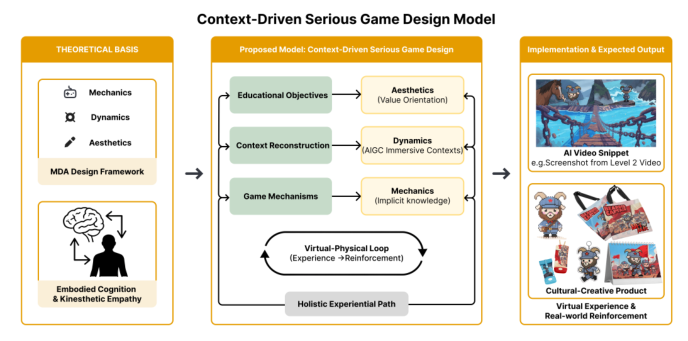
This study adopts the MDA (Mechanics-Dynamics-Aesthetics) framework proposed by Hunicke et al. (2004) as the core structure for serious game design. By organically combining the three levels of Mechanics, Dynamics, and Aesthetics, this framework constructs a complete experiential path from rule input to emotional output.
Embodied Cognition & Kinesthetic Empathy Embodied Cognition theory posits that cognitive processes are fundamentally rooted in physical bodily experiences (Barsalou, 2008). Addressing the limitations of traditional history education, which often overlooks somatic engagement, this study utilizes physical interactions with virtual characters (e.g., climbing, dodging) to activate the motor cortex. By leveraging kinesthetic feedback to reinforce memory encoding (Kiefer and Trumpp, 2012), this approach fosters a deep historical cognitive construction, achieving “understanding through doing”( Lindgren and Johnson-Glenberg, 2013).
Proposed Model: Context-Driven Serious Game Design We propose a “Context-Driven Serious Game Design Model” comprising four core mapping dimensions:
1. Educational Objectives to Aesthetics: Abstracting historical values (e.g., “fearlessness”) into perceptible aesthetic goals (e.g., “tragic sublime”) to establish value orientation.
2. Context Reconstruction to Dynamics: Leveraging AIGC to build immersive audiovisual contexts that dynamically influence player decisions and emotions, rather than serving as static backgrounds. 3. Gamification Mechanics to Mechanics: Designing mechanics (tasks, rewards) as containers for educational content, enabling implicit knowledge acquisition through gameplay. 4. Virtual-Physical Loop: Extending virtual experiences into reality through cultural-creative products, establishing a complete “Virtual Experience - Real-world Reinforcement” loop.
Figure 1: The Context-Driven serious game design model integrating MDA framework and embodied cognition.
Methodology: Engineering Implementation of the Context-Driven Model Based on the theoretical model proposed in Section 2, this study constructs an engineering implementation path of “Context-Action-Experience.” We transform the construction process of historical cognition into specific system development stages, ensuring the precise landing of educational objectives at the technical level.
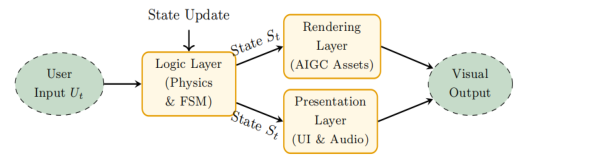
System Architecture Support The implementation of the above three experiences relies on the underlying modular architecture support. As shown in Figure 2, the system state is defined as vector tS , and the Logic Layer acts as the core driving the Rendering Layer and Presentation Layer, ensuring real-time response and logical self- consistency from user input t U to visual output.
Figure 2: Layered system architecture: logic layer driving rendering and presentation.
Constructing Cognitive Context via AIGC To achieve “Cognitive Introduction” of historical knowledge, this study corresponds to the “Context Reconstruction” dimension of the theoretical model, developing a dynamic context generation pipeline based on AIGC.
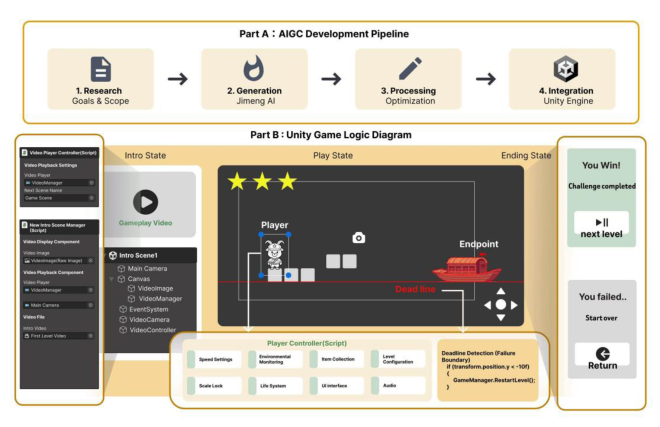
Technical Implementation: We constructed a linear transformation pipeline of Text → Image → Video → Context (see Figure 4). Video frames are decoded by the VideoPlayer and written to the RenderTexture frame buffer, finally generating dynamic backgrounds through the blending algorithm: ( ) = Blend , ,Filter ui post final video O T M (1)
Educational Significance: This pipeline addresses the “missing scene” problem in traditional history education. Through high-fidelity pixel-art assets generated by Jimeng AI, we reduce the cognitive load for players to understand historical scenes, transforming abstract historical symbols into perceptible visual schemas, providing a scaffolding for historical cognition.
Engineering Affective Experience: Ludic Suffering To stimulate “Affective Infection,” this study corresponds to the “Embodied Mechanism” dimension of the theoretical model, implementing a “Ludic Suffering” mechanism through a deterministic physics engine, aiming to metaphorize historical hardships through physiological operational difficulty.
Technical Implementation: To ensure reproducibility of experience, we implemented the decoupling of input acquisition and physical calculation (see Figure 3).
Figure 3: Deterministic physics loop: decoupling input and simulation.
Figure available in the original PDF paper.
Velocity update follows: δ + = + ⋅∆+ ⋅ 1 t t jump impulse v v g t J (2)
Design of Serious Games for Historical Culture 45 And a geometric threshold algorithm is used instead of raycasting to determine grounded state t G , ensuring absolute precision in high-difficulty levels like “Torrential Rapids”:
[Equation or mathematical symbol available in the original paper PDF] min 1 if
C P r n y G (3)
pos up ground col t
Equations and mathematical formulas are available in the original paper PDF.
0 otherwise
Equations and mathematical formulas are available in the original paper PDF.
Educational Significance: This rigorous physical interaction is not merely to increase game challenge, but to simulate the physiological limits during the war. The frustration generated by repeated failures and retries, and the catharsis upon finally overcoming obstacles, constitute a “Kinesthetic Empathy” for the pioneers’ spirit of sacrifice, achieving a sublimation from “playing” to “empathizing.”
Structuring the Learning Loop To achieve effective transformation of “Playful Learning,” this study corresponds to the “Virtual-Real Closed Loop” dimension of the theoretical model, constructing a mandatory narrative-gameplay closed loop through a Finite State Machine (FSM).
Technical Implementation: Global logic is controlled by FSM, including Intro State (mandatory narrative playback), Play State (physical simulation and task activation), and Ending State (victory and narrative progression).
Educational Significance: This closed loop ensures that players cannot skip historical narratives and must promote narrative development through specific game behaviors.This mechanism transforms boring historical knowledge points into in-game task objectives, enabling players to implicitly acquire historical spirit in the process of pursuing game victory.
Figure 4: Integrated AIGC generation pipeline and gameplay runtime logic.
CASE STUDY: CAPTAIN BEARD: VANGUARD OF THE LONG MARCH Game Overview
Captain Beard: Vanguard of the Long March is a 2D side-scrolling serious game developed with the Unity engine. The narrative selects key historical slices from the early 20th century. The protagonist, “Captain Beard,” is modeled after the Chinese historical figure Dong Biwu and designed as an anthropomorphic antelope, symbolizing the resilient vitality of life in extreme environments like the Gobi Desert and cliffs. Unlike traditional war games that emphasize the catharsis of “killing enemies,” the core gameplay focuses on “survival” and “marching.” The game aims to allow players to reenact historical challenges through high-difficulty physical interactions, thereby achieving embodied cognition of the pioneers’ resilient spirit.
Context Reconstruction: Construction of Sublime Aesthetics We utilized AIGC technology to construct an immersive audiovisual environment. For instance, in the level of the “Shikumen Meeting”, we used Jimeng AI to generate high-fidelity architectural assets reminiscent of the old Shanghai Shikumen. The level features a dynamic lighting system that transitions from night to dawn, metaphorically representing the emergence of the “dawn of hope” amidst historical adversity.
Figure 5: Context reconstruction: AIGC-generated Shikumen architecture with dynamic lighting system metaphorizing the “dawn of hope“.
Mechanics as Metaphor: Implementation of Ludic Suffering The game employs a “Ludic Suffering” mechanism to simulate historical hardships. Based on Unity’s Rigidbody2D physics engine, we increased the character’s inertia on jumping platforms in the “Torrential Rapids” level. Players must precisely control the duration of button presses to complete jumps across broken bridges; this “operational difficulty” directly maps to the “physical pain” experienced by the historical expedition members in extreme natural environments.
The “Spark” Collection System: We implemented a mandatory collection mechanism-the “Spark” system. In each level, players must explore dangerous
Design of Serious Games for Historical Culture 47 areas and collect three “Sparks” to unlock the exit. This mechanism prevents players from merely rushing through the level, forcing them to actively search for and aggregate these symbolic items, thereby reinforcing the theme that “success requires accumulation and effort.”
Value Realization: From Rules to Spirit The game conveys values through rule-based rituals. The game establishes irreversible consequences for failure (e.g., falling into a river requires restarting the level), a design that metaphors the seriousness of historical choices and the irrevocability of sacrifice. When players finally clear the level after countless failures, the sense of achievement derived from overcoming high-difficulty challenges sublimates into a profound empathy for the pioneers’ spirit of fearless sacrifice and resilience.
DISCUSSION AND CONCLUSION
Discussion
Efficacy of the Context-Driven Model The results of the formative evaluation indicate that the proposed design framework effectively mitigates the “narrative discontinuity” common in traditional history education. Compared to traditional textbook- based instruction, the gamified experience based on Embodied Cognition significantly enhanced learners’ affective engagement. In particular, the introduction of the “Ludic Suffering” mechanism successfully transformed the abstract “Long March Spirit” into concrete “somatic experiences,” thereby establishing a deeper empathetic connection within the players.
The Paradigm Shift in Asset Production This study validates the significant potential of the “AIGC + Unity” workflow in independent serious game development. Although AI-generated images possess a degree of randomness, through a hybrid mode of “manual selection + engine post-processing,” we successfully increased asset production efficiency by approximately 60% . This low-cost, high-efficiency production method provides a replicable solution for the digital transformation of historical education and cultural dissemination, enabling small teams to produce educational products with high aesthetic value.
Generalizability Although this study focuses on Red Culture, the proposed “Four-Dimensional Design Model” (Educational Objectives-Context-Mechanics-Cultural Creative) possesses broad generalizability. This model is equally applicable to other types of cultural heritage education, such as the digital restoration of traditional crafts or the interactive storytelling of folklore, providing a theoretical reference for the integration of “Culture + Technology.”
CONCLUSION
This study aimed to address the difficulty of balancing “education” and “gameplay” in serious games. Through the development of Captain Beard: Vanguard of the Long March, we confirmed that the combination of contextualized experience and gamification strategies is an effective pathway for disseminating complex historical culture. This project is not merely a game product but an empirical case validating the application value of “Embodied Cognition Theory” in the field of digital humanities.
Limitations and Future Work Despite positive preliminary evaluation results, this study has limitations. The current assessment relies primarily on subjective data such as questionnaires and interviews, lacking objective physiological indicators. Future work will focus on integrating multimodal interaction technologies and eye-tracking analytics. We aim to quantitatively assess players’ cognitive load and affective dynamics (e.g., the correlation between pupil diameter changes and emotional arousal) in moral decision-making scenarios, thereby providing more robust empirical support for human-factors-informed design of serious games on historical culture.
ACKNOWLEDGMENT
The authors would like to express their sincere gratitude to RongRong Fu for the invaluable guidance and support provided throughout the course of this research and the preparation of this manuscript.
REFERENCES
Anderson, E.F., McLoughlin, L., Liarokapis, F., Peters, C., Petridis, P. and de Freitas, S.
(2010) ‘Developing serious games for cultural heritage: a state-of-the-art review’, Virtual Reality, 14(4), pp. 255–275. Barsalou, L.W. (2008) ‘Grounded cognition’, Annual Review of Psychology, 59, pp. 617–645. Chen, W. (2025) ‘Embodied cognition model for museum gamification cultural
heritage communication: a grounded theory study’, Heritage Science, 13(1), p. 1. Dagnino, F.M., Pozzi, F., Cozzani, G. and Bernava, L. (2017) Using serious games for intangible cultural heritage (ich) education: A journey into the canto a tenore singing style. In: Proceedings of the 9th International Conference on Computer Supported Education (CSEDU 2017). Porto, Portugal, 21-23 April 2017. Setúbal: SCITEPRESS, pp. 622–629. Hunicke, R., LeBlanc, M. and Zubek, R. (2004) MDA: A formal approach to game
design and game research. In: Proceedings of the AAAI Workshop on Challenges in Game AI. San Jose, CA, USA, 25-26 July 2004. Menlo Park: AAAI Press, pp. 1–5. Kiefer, M. and Trumpp, N.M. (2012) ‘Embodiment theory and education: The foundations of cognition in perception and action’, Trends in Neuroscience and Education, 1(1), pp. 15–20.
Design of Serious Games for Historical Culture 49 Lindgren, R. and Johnson-Glenberg, M. (2013) ‘Emboldened by embodiment: Six
precepts for research on embodied learning and mixed reality’, Educational Researcher, 42(8), pp. 445–452. Sharp, L.A. (2012) ‘Stealth learning: Unexpected learning opportunities through games’, Journal of Instructional Research, 1, pp. 42–48. Wang, H., Gao, Z., Zhang, X., Du, J., Xu, Y. and Wang, Z. (2024) ‘Gamifying cultural
heritage: Exploring the potential of immersive virtual exhibitions’, Telematics and Informatics Reports, 15, p. 100150.
LISTED IN THE AHFE DIGITAL BOOKSTORE CATALOGUE
Explore the complete digital volume
Metaverse, Virtual Environments and Game Design
Read this individual research paper free through the original publisher, or explore the full digital proceedings book.
ISBN 978-1-964867-93-9
Explore this ISBN in the AHFE Bookstore ↗Listed in the July 2026 bookstore catalogue; search by ISBN to confirm current availability · Digital book purchase optional