Xun Chen, Yuxin Jiang, Xu Li (2024). Design of waste plastic recycling facilities based on campus scenarios. In: Intelligent Human Systems Integration (IHSI 2024): Integrating People and Intelligent Systems. AHFE Open Access, vol. 119, pp. 813–822. https://doi.org/10.54941/ahfe1004546
According to statistics from the China National Resources Recycling Association, only 31% of the approximately 62 million tons of waste plastic produced in China in 2021 was recycled. The reason is that the composition of domestic waste is complex, and the compatibility between plastics requires waste plastics to be classified before recycling. Relying only on waste pickers and staff at garbage drop-off points for sorting is inefficient and costly. The sorting problem in the recycling process needs to be solved urgently. Establish a more reasonable recycling system to increase the recycling rate of waste plastics and alleviate plastic pollution. First, in the pre-survey desktop research, reports released by authoritative organizations such as the China National Resources Recycling Association were studied, and 12 documents were selected for review based on timeliness and content relevance. From the data published in the documents, it is known that the proportion of waste plastics in campus domestic waste is higher than that of municipal domestic waste. The campus has more ample space and public facilities can be deployed flexibly. Therefore, the waste plastic recycling facilities in the campus scene were determined as the research object. The research will be conducted in two parts based on the impact of internal process factors and external situational factors on recycling and sorting behavior. Internal process factors are first based on stratified random sampling in the probability sampling method to sample different user groups on campus to obtain 20 samples, and record their behavioral processes through implicit observation. To prevent observer bias, standardized open-ended and in-depth interviews were added. Thus, the overall basic functions and the functional list of each behavioral stage required in the plastic recycling classification process are determined and described in the form of abstraction, quantification, and object-object structure. Then the KJ method is used to classify functions, and four types are summarized: physical function, cognitive function, symbolic function and aesthetic function. Research on external situational factors attempts to identify users’ willingness and operability to sort plastic waste in specific scenarios. Through focus groups and semi-structured interviews, we studied whether plastic sorting and recycling behavior habits can be formed and maintained from the perspectives of cognitive attitudes, facility convenience, and the correlation mechanism of short-term incentives and long-term incentives. Finally, several program ideas are proposed based on internal and external factors, and a conceptual program is selected from the perspectives of technology, economy, and implementation conditions. In the process of concretizing the plan, experiments were conducted on various permutations and combinations of each functional module. In the arrangement, there are four independent variables: the number of components, the unit arrangement, the geometric forming method and the size. Use this as a clue to produce the final product design. This study uses the above research to explore possible waste plastic sorting and recycling methods to improve the current low recycling rate of waste plastics. It’s also hoped that this design can provide ideas for other sustainable designs.
Harmless recycling has become a good way to deal with waste plastics that are difficult to degrade naturally. According to data released by authoritative organizations, in 2021, China produced about 62 million tons of waste plas- tics, of which only about 31% was recycled, and there is still a lot of room for improvement. The parts that are not recycled were mainly disposed of through low-cost but environmentally harmful methods such as incineration and landfilling.
At present, China’s plastic recycling industry is characterized by complex front-end processing links of waste plastic recycling, high manufacturing costs of recycled plastics, and low profit margins of finished products. The main reason for this situation is that the front-end recycling and sorting pro- cess is not systematic and the development is not standardized. At present, it is mainly carried out and collected by workers set up at garbage collection points, as well as scavengers. This method is inefficient and costly, and it is difficult to further improve the recycling efficiency of waste plastics.
DESKTOP RESEARCH The industry reports released by authoritative organizations such as the China Plastic Recycling Association of China National Resources Recycling Association was studied, and calculations and analyzes were conducted based on the data released by the National Bureau of Statistics of China. Analysis of data on China’s primary form of plastics, plastic product production, waste plastic production, and waste plastic recycling volume in recent years found that in the four years from 2018 to 2021, China’s waste plastic recycling rate fluctuated around 30%, which is at a relatively low level.
In view of the low recycling rate of waste plastics, a literature survey was conducted focusing on the current situation of China’s waste plastics recycling industry and waste plastics identification technology. During the literature survey, it was found that the current problems faced by the waste plastic recycling industry include but are not limited to: there is a large demand for plastic products, but no suitable alternative materials have been found; there are relatively few plastic recycling companies and the scale is relatively small… The recycling and regeneration process can be divided into two parts: the collection and sorting link completed in the waste plastic discarding scene and the waste plastic regeneration link. At present, waste plastics in China are generally collected and sorted manually before recy- cling. The sorting process mainly involves the separation of waste plastics and other domestic waste and the classification of different types of waste plastics. The operation is relatively simple and highly replaceable. Therefore, starting from the sorting and collection process, we try to conduct design research on waste plastic recycling facilities.
In addition, according to the data published in the literature, plastic waste accounts for about 20% of domestic waste in economically developed cities. In the campus scenario, this proportion is around 30%. The campus space is more open than the city, giving public facilities more flexible deployment space, and a higher proportion of waste plastic waste can make waste plastic recycling facilities better pilot application. Therefore, this paper will study the function organization and modeling design of waste plastic recycling facilities in the campus scenario.
INTERNAL PROCESS ANALYSIS - FUNCTIONAL REQUIREMENTS SORTING BASED ON KJ METHOD The KJ method is a method of sorting out relevant information about unknown problems and using their inherent relationships to sort out ideas
Design of Waste Plastic Recycling Facilities Based on Campus Scenarios 815
from complex phenomena and find solutions. The KJ method is now used to define and organize the functions of waste plastic recycling facilities in campus scenario.
First, four buildings in the campus dormitory area were selected as sam- ple sources based on stratified random sampling in the probability sampling method. Based on the criterion of whether they were carrying waste to be dis- carded, 5 individuals who walked out of the building were randomly selected as samples, and a total of 20 samples were obtained. Follow and covertly observe the selected individual and decompose the discarding action. In order to prevent the observer’s bias, after obtaining the consent of the observed subjects, standardized open interviews were conducted on the causes, timing, discarding actions and other behaviors of their waste disposal behaviors to deepen their understanding of their behaviors. Sort out the covert observation and interview results to obtain the behavior process of users when discarding waste.
Table 1. Waste disposal behavior process analysis.
Table available in the original PDF paper.
Leave
Behavior process
Carrying waste
Items carried
Throw away waste
Open the dormitory door
Determine the discard location
Make sure it is securely placed
Go to garbage collection points
Observed behavior
Throw in (empty trash can)
Travel to other destinations
Carrying back- packs and bags
Go as normal According to garbage classification regulations
One-hand carry (Smaller bags of household waste)
Push the door with one hand (one- hand carry)
Observe whether it is shaking (Place behavior) Return the same way
Holding other items
Place (full trash can)
Holding in both hands (Medium- sized carton)
Observe whether it falls or shifts (dropping behavior)
Push the door with your torso (Holding in both hands and drag)
Walk carefully (When the waste carried affects road observation)
Empty bottles, cartons, foam boxes, etc. are stacked separately.
Throw away Leave directly
No items brought
Drag (Large carton)
Push the door with your feet and knees
Staff at the drop-off point intervene
According to covert observation and interview results, it was found that the type and size of waste directly determines the user’s discarding behav- ior. At the same time, the discarding process may require a small learning cost - when users discard wastes with recycling value such as cartons and empty bottles, the drop-off point staff will usually intervene and tell them to drop the relevant items to a dedicated stacking point. Most users’ waste dis- posal behavior is an additional behavior of going out (going to class, dining), and only a few users will make a special trip from the building to discard waste. In addition, it was noted through observation that when the waste drop-off point is not on the same route as the user’s other destinations, a moderate detour is acceptable. Generally speaking, the behavior process of waste disposal is a relatively mechanical process that requires little mental thinking.
By splitting and sorting out the behavior process and analyzing the behav- ioral actions at each stage, the overall basic function of the plastic recycling facility was determined - waste plastic classification and recycling. And the
functions of each stage are abstracted, quantitative, and the form of the verb- object structure is defined, and 11 stage functions are obtained by providing inlets, pretreating waste plastics, identifying plastics, classifying plastics, stor- ing plastics, providing outlets, transporting plastics, providing guidance, conveying environmental protection information, integrating into the use environment, and conforming to user aesthetics, and summarizing them as second-level demand indicators. Then, based on the results of behavior obser- vations and interviews, we diverged our thinking around the definition of each function, and refined the goals that each second-level demand indicator needs to achieve as the third-level demand indicator. Obtained 31 demand indicators such as the safety of the waste plastic pretreatment process and the identification of plastic types covering a wide range of plastic types. At the same time, the KJ method was used to further summarize four first-level demand indicators for the defined functions: physical function, cognitive function, symbolic function and aesthetic function. From this, a product function list of waste plastic recycling facilities in the campus scenario is established.
Table 2. Function list of waste plastic recycling facilities in campus scenario.
Table available in the original PDF paper.
Third-level demand indicators
First-level demand indicators
Second-level demand indicators Physical function Providing inlets 1. Easy to open; 2. Convenient to put in; 3. Safe in the putting process;
Pretreating waste plastics
1. The pretreatment process is safe; 2. The output is usable; 3. The output is easy to store; Identifying plastics 1. Low technology cost; 2. Low application threshold; 3. Wide coverage of plastic types; 4. Efficient identification; 5. No negative impact;
Classifying plastics Effectively classify according to identification results; Storing plastics 1. Sufficient space; 2. Easy to recycle;
Providing outlets 1. The outlet is easy to open; 2. Recycling is convenient; 3. The recycling process is safe; Transporting plastics 1. Safe transportation process; 2. Efficient transportation; 3. Reduce the impact on traffic;
Providing guidance 1. Simple and easy to understand; 2. Reasonable scale; 3. Audio-visual combination;
Cognitive function
1. Rational shape; 2. Soft color matching; 3. Use of clean energy;
Symbolic function Conveying environmental protection information Integrating into the use environment
The shape conforms to the public’s perception of public facilities;
Aesthetic function Conforming to user aesthetics
1. Reasonable size; 2. Unobtrusive shape and color matching; 3. No noise impact; 4. Beautiful shape and color matching.
Design of Waste Plastic Recycling Facilities Based on Campus Scenarios 817
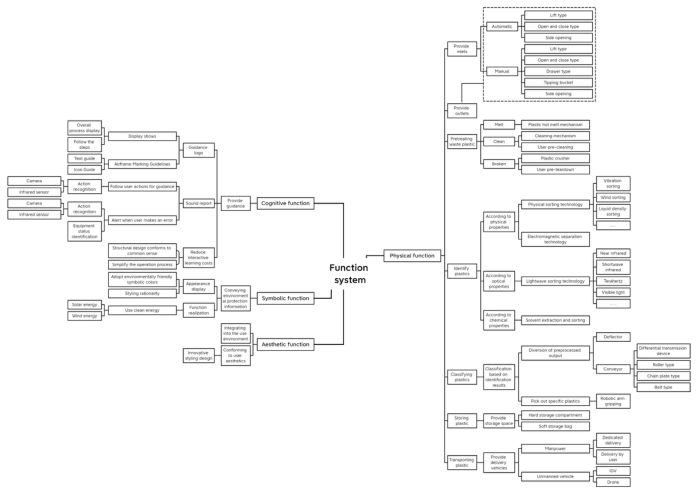
Figure 1: Function system diagram.
After defining each function through the functional requirements list and clarifying their respective functional indicators, a function series connec- tion diagram is drawn using abstract functions and specific implementation methods as the purpose and means of each other. Use this to find possi- ble implementation methods for each function, sort out the primary and secondary relationships and system structure relationships between each function, and integrate the functional connection diagram to form a complete function system diagram.
EXTERNAL SITUATION ANALYSIS - FEASIBILITY ANALYSIS OF WASTE PLASTIC CLASSIFICATION AND RECYCLING IN CAMPUS SCENES Considering that the waste plastic classification and recycling behavior requires a small amount of additional operation and physical and mental expenditure by users. Therefore, it is necessary to explore the feasibility of classifying and recycling waste plastics in campus scenario to ensure that plas- tic recycling facilities in campus scenario can achieve their design purposes in actual use. Focusing on the cognitive attitude towards waste plastic classi- fication, the possibility and convenience of hardware facility design, and the correlation mechanism that combines short-term and long-term incentives, semi-structured interviews were conducted using focus group methods on some of the objects of covert observation and interview. Explore users’ will- ingness and operability to participate in plastic classification and recycling behavior in campus scenario.
Table 3. Compilation of interview results.
Table available in the original PDF paper.
Question type Question Answers Do Do not Waste sorting behavior Do you usually sort garbage? What are the reasons for doing/not doing garbage sorting?
1. Garbage station staff will divide; 2. Weak awareness of classification among those around you;
1. Classification is obligatory and not complicated; 2. Failure to classify will result in penalties; 3. Garbage station staff are required to sort;
How do you usually deal with recyclable waste such as cartons and plastic bottles?
1. Discard it with other recyclable garbage; 2. The garbage station sanitation union asks for help; 3. Pile it next to the garbage station with other people; 4. Throw it away or sell it according to the actual situation;
Willingness to sort waste plastics
What impact do you think separate sorting of waste plastics will have on daily littering?
1. It is not much different from ordinary garbage classification; 2. It will be necessary to sort out the plastic separately, which is more troublesome; 3. An additional step will be added when discarding;
If public facilities could be provided for dedicated plastic recycling, would you be willing to participate in waste plastic recycling?
1. Yes, it should not be much different from throwing garbage normally; 2. It will be participated in just like normal stacking; 3. Hope it coincides with the moving line of garbage disposal as much as possible; 4. Will participate if required by the school or dormitory;
1. It feels more troublesome, not as convenient as throwing away garbage.; 2. If the operation is not particularly troublesome, you will participate; 3. Willing to participate if it can be popularized; 4. Make a decision based on the actual benefits;
Would it change your willingness to participate if it could return you actual benefits after you recycle the plastic correctly, but require you to sort or simply dismantle the plastic before recycling?
What are your expectations for incentives?
1. Establish a red list and black list system; 2. Points redemption; 3. Special supervision and reminder; 4. Those who do not comply will be fined and photographed.
The interview results showed that in the opinions of the interviewees, the behavior of discarding waste is a relatively simple process without strict requirements and restrictions. The interviewees are willing to recycle with- out requiring users to make too much extra mental or physical effort, but
Design of Waste Plastic Recycling Facilities Based on Campus Scenarios 819
they also put forward more design requirements for hardware facilities. Incentive mechanisms can promote users to classify and recycle waste plas- tics to a certain extent, but interviewees also mentioned that the type and intensity of incentive mechanisms will also affect their decision-making to participate in waste plastic classification and recycling behaviors. Therefore, reasonable hardware facility design combined with appropriate incentive mechanisms can realize the classification and recycling of waste plastics in campus scenario.
FUNCTIONAL SOLUTION INTEGRATION AND MODELING DESIGN Combining the results and requirements of internal and external factor analysis, arrange and combine the physical functional links, and sort out the implementation process of functional requirements in hardware facil- ity design based on the characteristics of the input and output factors of the functional links to form a function flow chart. Based on this, we pro- posed an overall solution concept, conducted permutation and combination experiments on the functional solutions proposed in the function system dia- gram, and comprehensively considered the four independent variables of the number of hardware components, economy, implementation conditions and hardware facility size. And combined with the current popularity and appli- cation level of each technology, the best functional concept solutions are selected for hardware facility design.
Figure 2: Functional flow chart.
Figure available in the original PDF paper.
Table 4. Function solution.
Table available in the original PDF paper.
Function Implementation
1 2 3 4 5
Igv Drone
Transport Delivered by user
Dedicated delivery Put in Lift type Open and close type Tipping bucket Drawer type
Side opening Identify Physical sorting
Lightwave sorting
Electromagnetic separation
Solvent extraction and sorting Pretreatment Plastic crusher Cleaning mechanism
Plastic hot melt mechanism Sorting Rely on identification technology
Conveyor Deflector Robotic arm gripping Storage Storage box + partition
Multiple storage bags
Multiple independent storage boxes
In order to reduce the physical expenditure of users during the delivery pro- cess and reduce the impact on traffic, drones are added to transport waste plastics on the basis of users placing waste plastics themselves, and containers are set up to store waste plastics during drone delivery. The inlet adopts a lift- ing mechanism with a simple structure to achieve the purpose of easy opening and safe delivery. Light wave identification technology has a relatively low threshold for use among current plastic identification technologies, covers a wider range of plastic types, and is more suitable for identifying waste plas- tics in campus scenario. Considering the availability of the output, a crusher is used to crush the plastic after identification, and a guide plate combined with a conveyor is used to classify the waste plastic fragments. Due to the randomness of the composition and quantity of plastic types, storage boxes are used for storage and movable partitions are deployed in them to store and separate the plastic fragments.
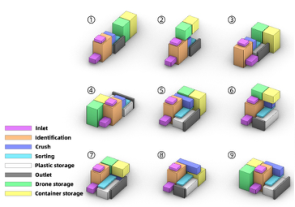
After determining the implementation method of each function module, conduct spatial arrangement experiments. Use modeling software to simplify each function module into blocks of different colors. Based on the func- tion implementation process, conduct spatial arrangement experiments on the function modules in the software interface to determine the functional structure layout within the final hardware design.
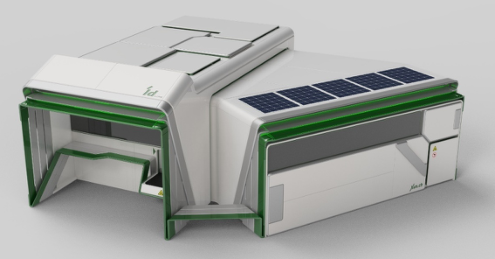
Figure 3: Function module arrangement experiment and function module layout modelling.Figure 4: Modeling design of waste plastic recycling facilities.
Design of Waste Plastic Recycling Facilities Based on Campus Scenarios 821
During the spatial arrangement experiments, four independent variables - number of builds, unit arrangement, geometric shaping method and size - were varied to obtain different functional layout solutions and evaluated. Use this as a clue to optimize the spatial layout until the final functional structure layout is determined, and use this as a basis for further hardware modeling design.
CONCLUSION AND OUTLOOK This paper explored the impact of internal process factors and external situation factors on recycling and sorting behavior. The study of internal process factors uses the KJ method to analyze waste disposal behavior and arrange the functions of hardware facility design. External situation factors explore the possibility of plastic recycling facility in specific scenarios through user interviews. Finally, the research results of the two were combined to design a plastic recycling device in a campus scenario. It is hoped that this design can improve the current situation of low recycling rate of waste plas- tics. It is also hoped that this study can provide more ideas for sustainable design.
REFERENCES
Cai, Zhenxing. Yang, Jianhong. Fang, Huaiying. Ji, Tianchen. Hu, Yangyang and Wang, Xin. (2022). Research on Waste Plastics Classification Method Based on Multi-Scale Feature Fusion, Sensors Volume 22, No. 20. Carrera, Berny. Piñol, Victor Luid. Mata, Judit Bazin and Kim, Kwanho. (2022). A
machine learning based classification models for plastic recycling using different wavelength range spectrums, Journal of Cleaner Production Volume 374. Carrera, Berny. Mata, Judit Bazin. Piñol, Victor Luid and Kim, Kwanho. (2023).
Environmental sustainability: A machine learning approach for cost analysis in plastic recycling classification, Resources, Conservation and Recycling Volume 197. Chen, Huan. Wan, Kun. Zhang, Yayun and Wang, Yanqin. (2021). Waste to wealth: chemical recycling and chemical upcycling of waste plastics for a great future, CHEMSUSCHEM Volume 14, No. 19. Chen, Yong. (2022). Development status and trend of harmless recycling of waste
plastics, Modern Chemical IxVolume 42, No. 9. Cui, Chengyu. Tang, Jian. Qiao, Junfei. Wang, Zixuan and Sun, Zijian. (2020) “Review of Waste Plastic Bottle Recycling Equipment Research Status”, proceed- ings of the 39th Chinese Control Conference (CCC), Shenyang. Deng, Xiaoni. Xiang, Yi. Hong, Qianliang. Liu, Wenxin. Wang, Rui and Li,
Qingshuang. (2021). Investigation and Research on the Status Quo of Garbage Classification in University Campus, Journal of Green Science and Technology Volume 23, No. 20. Fan, Wangxi, Lu, Xinru and Wang, Xinjie. (2021). Study on the classification recycling and comprehensive utilization of waste plastics, RECYCLING RESEARCH Volume 14 No. 7. Khangale, Unatshilidzi Benedictus. Ozor, Paul Amaechi and Mbohwa, Charles.
(2021). A review of recent trends and status of plastics recycling in industries, Engineering and Applied Science RESEARCH Volume 48, No. 3.
(2016). Application of plastic trash sorting technology in separating waste plastic mulch films from impurities, Transactions of the Chinese Society of Agricultural Engineering Volume 32, No. 1. Su, Ying. (2021). Current Status and Prospects of Recycling and Recovery of Waste Plastics in Domestic Garbage, China Resources Comprehensive Utilization, Volume 39, No. 12. Sun, Ying. Liu, Shuang. Wang, Peng. Jian, Xiaomei. Liao, Xiawei and Chen,
Wei-Qiang. (2022). China’s roadmap to plastic waste management and associated economic costs, Journal of Environmental Management, Volume 309.
LISTED IN THE AHFE DIGITAL BOOKSTORE CATALOGUE
Explore the complete digital volume
Intelligent Human Systems Integration (IHSI 2024): Integrating People and Intelligent Systems
Read this individual research paper free through the original publisher, or explore the full digital proceedings book.
ISBN 978-1-958651-95-7
Explore this ISBN in the AHFE Bookstore ↗Listed in the July 2026 bookstore catalogue; search by ISBN to confirm current availability · Digital book purchase optional