Vivian Chung, Daniel Vera, Jiayi Zhang (2024). Design and implementation of a marker-based AR-enabled tool tracking system for manufacturing manual operation. In: Human Interaction and Emerging Technologies (IHIET-AI 2024): Artificial Intelligence and Future Applications. AHFE Open Access, vol. 120, pp. 227–236. https://doi.org/10.54941/ahfe1004572
Although automation and robotics are widely implemented in manufacturing industry nowadays, assembly tasks and rework processes are still carried out manually by human operators because of their complexity and the need for a level of adaptability and flexibility greater than automation solutions can provide. However, manual operations exhibit variability and are subject to human errors, which could lead to unexpected delays or quality issues. Enabling traceability of manual operations is also intrinsically more challenging than for automated processes as it typically relies on the operator consistently providing direct input (e.g. HMI/operator interaction).Research suggests that augmented reality (AR) technology can contribute to enhance human-machine interaction by providing operators with a seamless digital bi-directional interface with physical systems (e.g. product or production systems), thus improving manual operations’ overall effectiveness. Existing research related to the development of AR-based solutions for manufacturing focus essentially on training and maintenance use cases, while there is limited development of applications aiming at supporting in-production operations. In addition, while AR technologies are used to provide information to the operator, the development of capabilities allowing manual process and operators to be monitored during operations, are lacking. The research presented in this paper adopt a holistic approach combining manual operation monitoring and operator feedback capabilities. The DAMPO (Digitally Augmented Manual Process Optimisation) system implements a) computer vision technologies to provide continuous operator and manual operations monitoring capabilities b) content rich and highly interactive user interfaces using screen-based 3D and AR-based information display, and c) near real-time data capture, management and processing pipelines that provide both real-time system/user interaction and collection of historical process data. The use case for this research focuses on specific manual assembly operations of safety critical components of seating systems for the automotive industry, which require precise sequence of operations and full traceability of the assembly process for audit purposes (safety critical operations). The DAMPO system is implemented in the Automation Systems Group's Digital Automation Laboratory at the University of Warwick, WMG department, UK, and is used to support both low TRL level research and direct engagement with industry on developing human centric manufacturing solutions. The DAMPO systems implement both process monitoring capabilities (i.e. data capture) and Electronic Work Instruction functions (information feedback and presentation of the operator) in view of improving process traceability and implementing no-fault forward capabilities. The DAMPO solutions combines a wide range of a) visual computing methods (fiducial, IR marker and 3D object based pose estimation), and b) information display and operator interface technologies (e.g. projected, screen-based and head-mounted AR layer display, HMI and work instruction screens with interactive 3D content, haptic feedback), which can be combined differently depending on the use case, and use case requirements such as hand free operations, complexity of work instructions or operator feedback and interactions, etc. This production-ready solution is tested and evaluated on a replicable production cell using real product and real assembly process.
Although automation and robotics are widely implemented in the manu- facturing industry, assembly tasks and rework processes that are complex or require a high level of flexibility and adaptability are still carried out manually (Mourtzis, Zogopoulos and Xanthi, 2019). By nature, manual operations exhibit variability and are subject to human errors, which can result in production delays, process deviations and quality issues.
The Industry 4.0 paradigm has promoted the development and deploy- ment of digital solutions to support the manufacturing workforce (Longo, Nicoletti and Padovano, 2017). Solutions that support manual operations generally focus on either or a combination of two types of functions: pro- viding guidance to the operator to complete a process (Büttner and Röcker, 2017; Álvarez et al., 2019), and/or monitoring the process for validation and/or traceability purposes (Lou et al., 2022; Yan and Wang, 2022).
Research suggests that augmented reality (AR) technology can contribute to enhancing human-machine interactions by providing operators with a seamless digital bi-directional interface to physical systems (e.g., product or production systems). Existing research related to the development of AR-based solutions for manufacturing focuses on supporting specific use cases such as training (Wang et al., 2022), maintenance (Dvorak, Josth and Delponte, 2017) and system configuration use cases (Álvarez et al., 2019).
Traceability of manual operations is intrinsically more challenging to achieve than for automated processes, as it typically relies on the operator consistently providing direct input e.g., via HMI/operator interaction. Solu- tions have been implemented to monitor specific operations (Lou et al., 2022) and also automatically characterise the operation being carried out (Günther, Kärcher and Bauernhansl, 2019). However, the consistency and accuracy required for deployment and operation in a real production environment are difficult to achieve.
The research presented in this paper adopts a holistic approach to the digi- tisation of manual operations, combining process monitoring and validation, and operator feedback and guidance capabilities. The DAMPO (Digitally Augmented Manual Process Optimisation) system results from the integra- tion of a) a marker-based tracking solution used to track the pose of tools used by operators, b) an information-rich and highly interactive user inter- face deployable on screen-based and AR head-mounted displays as well as normal screens, and c) of a data capture, management and processing solu- tions that support real-time data collection and processing, and the provision of feedback information to the user throughout the process.
BACKGROUND RESEARCH Traceability of Manual Process
A manufacturing process that involves human activities could lead to unwanted incidents, for instance, quality issues and unexpected delays (Rodriguez et al., 2015; Mura, Dini and Failli, 2016). Reducing human errors by improving the level of traceability of manual processes could enhance pro- duction efficiency (Mura, Dini and Failli, 2016). However, capturing manual process data is challenging as the data collected is not guaranteed to be comprehensive or accurate (Standfield and Graˇcanin, 2021).
There are different approaches to tracking manual operations and accu- racy varies depending on the approach adopted (Fischer et al., 2016; De Feudis et al., 2022). High tool pose (i.e., position and orientation in space) tracking accuracy is required in order to consistently validate specific pro- cesses (e.g., specific and precise positioning of the tooltip). Unlike marker-less tracking methods (e.g., feature-based pose estimation (Seppala et al., 2022)), the tracking of markers allows precise pose estimation (Lou et al., 2022). The DAMPO system integrates an NDI Polaris Vega XT optical tracker to track markers made of reflective spheres arranged in various patterns. NDI systems are used in surgical settings (Teatini et al., 2019, 2021) and provide sub-millimetre accuracy and high-frequency tracking, which is an important
Design and Implementation of a Marker-Based AR-Enabled Tool Tracking System 229
factor for tracking fast operations and for implementing near real-time user feedback functions.
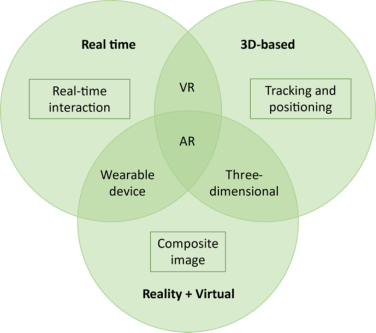
User interfaces and interactions DAMPO offers an AR-based user interface for operator guidance. Vari- ous research projects have demonstrated that MR can minimise the barrier between physical and digital worlds. It is nowadays widely used in vari- ous industries including architecture, healthcare and manufacturing (Teatini et al., 2021; Tan et al., 2022). It is suggested that AR is one type of MR that provides virtual content on real objects in a physical environment seam- lessly (Carmigniani et al., 2011; Chun and Lee, 2012; Juraschek et al., 2018). Existing literature identifies some key elements of AR. Tan, Xu, Li and Chen summarise from previous literature that AR consists of i) real- time interaction, ii) tracking and positioning and iii) composite image (see Figure 1). In the following subsections, implementation of a head-mounted display (HMD) and three-dimensional environment that helps achieve AR is discussed.
Figure 1: Components of MR (Adapted from Azuma, 1997; Tan et al., 2022).
Wearable device: The use case assembly process for DAMPO requires hand-free operation, as the operator needs to handle both the product (i.e., operate the pallet rotation and tilt mechanisms to access working points) and the tool itself. Unlike traditional screen-based human-machine inter- faces (HMIs) or tablet-based AR, Head Mounted Displays (HMD) allow users to experience handsfree, interactive and collaborative AR in real-time (Carmigniani et al., 2011; Tan et al., 2022), and thus can enable more efficient assembly processes (Mura, Dini and Failli, 2016; Hoover et al., 2020). Some head-mounted systems allow interactions through tracking of body gestures and voice (Kress, Saeedi and Brac-de-la-Perriere, 2014) further enhancing hands-free capabilities.
Three-dimensional environment: There are various methods to define the pose of AR content in the virtual environment (Chun and Lee, 2012). Marker- based AR uses fiducials to calculate the relative pose of the device camera
and the physical scene, which is needed to display the AR content in the required position and orientation (Siltanen, 2012; Romli et al., 2020). The fiducial can be a 2D graphic (e.g., QR code) or a 3D object (Siltanen, 2012; Cheng, Chen and Chen, 2017; Romli et al., 2020). Markers need to be fully or partially contained in the camera field of view for the AR content position and orientation to be updated continuously.
Research Gap Research shows that AR could be beneficial at various stages of manufactur- ing processes (Bottani and Vignali, 2019). AR can be used to provide instant feedback to operators (Rodriguez et al., 2015; Alves et al., 2021). How- ever, MR solutions appear to be used mainly to support training, system set-up and maintenance operations (Quint, Sebastian and Gorecky, 2015; Juraschek et al., 2018), and there is limited research currently focusing on providing solid technical solutions to support in-production scenario (Bottani and Vignali, 2019).
The use of MR and AR to support in-process operation poses some challenges, including suitability of existing HMDs for extended periods, hardware reliability, as well as consistency and stability of the real-world pose tracking and AR layer display, which can significantly impact the usability of AR solutions (Brizzi et al., 2018). The research presented in this paper pro- poses a solution that combines a) process monitoring and validation based on the tracking of tools used by the operators, b) augmented work instruc- tions, which can be delivered in various forms depending on the use case requirements and constraints, i.e., via AR HMDs (HoloLens in this case), screen-based AR (use of a tablet camera/screen), or via a classic screen-based HMI with the addition of rich and interactive 3D content.
MARKER-BASED TOOL TRACKING SYSTEM OVERVIEW Functional Overview
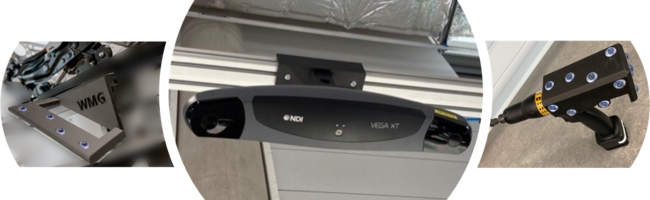
The DAMPO system comprises several elements: 1) an NDI Polaris Vega XT sensor mounted above the work cell at a height of 3m to ensure the entire seat is contained in the pyramidal detection volume. 2) A tool sleeve with dif- ferent marker patterns on the four sides of the tools to allow tracking of tools regardless of their orientation as one marker is always exposed to the NDI sensor’s IR cameras. 3) An additional marker is mounted on the pallet that supports the product so that the position of the tool can be tracked relatively to the pallet. This is required to ensure tracking consistency and accuracy regardless of the pallet stop position, inclination, or rotation. The DAMPO software solution is composed of 4) the real-time data capture and manage- ment module, which ensures a continuous log of the tool pose data composed of timestamp, XYZ coordinates and orientation quaternion (4 values). Each cycle data is further linked to a metadata set that includes station_ID, prod- uct_Type and product_ID. 5) A process database contains a) a definition of working locations for each product type (obtained from scanning the bar code on the pallet) and the associated pose that the tool should be in when
Design and Implementation of a Marker-Based AR-Enabled Tool Tracking System 231
operating at these locations, b) a sequence in which these operations must be carried out (e.g. bolt tightening pattern) so that in addition to each individ- ual steps, the whole assembly sequence can be validated. 6) The DAMPO systems implement various forms of HMI (i.e., screen-based 3D content, screen-based AR content, HMD-based AR) that all provide a) operator guid- ance as the location of the next work position and b) operator feedback, which include product type, process steps completed, as well as other con- trols allowing the operators to input a redo-step, skip-step, product-fault action.
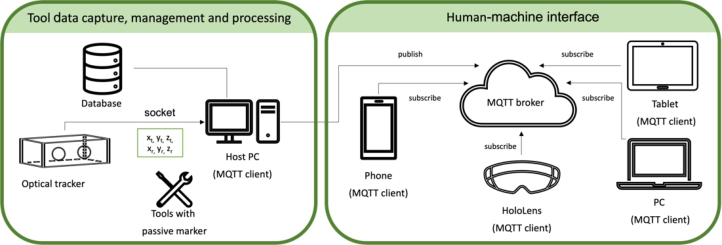
Database, Data Management and Data Pipeline Design The database system is composed of two sub-systems a) pose data cap- ture, management and processing and b) human-machine interface (HMI) (see Figure 2). The host computer fetches the real-time data from the NDI sensor at 10 Hertz, attaches the metadata and stores the pose data cor- responding to a cycle into a Time Serie database. The HMI sub-system focuses on creating high-interactive user interfaces for operators and/or line supervisors.
Figure 2: System architecture and data flows of the DAMPO tool tracking system.
Portable devices (e.g., laptops, tablets, HMD) subscribe to the MQTT broker to obtain the live data and/or historical data from the data capture system and display process-related information (i.e., work instructions and validation results, tool path for previous cycles).
System Setup The elements supporting pose tracking are shown in Figure 3. The use case application requires a 3 mm accuracy in tool pose detection in order to differ- entiate the closest working positions. This is within the NDI sensor tracking accuracy which is 0.12 to 0.15 mm Tools must be registered to the system by performing pivot calibration to derive the pose of the tooltip. The pallet- mounted marker must also be registered to the system as a global marker. Thus, the output of the tool pose is calculated with reference to the global marker.
To implement hands-free AR-enabled HMI for the use case, Microsoft HoloLens 2 is used. The sensors (e.g., IR cameras, IMU, depth) equipped in the device provide capabilities to deploy high interactive and hands-free features (e.g., gesture tracking and voice control) in the AR application. A Universal Windows Platform (UWP) application is developed with Mixed Reality Toolkit (MRTK) from Microsoft on the Unity 3D platform while Vuforia SDK from PTC enables marker detection and tracking. CAD file of the product (e.g., obj, fbx, stl) is used as a marker for the virtual environ- ment so that no extra markers are required on the working station. The NDI coordinate system with respect to the global marker is transformed to the coordinate system with reference to the product marker and the AR content is displayed accordingly.
USE CASE APPLICATION Assembly of Safety-Critical Components of Seating Systems
The use case for this study focuses on the monitoring and validation of man- ual assembly processes of airbag and seat pre-tensioning systems, which are safety-critical components for car seat products. The replica of a manual station is set up in the Automation Systems Group’s Digital Automation Laboratory at WMG, University of Warwick, and comprises a section of con- veyor, the articulated pallet (tilt and rotation) on which the product (i.e., seat frame) is mounted. The station also includes two power tools and tool mounts from which the operator picks the tool when a cycle starts, a bar code reader for product identification, and a touch-screen HMI.
One cycle of the assembly process in this use case includes tightening two bolts on the front of the seat’s lower part, and two on the side of the backrest. The pose of the tool is continuously acquired by the NDI sensor. The data processing software then evaluates the pose of the power tool and validates whether the operation is completed by comparing it with the expected pose behaviour.
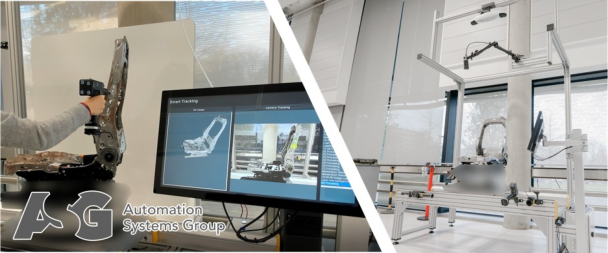
The screen-based work instructions software (see Figure 4) then provides instant feedback to the operator on the validation result and guidance to the next bolt position on both 2D and 3D visuals of the seat frame.
Design and Implementation of a Marker-Based AR-Enabled Tool Tracking System 233
Figure 4: Screen-based work instructions with 3D model view (left) and overview of the DAMPO station set-up (right).
Integration of AR Application to Screen-based Tool Tracking System To provide operators with a seamless in-process experience, AR features are integrated in addition to the screen-based instruction software to maximise the benefits of the system. HoloLens application is deployed in this use case application to provide the operator with a hands-free experience during the assembly process (see Figure 5).
To activate the AR content, the seat frame is used as a reference object maker for the HoloLens application. After detecting the seat frame and regis- tering the virtual space to its pose using the camera on HoloLens, coordinate transformation from the optical tracker system to the virtual space is per- formed. Work instructions are then overlayed through the HMD on the seat frame. With continuous tracking of the seat frame, positions of work instructions are updated constantly to align with any movement of the seat frame.
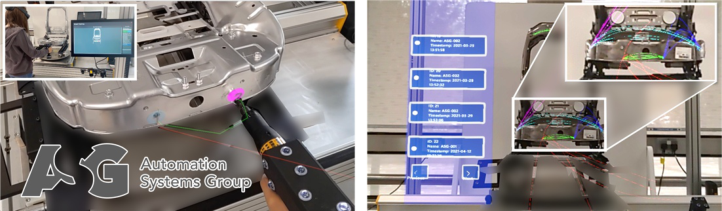
Figure 5: Left: HoloLens view of the second assembly process step, with the target tooltip position displayed as a magenta disc in the AR layer. Right: AR HoloLens view of tool paths for 6 cycles (historical data display).
The HoloLens, in the meantime, subscribes to the MQTT broker to receive real-time tool pose and validation results generated by the data processing software and update the guidance accordingly (i.e., changing the colour of the working instructions). Figure 8 shows the scenario that the first screwing
is completed (in blue) and the next screwing position (in magenta). With the 3D pose of the tool position, the tool path of the operation is also visualised. In addition, historical tool paths can be displayed to provide traceability of previous processes.
CONCLUSION AND FUTURE WORK The research demonstrates the implementation of a production-ready that combines process monitoring (via the tracking of tools) and user guidance systems. In-production deployment in the car seat and engine assembly plants has highlighted the need for further development, in particular, to tackle the occlusion of markers (multiple sensors), the integration with tool control systems to allow operation in the correct pose only, and with manufactur- ing execution systems (MES), to retrieve working locations associated with a specific product type. The use of HMD hardware and AR interfaces for guiding operators in production has proven to be unrealistic, mainly due to the limitation of the hardware (short battery life, fragile, disorientating over extended periods of use). However, initial testing has shown that the use of HMD AR can reduce operator training time for complex sequences of oper- ations. Further research is required to quantify the cross-over point between task complexity and training time.
ACKNOWLEDGMENT
The authors gratefully acknowledge the support for this work from Inno- vate UK, through the Digitally Assisted Manual Processes Optimisation (DAMPO) research project.
REFERENCES
Álvarez, H. et al. (2019) ‘Augmented reality system to guide operators in the setup of die cutters’, International Journal of Advanced Manufacturing Tech- nology, 103(1–4), pp. 1543–1553. Available at: https://doi.org/10.1007/S00170- 019-03634-0. Alves, J. B. et al. (2021) ‘Using augmented reality for industrial quality assurance:
a shop floor user study’, The International Journal of Advanced Manufactur- ing Technology, 115(1–2), pp. 105–116. Available at: https://doi.org/10.1007/ s00170-021-07049-8. Azuma, R. T. (1997) ‘A Survey of Augmented Reality’, Presence: Teleoperators and Virtual Environments, 6(4), pp. 355–385. Available at: https://doi.org/10.1162/pr es.1997.6.4.355. Bottani, E. and Vignali, G. (2019) ‘Augmented reality technology in the manufactur-
ing industry: A review of the last decade’, IISE Transactions, 51(3), pp. 284–310. Available at: https://doi.org/10.1080/24725854.2018.1493244. Brizzi, F. et al. (2018) ‘Effects of Augmented Reality on the Performance of Teleoperated Industrial Assembly Tasks in a Robotic Embodiment’, IEEE Transactions on Human-Machine Systems, 48(2), pp. 197–206. Available at: https://doi.org/10. 1109/THMS.2017.2782490.
Design and Implementation of a Marker-Based AR-Enabled Tool Tracking System 235
Büttner, S., Sand, O. and Röcker, C. (2017) ‘Exploring design opportunities for intelligent worker assistance: a new approach using projetion-based AR and a novel hand-tracking algorithm’, Lecture Notes in Computer Science (including subseries Lecture Notes in Artificial Intelligence and Lecture Notes in Bioinfor- matics), 10217 LNCS, pp. 33–45. Available at: https://doi.org/10.1007/978-3- 319-56997-0_3. Carmigniani, J. et al. (2011) ‘Augmented reality technologies, systems and appli-
cations’, Multimedia Tools and Applications, 51(1), pp. 341–377. Available at: https://doi.org/10.1007/s11042-010-0660-6. Cheng, J. C. P., Chen, K. and Chen, W. (2017) ‘Comparison of Marker-Based and Markerless AR: A Case Study of An Indoor Decoration System’, in Lean and Com- puting in Construction Congress - Volume 1: Proceedings of the Joint Conference on Computing in Construction. Edinburgh: Heriot-Watt University, pp. 483–490. Available at: https://doi.org/10.24928/JC3-2017/0231. Chun, J. and Lee, S. (2012) ‘A vision-based 3D hand interaction for marker-based
AR’, 7, pp. 51–58. Dvorak, P., Josth, R. and Delponte, E. (2017) ‘Object State Recognition for Automatic AR-Based Maintenance Guidance’, IEEE Computer Society Conference on Computer Vision and Pattern Recognition Workshops, 2017-July, pp. 1244–1250. Available at: https://doi.org/10.1109/CVPRW.2017.164. De Feudis, I. et al. (2022) ‘Evaluation of Vision-Based Hand Tool Tracking Methods
for Quality Assessment and Training in Human-Centered Industry 4.0’, Applied Sciences, 12(4), p. 1796. Available at: https://doi.org/10.3390/app12041796. Fischer, C. et al. (2016) ‘Enabling Live Data Controlled Manual Assembly Processes by Worker Information System and Nearfield Localization System’, Procedia CIRP, 55, pp. 242–247. Available at: https://doi.org/10.1016/j.procir.2016.08. 013. Günther, L. C., Kärcher, S. and Bauernhansl, T. (2019) ‘Activity recognition in
manual manufacturing: Detecting screwing processes from sensor data’, Pro- cedia CIRP, 81, pp. 1177–1182. Available at: https://doi.org/10.1016/J. PRO- CIR.2019.03.288. Hoover, M. et al. (2020) ‘Measuring the Performance Impact of Using the Microsoft HoloLens 1 to Provide Guided Assembly Work Instructions’, Journal of Comput- ing and Information Science in Engineering, 20(6). Available at: https://doi.org/ 10.1115/1.4046006. Juraschek, M. et al. (2018) ‘Mixed Reality in Learning Factories’, Procedia Manu-
facturing, 23, pp. 153–158. Available at: https://doi.org/10.1016/j.promfg.2018. 04.009. Kress, B., Saeedi, E.and Brac-de-la-Perriere, V.(2014) ‘The segmentation of the HMD market: optics for smart glasses, smart eyewear, AR and VR headsets’, in A. A. Kazemi, B. C. Kress, and E. A. Mendoza (eds), p. 92020D. Available at: https: //doi.org/10.1117/12.2064351. Longo, F., Nicoletti, L. and Padovano, A. (2017) ‘Smart operators in industry 4.0:
A human-centered approach to enhance operators’ capabilities and competencies within the new smart factory context’, Computers & Industrial Engineering, 113, pp. 144–159. Available at: https://doi.org/10.1016/J. CIE.2017.09.016. Lou, P. et al. (2022) ‘Real-time monitoring for manual operations with machine vision in smart manufacturing’, Journal of Manufacturing Systems, 65, pp. 709–719. Available at: https://doi.org/10.1016/J. JMSY.2022.10.015. Mourtzis, D., Zogopoulos, V. and Xanthi, F. (2019) ‘Augmented reality appli-
cation to support the assembly of highly customized products and to adapt
to production re-scheduling’, International Journal of Advanced Manufactur- ing Technology, 105(9), pp. 3899–3910. Available at: https://doi.org/10.1007/ S00170-019-03941-6. Mura, M. D., Dini, G. and Failli, F. (2016) ‘An Integrated Environment Based on Augmented Reality and Sensing Device for Manual Assembly Workstations’, Pro- cedia CIRP, 41, pp. 340–345. Available at: https://doi.org/10.1016/j.procir.2015. 12.128. Quint, F., Sebastian, K. and Gorecky, D. (2015) ‘A Mixed-reality Learning Environ-
ment’, Procedia Computer Science, 75, pp. 43–48. Available at: https://doi.org/ 10.1016/j.procs.2015.12.199. Rodriguez, L. et al. (2015) ‘Developing a Mixed Reality Assistance System Based on Projection Mapping Technology for Manual Operations at Assembly Work- stations’, Procedia Computer Science, 75, pp. 327–333. Available at: https://doi. org/10.1016/j.procs.2015.12.254. Romli, R. et al. (2020) ‘Mobile Augmented Reality (AR) Marker-based for Indoor
Library Navigation’, IOP Conference Series: Materials Science and Engineer- ing, 767(1), p. 012062. Available at: https://doi.org/10.1088/1757-899X/767/1/ 012062. Seppala, T. et al. (2022) ‘Feature-Based Object Detection and Pose Estimation Based on 3D Cameras and CAD Models for Industrial Robot Applications’, MESA 2022 - 18th IEEE/ASME International Conference on Mechatronic and Embedded Sys- tems and Applications, Proceedings [Preprint]. Available at: https://doi.org/10. 1109/MESA55290.2022.10004402. Siltanen, S. (2012) Theory and applications of marker-based augmented reality:
Licentiate thesis. Aalto University. Standfield, B. and Graˇcanin, D. (2021) ‘An Approach to Monitoring and Guiding Manual Assembly Processes’, in, pp. 165–176. Available at: https://doi.org/10. 1007/978-3-030-90176-9_23. Tan, Y. et al. (2022) ‘Augmented and Virtual Reality (AR/VR) for Education and
Training in the AEC Industry: A Systematic Review of Research and Applications’, Buildings, 12(10). Available at: https://doi.org/10.3390/buildings12101529. Teatini, A. et al. (2019) ‘The effect of intraoperative imaging on surgical navigation for laparoscopic liver resection surgery’, Scientific Reports, 9(1), p. 18687. Available at: https://doi.org/10.1038/s41598-019-54915-3. Teatini, A. et al. (2021) ‘Mixed reality as a novel tool for diagnostic and surgical nav-
igation in orthopaedics’, International Journal of Computer Assisted Radiology and Surgery, 16(3), pp. 407–414. Available at: https://doi.org/10.1007/s11548- 020-02302-z. Wang, Z. et al. (2022) ‘A comprehensive review of augmented reality-based instruction in manual assembly, training and repair’. Available at: https://doi.org/10. 1016/j.rcim.2022.102407. Yan, J. and Wang, Z. (2022) ‘YOLO V3 + VGG16-based automatic opera-
tions monitoring and analysis in a manufacturing workshop under Indus- try 4.0’, Journal of Manufacturing Systems, 63, pp. 134–142. Available at: https://doi.org/10.1016/J. JMSY.2022.02.009.
LISTED IN THE AHFE DIGITAL BOOKSTORE CATALOGUE
Explore the complete digital volume
Human Interaction and Emerging Technologies (IHIET-AI 2024): Artificial Intelligence and Future Applications
Read this individual research paper free through the original publisher, or explore the full digital proceedings book.
ISBN 978-1-958651-96-4
Explore this ISBN in the AHFE Bookstore ↗Listed in the July 2026 bookstore catalogue; search by ISBN to confirm current availability · Digital book purchase optional