Simge Güner, Arzu Vuruskan (2024). Investigating the Use of Blockchain Technology in Fashion and Textile Industry. In: Accessibility, Assistive Technology and Digital Environments. AHFE Open Access, vol. 121, pp. 172–179. https://doi.org/10.54941/ahfe1004625
Nowadays, with the advancement of technology, software designed to provide perfect security for information in every field is emerging. Blockchain has also become a crucial component in such software, safeguarding information across various sectors. Blockchain technology represents one of the rapidly evolving methods for organizing and storing data online. Data is stored in blocks, and when enough blocks are connected, they form a chain, creating a blockchain. Additionally, the use of blockchain technology enhances the security of data on the network. This technology finds applications in various sectors, including media and telecom, energy and utilities, finance, healthcare, and basic industrial sectors. Notably, the fashion industry is also among the sectors benefiting from blockchain, primarily due to its transparency, a key factor given the increasing importance of sustainability.However, transparency is just one aspect of blockchain technology. It encompasses other essential features such as enhanced security, instant monitoring, increased efficiency and speed, and automation. Today, major players in the fashion industry, including LVMH, Nike, Zara, and textile-producing countries, employ blockchain technology. Blockchain facilitates the examination and recording of many issues, including supply chain management, product preparation, and fair labor practices. Luxury fashion companies, in particular, use blockchain to record product certificates, preventing the production of counterfeit models and ensuring the authenticity of their products.In this context, this study aims to reveal the perspectives of textile and fashion companies regarding blockchain, a topic with limited academic sources. As a case study, the research focuses on investigating the application of blockchain in the Turkish textile and fashion design industries. The research involves interviews with Turkish fashion designers and managers from textile companies, aiming to understand how and why businesses might potentially integrate blockchain internally. Although most interviewees stated that their companies currently lack active blockchain applications, they expressed their intention and progress toward incorporating blockchain in the near future.While blockchain is used worldwide, it is observed that Turkish fashion designers and the textile sector employ it for specific applications, and there is limited available information about Turkey. This study aims to bridge the knowledge gap by providing insights into how and why blockchain can be utilized in the Turkish fashion and textile sector, drawing from the data gathered through extensive research and interviews.
Software capable of providing superior security for data across all indus- tries has begun to emerge as technology advances. Blockchain technology, in particular, enhances the security of data on the network by employing a unique approach. This involves storing data in blocks, with a chain struc- ture connecting these blocks, thereby bolstering the privacy and security of the system. The foundational elements of blockchain are built in a decen- tralized manner, independent of external infrastructure. Online transactions are carried out within a decentralized, highly secure network (Gore et al., 2023). Blocks serve as the storage units for data, and when a sufficient num- ber of these blocks are linked together, they form a chain, giving rise to a blockchain. These blocks are utilized to store data in a manner that makes it challenging for unauthorized users to alter or hack the digital ledger. Gov- ernments can benefit from the adoption of blockchain and virtual currency. However, it could be challenging to integrate with other databases because every government agency has its own. Future advancements in blockchain technology will enhance the effectiveness of data management. The banking, security, real estate, healthcare, education, and supply chain industries will all continue to employ the benefits of blockchain technology (Patan et al., 2023).
Investigating the Use of Blockchain Technology in Fashion and Textile Industry 173
Globally, there is a goal to initiate the utilization of blockchain tech- nology’s innovative potential in other major sectors, expanding its scope beyond financial uses. It is claimed that the employed blockchain technology offers five main advantages: improved security, greater transparency, instant tracking, enhanced speed and efficiency, and automation (Europe’s Future in Blockchain Technology - EU Business News, nd). These advantages are expected to support the utilization of blockchain technology in alternative sectors, one of which is the textile and clothing industry.
The main purpose of this research is to investigate the use of blockchain technology from the perspective of textile and fashion industries by focus- ing on a specific region in Türkiye. As stated by Takaoglu, et al. (2019) blockchain is mainly applied to energy management, smart contracts, real estate and title transactions, foundation and contribution activities. It is also utilized for internet security in addition to these applications in Türkiye (Takao˘glu, Özer and Parlak, 2019). Yet, the amount of knowledge regard- ing the use and understanding of blockchain in Turkish fashion and textile business is rather limited and needs investigation. Therefore, to examine the current status and to draw an overall picture regarding the textile and fash- ion industry, interviews were held with Turkish fashion designers, as well as textile and fashion enterprises, in this research. An overview of current appli- cations of blockchain in the textile and fashion industry is also presented, along with some outstanding examples from the industry.
BLOCKCHAIN APPLICATIONS IN THE TEXTILE AND FASHION INDUSTRY When examining the supply chain of the contemporary textile and fashion sector, several difficulties are discovered. These challenges include the lack of transparency in the supply chain, poor inventory management at different levels, and the potential for unexpected circumstances, such as natural disas- ters, leading to losses in cash flow, reputation, and raw materials. However, businesses in the textile and fashion industries that choose different levels of integration might be able to record all transactions related to textile and fash- ion production using blockchain as an immutable database. This includes distribution, logistics, and payment operations. The main aspect expected to make this application useful in the future is that blockchain automates many tasks. If blockchain is used in the textile and fashion industries, it is anticipated to reduce costs, expedite delivery, and, most importantly, miti- gate global environmental issues (‘Blockchain Can Revolutionize the Textile Industry. Here’s How.’, nd). Additionally, with blockchain technology, var- ious issues, such as supply chain, product preparation, and fair labor, can be assessed and recorded. In the textile and fashion industries, the most important issue is the lack of transparency, which has long characterized the management of the fashion supply chain, leading to increased costs and inef- ficiencies in the sector. With the use of blockchain technology to enhance visibility in supply chain operations, fashion enterprises can trace specific production processes from raw materials to the finished product, including warehousing, shipping, and delivery (Chang and Chen, 2020).
174 Güner and Vuruskan
Blockchain-supported smart contracts can establish a crypto-legal docu- mentation system that complies with multiple laws to precisely track global operations in the fashion industry and ensure transparency in the sourcing, production, and distribution of fashion products. Immutable records allow documentation and verification of design originality and royalty payments, thus reducing intellectual property crimes. Blockchain technology helps pro- tect consumer personal data in the fashion industry as it uses a unique user digital signature. Blockchain technology offers opportunities to globally accelerate the digital fashion movement characterized by digital collection, digital transactions, and digital tailoring (Fu et al., 2018).
EXAMPLES FROM FASHION BRANDS USING BLOCKCHAIN TECHNOLOGY For luxury fashion brands seeking digital provenance and authenticity, blockchain technology has the potential to be a powerful tool in the fight against counterfeit luxury products. In March 2019, the “Aura” initiative, a collaborative effort involving LVMH Group, Quorum, Microsoft, and Con- senSys, utilized blockchain technology to facilitate customer verification of the authenticity of fashion products and ensure supply chain transparency. This transparency serves to address growing consumer concerns regarding factory locations, production procedures, environmental implications, and support for human rights (Mesjar et al., 2023). By leveraging blockchain technology in this way, LVMH is improving its ability to combat fraud and protect the interests of its customers (Apicelli, 2023).
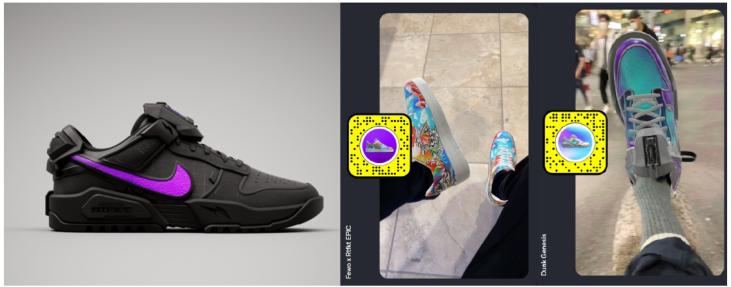
Moreover, non-fungible tokens (NFTs), a digital combination of art, film, and other virtual materials, are gaining popularity in the sports fash- ion industry as sportswear fashion brands respond to increasing market demands for innovation and personalization. Nike is encouraging the adop- tion of blockchain technology by acquiring RTFKT, a blockchain-based sneaker startup studio, and launching “Swoosh,” a platform and commu- nity ecosystem driven by blockchain technology. With the latest advance- ments in blockchain technology at its disposal, Nike has embarked on a more ambitious exploration of product innovation for the metaverse (Davies et al., 2024). As depicted in Figure 1 of the collaborative study conducted with RTFKT and Nike, individuals are shown interacting with products on their feet before acquiring them as non-fungible tokens (NFTs) through the Snapchat application. This virtual try-on experience allows con- sumers to assess the suitability of the product before making a physical purchase.
Moreover, ZARA, one of the most well-known fashion brands in the world as a fast fashion brand, has used radio frequency identification and blockchain technology to improve real-time supply chain transparency and data exchange. ZARA can more precisely assess supply chain participants and reduce the cost of supply chain coordination by using blockchain-based smart contracts to automate the recording of transactions and the flow of data throughout the chain (Pérez et al., 2020).
Investigating the Use of Blockchain Technology in Fashion and Textile Industry 175
Figure 1: (Left) RTFKT x Nike, NFT sneakers. (Right) RTFKT, blockchain-based Nike sneakers can be tried on through an application (rtfkt.com, nd.), (2024, January 23).
The capability of blockchain to ensure legality, security, and transparency in the supply chain is further enhanced by the direct generation of smart con- tracts. The advent of Non-Fungible Tokens (NFTs), digital assets acquired by consumers on the blockchain alongside smart contracts, introduces novel dimensions to the fashion industry. The status of being a collector offers potential future sales as licenses and opportunities to enhance brand value. In response to sustainability challenges, facilitated by the emergence of NFTs, the fashion sector is perceiving a transition towards slow fashion, empha- sizing more durable and sustainable product offerings. Beyond sustainability concerns, immersive technologies such as blockchain-integrated 3D simula- tions and visualizations are diversifying their applications beyond the realm of fashion. These technologies streamline the design and production processes by facilitating efficient prototyping and virtual fashion showcases (Rocha, 2023).
INTERVIEWS WITH TEXTILE AND FASHION COMPANIES Procedures
In this research, interviews were conducted with textile and fashion com- panies and designers to acquire an understanding of the sector’s current approach to blockchain technology. 20 businesses that were considered appropriate were chosen from Izmir/Türkiye. Nine of these were willing to contribute to the research and participated in the interviews. The next phase involved scheduling meetings with the selected companies and deter- mining whether they were using blockchain technology. A set of questions was directed in the interviews based on the company’s use of blockchain. The interviews were audio-recorded with the permission of the companies.
The information obtained at the end of the interviews was first tran- scribed using an application called “transcritor”. Later, the interviews, which were transcribed using the qualitative analysis application called “taguette”, were evaluated according to appropriate keywords. For data privacy, each company is assigned a specific number for evaluations.
176 Güner and Vuruskan
RESULTS OF INTERVIEWS The primary finding of the study reveals that only Company #5 out of the nine interviewed companies utilize blockchain technology. Specifically, Com- pany #3 employs blockchain solely for identifying the cotton utilized in their operations. However, all companies expressed intentions to understanding the benefits of blockchain and transition to blockchain technology eventu- ally. The interview analysis identified key terms that were most commonly used, including: (1) success factors and customer satisfaction, (2) software and supply chain challenges, and (3) traceability.
1. Regarding the success factor, eight out of nine companies believe that blockchain will provide information faster and enhance the performance of companies compared to the software alternatives they currently use. They also anticipate that blockchain will create a more secure environ- ment for company payments. Additionally, the transparency of traceabil- ity, facilitated by the integration of blockchain with QR codes added to products, is viewed by companies as a success factor that will increase cus- tomer satisfaction. Moreover, certain situations, which may not be clearly presented to other parties based on the main certificates held by environ- mental companies, can be resolved through the transparency provided by blockchain. Consequently, this is expected to bolster the success rates of the companies. 2. Companies identify most of the difficulties they experience as arising from the supply chain. Challenges such as failures to complete work or incom- plete entry of certain data in company-specific software compound issues in the supply chain. Furthermore, difficulties arise when the software pro- grams they use are unable to delete incorrectly entered data, leading to concealed errors that exacerbate supply chain problems. Moreover, there are concerns regarding potential challenges in effectively controlling and monitoring various stages of work. This situation arises from the per- ceived challenge in ensuring complete compatibility between the artificial intelligence utilized in the design process and blockchain technology, as indicated by Company #6.
Also, Company #1 attributes some of the difficulties to perceived energy consumption associated with blockchain technology. Company #6 encounters challenges in safeguarding design rights stemming from the limited adoption of blockchain technology. Consequently, they rely on conventional methods for protection. Furthermore, the company asserts that this circumstance is solely attributable to the information available to them.
According to Company #2, failures in areas such as design security or sustainability are anticipated due to incorrect entry of supply chain and quality control data into the systems they use. Regarding software, companies utilize nearly identical systems such as ERP, SAP, PLM, and V3 Nebim software.
Investigating the Use of Blockchain Technology in Fashion and Textile Industry 177
In addressing supply chain concerns, Company #2 contends that prod- ucts with inaccurate dimensions are dispatched without adequate inspec- tion, particularly within the overseas-based supply chain, thereby present- ing challenges for companies. Nonetheless, they posit that the integration of blockchain technology can mitigate such issues by enabling preemptive resolution of errors. This assertion is predicated on the notion that com- prehensive data, including clothing measurements, will be systematically recorded on the blockchain.
Another significant challenge highlighted by Company #7 is human rights issues in the supply chain, which they believe can be addressed through the implementation of blockchain.
Despite experiencing fewer supply chain issues compared to other companies, Company #6 still transmits information shares through its Enterprise Resource Planning (ERP) system. Nevertheless, they acknowl- edge encountering challenges within the supply chain attributable to the disparate systems utilized in Europe and Türkiye. Nevertheless, they posit that blockchain technology holds promise in averting such difficulties, potentially offering a solution to the interoperability challenges posed by distinct systems across regions.
Overall, concerns regarding data accuracy within the supply chain and delays in data sharing significantly contribute to notable challenges within the supply chain. As a general opinion, interviewees suggested that these issues could potentially be alleviated through the implementation of blockchain technology. 3. Regarding traceability, only Company #3 plans to leverage blockchain technology specifically for tracing cotton. As a clothing company spe- cializing in products made from organic cotton, Company #3 envisions a future where all relevant product information can be readily accessed through blockchain technology. They emphasize their primary objec- tive of implementing blockchain for the traceability of the cotton they produce. Overall, only three out of nine textile companies assert that ensuring traceability within the supply chain is of paramount importance, emphasizing that advancements in this domain directly impact customer satisfaction. Moreover, these three companies expressed their intention to transition to a digital product passport application for finished products in the future.
Regarding customer satisfaction, companies generally believe that cus- tomer satisfaction will increase when traceability is transparent. They plan to achieve this transparency by presenting all information to con- sumers through QR codes or digital product passports.
Overall, only Company #5 holds the belief that blockchain is energy- intensive and unsuitable for implementation within the textile industry. Conversely, the remaining eight companies express intentions to explore blockchain technology in the future, anticipating greater benefits than ini- tially envisioned. However, among these eight companies, only Company #3 has made preparations for the adoption of blockchain. Notably, there is no definitive timeline regarding when the remaining companies intend to transition to blockchain technology.
178 Güner and Vuruskan
It is anticipated that this study will contribute to bridging gaps in the liter- ature and illuminating aspects related to textile companies. This study sheds light on companies that operate using traditional methods. Additionally, it underscores the importance for companies that blockchain technology can minimize mistakes and highlight transparency.
CONCLUSION
This study aims to explore the relevance and extent of blockchain integration within companies in Türkiye. Nine companies were subjected to interviews as part of the research process. The companies interviewed in this study are not currently utilizing blockchain. Conversely, eight out of nine companies antic- ipate that adopting blockchain will lead to increased success in the future. Every company faces challenges in the supply chain, but they express confi- dence that blockchain’s secure and immutable ledger can address these issues. Despite facing similar challenges stemming from the utilization of nearly identical software, the companies hold the collective belief that blockchain technology harbors the potential to alleviate these issues. Furthermore, all companies believe that customer satisfaction will rise when providing trace- ability to consumers in a transparent manner using blockchain-integrated software, such as QR codes. Additionally, eight out of nine companies are contemplating experimenting with blockchain in the near future.
For future research, reaching out to a larger number of companies is sug- gested. Additionally, it would be beneficial to include various companies, not only from Türkiye but also internationally, including well-known enterprises, to explore the utilization of blockchain in the textile industry.
ACKNOWLEDGMENT
We extend our gratitude to nine companies for their invaluable support and cooperation in this study.
REFERENCES
Apicelli, D. M. L.-S. W. Blockchains in Fashion: Authenticity + Sustainability = Profit. Lexology. https://www.lexology.com/library/detail.aspx?g=b7fe081a-8c 33-48cc-9b63-9e6d080d37c4 (accessed 2024-01-24). Benefits of blockchain - IBM Blockchain | IBM. https://www.ibm.com/topics/benef
its-of-blockchain (accessed 2023-04-17). Blockchain And Its Relevance In Fashion Industry. Elem. Educ. Online 2021, 20 (3).
https://doi.org/10.17051/ilkonline.2021.03.331 Blockchain Can Revolutionise The Textile Industry. Here’s How. https://www.textil esphere.com/2022/06/blockchain-in-textile-industy.html (accessed 2023-12-03). Bullón Pérez, J. J.; Queiruga-Dios, A.; Gayoso Martínez, V.; Martín del Rey, Á. Trace-
ability of Ready-to-Wear Clothing through Blockchain Technology. Sustainability 2020, 12 (18), 7491. https://doi.org/10.3390/su12187491 Chang, S. E.; Chen, Y. When Blockchain Meets Supply Chain: A Systematic Literature Review on Current Development and Potential Applications. IEEE Access 2020, 8, 62478–62494. https://doi.org/10.1109/ACCESS.2020.2983601
Investigating the Use of Blockchain Technology in Fashion and Textile Industry 179
Chen, Y. (2023). How blockchain adoption affects supply chain sustainability in the fashion industry: A systematic review and case studies. International Transactions in Operational Research, itor. 13273. Davies, J.; Sharifi, H.; Lyons, A.; Forster, R.; Elsayed, O. K. S. M. Non-Fungible
Tokens: The Missing Ingredient for Sustainable Supply Chains in the Metaverse Age? Transp. Res. Part E Logist. Transp. Rev. 2024, 182, 103412. https://doi.org/ 10.1016/j.tre.2024.103412 Europe’s Future in Blockchain Technology - EU Business News. https://www.eubusi nessnews.com/europes-future-in-blockchain-technology/ (accessed 2023-04-17). Fu, B.; Shu, Z.; Liu, X. Blockchain Enhanced Emission Trading Framework in Fash-
ion Apparel Manufacturing Industry. Sustainability 2018, 10 (4), 1105. https: //doi.org/10.3390/su10041105 Gore, S.; Dhindsa, G. S. P. S.; Gore, S.; Jagtap, N. S.; Nanavare, U. Recommendation of Contemporary Fashion Trends via AI-Enhanced Multimodal Search Engine and Blockchain Integration. In 2023 4th International Conference on Electronics and Sustainable Communication Systems (ICESC); IEEE: Coimbatore, India, 2023; pp. 1676–1682. https://doi.org/10.1109/ICESC57686.2023.10193587 Mesjar, L.; Cross, K.; Jiang, Y.; Steed, J. The Intersection of Fashion, Immersive
Technology, and Sustainability: A Literature Review. Sustainability 2023, 15 (4), 3761. https://doi.org/10.3390/su15043761 Patan, R.; Parizi, R. M.; Dorodchi, M.; Pouriyeh, S.; Rorrer, A. Blockchain Education: Current State, Limitations, Career Scope, Challenges, and Future Directions. arXiv January 19, 2023. http://arxiv.org/abs/2301.07889 (accessed 2023-04-17). Takao˘glu, M.; Özer, Ç.; Parlak, E. Blokzinciri Teknolojisi ve Türkiye’deki Muhtemel
Uygulanma Alanları. 2019. Victória Rocha, M. Fashion: From 3D Printing to Digital Fashion. In Advances in 3D Printing IntechOpen, 2023. https://doi.org/10.5772/intechopen.110118
LISTED IN THE AHFE DIGITAL BOOKSTORE CATALOGUE
Explore the complete digital volume
Accessibility, Assistive Technology and Digital Environments
Read this individual research paper free through the original publisher, or explore the full digital proceedings book.
ISBN 978-1-958651-97-1
Explore this ISBN in the AHFE Bookstore ↗Listed in the July 2026 bookstore catalogue; search by ISBN to confirm current availability · Digital book purchase optional