Chengyuan An (2024). Exploring the Relationship Between Acceptance and Usage Intention of Smart Mobility Applications and the Mobility of Older Adults: A Systematic Review. In: Accessibility, Assistive Technology and Digital Environments. AHFE Open Access, vol. 121, pp. 61–72. https://doi.org/10.54941/ahfe1004614
In recent decades, rapid advancements in science and technology have raised awareness of the potential benefits that smart technology may bring to transportation. It is increasingly recognized that the integration of new technical services, grounded in information technology, can enhance the independence and autonomy of older individuals in their transportation choices, thus supporting active aging. Smart mobility applications, as an innovative solution, offer an integrated digital platform that simplifies travel by merging various services and providing real-time hazard detection, thereby enhancing travel flexibility, convenience, and safety. However, there is a clear gap in research focusing on applications specifically designed for older users. This paper aims to identify the critical factors that influence older users' acceptance and intention to use smart mobility applications, as determined through a systematic literature review. The findings indicate that while older adults generally hold positive attitudes towards smart mobility apps and demonstrate a willingness to learn, this does not significantly alter their travel habits. The adoption of smart mobility applications by older users is shaped by four principal factors: personal characteristics, travel habits, technological literacy, and age-related psychological aspects. Urban older adults, particularly those with higher education, are more inclined to utilize these apps, in contrast to their counterparts in suburban or rural areas who may lack awareness of such technologies. The diversity in older adults’ preferences is crucial in determining their willingness to engage with smart mobility apps. Additionally, the promotion of these apps, coupled with government support for digital platforms, plays a significant role in influencing older users' intentions to use them. This study offers essential insights for stakeholders in city-building, including urban and transport policymakers and programmers, to better develop age-friendly smart mobility applications tailored for an aging society.
As people become older, they face numerous challenges concerning outdoor mobility, primarily due to the functional, sensory, and cognitive changes associated with aging (Zandieh & Acheampong, 2021). These changes pose distinct limitations on their outdoor mobility (Maresova et al., 2020). For instance, impaired vision may lead older adults to feel insecure while driv- ing (Brinkley et al., 2020) Additionally, due to a lack of digital competence, older individuals encounter challenges in planning travel modes and seeking travel assistance (Tahir et al., 2023). The gradual deterioration of senses fur- ther hinders the timely detection of sudden dangers during travel, resulting in unavoidable consequences (Anstey et al., 2005). Scholars emphasize the sig- nificance of transportation system characteristics for the elderly, considering mobility and the ability to use transport as crucial factors that can enhance their ability to engage in daily activities and maintain a higher quality of life in later years (Bartley & O’Neill, 2010; Dickerson et al., 2007; Kim & Ulfarsson, 2013; Li et al., 2020).
In recent years, intelligent transportation solutions have played a piv- otal role within the transportation sector, specifically focusing on enhancing independent mobility and autonomous transportation alternatives for older adults (Rocha et al., 2021). For example, Brinkley et al. (2020) presented that human-machine interfaces (HMIs) in self-driving vehicles can help older individuals navigate travel hazards and identify building location informa- tion, contributing to safer and more accurate journeys for older adults, particularly those traveling alone. Additionally, the implementation of tai- lored Mobility as a Service (MaaS) travel services caters to the specific needs of older adults, ensuring the overall convenience of their entire journey and minimizing bureaucratic processes, as highlighted by Ye et al. (2020). Furthermore, configuring suitable mobile applications, such as ride-hailing services, on smart mobile devices can facilitate older adults to access any location at any time, thereby enhancing their overall mobility and acces- sibility via car (Talmage et al., 2021). It is evident that intelligent mobile applications, as a crucial component of smart transportation solutions, hold significant potential for improving the mobility of the elderly. While some articles have examined the impact of smart mobile applications on the mobility of older individuals, specifically exploring subjective attitudes, acceptability, and intention to use ICT-based applications in autonomous vehicles (AVs), shared transport services (STSs), and mobile devices, there remains a need to synthesize knowledge and demonstrate potential value. This knowledge gap has motivated the current study to undertake a sys- tematic investigation, aiming to provide a comprehensive understanding of current smart mobile application technologies for older people’s mobility and gain insights into the factors influencing their acceptance and use of such applications.
LITERATURE REVIEW
The development goals of intelligent transportation align with those of smart cities, seeking to establish citizen-centered transportation service systems and
Exploring the Relationship Between Acceptance and Usage Intention 63
enhance the overall quality of transportation services (Šemanjski et al., 2018). Intelligent travel solutions play a crucial role in this development, utilizing Internet of Things (IoT) network applications to address various challenges in meeting people’s travel needs by integrating different transportation modes and service systems (Al-Shariff et al., 2019). Notably, application-based mobility services are gaining the trust of cities worldwide and are being imple- mented across all available public and private transportation systems (Tahir et al., 2023). In recent years, scholars have increasingly focused on under- standing the impact of such mobility solutions on people’s travel (Liang, 2015; Kaplan et al., 2018; Chou et al., 2010; Lopez-Carreiro et al., 2021). Such as, Miah et al. (2020) introduced the on-demand micro-transit service (Via), utilizing smartphone technology, cellular data connections, and mobile applications to provide convenient travel services. Provencher et al. (2022) suggested to construct a Mobility as a Service (MaaS) platform (Mobilaines) to assist elderly individuals in community mobility. Additionally, Nikiforiadis et al. (2019) proposed to establish a bike-sharing app (the ThessBike system) to aid people in planning driving routes and ensuring accurate bicycle returns.
While numerous articles have explored the role of public attitudes in influencing the willingness to accept and use smart mobility applications (Nikiforiadis et al., 2019; Susilawati & Lim, 2021; Safdar et al., 2022), the rate of adoption among older adults remains notably low (Nikiforiadis et al., 2019; Liang et al., 2020). This is often attributed to a perceived lack of digital literacy among the elderly (Li, 2023), alongside concerns about trust- worthiness (Liang et al., 2020), affordability (Li et al., 2021), and security (Miller et al., 2020). Consequently, older individuals are frequently over- looked in the initial phases of new mobility applications development. Yet, understanding the perceptions, attitudes, and usage intentions of older adults towards smart applications is crucial for researchers and other stakehold- ers, as it is key to identifying usability features that could enhance future acceptance of these apps by the elderly. Several studies have addressed this subject. Chua et al. (2023) highlighted that factors such as ease of use, practicality, learning preferences, and safety are pivotal in influencing older adults’ adoption of mobile applications. Similarly, Faber and van Lierop (2020) suggested that factors like mode preference, sociability, cost, trust, and control play a significant role in their acceptance of autonomous driv- ing technology, particularly in scenarios involving older individuals traveling with autonomous vehicles (AV). Oxley et al. (2022) investigated the driv- ing habits of older drivers, highlighting that their acceptance and trust in newly configured in-vehicle technologies are influenced by their perceptions of safety and the practical usability of these technologies. Despite these studies, there has yet to be a thorough and systematic review of this field. To address this gap, the Systematic Literature Review (SLR) employed in this research adopts a comprehensive search strategy to better understand the influence of older users’ acceptance and adoption of smart mobility applications.
64 An
RESEARCH METHODS Data Collection
The study conducts a systematic review of scientific publications to explore the research question: What factors affect older individuals’ acceptance and use of smart mobility apps during travel? In addressing this question, the study aims to analyze numerous relevant studies published over the past decade to gain insights into the development and impact of various smart mobility technologies on the elderly’s mobility, and their acceptance and usage intention. The review follows the PRISMA guidelines and only includes English-language articles from the last 10 years. It gathers data from Web of Science, Scopus, and IEEE Xplore, which span diverse interdisciplinary fields, making them ideal for this research.
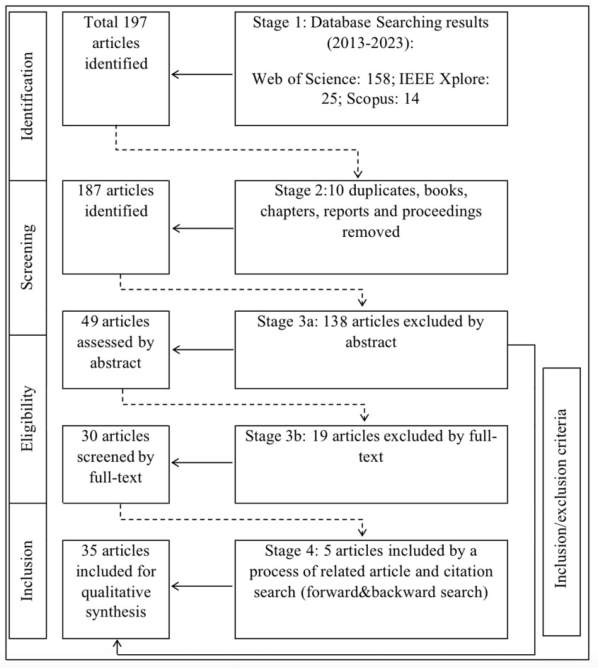
The search strategy for this study involves four main steps: (a) Identifica- tion, (b) Screening, (c) Eligibility, and (d) Inclusion. To align with the research aim and question, the first stage involves identifying relevant search terms for this study, and the search string was structured using Boolean searching prin- ciples as follows: TITLE-ABS-KEY ((“mobility applications” OR “mobility apps” OR “MaaS” OR “Mobility as a Service” OR “mobility interface” OR “mobility information system”) AND (“elderly mobility” OR “older people mobility” OR “aging mobility” OR “ageing mobility”) AND (“acceptance” OR “adoption” OR “intention”)), leading to the discovery of 197 articles. The second phase involved a thorough screening based on specific criteria (see Table 1), reducing the count to 187 by removing duplicates, books, chapters, and reports. The abstracts of these articles were then reviewed, including those covering a broader age range and focusing on smart mobility appli- cations for those with physical, sensory, or cognitive impairments, due to the mobility challenges often faced by older adults. This was followed by a detailed full-text review of 30 articles to check their eligibility. The final count of articles for review stood at 35 after excluding 19 more articles and adding 3 from a forward search and 2 from a backward search. This entire process is illustrated in Figure 1.
Table 1. Criteria for literature selection.
Table available in the original PDF paper.
Inclusion criteria Exclusion criteria Books, chapters, handbook, reports English-language articles Not written in English language Studies focus on the research aim and question
Studies only focus on older people’s preferences
Include only the theoretical framework, without any results or findings The subjects is limited in transportation field
Only consider the technical aspects without the users’ point of view Articles published between 2013 to 2023 Not relevant to the research goal and question
Exploring the Relationship Between Acceptance and Usage Intention 65
Figure 1: Procedure for systematic literature search.
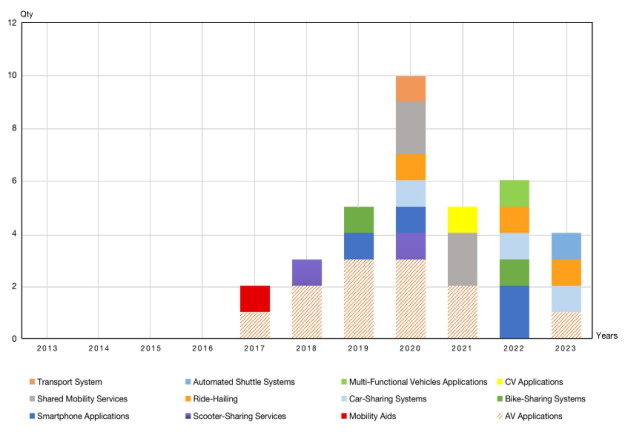
Descriptive Analysis In recent years, the topic of smart mobility applications designed to improve mobility for older adults has garnered significant attention. However, research into the acceptance and intention of older adults to use these emerg- ing smart mobility applications did not begin until 2017. Boerema et al. (2017) proposed the use of design sketches as an assistive tool, specifically aimed at giving older adults comprehensible insights into mobility-related ser- vices, thereby assess and shape their attitudes and preferences regarding the use of such services. Since that, the field has seen a surge of academic interest. Notably, the majority of researches from 2017 to 2020, including 12 articles, concentrated on the operator interface of Autonomous Vehicles (AVs). How- ever, over the past two years, the research domain has expanded to include 11 other areas. This expansion includes 4 articles on shared mobility services, 4 on smartphone applications, 3 each on car-sharing systems and ride-hailing, 2 each on bike-sharing and scooter-sharing services, and 1 each on Connected Vehicle (CV) applications, multi-functional vehicle applications, automated shuttle systems, mobility aids, and transport systems. Figure 2 illustrates this shift, showing a growing trend in the development of diverse applications to
66 An
improve elderly mobility, particularly marked by a notable increase in variety beginning in 2020.
Figure 2: Trend analysis of publications involving application areas that influence older people’s acceptance and usage intention.
RESULT AND DISCUSSION
Numerous studies have delved into the attitudes and preferences of older individuals toward specific smart information-sharing systems across various application fields. These studies primarily aimed to identify the most pressing concerns of older people regarding smart mobility applications, employing a combination of qualitative and quantitative methods, such as combined online surveys and focus groups methods (Robertson et al., 2019; Faber and van Lierop, 2020), to gather genuine feedback from diverse older demograph- ics. Additionally, numerous studies are based on established or expanded theoretical models that guide the development of their survey questions. For instance, some are based on the Technology Acceptance Model (TAM), hypothesizing about various predictors influencing older adults’ intention to use these technologies (Chen, 2019; Cherrilene et al., 2021).
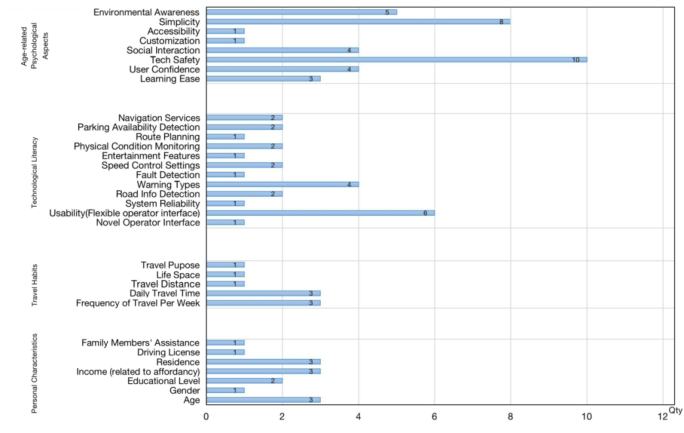
The analysis of the selected articles resulted in a refined categorization into four key clusters, crucial for understanding the factors influencing older adults’ acceptance and use of smart mobility applications: personal characteristics, travel habits, technological literacy, and age-related psycho- logical aspects Each broad category is further detailed to highlight specific concerns of older people, like their increased focus on security aspects of smart mobility apps (Miller et al., 2020; Miah et al., 2020; Liang et al., 2020; Greenwood & Baldwin, 2022), encompassing concerns about privacy breaches and technological delays that could lead to unavoidable risks.
Exploring the Relationship Between Acceptance and Usage Intention 67
Figure 3: Factors affecting elderly people’s use and accept of smart mobility applications.
Figure 3 illustrates the factors influencing elderly individuals’ acceptance and usage intention of smart mobility applications. Generally, older adults show a positive attitude toward new smart mobility applications (Kaplan et al., 2018; Booth et al., 2022; Oxley et al., 2022; Chua et al., 2023), dis- playing a willingness to enhance their mobility through learning and training. This is particularly relevant as many lack the technological knowledge nec- essary to utilize assistive applications for travel. Despite their openness to new technologies, they are less inclined to change their travel habits due to new apps. For instance, Nikiforiadis et al. (2019) introduced a bike-sharing app, TheseBike, featuring advanced applications to offer detailed informa- tion about bike rental systems, including site locations and real-time status. However, it seems that older adults are less inclined to use these apps and subsequently alter their travel behavior. Moreover, older adults tend to pre- fer learning about necessary technology through traditional means such as paper manuals rather than auxiliary information provided by applications. Greenwood & Baldwin (2022) found that older people are more inclined to learn about Advanced Driver-Assistance Systems (ADAS) from the vehi- cle’s owner’s manual. Nonetheless, older people highlighted key factors that could encourage them to use these apps. The most influential of these was how their psychological profile influenced their personal preferences, partic- ularly in terms of security and ease of use (Miller et al., 2020). Additionally, there is a consideration of the environmental impact associated with using AVs through these apps (Kaplan et al., 2018). Also, building confidence and promoting social interaction are crucial in encouraging older individuals to use these apps (Millonig, 2019; Skrickij et al., 2020; Provencher et al., 2022), as they significantly influence their adoption.
68 An
The degree to which older people understand technology significantly influences their acceptance and use of smart mobility applications. This can be categorized into two key areas. Firstly, the user-friendliness of the app’s interface plays a crucial role. It’s important that the interface is clear, easy to navigate, and includes an assisted search function to help the elderly easily find and understand different programs. Secondly, it’s essential that the apps provide clear and concise information about its services, ensuring users can easily understand its features. For example, Li et al. (2021) highlight this by illustrating how various types of warning information, such as visual, audi- tory, and tactile alerts, can assist older individuals in accessing information more effectively. This level of comprehension often correlates with their edu- cational background. Older adults with a higher education level are typically more eager to learn about mobility applications that facilitate their travels. Furthermore, those who frequently travel or have a passion for travel are more inclined to explore apps related to smart travel. They prefer to dedicate time in understanding the new features and information provided by these apps, which can enhance the efficiency and quality of their journeys, thereby reducing travel delays and potential risks caused by a lack of knowledge.
Additionally, there is a gender-based difference in attitudes towards learn- ing and operating multiple interfaces of AVs. Male drivers tend to be more open to learning and using these systems compared to female drivers. Older individuals living in urban areas also demonstrate a higher willingness to adopt such apps. This is likely influenced by the more advanced smart travel policies in urban settings, which provide a variety of travel options including ride-hailing services and shared bicycle systems. Conversely, older residents in rural areas often show more resistance, possibly due to a lack of rele- vant knowledge, making them less open to the changes these mobility apps introduce to their travel habits.
CONCLUSION
Developing innovative mobility applications is a crucial component in advancing transportation systems. And, creating age-friendly mobility apps for older users is essential in aligning with the global trend of meeting the needs of an aging population. The objective of this study is to explore the dif- ferent contexts in which these mobile applications are utilized and to identify the factors that affect users’ willingness to adopt them. These factors include personal characteristics, travel habits, technological literacy, and age-related psychological aspects. The findings reveal an increasing emphasis on explor- ing older people’s views on using mobility apps across various platforms, such as shared mobility and public transportation services, rather than solely examining their attitudes towards autonomous vehicles. And, the reviewed literature clearly shows that older males with higher education levels, espe- cially those residing in urban areas, are more inclined to adapt to the changing travel patterns facilitated by advanced mobility applications. Additionally, elderly individuals who travel frequently view these apps as essential tools for convenient travel. Given the elderly’s limited capacity for adopting new tech- nology, one of the primary challenges for designers is to create applications
Exploring the Relationship Between Acceptance and Usage Intention 69
that are both user-friendly and easy to understand. Similarly, the implementa- tion of various policies and targeted incentives plays a key role in encouraging the widespread adoption and use of these mobile applications among older users.
Furthermore, it is important to acknowledge that the lack of research focusing entirely on older adults’ acceptance and intention to use smart mobility apps necessitated the inclusion of broader demographic surveys in this study. This approach aimed to capture overall attitudes and concerns. However, it also resulted in less clarity regarding the specific influences affect- ing older adults, as the findings were drawn from a wider population base. Additionally, this review did not consider grey literature and other relevant reports, potentially overlooking some pertinent research, thus affecting the accuracy of the impact factors. Despite these limitations, the article employed a strict literature selection process, including forward and backward searches, to uncover more relevant studies. This approach enabled us to identify the key factors influencing older people’s adoption of smart transport apps for trav- elling and to gain a clearer understanding of their travel needs. To a certain extent, this study provides valuable insights for smart city policymakers and transport planners, and provides guidance for the future goal of developing age-friendly urban transport systems.
REFERENCES
Al-Shariff, Alam, M., Ahmad, Z. and Ahmad, F. (2019). Smart Transportation System: Mobility solution for Smart Cities. In: 2nd Smart Cities Symposium (SCS 2019), p. 59. doi.org/10.1049/cp.2019.0232. Anstey, K. J., Wood, J., Lord, S., & Walker, J. G. (2005). Cognitive, sensory and phys-
ical factors enabling driving safety in older adults. Clinical Psychology Review, 25(1), 45–65. https://doi.org/10.1016/j.cpr.2004.07.008 Bartley, and O’Neill, D. (2010). Transportation and driving in longitudinal studies on ageing. Age and Ageing, 39(5), pp. 631–636. doi.org/10.1093/ageing/afq089. Boerema, van Velsen, L., Vollenbroek-Hutten, M. M. R. and Hermens, H. J. (2017). Value-based design for the elderly: An application in the field of mobility aids. Assistive Technology, 29(2), pp. 76–84. doi.org/10.1080/10400435.2016.1208303. Booth, Tan, T., Norman, R., Anund, A. and Pettigrew, S. (2022). Experiences of
older adults interacting with a shared autonomous vehicle and recommendations for future implementation. Transportation Research Part F: Traffic Psychology and Behaviour, 90, pp. 100–108. doi.org/10.1016/j.trf.2022.08.014. Brinkley, Huff, Jr, Earl, Posadas, B., Woodward, J., Daily, S. and Gilbert, J.
(2020). Exploring the Needs, Preferences, and Concerns of Persons with Visual Impairments Regarding Autonomous Vehicles. ACM Transactions on Accessible Computing, 13(1), pp. 1–34. doi.org/10.1145/3372280. Chen. (2019). Factors affecting the decision to use autonomous shuttle services: Evidence from a scooter-dominant urban context. Transporta- tion Research Part F: Traffic Psychology and Behaviour, 67, pp. 195–204. doi.org/10.1016/j.trf.2019.10.016. Chua, Lim, W. M. and Teh, P.-L. (2023). Designing age-friendly mobile apps: Insights from a mobility app study. Activities, Adaptation, & Aging, [online] (ahead-of- print), pp. 1–21. doi.org/10.1080/01924788.2023.2213028.
70 An
Classen, Mason, J. R., Hwangbo, S. W. and Sisiopiku, V. (2021). Predicting Autonomous Shuttle Acceptance in Older Drivers Based on Technology Readi- ness/Use/Barriers, Life Space, Driving Habits, and Cognition. Frontiers in Neurol- ogy, 12, 798762. doi.org/10.3389/fneur.2021.798762. Dickerson, Molnar, L. J., Eby, D. W., Adler, G., Bédard, M., Berg-Weger, M.,
Classen, S., Foley, D., Horowitz, A., Kerschner, H., Page, O., Silverstein, N. M., Staplin, L. and Trujillo, L. (2007). Transportation and Aging: A Research Agenda for Advancing Safe Mobility. The Gerontologist, 47(5), pp. 578–590. doi.org/10.1093/geront/47.5.578. Faber, and van Lierop, D. (2020). How will older adults use automated vehicles? Assessing the role of AVs in overcoming perceived mobility barriers. Transportation Research Part A: Policy and Practice, 133, pp. 353–363. doi.org/10.1016/j.tra.2020.01.022. Greenwood, and Baldwin, C. L. (2022). Preferred Sources of Information, Knowl-
edge, and Acceptance of Automated Vehicle Systems: Effects of Gender and Age. Frontiers in Psychology, 13, 806552. doi.org/10.3389/fpsyg.2022.806552. Kaplan, Wrzesinska, D. K. and Prato, C. G. (2018). The role of human needs in the intention to use conventional and electric bicycle shar- ing in a driving-oriented country. Transport Policy, 71, pp. 138–146. doi.org/10.1016/j.tranpol.2018.09.010. Kim, and Ulfarsson, G. F. (2013). Transportation in an Aging Society. Transportation Research Record, 2357(1), pp. 109–115. doi.org/10.3141/2357-13. Li (2023). Revisiting the relationship between information and communica- tion technologies and travel behavior: An investigation of older Americans. Transportation Research Part A: Policy and Practice, 172, pp. 103689. doi.org/10.1016/j.tra.2023.103689. Li, Wu, G., Yao, D., Zhang, Y., Barth, M. J. and Boriboonsomsin, K. (2021).
Stated acceptance and behavioral responses of drivers towards innovative con- nected vehicle applications. Accident Analysis and Prevention, 155, 106095. doi.org/10.1016/j.aap.2021.106095. Li, L., Zheng, Y., Zheng, S., & Ke, H. (2020). The new smart city programme: Evaluating the effect of the internet of energy on air quality in China. Science of The Total Environment, 714, 136380. https://doi.org/10.1016/j.scitotenv.2019. 136380. Liang, Lau, N., Baker, S. A. and Antin, J. F. (2020). Examining Senior Drivers’ Atti-
tudes Toward Advanced Driver Assistance Systems After Naturalistic Exposure. Innovation in Aging, 4(3), igaa017. doi.org/10.1093/geroni/igaa017. Liang. (2015). Research Proposal on Reviewing Augmented Reality Applications for Supporting Ageing Population. Procedia Manufacturing, 3, pp. 219–226. doi.org/10.1016/j.promfg.2015.07.132. Lopez-Carreiro, Monzon, A. and Lopez-Lambas, M. E. (2021). Comparison of the
willingness to adopt MaaS in Madrid (Spain) and Randstad (The Netherlands) metropolitan areas. Transportation Research Part A: Policy and Practice, 152, pp. 275–294. doi.org/10.1016/j.tra.2021.08.015. Maresova, P., Krejcar, O., Barakovic, S., Barakovic Husic, J., Lameski, P., Zdravevski, E., Chorbev, I., & Trajkovik, V. (2020). Health–Related ICT Solutions of Smart Environments for Elderly–Systematic Review. IEEE Access, 8, 54574–54600. http s://doi.org/10.1109/ACCESS.2020.2981315. Maresova, P., Krejcar, O., Maskuriy, R., Bakar, N. A. A., Selamat, A., Truhlarova,
Z., Horak, J., Joukl, M. and Vítkova, L. (2023). Challenges and opportunity in mobility among older adults - key determinant identification. BMC Geriatrics, 23(1), pp. 447–447. doi.org/10.1186/s12877-023-04106-7.
Exploring the Relationship Between Acceptance and Usage Intention 71
Miah, Naz, F., Hyun, K., Mattingly, S. P., Cronley, C. and Fields, N. (2020). Barriers and opportunities for paratransit users to adopt on- demand micro transit. Research in Transportation Economics, 84, 101001. doi.org/10.1016/j.retrec.2020.101001. Miller, Chng, S. and Cheah, L. (2020). Understanding acceptance of shared autonomous vehicles among people with different mobility and communication needs. Travel Behaviour & Society, 29, pp. 200–210. doi.org/10.1016/j.tbs.2022.06.007. Nikiforiadis, Chrysostomou, K. and Aifadopoulou, G. (2019). Exploring Travelers’ Characteristics Affecting their Intention to Shift to Bike-Sharing Systems due to a Sophisticated Mobile App. Algorithms, 12(12), 264. doi.org/10.3390/a12120264. Oxley, Logan, D. B., Coxon, S. and Koppel, S. (2022). Understanding Current
and Future Transport Needs of Older Australian Drivers to Guide Development of Sustainable and Smart Initiatives to Support Safe Mobility of Older Adults. Sustainability (Basel, Switzerland), 14(10), 5906. doi.org/10.3390/su14105906. Provencher, Baillargeon, D., Abdulrazak, B., Boissy, P., Levasseur, M., Delli- Colli, N., Pigot, H., Audet, M., Bahrampoor Givi, S. and Girard, C. (2022). Developing a One-Stop Platform Transportation Planning Service to Help Older Adults Move Around in Their Community Where, When, and How They Wish: Protocol for a Living Lab Study. JMIR Research Protocols, 11(6), e33894. doi.org/10.2196/33894 . Robertson, Woods-Fry, H., Vanlaar, W. G. M. and Mainegra Hing, M. (2019).
Automated vehicles and older drivers in Canada. Journal of Safety Research, 70, pp. 193–199. doi.org/10.1016/j.jsr.2019.07.003. Rocha, Bastardo, R., Pavão, J., Santinha, G., Rodrigues, M., Rodrigues, C., Queirós, A. and Dias, A. (2021). Smart Cities’ Applications to Facilitate the Mobility of Older Adults: A Systematic Review of the Literature. Applied Sciences, 11(14), 6395. doi.org/10.3390/app11146395. Safdar, Jamal, A., Al-Ahmadi, H. M., Rahman, M. T. and Almoshaogeh, M. (2022).
Analysis of the Influential Factors towards Adoption of Car-Sharing: A Case Study of a Megacity in a Developing Country. Sustainability (Basel, Switzerland), 14(5), 2778. doi.org/10.3390/su14052778. Semanjski, Mandzuka, S. and Gautama, S. (2018). Smart Mobil- ity. In: 2018 International Symposium ELMAR, pp. 63–66. doi.org/10.23919/ELMAR.2018.8534693. Skrickij, Šabanoviˇc, E. and Žuraulis, V. (2020). Autonomous road vehicles: recent issues and expectations. IET Intelligent Transport Systems, 14(6), pp. 471–479. doi.org/10.1049/iet-its.2018.5513. Susilawati, and Lim, T. S. (2021). A study of the scheduling effect on shared
autonomous vehicles adoption. Transportation Research Interdisciplinary Per- spectives, 10, 100394. doi.org/10.1016/j.trip.2021.100394. Tahir, Abdulrazak, B., Baillargeon, D., Girard, C. and Provencher, V. (2023). Adapting Transportation Planning e-Tools to Older Adults’ Needs: Scoping Review. JMIR Aging, 6, e41938. doi.org/10.2196/41938. Talmage, Knopf, R. C., Wu, T., Winkel, D., Mirchandani, P. and Candan, K. S. (2021).
Decreasing Loneliness and Social Disconnectedness among Community-Dwelling Older Adults: The Potential of Information and Communication Technologies and Ride-Hailing Services. Activities, Adaptation, & Aging, 45(2), pp. 89–117. doi.org/10.1080/01924788.2020.1724584.
72 An
Wen-Hui Chou, Yu-Ting Lai, and Kuang-Hsia Liu. (2010). Decent digital social media for senior life: A practical design approach. In: 2010 3rd International Conference on Computer Science and Information Technology, 4, pp. 249–253. doi.org/10.1109/ICCSIT.2010.5565189. Ye, Zheng, J. and Yi, F. (2020). A study on users’ willingness to accept mobility as
a service based on UTAUT model. Technological Forecasting & Social Change, 157, 120066. doi.org/10.1016/j.techfore.2020.120066. Zandieh, and Acheampong, R. A. (2021). Mobility and healthy ageing in the city: Exploring opportunities and challenges of autonomous vehicles for older adults’ outdoor mobility. Cities, 112, 103135.
LISTED IN THE AHFE DIGITAL BOOKSTORE CATALOGUE
Explore the complete digital volume
Accessibility, Assistive Technology and Digital Environments
Read this individual research paper free through the original publisher, or explore the full digital proceedings book.
ISBN 978-1-958651-97-1
Explore this ISBN in the AHFE Bookstore ↗Listed in the July 2026 bookstore catalogue; search by ISBN to confirm current availability · Digital book purchase optional