Panagiotis Mitropoulos (2024). The Role of the Production Control and Safety Management Systems in Construction Safety Performance. In: Human Aspects of Advanced Manufacturing, Production Management and Process Control. AHFE Open Access, vol. 146, pp. 215–222. https://doi.org/10.54941/ahfe1005167
This paper explains how the likelihood of accidents on a construction project is shaped by two systems: (1) the Production Control System, and (2) the Safety Management System. The Safety Management System (SMS) includes all the policies, programs and efforts to control the hazards and the workers’ safety-related behaviors. The Production Control System (PCS) includes all the processes and criteria that produce the work plans and ultimately, the work assignments for the workers. An ineffective PCS creates high-risk situations, such as unexpected conditions, high workload and production pressures, frustration, rushing, fatigue, and conflicts between production and safety. These situations undermine the SMS and increase the likelihood of violations, errors and accidents. An effective PCS produces high quality work assignments for the crews, mitigates the task demands on the workers and reduces the potential for errors even under exposure to hazards. The framework provides an integrated understanding of the project systems that shape the development of construction accidents. Traditional accident prevention strategies focus on increasing compliance by strengthening the SMS. Such efforts to control hazards are important, they cannot overcome the problems of an ineffective PCS. Thus, to improve safety performance it is necessary to improve the production control system.
In 2022 the US construction industry employed 4.8% of all industries and had 19.2% of the fatal work injuries (Bureau of Labor Statistics, 2023). The 1,056 fatal work injuries increased the US construction fatality rate to 9.6 per 100,000 FTE workers. Despite the increased safety efforts in construction, the fatality rate has remained plateaued in the last 15 years.
With regards to safety management, Rasmussen (1994) identifies three paradigms: (1) the normative paradigm, (2) the human error paradigm, and (3) the cognitive engineering paradigm. The normative paradigm focuses on prescriptive theories concerning the way people ought to act with regards to hazards. Efforts to prevent occupational accidents focus on control of hazards and safe rules of conduct. Normative practices attempt to control workers’ behaviors through normative instruction of the ‘one best way,’ selection and development of competent personnel, and motivation and pun- ishment. Typical responses to errors and accidents are increased training and
selection practices to eliminate ‘error-prone’ individuals, and have the rest try harder through ‘zero defects’ programs (Rasmussen, 1994). Safety practices in construction are based on this paradigm.
The human error paradigm focuses on the deviations from the normative, “best way”of working—that is errors and biases. This paradigm views errors and violations as a human “malfunction.” It includes studies of errors (Rigby, 1970; Rasmussen et al., 1981), management errors and resident pathogens (Reason, 1990). Efforts to prevent accidents focus on removing causes of errors.
The cognitive engineering paradigm is concerned with the characteristics of the work system (the features of the task, tools and work context) that influence the decisions, behaviors and the possibility of errors and failures (Rasmussen et al., 1994). From a cognitive perspective, an error is not simply a human failure but a symptom of a problem in the work system (Hollnagel and Woods, 2005). The cognitive engineering approach to safety attempts to prevent accidents by designing work systems that are adapted to people and avoid operators’ overload and errors. This paper takes a cognitive engi- neering perspective of construction safety, and develops a framework that examines how the production control system and the safety management system together shape the safety outcomes of construction operations.
BACKGROUND
In construction, safety strategies are based on a normative paradigm. Safety strategies focus on the reduction of hazards through engineering, and the control of hazards through barriers and administrative procedures—that is, safety rules that prescribe how workers must interact with the various hazards. The essential elements of formal safety practices are rules and proce- dures, training, and enforcement and motivation so that the workers follow the safety rules (Hill, 2004; Mascini and Bacharias, 2012; Garner, 2004). Efforts towards behavior-based safety and safety culture also aim at increas- ing the workers’ voluntary compliance with safety rules (Li et al., 2015; Choundhry et al., 2007; Al-Bayati, 2021).
The compliance approach has contributed to the reduction of accidents, but it also has theoretical and practical limitations as it neglects the impor- tant role of work practices and context in the production of accidents. Several construction researchers have emphasized the influence of production factors on safety. Hinze and Parker (1978) found that job pressures and crew compe- tition are related to more injuries, and suggested that job practices are more important than safety policies in preventing accidents. Hinze (1979) found that crews with higher turnover also had higher accident rates. Suraji et al. (2001) argued that project conditions, design decisions or management deci- sions can cause responses that create inappropriate conditions or actions that lead to accidents. Scarf et al. (2001) argued that a very dynamic environment and a constant change is a key feature of hazardous work environments.
Compliance with safety requirements is strongly influenced by the pro- duction system elements that shape the work situations, production pres- sures and worker behaviors (Rasmussen, 1994; McLain and Jarrell, 2007; Choudhry and Fang, 2008; Hollnagel et al., 2006; Veltri et al., 2013; Han et al., 2014; Hashemian et al., 2023).
The Role of the Production Control and Safety Management Systems 217
Construction work involves a large number of dynamic and hazardous processes (Scharf et al., 2001) that are adapted to the project-specific require- ments and context. Construction work involves significant physical, mental, and temporal task demands (Memarian and Mitropoulos, 2010, 2016; Mitropoulos and Memarian, 2013), The combination of the various demands create high workload (Wood, 1986), fatigue (Zong et al., 2024) and create high potential for errors and accidents. Task demands significantly affect task performance. In general, when task demands exceed an individual’s capacity, the likelihood of errors increases and performance decreases (Wood, 1986).
Rasmussen (1994) explains how workers’ behaviors tend to migrate closer to the ‘boundary of loss of control’ due to two primary pressures: the pro- duction pressures for increased efficiency, and the tendency for least effort, which is a response to increased workload. Construction researchers adopted this proposed this perspective of safety in the construction context (Howell et al., 2002; Mitropoulos et al., 2003; Saurin et al., 2008; Mitropoulos et al., 2009).
PROJECT SYSTEMS AFFECTING SAFETY The above discussion briefly highlights the importance of production factors for safety. On project-based organizations, the organizational system that shapes the production context is the production control system. The produc- tion system determines, to a large extent the work division, task allocation, sequencing, workload and pace, coordination, etc. The paper discusses how the safety outcomes of a construction project are a function of two pri- mary organizational systems: (1) the Safety Management System, and (2) the Production Control System.
Safety Management System The Safety Management System (SMS) includes all the safety policies, pro- grams and efforts that aim at controlling the hazards and the workers’ safety-related behaviors. This includes management efforts towards safety, safety policies, training programs, safety resources (in personnel and equip- ment), site audits, safety enforcement, efforts to increase safety-related workers’ motivation, safety culture, and all the efforts and programs that increase the likelihood of safe behaviors. A strong safety system is expected to result in fewer unsafe conditions and behaviors that a weaker safety sys- tem (under similar organizational and project conditions), and to result in better safety performance. However, factors related to production (produc- tion pressures, work organization, etc.) are considered outside of the scope of the safety management system.
Production Control System The production control system (PCS) includes all the processes, actions, deci- sions and criteria that produce the work assignments for the workers (Ballard and Howell, 1998). The PCS defines the scope of work to be performed, and the work directives (information, methods, and performance requirements); establishes the production goals; provides the required resources (tools and equipment and material) and labor with the appropriate capabilities. An
218 Mitropoulos
effective production system creates reliable work assignments – that is there is high confidence that the work will be performed as planned.
With regards to safety, the PCS is important because it generates the task demands on the workers. An ineffective production control system will gen- erate work assignments with high task demands that do not meet the above criteria. Such assignments create work situations with more opportunities for errors and violations (Mitropoulos and Nichita, 2010; Memarian and Mitropoulos, 2016).
Unexpected work situation, such as unexpected scope or work conditions may lead to not having all the required equipment, tools, and material. This can create trade-off situations between safety and production. For example, if the appropriate equipment is not available, the workers will have to choose between waiting for the equipment or “make-do” using the means available.
High workload and production pressures can lead to rushing, frustration and distractions, and increase the task difficulty, and the likelihood of violations and errors. Such production situations can result from project acceleration or poorly managed project changes that are forced into the field with the expectation of high production to maintain the schedule.
Tasks with high physical, high complexity or high mental demands have high likelihood of errors or reduced performance.
Poor task allocation may result in crew members performing tasks that are not skilled enough to do correctly. Fatigue, distractions and interruptions can also reduce the workers’ applied capabilities.
These situations increase the likelihood of violations and errors.
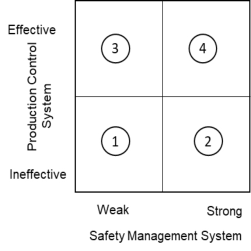
CLASSIFICATION FRAMEWORK Based on the two major systems that influence safety—that is, the production control system (PCS) and the safety management system (SMS), construc- tion operations can be classified into four general categories, as illustrated in Figure 1: (1) Operations with ineffective PCS and weak SMS. (2) Operations with ineffective PCS and strong SMS. (3) Operations with effective PCS and poor SMS. (4) Operations with effective PCS and strong SMS.
Figure 1: Four production situations depending on PCS and SMS.
The Role of the Production Control and Safety Management Systems 219
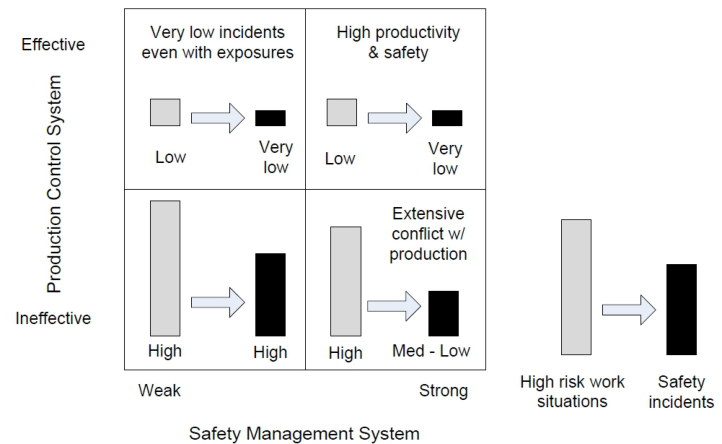
Situation 1: Ineffective PCS and Weak SMS In such situations, the ineffective PCS generates many high risk situations. The crew may not be well prepared for the work (possibly another activity was disrupted and the workers were sent to another task), the work condi- tions or requirements may be different than what the crew expected, high production pressures create rushing and frustration, the required resources (for production or safety) may not be available, the manpower is not ade- quate for the tasks, workers may be assigned work they are not trained to do, etc. Overall, the PCS creates may trade-offs between production and safety. It also increases interruptions, frustration, and rushing.
At the same time, a weak safety system provides inadequate training and controls, it may not identify or remove hazards, and may not provide the safety equipment required. Thus, the combination of ineffective produc- tion control and weak safety system is expected to result in more high-risk situations, and high levels of accidents.
Situation 2: Ineffective PCS and Strong SMS In such situations, the ineffective PCS generates many high risk situations. The workers may be rushed, stressed or frustrated and face many situations where there is a trade-off between productively and safety. However, there is a strong SMS that emphasizes the importance of safety, provides training, there are regular safety audits, etc. Under these conditions, the safety system can be overworked (and overwhelmed), fighting back the problems gener- ated by the poor production control system. As violations, near misses and incidents start to occur, the typical management response is to increase the safety effort by adding safety personnel, safety inspections, safety rewards and incentives. Such measures however do no improve the production con- trol system. Typically, they slow down production and further increases the conflict between safety and production.
Situation 3: Effective PCS and Weak SMS In such situations, there is limited / minimal formal SMS such as formal safety training and enforcement of safety rules. As a result, workers have greater exposure to hazards that operations with strong SMS. On the other hand, the effective PCS produces high quality work assignments. Work activities are well prepared with appropriate material, tools, equipment, manpower and time. The effective production control system allows the crew to avoid situations of excessive workload and task demands, production pressures, rushing, frustration, confusion and excessive fatigue. etc. This makes it pos- sible to avoid mistakes and cope effectively with the exposures to hazards that are not controlled by the weak safety system. Studies of an exceptional supervisors (Mitropoulos and Cupido, 2009) found that a very well managed production system resulted in exceptional productivity and safety, despite the limited safety measures.
Situation 4: Effective PCS and Strong SMS In these situations the effective PCS reduces the unpredictability, complexity and difficulty of the work, making easier for the workers to perform the work
220 Mitropoulos
without rushing, mistakes, shortcuts and violations. The strong SMS provides the safety training and controls, and the PCS allows the time for the safety tasks. These situations illustrate that a well-designed production system can achieve exceptional production and safety without friction and trade-offs.
Implications for Construction Accidents The different production situations create different potential for accidents because of two main factors. First, they create different amount of high- risk situations and second, they create different likelihood (potential) for a high risk situation to result in a safety incident. This is because the task demands influence the workers’ ability to avoid mistakes and interact “suc- cessfully”with the hazards when they are under exposure. Figure 2 illustrates the implications for the different situations.
Figure 2: Situations and safety outcomes.
CONCLUSION
The paper proposed a new framework that described how the PCS and the SMS shape the safety of construction operations. The paper argues that an effective PCS prevents variability and errors and is essential in preventing accidents, as they generate “high quality work situations” for the work- ers. Such situations mitigate the task demands and reduce the opportunities for errors and violations. On the contrary, an ineffective production system generates low quality work situations. Safety efforts create further friction with production, and the safety outcomes are likely to be poor. This is not to say that strong efforts to control hazards are not important, but they are not sufficient to overcome the problems of an ineffective production system.
The Role of the Production Control and Safety Management Systems 221
The implication of this perspective is that improving the effectiveness of the production control system should be a key strategy for safety improvement. However, in construction organizations, the functions of safety management and production control are not integrated. The framework provides another set of questions and criteria that project safety needs to address—such as the task design and complexity, the schedule pressures, the workload etc. Thus, a closer and more integrated effort between production and safety efforts is needed, with a focus on the production control system.
REFERENCES
Al-Bayati, Ahmed Jalil. “Impact of construction safety culture and construction safety climate on safety behavior and safety motivation.” Safety 7.2 (2021): 41. Bureau of Labor Statistics (2023) “Census of Fatal Occupational Injuries Summary,
2022” https://www.bls.gov/news.release/cfoi.nr0.htm. Choudhry, R. M., Fang D. (2008) “Why operatives engage in unsafe work behavior: Investigating factors on construction sites”, Safety Science, 46 (4), 566–584. Choudhry R. M., Fang D., and Mohamed S. (2007) “Developing a model of con-
struction safety culture.” Journal of management in engineering 23.4: 207–212. Garner, C. (2004) “Construction Safety Program Essentials.” In Construction Safety Management and Engineering (Darryl C. Hill, ed.), American Society of Safety Engineers. Hill, D. C. 2004 Construction Safety Management and Engineering, American
Society of Safety Engineers. Hollnagel E, Woods DD 2005. Joint Cognitive Systems: Foundations of Cognitive Systems Engineering. Boca Raton, FL, CRC Press; 2005. Hinze, J., and Parker, H. W. 1978. “Safety, productivity and job pressures.” J. of the
Const. Div. ASCE, 104(1): 27–35. Hinze, J., and Gordon, F. 1979. “Supervisor-worker relationship affects injury rate.”
Journal of the Construction Division, 105(3): 253–261. Han, S., Saba, F., Lee, S., Mohamed, Y., & Peña-Mora, F. (2014). Toward an understanding of the impact of production pressure on safety performance in construction operations. Accident analysis & prevention, 68, 106–116. Hashemian, S. M., Triantis, K (2023) “Production pressure and its relationship to
safety: A systematic review and future directions” Safety Science, Vol. 159. Hollnagel, E.; Woods, D.; Leveson, N. (2006) (Eds.) Resilience engineering: concepts and precepts. London: Ashgate. Howell, G. A., Ballard G., Abdelhamid TS, and Mitropoulos P. (2002) “Working
near the edge: A new approach to construction safety” Proceedings., 10th Annual Conference on Lean Construction, IGLC, 49–60. Li, H., Lu, M., Hsu S-C, Gray M., Huang T. (2015) “Proactive behavior-based safety management for construction safety improvement” Safety Science, Vol. 75, 107–117. Mascini, P., and Bacharias Y. (2012) “Integrating a Top-Down and a Bottom-Up
Approach: Formal and Informal Risk-Handling Strategies in a Utility Company” Risk Analysis, Vol. 32, No. 9, 1547–1560. McLain D. L., Jarrell K. A. (2007) “The perceived compatibility of safety and production expectations in hazardous occupations” Journal of Safety Research, 38, pp: 299–309. Memarian B. and Mitropoulos, P. (2010) “Effect of Work Practices on Task Demand
and Performance of Construction Workers: A Case Study of Masonry Crews.” XXIInd Annual International Occupational Ergonomics and Safety Conference, June 10–11, Tempe, Arizona.
222 Mitropoulos
Memarian, B. and Mitropoulos P. (2016) “Production practices affecting worker task demands in concrete operations: A case study” Work 53 (3), 535–550. Mitropoulos, P., and Cupido, G. (2009). “Safety as an Emergent Property: An Inves-
tigation into the Work Practices of High Reliability Framing Crews,” ASCE J. of Constr. Engrg. & Mgt., 135 (5), 407–415. Mitropoulos, P., Cupido, G., and Namboodiri, M., (2009). “Cognitive Approach to Construction Safety: Task Demand-Capability Model.” Journal of Construction Engineering and Management, 135(9): 881–889. Mitropoulos, P., Howell, G. A., Reiser P. (2003) “Workers at the edge; hazard recog-
nition and action” Proceedings, 11th Annual Conference on Lean Construction, IGLC, 22–24. Mitropoulos, P. and Memarian B. (2013) “Task Demands in Masonry Work: Sources, Performance Implications and Management Strategies”J. Constr. Eng. & Manage, ASCE, 139(5): 581–590. Mitropoulos, P. and Nichita T. (2010) “Critical concerns of production control sys-
tem on projects with labor constraints: Lessons from a residential case study”, ASCE, J.of Manage. in Engrg. 26 (3), 153–159. Rasmussen J. (1982) “Human Errors. A Taxonomy for Describing Human Malfunction in Industrial Installations” J. of Occup. Acc., 4, pp. 311–333. Rasmussen J., Pejtersen A. M., and Goodstein L. P 1994. Cognitive Systems
Engineering. John Wiley & Sons, Inc. NewYork, NY. Reason, J. T. 1990. Human Error. Cambridge University Press, New York, NY. Rigby, L. 1970. “The Nature of Human Error.” Annual Technical Conference Transactions of the American Society for Quality Control, pp. 475–566. Saurin, T. A., Formoso C. T., Cambraia, F. B. (2008). “An analysis of construc-
tion safety best practices from a cognitive systems engineering perspective.” Safety Science, 46(8): 1169–1183. Scharf, T., Vaught, C., Kidd, P., Steiner, L., Kowalski, K., Wiehagen, B., Rethi, L., and Cole, H. 2001 “Toward a Typology of Dynamic and Hazardous Work Environments.” Human and Ecological Risk Assessment, Vol. 7 (7): 1827–1841. Suraji A., Duff, A. R., and Peckitt S. J. 2001. “Development of Causal Model
of Construction Accident Causation.” Journal of Construction Engineering and Management, ASCE, 127(4), pp. 337–344. Veltri A., Pagell M., Johnston D., Tompa E., Robson L., Amick III B. C., and Macdonald S., (2013) “Understanding safety in the context of business operations: An exploratory study using case studies,” Safety Sci., 55: 119–134. Wood, R. E. (1986). “Task Complexity: Definition of the Construct.” Organizational
Behavior and Human Decision Processes, 37: 37–60. Zong H., Yi W., Antwi-Afari M. F., and Yu Y. (2024) “Fatigue in construction workers: A systematic review of causes, evaluation methods, and interventions, Safety science, Vol. 176, Aug 2024.
LISTED IN THE AHFE DIGITAL BOOKSTORE CATALOGUE
Explore the complete digital volume
Human Aspects of Advanced Manufacturing, Production Management and Process Control
Read this individual research paper free through the original publisher, or explore the full digital proceedings book.
ISBN 978-1-964867-22-9
Explore this ISBN in the AHFE Bookstore ↗Listed in the July 2026 bookstore catalogue; search by ISBN to confirm current availability · Digital book purchase optional