Ana Cardoso, Raquel Salomé (2024). Matter by Design. How Can the Circular Economy Play a Role in Building Green, Efficient and Sustainable Methods Through Innovative Use of Mediterranean Materials. In: Sustainable Construction in the Era of the Fourth Industrial Revolution. AHFE Open Access, vol. 149, pp. 72–82. https://doi.org/10.54941/ahfe1005276
Publisher statistics will load when you open Metrics.
AHFE OPEN ACCESS OPEN ACCESS CONFERENCE PROCEEDINGS PAPER
Matter by Design. How Can the Circular Economy Play a Role in Building Green, Efficient and Sustainable Methods Through Innovative Use of Mediterranean Materials
esad—Idea · Research in Design and Art; ESAD-College of Art and Design; Blue Design, Alliance; FCT — Fundação para a Ciência e a Tecnologia, Matosinhos, 4460-268, Portugal ↗
The shift towards a circular economy, moving away from the traditional linear "take, make, dispose" model, has gained momentum due to its potential for fostering green, efficient, and sustainable practices. Particularly in the Mediterranean region, characterized by its rich history, diverse ecosystems, and unique resources, there is a promising opportunity to implement these principles in construction and design methods.The Mediterranean abounds in resources from cork to ceramics, offering a diverse set of raw materials that can be sustainably harnessed. The challenge is to reimagine how these materials are sourced, processed, utilized, and eventually repurposed or recycled. Leveraging technology innovation, a product of the Fourth Industrial Revolution, may revitalize these traditional Mediterranean materials.One significant aspect of building a circular economy in the Mediterranean is the integration of traditional craftsmanship and techniques. Local artisans, who have been working with materials like cork and clay for generations, can blend these time-honoured methods with modern technology to create innovative products.This paper describes a project aimed at activating collective memory and cultural identity as a reference for design activity, fostering critical thinking to drive urban communities towards including Mediterranean materials in green building development. The project involves the conception and development of a modular-based product that incorporates both active and passive solar functions with aesthetic characteristics. The goal was to create a solar experimental product for cladding building surfaces (vertical and non-vertical façades), combining parts with passive solar characteristics—including solar protection elements, solar thermal energy storage, ventilated walls, and Trombe wall effects—with active solar parts such as solar thermal collectors and photovoltaic systems.The modular-based solar cladding product successfully improved energy efficiency and contributed to reducing the building's overall energy consumption. The incorporation of locally-sourced Mediterranean materials, such as cork, not only enhanced the sustainability of the product but also promoted the use of indigenous resources.In conclusion, the circular economy, when applied in conjunction with the innovative use of Mediterranean materials, can lead to a greener, more efficient, and sustainable future. By valuing and reimagining traditional craftsmanship, harnessing the potential of diverse resources, and embracing cutting-edge recycling technologies, the Mediterranean region can become a showcase for circular economy success, demonstrating how environmental stewardship and economic prosperity can go hand in hand.
Matter by Design. How Can the Circular Economy Play a Role 73
INTRODUCTION
The global shift towards sustainable practices and environmental responsi- bility has prompted a re-evaluation of traditional economic models, giving rise to the concept of the circular economy. Departing from the linear “take, make, dispose” model, the circular economy emphasizes the continual use, up-cycling, repurposing, and recycling of materials to minimize waste and promote sustainability. This paradigm shift gains particular significance when coupled with the innovative utilization of materials vernacular to the Mediterranean.
The Mediterranean, renowned for its rich history, diverse ecosystems, and unique resources, stands as an ideal starting point for implementing circular economy principles, especially within the realms of construction and design. This paper aims to explore the still untapped potential of Mediterranean materials, ranging from cork to ceramics, and their role in fostering green, efficient, and sustainable practices. The challenge lies in reimagining how these materials are sourced, processed, utilized, and eventually repurposed or recycled.
In the context this paper focuses on the integration of circular econ- omy principles with innovative technology to create sustainable solutions for the construction and design industry. The Mediterranean’s abundance of resources provides a diversified set of raw materials that, if harnessed sus- tainably, can contribute significantly to environmentally conscious practices.
In the pursuit of sustainable development within the context of green build- ing practices, a crucial facet in the Mediterranean region lies in strategically harnessing the rich tradition of craftsmanship and techniques inherent to the locale. This reservoir of traditional knowledge, when amalgamated with contemporary technological advancements, becomes a potent catalyst for the emergence of innovative products. This synergistic fusion not only con- tributes to the realization of sustainable building solutions but also propels the establishment of a market for locally-produced goods with environmental conscientiousness at its core.
Within the realm of sustainable construction, this paper intricately expounds upon the conceptualization and evolution of a modular ceramic- based product. This type of pioneering creations goes beyond conventional boundaries by seamlessly integrating both active and passive solar function- alities with distinct aesthetical attributes. Central to the project’s ethos is the strategic utilization of a spectrum of materials, ranging from time-honoured raw materials like cork to the cutting-edge domain of ceramics and advanced composites.
The presented project’s primary objective is to craft a sustainable and modular product expressly designed for cladding building surfaces. This endeavour represents a departure from the conventional paradigm, as it explores the synergistic potential embedded in the amalgamation of tradi- tional materials, known for its inherent sustainability, with the versatility and technical prowess offered by ceramics and advanced composites.
In essence, this paper underscores the transformative potential of inno- vative building materials, emphasizing the strategic synthesis of traditional
74 Cardoso and Salomé
wisdom with contemporary advancements. The resultant product, marked by its sustainability, modularity, and multifunctionality, not only aligns with the imperatives of sustainable construction but also embodies a forward-looking approach for more environmentally responsible and innovative building practices.
RESEARCH REFERENCES AND CONTEXTUALIZATION During the 1990’s, sustainability was predominantly relegated to the domain of specialists; however, it has since evolved into a pervasive and fundamental awareness. The discourse surrounding sustainability has gained prominence due to the overarching concerns of climate change and resource scarcity, which have become central themes in contemporary discussions. Within this context, Western societies find themselves under the imperative to achieve a 50% reduction in carbon emissions. Notably, the construction sector, respon- sible for 40% of carbon emissions and consuming 50% of the planet’s energy, presents a formidable challenge that necessitates concerted attention from architects and designers.
As already articulated by experts in this field (Bergdoll and Ursprung, 2010), the crux of the matter lies in understanding how architects and designers can contribute meaningfully and shape the trajectory of project ideation. To this end, a pivotal consideration involves evaluating two distinct choices: first, the reduction of passive energy consumption through intelligent project design, and second, the active incorporation of technologies associ- ated with energy development or generation. This conceptual shift requires a recalibration of our conventional understanding of buildings, extending beyond the mere assimilation of these technologies (Bergdoll and Ursprung, 2010). The emergent paradigm compels a comprehensive reassessment of our conceptualization of buildings, necessitating a departure from conventional approaches and gearing towards an integrative perspective that encompasses technological considerations alongside broader environmental implications.
The emerging generation of more environmentally conscious architects and designers has undertaken the task of devising innovative approaches to seamlessly incorporate both passive design principles and active sys- tems within their projects. This endeavour encompasses the integration of traditional, time-tested bioclimatic features with state-of-the-art technolo- gies, thereby synergizing ecological considerations with aesthetic aspirations. These initiatives, driven by an acute sense of urgency, have stimulated a renewed innovative spirit, fostering design explorations and experimentation. Moreover, they underscore a heightened commitment to fortify endeavours aimed at achieving more adept ecological responses.
It is noteworthy, however, that the predominant approach to this issue has been focused on the exploration of novel materials, structures, and technolo- gies, overlooking a crucial perspective – the restoration of cultural heritage – a foundational tenet of our project. In contrast, our stance posits the imperative of reclaiming cultural heritage as an integral aspect of addressing the ecolog- ical challenge. Today, more than ever, there is an imperative to recalibrate our orientation and return to our fundamental source of life—the sun—as a
Matter by Design. How Can the Circular Economy Play a Role 75
guiding principle to chart our trajectory towards a more sustainable future (Guzowski and Guzowski, 2010). This reconceptualization emphasizes the integration of ecological considerations with cultural heritage preservation, acknowledging the symbiotic relationship between architectural innovation and the safeguarding of historical and cultural legacies.
Solar architecture should transcend mere isolated interventions, such as the installation of singular components like solar collectors or photovoltaic panels. Rather, it necessitates a comprehensive perspective that regards the building as an integrated configuration—a concept grounded in total energy utilization. This holistic approach maximizes the efficient harnessing of local natural resources, encompassing solar, wind, and geothermal energy, to fulfil a diverse array of requirements. The synergy between passive and active mea- sures is imperative, extending from considerations in orientation and spatial planning to the seamless integration of systems dedicated to the produc- tion of heated water or electricity. This integrative approach is exemplified by the incorporation of flexible façades governed by intelligent control sys- tems, capable of responsive adjustments to changes in climatic conditions. The dynamic adaptability afforded by these intelligently regulated façades presents noteworthy contributions to the overarching objective of optimiz- ing energy efficiency within the framework of solar architecture (Guzowski and Guzowski, 2010).
Prominent instances of contemporary solar architecture underscore a hybrid methodology, wherein both passive and active systems are seamlessly integrated from the project’s inception. This integrated approach delineates a trajectory towards achieving sustainable solar architecture and optimal energy efficiency. The strategic initiation involves the harnessing of solar pas- sive energy, characterized by its reliability and ease of implementation, and further regulated through the application of self-regulating intelligent tech- nologies. Initiating the architectural design process with the utilization of solar passive energy represents a foundational step. This method, owing to its reliability and ease of integration, serves as a pragmatic starting point and is amenable to control through sophisticated self-regulating intelligent technologies. As the design progresses, the culmination involves the har- monious integration of both passive and active solar systems, encapsulated by the terminology “hybrid solar systems.” This entails the incorporation of microclimate-enveloping structures and self-regulating façades, thereby encapsulating a comprehensive and dynamic approach to solar architecture. The forward trajectory in solar architecture is epitomized by the develop- ment of intelligent solar architectural frameworks that assimilate innovative technologies. This evolution promises to give rise to an eagerly anticipated paradigm shift in architecture, characterized by enhanced efficiency and sustainability (Hegger, 2003).
In the principal example of new solar architecture there is a hybrid focus that integrates passive systems with active ones in the ideation phase. This will be the way for a sustainable solar architecture and energetically efficient. “Starts with the utilization of solar passive energy, easy to implement and reliable (…) it can be adjusted according to intelligent and auto regulated control technologies. At last combines solar passive and active systems (…).
76 Cardoso and Salomé
The keywords in this field are hybrid solar systems, micro climate buildings and auto regulated façades. The development of intelligent solar architecture will open new technologies and an awaited architecture (...)” (Hegger, 2003, p. 14).
The culmination of the project is the result of an intricate design pro- cess marked by stages of survey, analysis, and communication proposals, all underpinned by a profound commitment to sustainable design princi- ples. Going beyond mere formal manipulations, the endeavour represents a quest for a conceptual foundation that seamlessly intersects with diverse disciplines and knowledge domains, particularly emphasizing the integration of sustainable practices within the realms of design, architecture and engi- neering. Situated within its operative context, the designer navigates not only the rich cultural heritage rooted in the collective memory of centuries-refined material culture but also the on-going evolution of sociocultural models and emerging social dynamics, with a keen emphasis on sustainable trajectories.
This project assumes a distinctive condition that empowers its intervention in societies and their values with sustainability as a guiding ethos. It pos- sesses the capacity to engender novel functional uses, alter habitual practices, evoke emotions, and reshape the relationships individuals maintain with the constructed environment—all while maintaining a robust commitment to sustainable design principles. Throughout this transformative process, the designer assumes the role of a filter within the dynamics of societal groups, concurrently imprinting the project with a distinct language, a unique worldview, emotional nuances, cultural values, and individual identity, all grounded in sustainability imperatives.
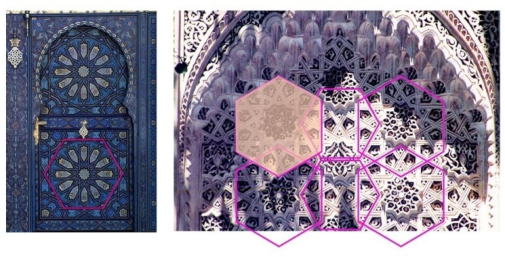
An in-depth analysis was conducted to evaluate the pivotal features of Mediterranean architecture, with a specific focus on sustainability. The prevalent geometry employed in both structural and ornamental components was found to be effectively based on hexagonal meshes (Castéra and Peuriot, 1996). The selection of the hexagon as the primary geometry holds signifi- cance, as the hexagon, akin to the square and triangle, possesses the unique capability to fill the plane without the need for additional shapes, promoting efficiency and minimal environmental impact.
Figure 1: a) Door of the Palais Royal, Casablanca; b) Identification of secret geometries of the Bahía Palace, Marrakech (Oliveira, 2012).
Matter by Design. How Can the Circular Economy Play a Role 77
As illustrated in Figure 1a and 1b there are exemplary instances of Islamic patterns rendered through wood carving or painting, showcasing the use of a star with twelve vertices inscribed within a hexagonal grid, reflecting a sustainable integration of cultural and geometric elements. These reference patterns, among others, played a crucial role in the ideation process, guiding the exploration and sketching of the final geometry that served as the foun- dation for integrating the energy technological functions within the modular technological product system.
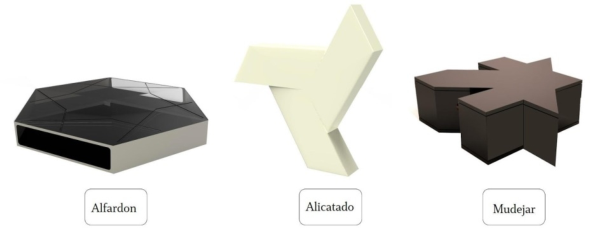
While the project predominantly centres’ on hexagonal geometries, it acknowledges the possibility of exploring non-hexagonal geometries inher- ent to Arabic architectural culture with a sustainability lens. For instance, an alternative geometry – the Mudejar Module – known for its geometric “mudejar” motifs, colloquially referred to as the “cock’s feet” (Meco, 1993).
Building upon these diverse and sustainable geometries, three primary modules were conceptualized: “alfardon”, “alicatado” and “mudejar” (Figure 2). This intricate process of integrating cultural and sustainable design references not only contributes to the aesthetic richness of the project but also underscores a steadfast commitment to preserving and reinterpret- ing historical architectural elements within the context of contemporary sustainable design practices.
Figure 2: The “alfardon”, “alicatado” and “mudejar” modules (Oliveira, 2012).
THE ECO-MULTITASK MODULAR ALVEOLI (EMMA) AND THE DIFFERENT TECHNICAL OPTIONS The Alfardon, a hexagonal pavement tile historically employed in Valencia (Spain) and Italy during the XV and XVI centuries became prominent in mosaic pavements by the mid-XV century, particularly in Lisbon and Beja palaces. Derived from Valencia and influenced by Islamic applications, these tiles were intricately arranged in geometric patterns. In the context of the present project, the emphasis was not on creating a novel geometry but rather on distilling the essence of Islamic Art’s geometrization and repurpos- ing it. The objective was to interpret, recreate, and re-contextualize these forms within contemporary settings, identifying the advantages of the cho- sen geometry for material applicability, fixation devices, and the integration of various eco-energy and sustainable functions during the conceptualization phase.
78 Cardoso and Salomé
However, the selected geometry may present manufacturing and technical performance constraints, especially concerning the thermodynamic reliability performance sought in the project’s objectives. To explore this potential lim- itation, a real prototype was experimentally tested, and its performance was compared with an identical conventional commercial system. A summary of the findings of this experimental assessment are expounded upon within this paper.
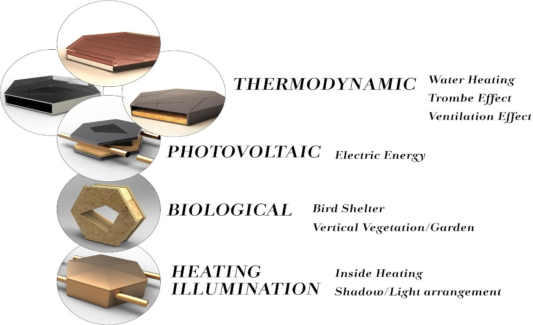
The technical tile created is known as the Eco-Multitask Modular Alve- oli (EMMA) constitutes a hexagonally-based modular alveolus designed with integrated energy and aesthetic functions. The EMMA tile represents a cohesive amalgamation of design and technology, providing a versatile and eco-efficient system for cladding buildings. This hybrid technological system incorporates various eco-efficient functionalities, with particular emphasis on the thermal function, which serves as its primary component. Addition- ally, the EMMA tile integrates photovoltaic, biological, and illumination functions (Figure 3). The ventilated function, driven by the chimney effect, is executed through a fully enclosed ceramic module. Vents strategically positioned on the thermodynamic module facilitate the chimney effect by allowing air circulation from the top, where temperatures are higher, to the bottom, where temperatures are lower. The modular assembling system underlying this concept is composed of distinct technical functional alveoli designed for high performance. This modular system exhibits adaptability for application in both the cladding of new constructions and the rehabilitation of existing structures.
Figure 3: Functions of EMMA system (Oliveira, 2012).
Five types of modules with different functions are proposed:
1. Passive thermal function - a ceramic module (chimney effect) and glass module (wall effect trumpets); 2. Active thermal function - a solar collector for DHW production; 3. Lightning functions - an open module (that filters natural light); 4. Biological functions - an open module (that filters natural light); 5. Electrical function - a photovoltaic module.
Matter by Design. How Can the Circular Economy Play a Role 79
Figure 3 provides a visual representation of the interconnectedness of various materials in the development of alveoli within the project. The initiative establishes linkages among materials such as ceramics, glass, cop- per, and cork, emphasizing their integration with both thermodynamic and photovoltaic solar functions. The assembly of this system resembles the modular nature of “lego” parts, where each component incorporates spe- cific functions aligned with technological and aesthetic imperatives. This approach underscores a deliberate focus on sustainability, aligning materials and functionalities in a manner that optimizes eco-efficiency and promotes environmentally conscious design principles.
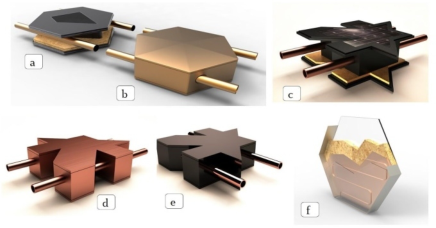
Utilizing a consistent geometric framework, the upper surface can be replaced with glass in order to execute the passive thermal Trombe function. Diverse modules were subsequently constructed, each incorporating distinct energy systems to facilitate thermodynamic and photovoltaic functionalities. Notably, the biological and illumination modules are configured with cen- tral apertures. The illumination module possesses the capacity to selectively filter natural light, whereas the biological module is designed to accommo- date gardens and create environments conducive to small avian species. The schematic representation in Figure 4 delineates the principal modules that have been developed within this framework.
Figure 4: Technical modules: a) opened “alfardon” tile made of black ceramic; b) cop- per “alfardon” tile; c) photovoltaic “mudegar” tile; d) copper “mudegar” tile; e) black ceramic “mudegar” tile and f) thermodynamic “alfardon” tile (Oliveira, 2012).
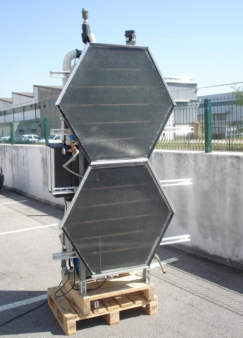
The Beta Prototype for the Alfardon Model A beta prototype was fabricated and employed to substantiate the attainabil- ity of functional equivalence between the envisaged thermodynamic module and comparable commercially available modules. The primary objective was to demonstrate that the introduction of novel materials and geometries, as an alternative to conventional solar device systems, did not result in a note- worthy loss of efficiency. Figure 5 showcases the prototype of the Solar Thermal Module (STM) collector, designed for hot water production and tested in experimental trials. The manufacturing and data collection pro- cesses were conducted by the FirstStep company located in Aveiro, Portugal. Each hexagonal module exhibits a surface area of 0.5 m2, with a hexagon
80 Cardoso and Salomé
side measuring 440 mm. The panel thickness is 85 mm, composed of glass affixed to a metallic rim. The dimensions of these modules were meticulously calculated to ensure an equivalent sunlight capture area when compared to other conventional systems.
Figure 5: “Alfardon” thermodynamic heating water beta prototype (Oliveira, 2012).
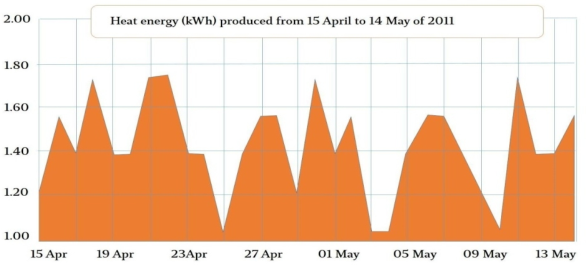
The utilized prototype occupied an area of one square meter in an upright position, precisely oriented at 90 degrees with respect to the horizontal plane. The absorbing surface is deliberately directed towards the south, marked by an azimuth of 180 degrees. The data collection period spanned from the 15th of April, 2011, to the 15th of May, 2011. In the context of this temporal interval, the experimental data was meticulously gathered, focusing on the temperature of the 150-liter water tank on a daily basis. By discerning the temperature differential and the accumulation of the fluid, an approxima- tion of the actual energy transferred from the prototype to the tank could be computed. Figure 6 juxtaposes simulated data against experimental data, providing a comparative analysis of energy production during the specified one-month period.
Figure 6: Graphic showing experimental data measured energy supplied to the 150l vessel in the period of time considered (Oliveira, 2012).
Matter by Design. How Can the Circular Economy Play a Role 81
CONCLUSION
In conclusion, the integration of circular economy principles with the inno- vative use of Mediterranean materials holds the promise of paving the way for a greener, more efficient, and sustainable future. By valuing and reimag- ining traditional craftsmanship, harnessing the potential of diverse resources, and embracing cutting-edge recycling technologies, the Mediterranean region can emerge as a showcase for circular economy success, demonstrating the harmonious coexistence of environmental stewardship and economic prosperity.
The primary aim of this research was to rekindle symbolic representations by interpreting concepts, forms, and materials rooted in the cultural iden- tity of the Mediterranean, particularly within its architectural heritage. The investigation was undertaken to imbue this cultural identity concept into the design of innovative modular building tiles tailored for application in contem- porary architecture. The design of these tiles was meticulously orchestrated to align with the utilization of natural, renewable, and non-polluting materials, thereby realizing the foundational principles of sustainable and circular archi- tectural design for modern projects that simultaneously embrace cultural and environmental sustainability.
To concretize these design principles, a thermodynamic prototype was meticulously fabricated and subjected to experimental testing. The equipment exhibited comparable efficiency and performance metrics when juxtaposed with commercially available counterparts. The envisioned application of this device on vertical façades demonstrates distinct advantages during win- ter months, as the more horizontal orientation of solar rays facilitates a more direct interaction with the thermodynamic façade, thereby optimizing its functionality. This research thus articulates a harmonious integration of sustainable design and circular economy principles within the context of con- temporary architectural endeavours, grounded in the rich cultural identity of the Mediterranean region.
ACKNOWLEDGMENT
The authors would like to acknowledge: António Torres Marques, Faculty of Engineering, University of Porto, Portugal; José António Simões, ESAD- College of Art and Design, Portugal; Cláudio Torres, Campo Arqueológico de Mértola, Portugal. Also the following institutions: Esad – Colege of Art and Design, Portugal; esad-idea – Research in Design and Art, Portugal; FCT – Fundação para a Ciência e a Tecnologia, Portugal; BDA – Blue Design Alliance, Portugal.
REFERENCES
Bergdoll, B. and Ursprung, P. (2010) Sauerbruch Hutton Vol. 52. Barcelona, Spain: Gustavo Gili (2G). Castéra, J. M. and Peuriot, F. (1996) Arabesques: art décoratif au Maroc. Art,
Création et Réalisation. Paris, France: ARC Édition Internationale. Guzowski, M. and Guzowski, M. (2010) Towards zero energy architecture: New solar design. London, UK: Laurence King Publishing.
82 Cardoso and Salomé
Hegger, M. (2003) ‘From Passive Utilization to Smart Solar Architecture’, in Schittich, C. (2003) Solar Architecture: Strategies, visions, concepts. Basel, Switzerland: Birkhäuser, p. 14. Meco, J. (1993) O azulejo em Portugal. Lisboa, Portugal: Edições Alfa. Oliveira, R. S. (2012) Mediterraneidade – Interacções no Design de Produto. A identidade cultural como referente para uma actividade projectual sustentada (Translation: Recovering of the Mediterranean culture in product design inter- actions: Culture identity as a reference for sustainable design activity) Phd Thesis. Faculty of Engineering of the University of Porto.
LISTED IN THE AHFE DIGITAL BOOKSTORE CATALOGUE
Explore the complete digital volume
Sustainable Construction in the Era of the Fourth Industrial Revolution
Read this individual research paper free through the original publisher, or explore the full digital proceedings book.
ISBN 978-1-964867-25-0
Explore this ISBN in the AHFE Bookstore ↗Listed in the July 2026 bookstore catalogue; search by ISBN to confirm current availability · Digital book purchase optional