Li Xu, Yuquan Zhou, Xiaoxuan Jiang, Ao Yu (2024). The outdoor intelligent work space design based on kano model. In: Usability and User Experience. AHFE Open Access, vol. 156, pp. 218–226. https://doi.org/10.54941/ahfe1005432
In recent years, with increasing urbanization and the new coronavirus pneumonia epidemic (COVID-19), the social workplace is changing at an unprecedented rate. The epidemic has led to an increased focus on healthy and green design in the workplace, and outdoor workspaces are becoming an increasingly important part for businesses, employees, freelancers, and real estate developers. The impact of the epidemic has posed a huge challenge to traditional office space, with some companies abandoning their original office space. Increased competition for social careers and a growing number of members of the public wishing to utilize their free time for self-improvement have also contributed to the rise of environmentally paid venues, such as paid study rooms and learning cafes. Although people's awareness of outdoor healthy office is beginning to increase, the specific needs of office space for outdoor scenes are still unclear, and tapping into the needs has become the key to outdoor office product innovation.This study aims to classify and prioritize the functional attributes of new outdoor office space by using the functional attributes classification and prioritization method proposed by the Kano model, and to classify the functional attributes by questionnaire design using the Kano model. The specific research process is as follows: extract demand elements through contextual observation and semi-structured interviews, collect data on users' cognition, tendency, consumption motivation and behavior, analyze users' behavioral and mental demands for outdoor office scenarios, and collect users' original demand data. Similar original requirements are summarized and integrated to form user outdoor office function modules, and each requirement module is refined. Kano analysis for each modularized demand, using the Kano questionnaire to derive the impact of each demand module on end-user satisfaction with the outdoor office experience, based on the Kano model of the evaluation of the classification table will affect the user's satisfaction with the outdoor office of the various factors module is divided into five types of demand attributes: Basic Quality, Performance Quality, Excitement Quality, Neutral Quality and Reverse Quality. Then, through the prioritization method in the Kano model, the better-worse coefficient is used to calculate the percentage of functional requirement attributes, and the impact of a certain functional module on the improvement of user satisfaction or the reduction of dissatisfaction is derived. Based on the calculation results of the better- worse coefficient, the priority ranking of each original requirement in similar functional modules is derived. Determine the prioritization of service functions in outdoor office space. Prioritize the design of the functional modules with high values, and propose the design of each service module and physical product of the new shape of the office space.Through this study we will collect and summarize the user's demand modules in outdoor office scenarios, derive the priority ranking of each demand element through Kano, and provide specific design strategies and principles for the design of the user's outdoor office scenarios, which will be used to develop the service system of the outdoor office space, and establish the outdoor office service products and systems.
In 2014, Premier Keqiang Li proposed “mass entrepreneurship and innova- tion” in his speech at the Davos Forum, and in the following years, China’s dual-creation wave has been popular, and small and medium-sized enter- prises continue to appear. Under this wave, co-working space in China
The Outdoor Intelligent Work Space Design Based on Kano Model 219
has been developing rapidly. Prior to the new coronavirus pneumonia epidemic(COVID-19), the rapid development of telecommunication tech- nologies and devices had given birth to more new professions and more free and flexible working styles, which made people less and less restricted to the traditional fixed office space. The COVID-19 has caused office workers who were previously required to go to the office to actively or forcibly adapt to working online. Previous work patterns are being gradually replaced by new hybrid, nomadic, and mobile work styles. The way people work is undergo- ing fundamental changes, and the public is better equipped to choose their office space independently and flexibly. At present, people are more con- cerned about the health, green office environment, outdoor office has become a new trend in people’s office choices. The specific demand for outdoor office is still not clear enough, and China has not yet appeared in the specialization of outdoor office space, exploring user demand has become the focus.
RESEARCH METHODS The Kano model is a quality management tool used to describe different types of product or service features. The model was proposed by Japanese scholar Noriaki Kano (1984). Kano classified the quality characteristics of prod- ucts and services into five categories: Basic Quality, Performance Quality, Excitement Quality, Neutral Quality and Reverse Quality.
Basic Quality, also known as must-be Quality, are attributes or features that customers take for granted that they must have. When the characteristics of such needs are not sufficient, customers will feel very dissatisfied, and when the characteristics are sufficient, customers will not show satisfaction.
Performance Quality, also called One-dimensional Quality, refers to the fact that when a need is met, the more satisfied the customer will be, and conversely, when that need is not met, the more dissatisfied the customer will be. This type of demand is the one that reflects the competitiveness of the product.
Excitement Quality, also known as Attractive Quality, does not reduce cus- tomer satisfaction when the product does not have this characteristic. When the product has this type of characteristic, even if it is not perfect, the level of customer satisfaction will be very high.
Neutral Quality, also called Indifferent Quality, is a category of demand that does not change the level of customer satisfaction whether the demand is met or not.
Reverse Quality. is a feature that causes strong customer dissatisfaction. When a product has such functional characteristics, the degree of customer does not increase, but rather decreases.
Each functional characteristic can be classified to the Kano evaluation table as shown below (see Table 1):
Table 1. Kano evaluation table (adapted from: Japan Noriaki Kano,1984).
Functional 1.like Q A A A O 2.Must-be R I I I M 3.Neutral R I I I M 4. acceptable R I I I M 5.dislike R R R R Q
The evaluation sequence is “M>O>A>I”. If two or more categories close to bounded, more information is needed.
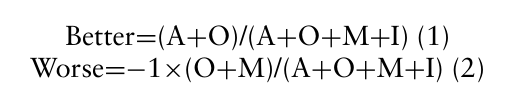
The better-worse coefficient is able to show the degree to which a char- acteristic affects the increase or decrease of dissatisfaction. A value of Better is usually positive, indicating that the provision of a feature or service will increase satisfaction with the product. Larger positive values indicate a stronger effect on user satisfaction, meaning that the feature or service should be prioritized. Worse is usually a negative value, indicating that the provision of a feature or service will lead to a decrease in product satisfaction. The larger the negative value, the faster the effect on user satisfaction decreases, meaning that the feature or service should not be prioritized. Better-worse is calculated with the formula:
Equation reproduced from the original PDF.
The functional prioritization of each requirement is derived by calculating the better-worse coefficient for each requirement element.
At present, more and more cities, enterprises and institutions are begin- ning to use outdoor public space for outdoor office. For example, parks, plazas and open-air cafes have become often chosen office spaces. More and more companies are choosing open outdoor office spaces to encourage com- munication and collaboration among employees. This type of office space usually has no fixed partitions and offers open work and recreational areas to promote teamwork and innovation as well as technical support such as high-speed internet connections, wireless charging facilities, and smart office devices. Although people’s awareness of outdoor office and healthy office has begun to rise, the specific needs of office space for outdoor scenarios are still unclear, and tapping into the needs has become the key to prod- uct development and innovation for outdoor office space. Kano analysis is a comprehensive analysis method that involves the evaluation of all factors that may affect customer satisfaction, and has been widely used by many scholars in user satisfaction research. For example, Chen et al. (2021) used Kano model to measure luxury fashion e-commerce platform services, and Zhao et al. (2024) used Kano model for travellers’needs. Therefore, the Kano model is used in this study to better understand users’ needs and expectations of outdoor office space.
The Outdoor Intelligent Work Space Design Based on Kano Model 221
DATA COLLECTION Through literature review, fieldwork, and semi-structured interviews, the needs of people with outdoor office intentions for outdoor office space were derived and then converted into function points. The resulting 20 demand function points were numbered, and the results are shown in Table 2:
Table 2. Initial user requirements for outdoor work space (Source: Author’s own).
Table available in the original PDF paper.
6.Privacy (visual)
1.Workstation reservation 2.Preview of the surroundings 3.Shade from the sun and rain 4.Space types for different numbers of people 5.Optional space (enclosed semi-enclosed open) 10.Custody of personal belongings 7.Privacy (sound) 8.Pest control 9.Temperature, weather, air quality, wind overview
11.Water, drinks provided 12.Rest area 13.Lunch and dinner provided 14.Charging power supply 15.Wifi 16.Provision of computer equipment 17.Liftable tables and chairs 18. Overall appearance 19. Color atmosphere 20.Interior styles
The KJ method is applied to collect linguistic information and use its intrin- sic connection to generalize in order to derive the modular requirements. The results are shown in Table 3. The main modularized verbal requirements for outdoor office space design are: Basic functions, Additional functions, Basic Equipment, and Appearance Requirements.
Table 3. modular requirements for outdoor work space(Source: Author’s own).
Table available in the original PDF paper.
Basic Functions Additional functions Basic Equipment Appearance Requirements Workstation reservation Temperature, weather, air quality, wind overview Charging power supply Overall appearance Preview of the surroundings
Custody of personal belongings
Interior styles
Wifi Color atmosphere Shade from the sun and rain
Water, drinks provided Provision of computer equipment Rest area Liftable tables and chairs
Space types for different numbers of people
Lunch and dinner provided
Optional space (enclosed semi-enclosed open) Privacy (visual) Privacy (sound) Pest control
DATA ANALYSIS In this study, data collection was carried out by designing a kano question- naire to derive the impact of each requirement module on users’ satisfaction with the outdoor office experience. The questionnaire study was conducted
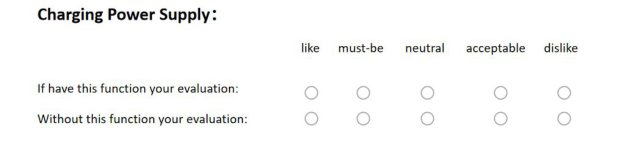
on a group of users aged 18–55 years old with the intention of working out- doors, and a total of 60 questionnaires were collected after removing invalid responses. In the questionnaire, the respondents were asked to evaluate 20 demanded function points, which were categorized into two dimensions, that is, the attitude that the product has the function and the attitude that it does not have the function. For each dimension, the respondents were given five options, namely “like”, “must-be”, “neutral”, “acceptable” and “dislike”(see Figure 1).
Figure 1: Design framework of Kano mode (Source: Author’s own).
The recovered valid questionnaires are collected for Kano, and the Kano evaluation table of Kano model is used to complete the calculation of the percentage of the 6 attributes of the requirement items, and to get the values of the 6 requirement attributes (including the suspicious attributes) for each function module. The following figure shows the percentage of 6 kinds of demand attributes of 14. Charging power supply (see Table 4).
Table 4. Provide the proportion of demand attributes of 14. Charging power supply (source: Author’s own).
Table available in the original PDF paper.
Quality attribute Dysfuctional
1. like 2. Must-be 3. Neutral 4. acceptable 5. dislike M:10% Function 1. like Q A A A O O:45% 2. Must-be R I I I M A:25% 3. Neutral R I I I M I:18.33% 4. acceptable R I I I M R:0% 5. dislike R R R R Q Q:1.67%
The Better-Worse coefficient is calculated for each of the 20 functions for the ranking and division of multiple functional demand items for outdoor office space. The five demand attribute percentages from table 4 are brought into the Better-Worse coefficient calculation formulas (1) and (2), and the data obtained are shown below: Better=(25%+45%)/(25%+45%+10%+18.33%)=71.19% (1) Worse=−1×(45%+10%)/(25%+45%+10%+18.33%)=−55.93 (2)
According to the Better-Worse formula, the better-worse coefficient values for each function of the outdoor office space can be obtained, and the data are summarized in Table 5.
The Outdoor Intelligent Work Space Design Based on Kano Model 223
Table 5. User demand attribute analysis (Source: Author’s own).
Table available in the original PDF paper.
NO. M (%) O (%) A (%) I (%) R (%) Q (%) KANO Quality
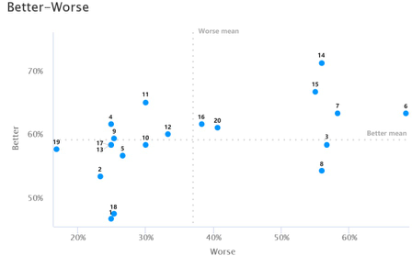
The resulting values of the better-worse coefficient were plotted on a scatter plot. (see Figure 2) The horizontal coordinates of the origin of the coordinates in the plot indicate the mean value of the Worse coefficient and the vertical coordinates indicate the mean value of the Better coefficient. Absolute values were used for the Worse coefficients. The scatterplot was divided into four quadrants. The first quadrant is for One-dimensional Qual- ity, the second quadrant is for Attractive Quality, the third quadrant is for Indifferent Quality, and the fourth quadrant is for Must-be Quality. The quadrant diagram is a division of attributes under the “relative concept”, there might be inconsistencies with the calculation results, which can be ana- lyzed by choosing one of them. For example, the absolute value concept of 8.Pest control is an One-dimensional Quality, while the relative concept is a must-have requirement, which is considered as a must-have requirement in this study.
One-dimensional Quality are located in the first quadrant and include 14. Charging power supply, 15. Wifi, 16. Provision of computer equipment, 6. Privacy (visual), 7. Privacy (sound), 20. Interior Styles. Satisfying these needs leads to higher user satisfaction and less on the contrary. The rec- ommended approach is to actively address such needs in order to improve product competitiveness.
Attractive Quality are located in the second quadrant and include three function points: 11. Water, drinks provided, 4. Space types for different num- bers of people, 12. Rest area. This category is a latent need, and providing this type of functionality would significantly increase user satisfaction, while the opposite would have no effect on satisfaction. The proposed approach is to try to tap into such needs to surprise and delight users by designing such features to make the product more competitive.
The Neutral Quality are located in the third quadrant and include: 1. Workstation Reservation, 2. Preview of the surroundings, 9. Temperature, weather, air quality, wind overview, 10. Custody of personal belongings, 13. Lunch and dinner provided, 18. Overall Appearance, 19. Color atmo- sphere, and 17. Liftable tables and chairs and 5. Optional space (enclosed semi-enclosed open). This category of requirements tends to go unnoticed by users and has no significant impact on user satisfaction. The suggested approach is that efforts to think about such needs should be avoided and other needs should be prioritized.
The Must-be Quality are located in Quadrant 4 and include 8. Pest control and 3. Shade from the sun and rain. This category of needs is considered to be a deserved need, and if not met will severely reduce user satisfaction. Therefore this category should be prioritized.
RESELT AND DESIGN WORK Finally, based on the Scatter diagram of Better- Worse coefficient values, we derive a prioritization of outdoor office needs as follows: on the basis of pri- oritizing the satisfaction of basic needs from highest to lowest Better factor: 3. Shade from the sun and rain >8. Pest control, outdoor workspaces need to satisfy performance needs first, based on the Better coefficients from high to low.The ranking is: 14. Charging Power Supply >15. Wifi>6. Privacy (visual) > 7. Privacy (sound) >16. Provision of computer equipment >20. Interior Styles. Secondly, the optional fulfillment of attractive needs is based on the Better coefficients in descending order: 11. Water, drinks provided >4. Space types for different numbers of people > 12. rest area. As for the neutral needs: 13. Lunch and dinner provided >17. Liftable tables and chairs >19. Color atmosphere >5. Optional space (enclosed semi-enclosed open) > 9. Tempera- ture, weather, air quality, wind overview >10. Custody of personal belongings >2. preview of the surroundings > 18. Overall appearance >1. Workstation Reservation, can be disregarded.
The basic need: 3. Shade from the sun and rain and 8. Pest control is prioritized, so we chose an enclosed space design. Among the Performance requirements, 14. Charging Power Supply, 15. Wifi, 6. Privacy (visual), 7.
The Outdoor Intelligent Work Space Design Based on Kano Model 225
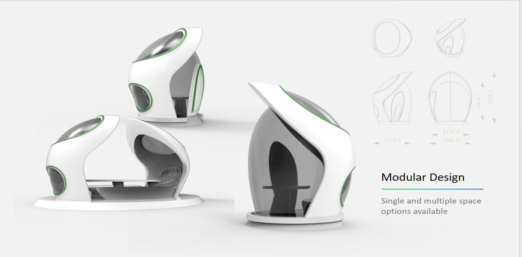
Privacy (sound), and 16. Provision of computer equipment have higher val- ues, so power and network equipment need to be configured inside the space. Opaque materials are used to protect users’ work privacy. In the attractive demand, 11. Water, drinks provided, 4. Space types for different numbers of people coefficient is higher, can be selectively satisfied. The modular design thinking is used to realize the choice between single and multi-person spaces.
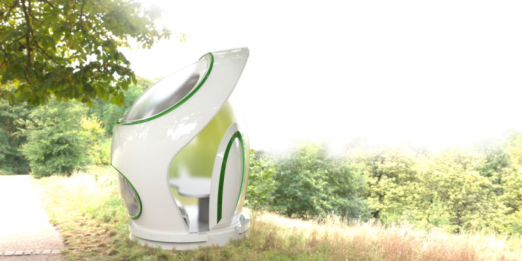
In general, as a workspace under outdoor conditions, its overall design needs to reflect the characteristics of nature and simplicity, to meet the needs of different users in terms of man-machine, interaction and materials. Mod- ular design thinking is used to realize the design of single and multi-person spaces. The design effect of single-person workspace is shown in Figure 3, and the modularized design effect is shown in Figure 4.
Figure 3: Design effect of single person workspace. (Source: Author’s own).Figure 4: Modular design effect. (Source: Author’s own).
ACKNOWLEDGMENT
The authors would like to thank the School of Art Design and Media of East China University of Science and Technology for providing help and support.
REFERENCES
Anna, S., Mariusz, S. (2023) “Decoding Consumer Preferences in Food Packaging with the Kano Model”, System Safety: Human - Technical Facility - Environment, 5(1), pp. 83–92. Bohao, M. et al. (2024) “Unveiling consumers’ nonlinear evaluation of service per-
formances in online food delivery: A quantitative Kano analysis”. British Food Journal, 126(2), pp. 834–863. Bouncken, R. B. et al. (2023) “New work design for knowledge creation and sustainability: An empirical study of coworking-spaces”, Journal of Business Research, 154, 113337. Chen, T. et al. (2021) “Analysis Customer Satisfaction in Luxury Fashion E-commerce Platform Services Based on Kano Model”, Proceedings of 3rd Inter- national Conference on Global Economy and Business Management (GEBM 2021). doi: 10.26914/c.cnkihy.2021.049918. Hensher, D. A., Wei, E., & Beck, M. J. (2023) “ The impact of COVID-19 and work-
ing from home on the workspace retained at the main location office space and the future use of satellite offices”, Transp Policy (Oxf), 130, pp. 184–195. Ibrahim, A. A. S. E., Farghaly, M. S. A. (2023) “Application of Kano model for optimizing the training system among nursing internship students: A mixed-method Egyptian study”, BMC Nursing, 22(1), pp. 316–316. Münster, P., Grabkowsky, B. (2023) “Kano Model Analysis of Digital On-Farm
Technologies for Climate Adaptation and Mitigation in Livestock Farming”. Sustainability, 16(1). Zhao, M. et al. (2024) “Classifying travellers’ requirements from online reviews: An improved Kano model”, International Journal of Contemporary Hospitality Management, 36(1), pp. 91–112.
LISTED IN THE AHFE DIGITAL BOOKSTORE CATALOGUE
Explore the complete digital volume
Usability and User Experience
Read this individual research paper free through the original publisher, or explore the full digital proceedings book.
ISBN 978-1-964867-32-8
Explore this ISBN in the AHFE Bookstore ↗Listed in the July 2026 bookstore catalogue; search by ISBN to confirm current availability · Digital book purchase optional