The training of healthcare professionals is a tough and prolonged process that requires deep understanding of theoretical concepts as well as technical, non-technical skills. Commonly, during the early stages of medical education instructional techniques involve static and unrealistic learning materials, based on the old philosophies. Nowadays, traditional approaches are being replaced by novel methods focused on the use of the new technologies and advanced simulators. The use of serious games and VR simulation can contribute to the training and improvement of the skills of healthcare professionals, thereby contributing to the quality of care, increasing patient safety and reducing costs of training programs. In this project, we developed a simulation-based serious game allowing students and professionals to practice on the evaluation of the patients’ state of consciousness according to the Glasgow scale. The Glasgow Coma Scale (GCS) is a neurological instrument that measures the “severity” and extent of impaired consciousness. The GCS has become the most used tool in the world to document alterations in the level of consciousness caused by brain damage. In combination with other neurological examinations, the scale is used to estimate the vital prognosis of patients with a severe brain injury. Because of its ease of use for all health professionals in all care settings, the scale has become an essential tool in all training programs. The neu-rological evaluation requires frequent simulation-based education to improve the cognitive, psychomotor and communication skills of the health students. However, current simulation approach¬es are resource-intensive and not routinely offered in all healthcare schools. Also, alternative approaches are needed to improve working memory, decision-making skills and teamwork per-formance. Serious games may be effective and more accessible alternatives if they use active, experiential and problem-based learning. They are indeed likely to solicit the student motivation and allow them to develop knowledge in complex learning situations. A multidisciplinary team including experts from healthcare, education and engineering ensure a coherent interaction between the game, content and pedagogical features. The GlasgowSim project aims to develop a pedagogical innovation that meets the requirements of the curriculum and extends the teaching options for the Glasgow Assessment Scale. The user is invited to interact with a computer-based device that combines teaching aspects with playful elements derived from video games. Theoretical and simulation workshops are currently being organized, but straight neurological assessment needs to be made more accessible to health students who will be applying ECS daily as future clinicians. When used for demonstration purposes, these approaches are resource-intensive (mannequins, technicians, teachers, etc....) In addition, through the various satisfaction evaluations, students express their wish to have access to different teaching tools to identify the future challenges of the practice sites. On the one hand, the teachers in the HESAV nursing care stream have developed clinical vignettes that promote the integration of knowledge and student learning, and on the other, the teachers in the HEPIA IT stream have developed a virtual environment that allows users to immerse themselves in a real-life neurological assessment situation. In this way, we will encourage the participants' reflective practice by optimizing their clinical judgement in the assessment and management of patients with neurological disorders. The trainers are convinced that simultaneous learning of Why and How the Glasgow Coma Scale is administered would optimize the clinical judgment of health professionals in the neurological assessment of brain-injured patients. Based on the design decisions, we have broken down the GlasgowSim solution into three essential components. The first component is the simulation tool, which allows the learner to interact with the patient, make diagnosis, and deliver assessments and recommendations. This tool creates the complete simulation environment based on a description of the scenario in JSON format and aggregates the necessary objects with the right configuration. The second component is the interactive patient. We considered this element to be essential given the importance of the patient in the diagnosis to be made by the learner. This patient has been developed to enable realistic GSC diagnosis. Finally, the last component is the interactive scenario creation tool. This tool will enable teachers to define all the parameterizable elements of a scenario and to export the scenario in JSON format to the simulation tool. To be able to create new scenarios and new clinical situations simply and easily, a scenario generator has been developed in the form of a web application connected to the simulator.
The Glasgow Coma Scale (GCS) is a neurological instrument that measures the “severity” and extent of impaired consciousness. The GCS has become the most used tool in the world to document alterations in the level of consciousness caused by brain damage (Ingram, 1994). In combination with other neurological examinations, the scale is used to estimate the vital prognosis of patients with a severe brain injury. Because of its ease of use for all health professionals in all care settings, the scale has become an essential tool in all training programs. The neurological evaluation requires frequent simulation-based education to improve the cognitive, psychomotor and communication skills of the health students. However, current simulation approaches are resource-intensive and not routinely offered in all healthcare schools. Also, alternative approaches are needed to improve working memory, decision-making skills, and teamwork performance. Serious games may be effective and more accessible alternatives if they use active, experiential, and problem-based learning. These tools are highly likely to ignite student motivation and facilitate their acquisition of knowledge within intricate learning scenarios. A multidisciplinary team including experts from healthcare, education and engineering ensure a
coherent interaction between the game, content, and pedagogical features. The GlasgowSim Project aims to create a serious game designed to enhance the training of aspiring healthcare professionals in Neurological Evaluation by encouraging knowledge acquisition and practical skill development.
CONTEXT Teaching Neurological Assessment at the Haute Ecole de Santé du Canton de Vaud (HESAV)
Students undergo comprehensive training through a series of practical workshops, which alternate between role-playing and the analysis of practical cases. HESAV employs simulation as a teaching method to enhance the precision of clinical observation and stress the significance of promptly identifying clinical alerts in neurological assessment—a vital skill across all healthcare disciplines. The knowledge and skills acquired during these simulation workshops represent a broadening of the clinical skills profile of Bachelor nurses in Switzerland. These skills, applied in clinical assessment, help to improve the quality of care (Lindpaintner et al., 2009) and at the same time enhance the position of the nursing profession in everyday clinical practice. As a result, students acquire in-depth knowledge and skills in taking a medical history and in basic neurological examination techniques.
Given the paramount importance of assessing consciousness levels clinically, we teach the use of the Glasgow Coma Scale (GCS). Accurately determining the severity of the altered state of consciousness is not only to establish a vital and functional prognosis, but also to monitor more effectively the patients with brain injury and to optimize the use of available resources.
The Glasgow Coma Scale (GCS) When Teasdale and Jennett published the Glasgow Coma Scale (GCS) in 1974, they promoted a major change in the clinical assessment of patients with an altered state of consciousness, by taking particular care in constructing their score. The scale was designed to be used reliably by all healthcare professionals. The authors aimed to establish a means of based on simple items with clear, unambiguous, and easily translatable definitions (Ledoux et al., 2008).
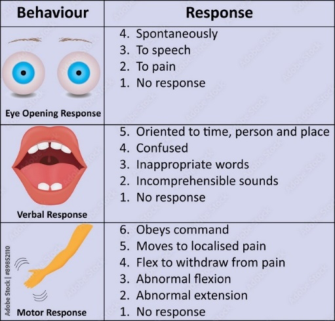
The scale is based on the separate clinical assessment of three distinct aspects of the behavioral response to stimuli during altered states of consciousness (Teasdale and Jennett, 1976): i) the motor response (M, five then six levels); ii) the verbal response (V, five levels); and iii) the eye opening (E, four levels).
The opening of the eyes reflects the integrity of the nerve connections within the central portion of the gray matter and cranial nerves III, V and VII in the brainstem. The verbal response makes it possible to estimate the degree of damage to Wernicke’s area (language comprehension center of the temporal lobe) and Broca’s area (speech production center of the frontal lobe). The motor response indicates the capacity of the sensorimotor fibers
to capture and interpret sensory information coming from the body or the environment and react to it in an appropriate manner.
By summing the evaluations of the different responses to obtain an overall score, with a scale ranging from three to 15 points, making it possible to establish a correlation between the severity of altered states of consciousness and patient outcomes. This allows healthcare professionals to align the severity score with appropriate clinical interventions (see Figure 1).
Figure 1: The “GCS” – Glasgow Coma Scale (Adobe stock).
The relationship between GCS score and the outcome constitutes the basis of a common classification of acute head injuries (Jain and Iverson, 2023): Severe, GCS 3 to 8 - Moderate, GCS 9 to 12 - and Mild, GCS 13 to 15.
The GCS is recognized for its ease of administration by all healthcare professionals in all care settings. The scores obtained guide professionals in their clinical decisions, to predict the patient’s prognosis and to evaluate the effectiveness of the treatments provided. A decrease in score from one assessment to another may reflect a worsening of the brain injury requiring immediate medical intervention, while an improvement in the score indicates a positive response to treatment. The frequency of application of the Glasgow scale varies depending on the neurological condition of the patient and the time elapsed since its admission, or even since the appearance of the first signs of brain damage. However, there is a lack of rigor in the evaluation of states of altered consciousness because the Glasgow scale is only used in 42% of care units (Santos, 2016). Equally worrying, health professionals claim to have learned to use GS by reproducing the habits of their department without necessarily having understood the principles of application (Reith et al., 2016). Thus, clinical experts agree on the fact that it is necessary to demystify this scale and to implement periodic training that uses active, immersive teaching methods based on real situations (Edwards, 2001).
The GlasgowSim Project The GlasgowSim project aims to develop a pedagogical innovation that meets the requirements of the curriculum and extends the teaching options for the
GlasgowSim - Glasgow Coma Scale Simulation 337
Glasgow Assessment Scale. The user is invited to interact with a computer- based device that combines teaching aspects with playful elements derived from video games (Chabert, 2010).
Theoretical and simulation workshops are currently being organized, but straight neurological assessment needs to be made more accessible to health students who will be applying ECS daily as future clinicians. When used for demonstration purposes, these approaches are resource-intensive (mannequins, technicians, teachers, etc...). Moreover, through the various satisfaction evaluations, students express their desire for access to diverse teaching tools to anticipate forthcoming challenges in clinical settings. On the one hand, the teachers in the HESAV nursing care stream have developed clinical vignettes that promote the integration of knowledge and student learning. On the other hand, the teachers in the HEPIA IT stream have developed a virtual environment that allows users to immerse themselves in a real-life neurological assessment situation. The present approach aims to cultivate participants’ reflective practice, thereby refining their clinical judgment in assessing and managing patients with neurological disorders. The trainers are convinced that simultaneous learning of Why and How the Glasgow Coma Scale is administered would optimize the clinical judgment of health professionals in the neurological assessment of brain-injured patients. For this reason, the team project has determined 4 structuring stages in the use of the game (see Figure 2):
Figure 2: Four stages of GlasgowSim.
Figure available in the original PDF paper.
1- EVALUATE: the level of consciousness of a patient with neurological impairment using the Glasgow scale.
2-INTERPRET: the scores obtained following the evaluation of three components of the Glasgow scale.
3-COMMUNICATE: critical information regarding a patient’s care in a structured manner.
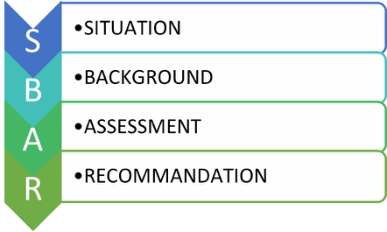
4-ENSURE: clinical monitoring of a patient with neurological damage. In the game, the user will have to transmit important clinical information through a standardized tool, the SBAR: Situation - Background - Assessment -Recommendation (see Figure 3).
Figure 3: SBAR, transmission structuring tool.
SBAR allows structured and effective communication between healthcare professionals, promoting the transmission of relevant information and facilitating the coordination of patient care.
GLASGOW SIMULATION DESIGN Multidisciplinary Team
Our aim was to create a tool that is appealing, user-friendly, adaptable, and customizable to cater to the requirements of both students and educators, while incorporating best practices. GlasgowSim project concerns three domains: (1) healthcare, for the development of clinical scenarios; (2) engineering, for the software application development and game technology advice, (3) pedagogy, as the science and art of teaching and learning.
The development of the immersive gamified simulation in GlasgowSim project relied on a multidisciplinary team. The team was composed of a health professional educator, an educational scientist, two computer scientists and students from Master of Science HES-SO in Computer Sciences Engineering. The team followed an iterative and collaborative approach to design and develop the serious game.
Initial Conceptual Choices GlasgowSim has been designed and developed by adopting six conceptual choices.
Immersion: recent literature clearly shows that a high level of user immersion during a simulation increases acceptance, strengthens motivation, and intensifies realism. That is why, from the outset of the project, we opted for an immersive simulation using virtual reality. At the outset, some thought was given to whether an approach based on augmented reality would be more appropriate. However, the intended mode of use did not justify such an approach. The scenario did not involve any interaction with real objects or the visualization of a real setting. The aim was clearly to simulate the entire context and immerse the learner in a highly realistic virtual reality.
Realism: Realism was desired for two essential reasons. Firstly, the realism of the setting and environment intensified the immersion of the learners and gave them a sense of ’déjà vu’ compared with real hospital diagnoses. The second aspect is the realism of the patient and the diagnosis. Indeed, the aim
GlasgowSim - Glasgow Coma Scale Simulation 339
of the simulation is to train learners to carry out a diagnosis according to GCS by performing the necessary gestures and procedures. It is therefore imperative that the patient and his diagnosis are as realistic as possible. However, in a Virtual Reality situation, it is not always easy to represent and capture these indicators. Taking the patient’s pulse is an example of this difficulty in the absence of a haptic device.
Pedagogy: With the aim of providing a comprehensive training tool, we chose to develop a simulation that could be used in various modes. We have selected three main modes of use. The learning mode, in which the learner will be guided and have access to a teaching aid to reinforce their theoretical and practical knowledge. Then there is the practical mode, in which the learner can carry out a diagnosis without support or assistance and be challenged by variations and constraints. Finally, the assertion mode enables the learner’s learning to be examined in a controlled, time-bound mode, with the possibility of weighting the assessment criteria.
Gamification: The gamification of a simulation makes it attractive and thus intensifies learner motivation and commitment. In addition to the classic gamification techniques (introduction of scores, time limits, rewards, etc), we decided to introduce two innovative aspects. The first is the transformation of training itself into an adventure in which a GSC diagnosis becomes a stage for acquiring clues and resources for progressing in the game. The second aspect is to model the teaching aids as limited game resources that require effort to obtain. This allows the resources to be better valued and therefore better appropriated and memorized.
Modularity: the two recurring problems with gamified simulations are their development costs and their rigidity. To reduce these two aspects, we decided to develop our simulation in a modular way that would allow it to be adapted and extended in the future. The idea is to develop the simulation by aggregating various modular and configurable objects. This makes it easier to adapt these objects and add new ones. The typical example of this approach is the patient himself, who has been developed as an autonomous object that can be integrated into various settings and contexts. Other examples are characters, instruments, diagnostic tools, etc.
Genericity: the final choice we have adopted is not to freeze the scenarios in the game, but rather to allow teachers to define their own scenarios and case studies. The simulation we are going to develop will be a player of scenarios given as parameters. This functionality will empower educators to generate a multitude of scenarios, encompassing the wide array of situations encountered in real-life settings. Each scenario will be crafted using an interactive, assisted tool, which will produce a comprehensive description sent to the simulator. This description will establish parameters for all components, including patients, settings, instruments, and behaviors.
GlasgowSim Architecture and Components Based on the design decisions mentioned above, we have broken down the GlasgowSim solution into three essential components. The first component is the simulation tool, which allows the learner to interact with the patient, make diagnosis, and deliver assessments and recommendations. This tool creates the complete simulation environment based on a description of the
scenario in JSON format and aggregates the necessary objects with the right configuration. The second component is the interactive patient. We deemed this element to be essential due to the pivotal role of the patient in facilitating learner diagnosis. As will be detailed later, this patient has been developed to enable realistic GSC diagnosis. Finally, the last component is the interactive scenario creation tool. This tool will enable teachers to define all the parameterizable elements of a scenario and to export the scenario in JSON format to the simulation tool.
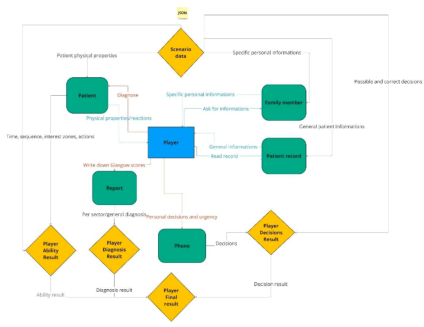
Immersive Simulation Tool One of the aims of the GlasgowSim project is to allow a multitude of scenarios and settings. For this reason, the simulation environment has been designed by combining two types of modules. Firstly, there are the user interface modules, which are responsible for providing information to the user or receiving data from them. These include the patient module, which represents the virtual character with which the user interacts. We also have the patient record module, which contains relevant medical information, and the diagnosis rendering module, which allows the user to submit their results through virtual tablet, virtual phone, virtual patient record, etc. Then, we have the data processing modules, which retrieve information from the scenario definition file (JSON format) and process it. These modules can compare the user’s results with the scenario data or simply provide information to the user interface modules. Their role is to guarantee the smooth operation of the simulation by utilizing the relevant data. By using this modular approach, we can effectively manage user interactions, provide the necessary information to the learner, and react to the learner actions and assessments within the immersive and entertaining simulation. This modular approach allows also for extensions to be added later with minimum adaptation. The generic scenario model used in GlasgowSim is shown in the Figure 4.
Figure 4: Scenario model for Glasgow simulation.
GlasgowSim - Glasgow Coma Scale Simulation 341
Interactive Animated Patient For this project, patient modelling is an essential component. It must be as realistic as possible to make the simulation more immersive. The patient must necessarily have a skeleton comprising the whole of his body, including his head, eyes, and mouth, so that we can then create animations adapted to the practices and diagnoses to be performed by the learners with a precise level of detail. The creation of the patient in the GlasgowSim project was based on UMA2, also known as Unity Multipurpose Avatar, which is an open-source project developed for Unity3D. Its aim is to enable the creation and customization of 3D characters in a flexible and modular way. UMA2 provides prefabs for dynamically generating humanoids. From these prefabs, it is then possible to add clothes to the patient, change his morphology and personalize him.
In addition to animations and tactile interaction with the patient (colliders zones), we have also developed voice interaction. This interaction is based on vosk-model-small-en-0.22. This is a model in French created exclusively for small devices. The model is based on the following sources: i) an acoustic model containing the sounds of the language; ii) a language model containing word sequences; and iii)a phonetic dictionary to break down words into sounds.
Vosk’s small language models allow the vocabulary to be reconfigured at runtime. This allows the language model to recognize only the words given following reconfiguration.
Scenario Generator Application To be able to create new scenarios and new clinical situations simply and easily, a scenario generator has been developed in the form of a web application connected to the simulator. This tool enables new scenarios to be created by defining the corresponding medical records and all the patient’s medical and behavioral parameters. Once created, a scenario is packaged in the form of a JSON file and sent to the simulator, which can then parse it, extract the information, and automatically generate a new simulation.
IMPLEMENTATION, VALIDATION, DISCUSSION State of Progress in the Project
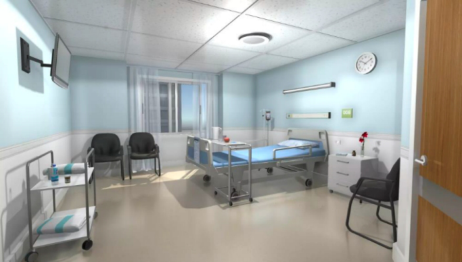
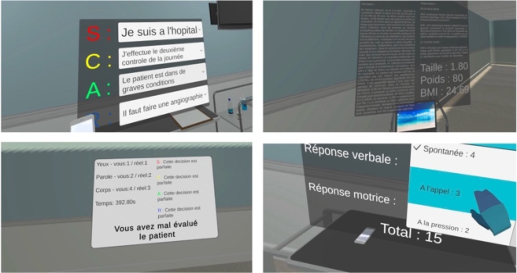
The GlasgowSim project is still in progress, but we already have a first functional and testable version. In this first version, all the scenarios take place in a realistic hospital (see Figure 5). This is a choice made by the HESAV teaching staff to replicate real-life sessions as closely as possible. However, there are plans for future diversification of environments to include training for diagnoses outside of hospital settings, such as road accidents, domestic accidents, etc.
The current simulation tool covers the three types of GCS diagnoses and allows practice on the SCAR tool recommended by the HESAV partners, as show in Figure 6.
Figure 5: 3D environment used in the current version of GlasgowSim.Figure 6: Some 3D GUI objects used in GlasgowSim simulation tool.
The scenario generation tool is also functional and uses a simple Web interface to create and configure new scenarios, store them in a scenario database and then import them into the simulation tool. So, as far as these two tools are concerned, we consider our project to be well advanced and the pilot uses are showing very positive feedback.
In terms of the interactive patient, however, a lot of work remains to be done. The current version of the patient does not seem to achieve the desired degree of realism. Muscle animations, which are responses to stimulation of specific areas by the learner, need to be better adjusted to approximate real movement. Eye movements also need to be improved and equipped with more intelligent behavior to adapt to the context: the learner’s location, movements in the vicinity, movement tracking, etc. Finally, the patient’s current conversational ability is judged to be very limited. To streamline operations, we initially opted for straightforward models that minimize server-side processing. However, it turns out that this choice is questionable and does not give satisfactory results. Finally, although some gamification aspects have been introduced in the current version, a lot of work remains to be to complete a fully gamified version in the form of a well-structured and balanced adventure-economy game.
GlasgowSim - Glasgow Coma Scale Simulation 343
Validation and Discussion The GlasgowSim solution is currently operational. For the time being, we have only carried out tests with pilot students outside the course. The aim is to assess the degree of satisfaction and usability. These initial tests have produced very positive results, which have encouraged us to plan tests next academic year.
CONCLUSION
Several studies investigating the application of the GSC have underscored that healthcare professionals lacking experience and ongoing training may inadvertently commit significant errors, especially in cases involving intermediate levels of consciousness. Such errors are particularly critical as they impede accurate detection of neurological changes crucial for patient monitoring (Rowley and Fielding, 1991). It is therefore important to integrate active teaching methods and simulation to diversify the learning scenarios which will allow students to train in environments that closely mimic real-life situations, thereby enhancing their preparedness for clinical practice.
ACKNOWLEDGMENT
The authors would like to acknowledge the entire teaching team of Neurological Clinical Evaluation, HESAV and the students who participated in the construction of the prototype, namely Mr. Jamal Albadri and Mr. Teo Ferrari.
REFERENCES
Chabert, G., Desmarais, C. and Jacques Ibanez Bueno (2010). Des cadres de santé ‘jouent’ à évaluer. Le ‘Serious gaming’ pour appréhender l’évaluation ?. Communication et organisation, 38(38). doi: https: //doi.org/10.4000/communicationorganisation.1419. Edwards, S. L. (2001). Using the Glasgow Coma Scale: Analysis and limitations. British Journal of Nursing, 10(2), pp. 92–101.doi: https://doi.org/10. 12968/bjon.2001.10.2.5391. Ingram, N. (1994). Knowledge and level of consciousness: Application to nursing practice. Journal of Advanced Nursing, 20(5), pp. 881–884. doi: https://doi.org/ 10.1046/j.1365-2648.1994.20050881.x. Jain, S. and Iverson, L. M. (2023). Glasgow coma scale. [online] National Library
Of Medicine. Available at: https://www.ncbi.nlm.nih.gov/books/NBK513298/. Ledoux, D., Piret, S., Boveroux, P., Bruno, M., Vanhaudenhuyse, A., Damas, P., Moonen, G. and Laureys, S. (2008). Les échelles d’évaluation des états de conscience altérée. Réanimation, 17(7), pp. 695–701. doi: https://doi.org/10. 1016/j.reaurg.2008.07.004. Lindpaintner, L. S., Bischofberger, I., Brenner, A., Knüppel, S., Scherer, T., Schmid, A.,
Schäfer, M., Stoll, H. R., Stolz-Baskett, P., Weyermann-Etter, S. and Hengartner- Kopp, B. (2009). Defining Clinical Assessment Standards for Bachelor’s-Prepared Nurses in Switzerland. Journal of Nursing Scholarship, 41(3), pp. 320–327. doi: https://doi.org/10.1111/j.1547-5069.2009.01286.x.
Reith, F. C. M., Brennan, P. M., Maas, A. I. R. and Teasdale, G. M. (2016). Lack of Standardization in the Use of the Glasgow Coma Scale: Results of International Surveys. Journal of Neurotrauma, 33(1), pp. 89–94. doi: https://doi.org/10.1089/ neu.2014.3843. Rowley, G. and Fielding, K. (1991). Reliability and accuracy of the Glasgow
Coma Scale with experienced and inexperienced users. The Lancet, 337(8740), pp. 535–538. doi: https://doi.org/10.1016/0140-6736(91)91309-i. Santos, W. C., Vancini-Campanharo, C. R., Lopes, M. C. B. T., Okuno, M. F. P. and Batista, R. E. A. (2016). Assessment of nurse’s knowledge about Glasgow coma scale at a university hospital. Einstein (São Paulo), 14(2), pp. 213–218. https://do i.org/10.1590/s1679-45082016ao3618 Teasdale, G. and Jennett, B. (1976). Assessment and prognosis of coma after head
injury. Acta Neurochirurgica, 34(1–4), pp. 45–55. doi: https://doi.org/10.1007/bf 01405862.
LISTED IN THE AHFE DIGITAL BOOKSTORE CATALOGUE
Explore the complete digital volume
Human Interaction and Emerging Technologies (IHIET 2024)
Read this individual research paper free through the original publisher, or explore the full digital proceedings book.
ISBN 978-1-964867-33-5
Explore this ISBN in the AHFE Bookstore ↗Listed in the July 2026 bookstore catalogue; search by ISBN to confirm current availability · Digital book purchase optional