This research paper proposed an ostrich locomotion-inspired walking cane as an aid for elderly individuals traversing natural landscapes. A unique leg structure that provides exceptional balance and stability to ostrich locomotion on uneven support was utilized. An experiment was conducted to compare the balance provided by the ostrich-inspired cane with that of a conventional small quad cane. Healthy male and female participants [Age 49 male and age 20, 20, 25 females] were instructed in testing procedures and provided written consent. Wireless inertia sensors were affixed to various points on the participant s' body and on the cane itself. Participants practiced standing and walking with both types of canes before engaging in balance challenging activities imitating age-related motion stability perturbance, including standing while rolling a ball forward and backward, and standing while rolling a ball clockwise, and walking while swinging over a cup. Each type of activities was performed on three different types of terrain including the firm, grassy, and gravelly surfaces. The Floquet multipliers analysis on motion data revealed that the ostrich locomotion-inspired cane outperformed the conventional cane in providing stability during gait and standing on both grassy and gravelly terrain. While further experimentation with a larger and more diverse population is necessary, this bio-inspired balance maintenance has the potential to revolutionize walking cane design and encourage older adults to engage in landscape travel for their well-being.
Landscape travel has a soothing effect on the older adult’s mental and physical fitness. It involves walking, sightseeing, and discovering, the activities of which the muscles are strengthened, mobility is promoted, and mind is engaged and sharpened. This “green exercise”is a popular part of the active aging lifestyle, which is widely accepted as a global goal for healthy
aging. Proper fitting and training with a cane have been shown to support this active lifestyle by increasing confidence and self-reported functional ability in elderly individuals prone to falls (Bertrand et al., 2017). Canes help improve gait and standing tolerance by partially off-loading a weak limb, enhancing the base of support, and improving balance sensory feedback (Miller et al., 2017; Sehgal et al., 2021). They also aid in negotiating obstacles on uneven surfaces. However, despite the variety of cane designs available (e.g., standard cane, offset cane, quadripod cane), reluctance to use canes on landscapes is often due to insufficient response of the cane during the cane-terrain negotiation.
The Shepherd’s crook, a nature-inspired design, has been utilized since the dawn of civilization. Its aesthetically pleasing design allows the cane to be conveniently hooked over the arm when not in use and provides a natural and comfortable grip while ensuring the tip maintains a firm stance on the ground. Yet, despite its growing popularity among aging users, its adaptation to an active lifestyle has not been widely recognized. Another nature- inspired design incorporates a flexible joint at the tip, enabling the cane to steer similarly to an animal’s ankle (Liu, 2011). However, the role of this steerable tip-ground interface in an active aging environment has not yet been thoroughly explored. While these designs aim to enhance grip performance and increase ground contact area along with their aesthetic appeal, they offer limited improvements in weight distribution and tip-ground negotiation, which are crucial for encouraging senior users towards outdoor walking activities. Despite the challenges in meeting both aesthetic and functional requirements for assistive outdoor walking, this fulfilment has already provided advancements in footwear (Zhang et al., 2023) and prosthetic leg designs (Valle et al., 2024), to which the comfortable locomotion of mammals such as cats and ostriches has been successfully applied.
Ostriches (Struthio camelus) are recognized as the largest and fastest bipedal land animals, known for their remarkable endurance during locomotion. Their legs are supported by two toes, so called third and fourth toes, and a permanently elevated metatarsophalangeal joint. The third toe bears most of the load, while the fourth toe aids in lateral stability, functioning as a complementary support. Ostriches often use an inverted pendulum gait at low speeds, optimizing movement performance and energy efficiency. Their ability to maintain balance on uneven terrain is facilitated by energy transfer through the elastic properties of their elevated metatarsophalangeal joint. This efficient energy transformation has been leveraged to optimize biomimetic neurostimulation in prosthetic legs (Valle et al., 2024) and improve cushioning performance in footwear (Zhang et al., 2023). Consequently, this principle has potential applications in the design of canes for seniors, enhancing balance maintenance on varied landscapes.
This study aimed to develop and validate a cane design intended to encourage older travellers to maintain an active lifestyle with minimal fear of navigating natural landscapes. A series of walking canes inspired by ostrich locomotion were customized from elastic materials, incorporating principles of efficient energy transformation and weight-bearing alignment derived from ostrich movement. Stability assessments were conducted on
Ostrich Locomotion-Inspired Walking Cane for Senior Adventurers 65
healthy adults during standing and walking, using both the proposed and conventional canes, in scenarios that simulated age-related motion instability (Miller, 2015). Floquet multipliers were calculated from kinematic data obtained via inertial measurement units (IMUs) attached to the canes and participants’ wrists during the trials. These stability indices were then analysed to compare the gait stability provided by the proposed cane designs versus conventional canes.
CANE DESIGN AND LOCOMOTION STABILITY MEASUREMENT AND ANALYSIS Cane Design
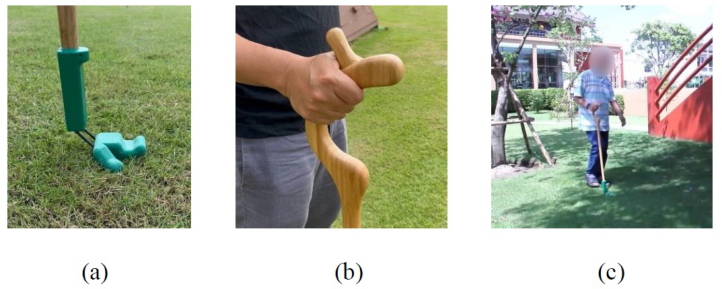
A series of canes inspired by ostrich locomotion were fabricated using high- density bamboo scrimber, steel-based torsion springs, silicone rubber, and acrylic resin. Each cane was customized to fit with the individual participant’s weight and height, maintain the torso in an upright position, and ensure that the lower arm remained parallel to the walking and standing surface (see Figure 1).
Figure 1: Materials and designs of the ostrich locomotion-inspired cane (a-b). Posture of the torso and lower arm during walking with ostrich locomotion-inspired cane (c).
Locomotion Stability Measurement Three heathy adult females [age 20, 20 and 25 years] and one heathy adult male [age 49 years] participated in this study. Instructions of testing procedures were provided, and written consent was obtained from each subject prior to the measurement. Each of three wireless inertia measurement units (IMUs) were affixed on the mid-point of the line connecting between ulna styloid process and radius styloid process of the cane handler, the mid-point of the cane’s neck, and the distance of 4-inch above the cane’s tip.
The wireless inertia measurement units (IMUs) were wrapped in polyester straps of which the length can be adjusted to fit on the cane and participant’s wrist. Each participant was asked to practice standing and walking by using each of small quad cane and ostrich locomotion-inspired cane before
performing the use of the canes on three different types of surfaces including the firm surface, grassy terrain, and gravelly terrain in following activities (Miller, 2015).
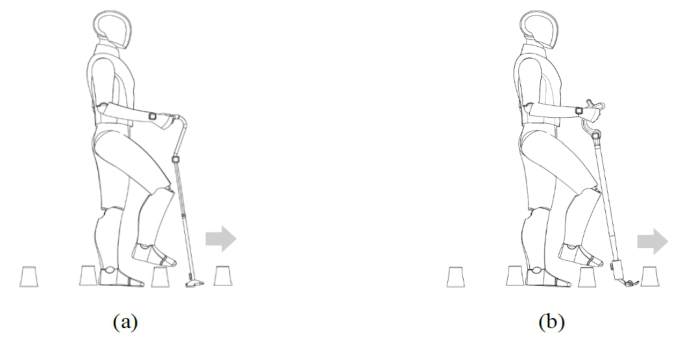
Walk at self-comfortable speed and swing over a cup for 5 consecutive steps (see Figure 2).
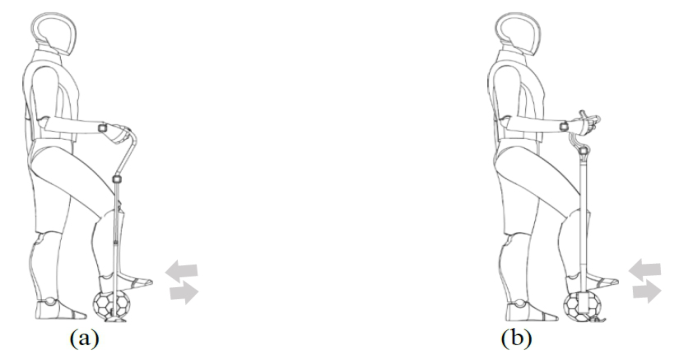
Stand and roll a ball forward and backward for 5 rounds (see Figure 3).
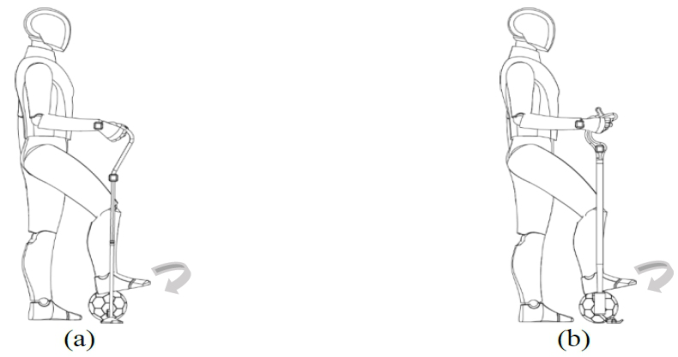
Stand and roll a ball in a clockwise direction for 5 rounds (see Figure 4).
Figure 2: Walking experiments with one leg swinging over a cup for 5 consecutive steps using small quad (a) and ostrich locomotion-inspired cane (b).Figure 3: Standing experiments with one leg rolling a ball forward and backward for 5 rounds using small quad (a) and ostrich locomotion-inspired cane (b).
Ostrich Locomotion-Inspired Walking Cane for Senior Adventurers 67
Figure 4: Standing experiments with one leg rolling a ball in clockwise direction for 5 rounds using small quad (a) and ostrich locomotion-inspired cane (b).
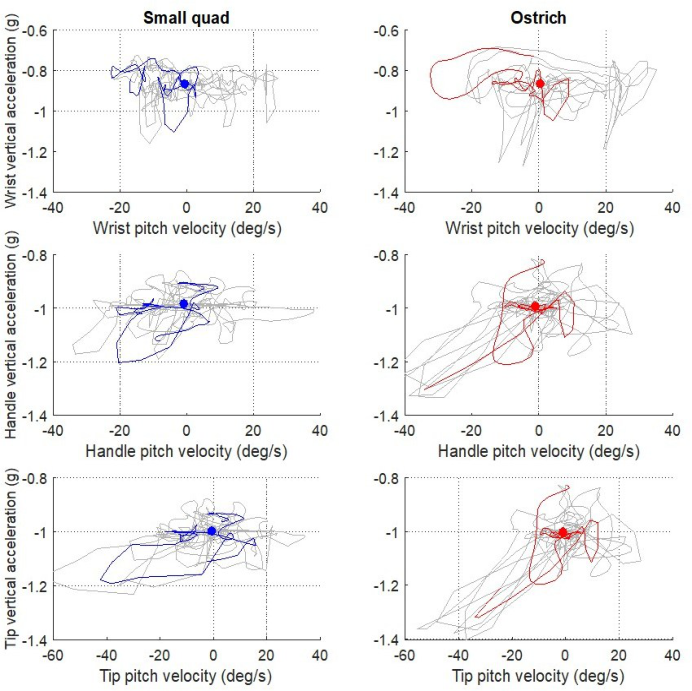
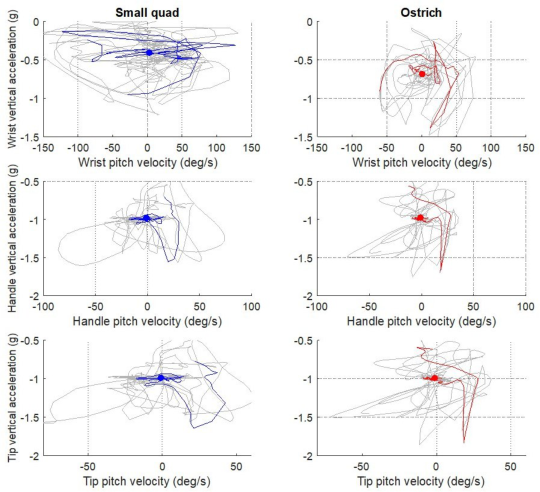
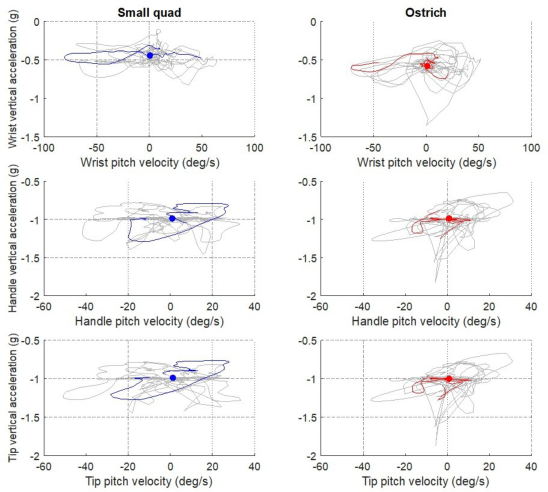
Locomotion Stability Analysis In this research, the indices of dynamic stability, referred to as ‘Floquet multipliers’ (Luzyanina et al., 2022) and derived from stability control theory, were utilized to analyze the level of locomotion stability. The Floquet multipliers were computed from the ‘state-space’—the relationship between the vertical acceleration and tilt velocity of the cane and the participant’s wrist—obtained from inertia measurement units (IMUs) during standing and walking experiments on three different surface types: firm, grassy, and gravelly terrain (see Figures 5–7). The state-space of the performed activities was represented by grey trajectories surrounding centers denoted by blue and red dots for the conventional small quad cane and the ostrich-inspired cane, respectively. The state-space of the initial motion cycle, such as the first walking step, was depicted by blue and red trajectories for the conventional small quad cane and the ostrich-inspired cane, respectively. The index was calculated from the convergence rates of the state-space trajectory towards the initial motion cycle. A higher rate of convergence to the initial motion cycle during balance maintenance signifies the ability of the assistive motion system to effectively negotiate obstacles on the terrain, such as slippery and unstable surfaces.
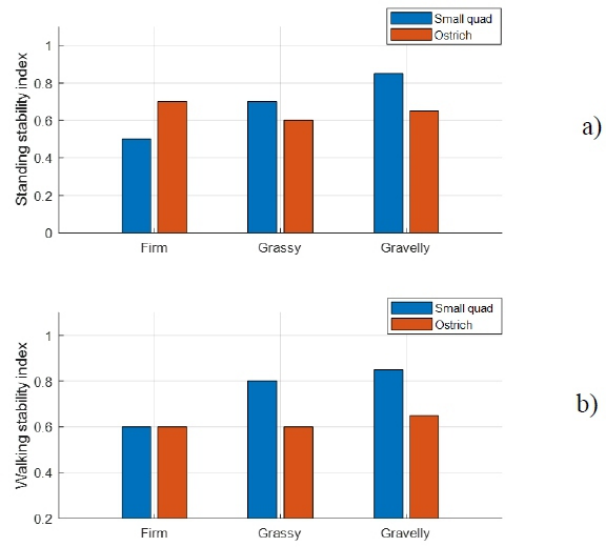
The indices, ranging from 0 to 1, indicate the rate of convergence to the initial motion cycle, thereby indicating the ability to regain balance. Lower values denote greater ability to maintain balance during locomotion, while higher values reflect reduced ability. Using this stability index, the performance of the ostrich locomotion-inspired cane was compared to that of the conventional small quad cane in terms of stability maintenance (see Figure 8). It was found that during stance and gait that simulates age- related motion instability, the conventional small quad cane provided optimal balance maintenance on the firm surface while the ostrich locomotion- inspired cane performed better balance maintenance compared to the
conventional small quad cane on uneven surfaces, particularly, on grassy terrain. This can be attributed to the original design of the conventional small quad cane, which was intended primarily for indoor surfaces where interaction with slippery grassy, and rough gravelly terrain was not a significant consideration.
Figure 5: A representative acceleration-velocity relationships (state-space) of an experiment of walking on “firm surface” with one leg swinging over a cup for 5 consecutive steps (grey) using small quad (blue) and ostrich locomotion-inspired cane (red) measured by three wireless inertia sensors affixed on the participants’ wrist, the tip, and the handle of the cane.
The enhancement in the ability to regain balance provided by the ostrich locomotion-inspired cane, particularly during navigation over slippery and rough terrain, can be attributed to its structural and interactive features. However, this preliminary analysis, focused on the physical imitation of age- related unstable motion, is limited to the physically assistive performance of the nature-inspired cane. The impact on diminished balance sensory reflexes, which is frequently observed in senior individuals, remains to be investigated.
Ostrich Locomotion-Inspired Walking Cane for Senior Adventurers 69
Figure 6: A representative acceleration-velocity relationships (state-space) of an experiment of walking on “grassy terrain” with one leg swinging over a cup for 5 consecutive steps (grey) using small quad (blue) and ostrich locomotion-inspired cane (red) measured by three wireless inertia sensors affixed on the participants’ wrist, the tip, and the handle of the cane.Figure 7: A representative acceleration-velocity relationships (state-space) of an experiment of walking on “gravelly terrain” with one leg swinging over a cup for 5 consecutive steps (grey) using small quad (blue) and ostrich locomotion-inspired cane (red) measured by three wireless inertia sensors affixed on the participants’ wrist, the tip, and the handle of the cane.Figure 8: The averages of stability indices (Floquet multipliers) quantified during standing (a) and walking (b) experiments performed by all participants by using small quad (blue) and ostrich locomotion-inspired cane (red).
CONCLUSION
This study proposed the design and performance evaluation of an ostrich locomotion-inspired walking cane, aimed at encouraging older travelers to maintain an active lifestyle in natural environment. Stability assessments were conducted on healthy adults during standing and walking, utilizing both the proposed and conventional canes in scenarios simulating age-related motion instability on three different types of terrain including the firm, grassy, and gravelly surfaces. Motion stability index derived from stability control theory were calculated from kinematic data obtained via inertial measurement units (IMUs) attached to the canes and participants’ wrists during the trials. Comparisons of these indices revealed that the ostrich locomotion-inspired cane provided superior stability assistance during both gait and standing on grassy and gravelly terrains compared to the conventional cane. Although further research involving the physically assistive performance on a larger and more diverse population, as well as the impact on diminished balance sensory reflexes, is necessary, this bio-inspired approach to balance maintenance has the potential to revolutionize walking cane design and promote landscape travel among older adults for their well-being. The nature-inspired aesthetic design could be further refined based on crucial safety and diverse mobility factors, as the confidence to use a cane derives not only from functional reliability but also from lifestyle representation.
Ostrich Locomotion-Inspired Walking Cane for Senior Adventurers 71
ACKNOWLEDGMENT
The authors would like to thank the National Research Council of Thailand (NRCT) for partially funding this research in the project entitled “The development of pilot digital industry of high processed bamboo for load bearing assistive devices for elderly in new normal state.”
REFERENCES
Bertrand, K., Raymond, M. H., Miller, W. C., Martin Ginis, K. A., & Demers, L.
(2017). Walking Aids for Enabling Activity and Participation: A Systematic Review. American journal of physical medicine & rehabilitation, 96(12), 894–903. https://doi.org/10.1097/PHM.0000000000000836 Luzyanina, T., Engelborghs, K., Computing Floquet multipliers for functional differential equations, Int. J. Bifurcat. Chaos, 12 (2022), 2977–2989. Liu, H. H., Eaves, J., Wang, W., Womack, J., & Bullock, P. (2011). Assessment of
canes used by older adults in senior living communities. Archives of gerontology and geriatrics, 52(3), 299–303. https://doi.org/10.1016/j.archger.2010.04.003 Miller, C. A., “Amputees’ Balance – Taking It to the Next Level: The Cup-Walking Exercise” (2015) Available at: https://works.bepress.com/carol-miller/6/. Sehgal, M., Jacobs, J., & Biggs, W. S. (2021). Mobility Assistive Device Use in Older
Adults. American family physician, 103(12), 737–744. Valle, G., Katic Secerovic, N., Eggemann, D. et al. Biomimetic computer-tobrain communication enhancing naturalistic touch sensations via peripheral nerve stimulation. Nat Commun 15, 1151 (2024). https://doi.org/10.1038/s41467-024- 45190-6 Zhang, R., Ji, Q., Luo, G., Xue, S., Ma, S., Li, J., & Ren, L. (2017). Phalangeal
joints kinematics during ostrich (Struthio camelus) locomotion. PeerJ, 5, e2857. https://doi.org/10.7717/peerj.2857 Zhang R., Zhao L., Kong Q., Yu G., Yu H., Li J., Tai W.-H. The Bionic High-Cushioning Midsole of Shoes Inspired by Functional Characteristics of Ostrich Foot. Bioengineering. 2023; 10(1):1. https://doi.org/10.3390/bioenginee ring10010001 Zhang, Y., Tao, C., Zhang, X., Guo, J., & Fan, Y. (2023). Effects of cane use on the
kinematic and kinetic of lower-extremity joints in inexperienced users. Journal of biomechanics, 146, 111426. https://doi.org/10.1016/j.jbiomech.2022.111426
LISTED IN THE AHFE DIGITAL BOOKSTORE CATALOGUE
Explore the complete digital volume
Human Systems Engineering and Design (IHSED2024): Future Trends and Applications
Read this individual research paper free through the original publisher, or explore the full digital proceedings book.
ISBN 978-1-964867-34-2
Explore this ISBN in the AHFE Bookstore ↗Listed in the July 2026 bookstore catalogue; search by ISBN to confirm current availability · Digital book purchase optional