Matthis Hoetter, Claus Bertram Bonerz, Marco Lohrey (2024). From Driving to Quality Time: Deriving User Requirements for Interiors of Highly Automated Vehicles. In: Human Systems Engineering and Design (IHSED2024): Future Trends and Applications. AHFE Open Access, vol. 158, pp. 144–154. https://doi.org/10.54941/ahfe1005538
The advent of SAE L4 automated vehicles transforms drivers into passengers, enabling engagement in non-driving related activities (NDRAs) and eliminating traditional interior design constraints. This shift entails new, complex requirements for vehicle interiors to enhance NDRA experiences, crucial for future product differentiation. However, limited knowledge in NDRA-centered interior development introduces significant design uncertainty. How will future interiors look like? This paper, as part of the KAI project (Bonerz et al., 2023), shall help car concept developers answer this question. It aims at reducing aforementioned uncertainties and high error costs in the concept phase of an interior. In order to ensure a high level of user acceptance, reliable user requirements and layout recommendations for the definition of vehicle interiors of tomorrow are needed. For generating these, the authors propose a method. This paper details the methodical approach taken for analysis of a Co-Creation study (CC) described in (Satrio et al., 2022) and shows exemplary specific results. The study was conducted in 2022 with 30 users, each covering four NDRAs in two travel scenarios. In this, participants expressed their needs by arranging component placeholders in an interior mock-up. The datasets were numerically and geometrically analyzed to identify NDRA specific interior arrangements. Criteria evaluated included configuration and number of seats, required components, their positioning, and criteria of visibility and reachability. The study revealed that NDRAs significantly influence preferred vehicle interior layouts, affecting the number of passengers, interior components, and seat configurations. The CC provides valuable insights into user motivations, and the interpretation helps translating the given information into user requirements and layout recommendations, which serve as a foundation for NDRA-centered interiors. As vehicle automation evolves, such methods are crucial to ensure interior design meets changing user requirements and technological advancements.
The automation of vehicles is fundamentally altering vehicle design. Traditionally, the focus is on designing the driver’s workspace, but from SAE L4 according to SAE J3016 onwards, the vehicle takes over driving tasks completely in its assigned operational design domain. The driver becomes
From Driving to Quality Time: Deriving User Requirements 145
a passenger, enabling engagement in non-driving related activities (NDRAs) such as working, reading or sleeping, turning the time spent in the car from a loss to quality time. With every considered NDRA, this shift creates a set of new complex requirements for vehicle interiors, focusing on optimizing the quality of these NDRA experiences. Latter will significantly shape future product differentiation.
The research project KAI (AI-supported assistant for interior development) at the Institute for Automotive Engineering (ika) at RWTH Aachen University aims to develop a software tool that supports developers of vehicle concepts in meeting these new requirements. The authors propose a method based on automated design for generating user centered concepts for future vehicle interiors, minimizing high error costs due to uncertainty in the concept phase. The tool seeks to resolve conflicts between costs, package and user experience (Bonerz et al., 2023).
To ensure a good user experience with the object of development, Human centered design according to ISO 9241–210 points to the importance of a high level of understanding of the user. Key is a deep insight of: first, what users like to do, second what they need and third how NDRA-optimized interiors look like.
Therefore, literature in regard to NDRAs was reviewed. First, preferred NDRAs were identified from literature, showing influences on the user’s ability to fully engage in an NDRA depend on the NDRA itself, personal preferences, age and other factors (Weigl et al., 2022). Literature also showed that trip purposes influence the chosen NDRA (Pelzer et al., 2023; Horvath & Partners et al., 2018). Hecht et al. (2020) analyses the duration and number of engaged activities in a simulator study, showing that NDRAs are done for different reasons and durations.
Second, components or functionalities for NDRA were found. While literature shows variation regarding activities, e.g. passengers working on a laptop need variable seating position, a docking station and a screen for a good working experience (Fitzen, 2020), it also show similarities between relaxing and working considering comfort features, e.g. refrigerator or blinds (Horvath & Partners et al., 2018).
Third, interior design of automated vehicles allows new seat arrangements. Turnable and adjustable seats impact the dimensions of the car. Vis-à-Vis arrangements require new safety and climating concepts. New component positionings (screens in windows) allow new ways of interaction (Golowko et al., 2017). In a co-design study, interior concepts for autonomous vehicles are developed. Drawings showing placements of components are made on the basis of previous interviews. While some users design their interiors specifically for one NDRA, most users take various activities into account. Larger vehicles tend to be favoured as basis (Stevens et al., 2019).
As shown, several studies or questionnaires have been developed and conducted to deepen user understanding. Generally, there is a good understanding of preferred NDRAs. However, users mostly express only needed components or technical solutions instead of motivations. Additionally, they are interviewed without being aware of objective conflicts within a car interior.
Therefore, there is a need to adapt the way information is collected to the boundary conditions of an interior. User understanding should be developed on the basis of free associations and interactive design in a defined immersive environment of a car interior. Geometric aspects should be included, with the placement of components and seats having implications on the overall vehicle concept. There is also the need to ask users about their motivations on choices as well as the need of interpretation of selected interior features which is necessary to reveal implicit solution-neutral motivations (such as need for control or safety).
The authors therefore conducted a Co-Creation study (CC) to enable free association within the boundary conditions of a car and asked for motivations behind choices. The study design and result insights were described in Satrio et al. (2022).
Still the derivation and usage of results from a CC is a challenge. Thus, a user’s motivation is difficult to incorporate directly into an evaluation or development process due to its unspecific form. Similarly, the geometric and numerical records of the study must first be made manageable before they can be analysed.
Therefore, a user’s motivation, mostly describing a user need, must be combined with the geometrical and numerical information and consequently translated into user requirements, which are defined structured sentences. They describe functionalities or qualities of an object of development in a measurable or testable way, while being solution-neutral. Additionaly, layout recommendations highlight relevant findings of the CC in a specific design proposal.
This paper proposes a method to abstract NDRA-optimal interior design from CC. It extends (Satrio et al., 2022) by focusing on analysis and detailed results.
METHOD TO DERIVE USER REQUIREMENTS FROM CO-CREATION The process involves four key stages. First, data collection by a CC study is performed. Data preparation is carried out by digitalizing and structuring the data for effective analysis. The subsequent stage is data interpretation. Finally, the results from the analysis are translated into requirements, resulting in independent layout recommendations for each selected NDRA. This ensures interiors optimally meet the user requirements resulting in high user acceptance.
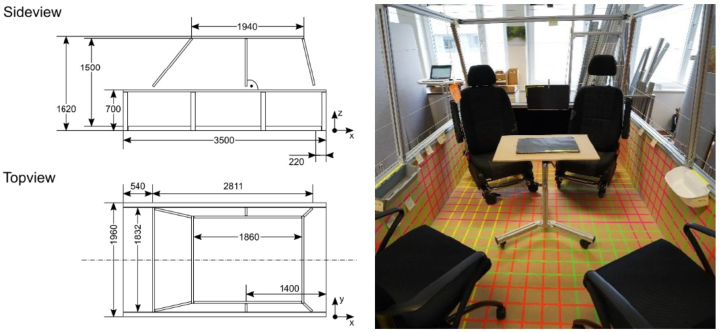
Data Collection Through CC The CC was conducted in 2022 at the Institute for Automotive Engineering (ika). Participants freely associated interiors by arranging placeholders for components in a seating-buck as shown in Figure 1. The study setup, participant demographics, and procedures are described in detail by (Satrio et al., 2022).
The study involved n = 30 users and covered four NDRAs in two different travel scenarios, creating a total of 120 datasets. The four NDRAs were divided into commuting (working on a laptop and relaxing) and leisure travel
From Driving to Quality Time: Deriving User Requirements 147
(reading and talking to passengers). These NDRAs and travel purposes were derived from an online interview (Pelzer et al., 2023).
The n = 30 participants (Age: M = 29.2 years, Min = 21, Max = 49) were 19 men and 11 women. Their average commuting time was M = 25 minutes. All participants held a driving license, driving an average annual distance of over M = 8.000 kilometers. Most had theoretical knowledge of automated driving, but little practical experience.
The experiment was designed to support precise recording of user interactions without interference. Participants were introduced to the topic, seating buck and available components. An option to add additional items was given. After placing the components, participants were questioned about their choices. Questions concerned the motivation behind seat arrangement, seat adjustment, relevant vehicle items, their position as well as the number of passengers using the interior. Up to five components per participant and NDRA were rated as subjectively relevant.
The selected layouts, as exemplary shown in Figure 1 (r), were photographed, digitally replicated, and stored in a database, including information on component positions and rotations, participant IDs, and associated NDRAs.
Figure 1: Seating-buck for CC (left) and exemplary result for talking to passengers (right).
Methodological Approach for Data Interpretation A method for deriving user requirements and layout recommendations based on the CC is proposed. First, the datasets are analyzed numerically and geometrically to identify resulting arrangements of components and peculiarities of different NDRAs. Secondly, participants’ feedback on their motivation is analyzed.
For geometrical and numerical analysis, a script-based evaluation of the CC based on the following established key figures is implemented in consideration of NDRAs: For the determination of selected seat
configurations, clusters with regard to number of seats and their position are formed, leading to a set of characteristics for each configuration. Components are analyzed with regard to their type, their counts, as well as based on their position within the interior and relative to the seat. Heatmaps help with the analysis of component distributions.
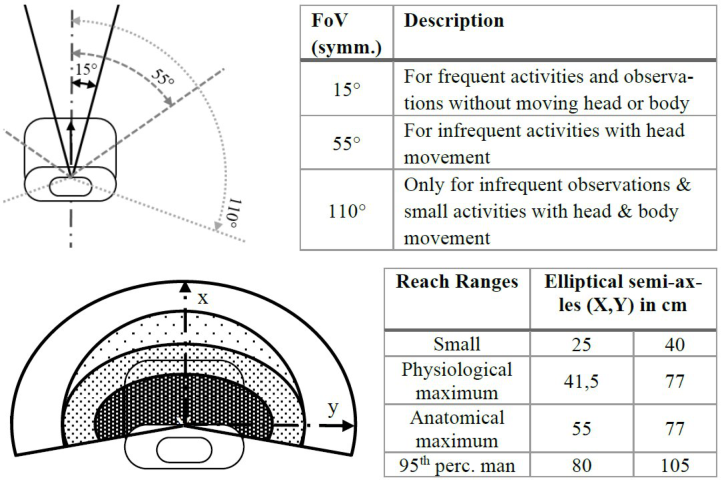
Ergonomic design criteria from vehicle and workplace design were evaluated in the context of the CC. Visibility and reachability criteria, as described in Figure 2, are applied in form of reach ranges and fields of view (FoV). Components placed within these within CC may induce requirements for components to be reachable or in view for the user.
Fields of view are divided into three categories according to DIN EN ISO 14738. The position of components within these fields of view is evaluated. Reach ranges are assessed according to criteria of small reach ranges, physiological and anatomical maximum reach ranges according to production ergonomics for seated activities. Components within the small ellipse can be reached comfortably. The two maximum ranges enable reachable components for every percentile (Kurz, 2010). Placed components outside the maximum range of a 95th-percentile-Male according to the RAMSIS manikin (Humanetics) are considered unreachable. Ambiguous components inside largest ellipse but outside of the ellipse of anatomical maximum need further evaluation.
Figure 2: Fields of view and reach ranges.
In addition to the numerical and geometrical evaluation, the motivations behind chosen layouts and type, relevance and positioning of components, which were collected in the questionnaire, are analyzed.
From Driving to Quality Time: Deriving User Requirements 149
For this, the recorded motivations are ranked by counts for each component, clustered and interpreted in their context. Motivations are also used to derive peculiarities and similarities between interior layouts over NDRAs.
RESULTING USER REQUIREMENTS AND RECOMMENDATIONS Satrio et al. (2022) already shows a high dependence of the preferred interior layout on the chosen NDRA. This paper’s results confirm that NDRAs strongly affect the preferred interior layout. Depending on the given NDRA, users preferred a specific number of passengers and seat configurations leading to NDRA specific types of components and corresponding layouts. The interiors varied in their geometrical overall layout for each NDRA.
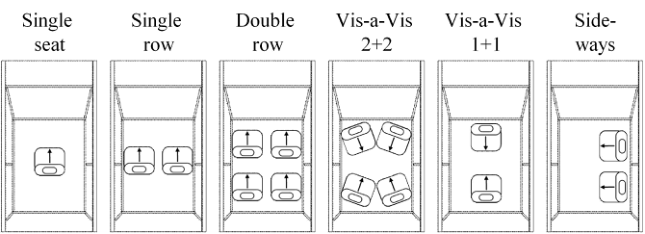
Based on the clustering of seats, standard configurations as shown in Figure 3 were defined based on the characteristics of: number of placed seats, their positioning, longitudinal distance between seats, seat rotation, rotation relative to seats.
Figure 3: Seat configurations identified in the CC.
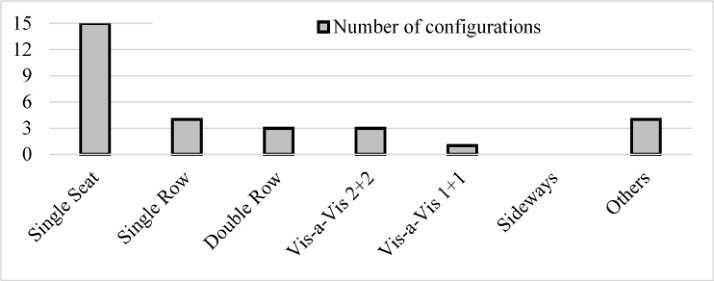
To give an example, the results of working on a laptop will be discussed in detail. As shown in Figure 4, central single seats are preferred. According to the motivations recorded in the interview, this is caused by the need for an individual workspace, free of distractions from other occupants, the improved spatial feeling while working, and a clear view on the road as well as on the workplace. The motivation to have a clear view on the road may result from user’s need for a high level of perceived safety and control. Additional recorded motivations are reduction of kinetosis for seat configurations in driving direction and better communication for Vis-à-Vis-configurations.
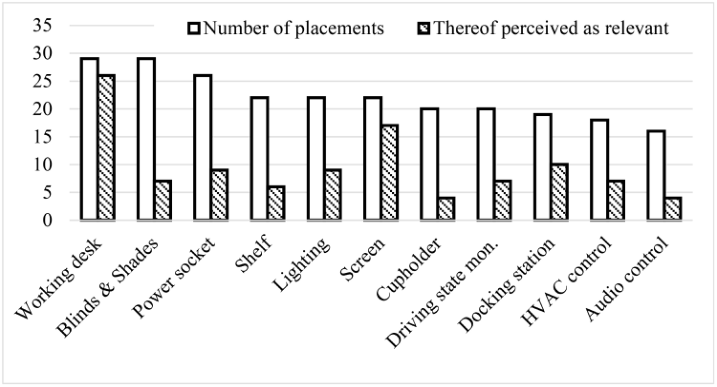
Figure 5 shows the total number of component type placements for this NDRA and the results of the question of which placed components are relevant. It shows the importance of desks (motivation: laptop fixation and work surface), screens (motivation: display of work content), power sockets, lighting, and docking stations (motivation: connection of mobile devices to car system). Some components are installed multiply per seat (blinds, air vents), while others are shared within the interior (desks, shelfs, driving state monitors, power sockets).
Figure 4: Distribution of seat configurations for NDRA working on a laptop.Figure 5: Distribution of placed components for NDRA working on a laptop.
Whereas shown results address the number and relevance of components, information about positional constraints, such as the required reachability and visibility of components, is needed for interior layout. The components within reachability (s. Table 1) and field of view (s. Table 2) indicate that users wish to work ergonomically in a close-range field. The backrest inclination angles observed show an upright position.
Table 1. Excerpt of required reach ranges of placed components.
Table available in the original PDF paper.
Reach ranges Small Physiological maximum Anatomical maximum No clear preference No reachability required
Table Center console Docking station Storage compartment Audio system Cupholder Power socket Air vents Screen Window controls Driving state monitor
From Driving to Quality Time: Deriving User Requirements 151
Table 2. Excerpt of components required within field of view.
Table available in the original PDF paper.
Field of view Narrow Wide Maximum No FoV req.
Table Sun visor Power socket Lighting Screen Cup holder Driving state monitor Docking station Storage compartment Blinds
Additional component position information is exemplary given for screens. Analyzing with regard to both, the position relative to the vehicle and relative to the seat lead to the following results: When seats are oriented in the direction of travel, seat-related analysis typically shows a screen position in front of the seats. Relative to the vehicle, screens are attached to the windows or at the back of the front seats. In combination with the forward seat rotation, this results in an orthogonal alignment of the screen to the line of vision and optimum viewing conditions on screen and road. In Vis-à-Vis-configurations, screens are positioned between the seats.
Derived User Requirements and Layout Recommendations Overall, the analysis of the recorded motivations and the geometrical information leads to the following user demand: Provision of an ergonomic working environment while ensuring a high level of perceived safety within the given boundaries of a car interior. From the given information, user requirements are derived in a structured form, of which several are presented in Table 3.
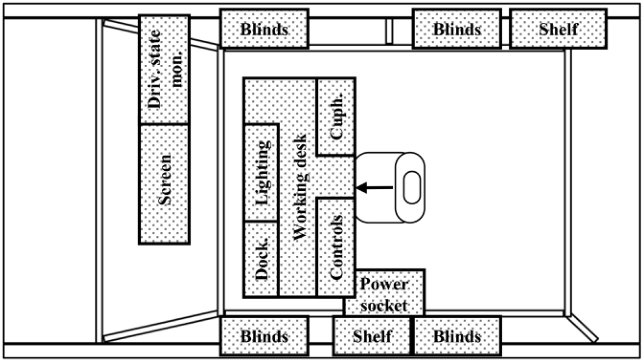
For all investigated NDRAs, layout recommendations are shown in Table 4. These summarize relevant findings of the CC and function as a startpoint for the layout of NDRA-specific purpose built interiors. Figure 6 shows a design proposal of such an interior for working on a laptop. It represents a recommendation for an NDRA-centered interior, fulfilling the solution-neutral user requirements.
Table 3. Excerpt of user requirements for working on a laptop.
Table available in the original PDF paper.
The interior must provide: 1 an accessible desk and storage for work utensils in front of the seat to ensure an optimal working posture. 2 a reachable power supply, with cable management that does not disturb the user. 3 adjustable lighting for optimal illumination of the workspace. 4 adequate storage options for various items. 5 means to inform occupants about the driving condition, if visual then positioned within the field of view of the workspace to enhance safety perception.
Table 4. NDRA-specific layout recommendations.
Table available in the original PDF paper.
NDRA Seat configuration Relevant Components Component position Working on a laptop Single seat for space and an undisturbed environment
Table as desk, power outlets, lighting, shelfs, storage, cupholder, docking station and screens Lighting, shelfs, screens, HVAC, audio system, refrigerator, seat comfort features.
Table in front of the seat, power outlet near the table, screen on the windshield, work lighting Relaxing Single seat and single row for maximum comfort. Relaxing seating position.
Lighting and blinds, tables, HVAC and cupholders.
Diffuse lighting above the seat, table in front of or next to the seat.
Screen on the windshield, individual seat lighting, refrigerator near seat rows Reading Single or double row for comfort and avoiding kinetosis.
Talking to passengers
Vis-a-vis 2+2 for communication.
Table between seat rows, refrigerator on the sides or between seats
Seats, table for interaction, refrigerators, audio system, and HVAC
Figure 6: Design proposal for an interior for NDRA working on a laptop.
Comparison of NDRA-Specific Interior Layouts While there are motivations for purpose-built seat configurations per NDRA, still conventional seat configurations are found. The front seats tend to be denser with regard to components and functionality. Across all NDRAs used components included lighting, shading, and controls for climate and audio, fulfilling basic needs and showing similar base placement patterns that are overlayed with NDRA-specific placements. Tables are used across all NDRAs, but with different motivations (in working on a laptop and talking to passengers as a desk for interaction, while reading and relaxing as storage).
From Driving to Quality Time: Deriving User Requirements 153
There were major differences with screens. For working on a laptop, these were placed in the windscreen and centrally in the field of view. For relaxing and talking to passengers, screens tended to be peripheral and did not have a high subjective weighting. Overall, for relaxing, there were less pronounced components within reachability and field of view, with fewer components and less vehicle interaction overall required.
DISCUSSION
The results show consensus with the state of the art and extend prior findings with geometrical information and motivations. User requirements and layout recommendations were derived with the proposed method.
While for working on a laptop and talking to passengers requirements were clear, relaxing and reading showed more diverse designs. These differences are presumably due to the clear definition of working on a laptop and talking to passengers themselves, compared to more individual interpretation for relaxing and reading. At the same time, Relaxing represents more of a state of mind. Therefore, further research in a definition of NDRA considering given scenarios, travel purpose, activity and state of mind is recommended.
Looking at the results, it seems that flexibility within an interior is key. Still the realisation of a very flexible interior creates challenges for i.e. passive occupant safety, dimensional restrictions, or weight. If NDRAs are chosen that have a familiar layout, one cleverly arranged, less flexible interior might be sufficient. Here the demand to fulfil the driving task outside the ODD, while creating benefit when being driven, shows the necessity of further research regarding interior layouts.
With this, further research should also create higher immersion improving geometrical, interactive, and visual kinaesthetic conditions within studys. Using tighter mock-up dimensions and real components as well as using a high-fidelity driving simulator would enhance immersion. Position height informations, anthropometric topics such as seating postures and the influencing factors on spatial feeling would provide valuable insights as well.
CONCLUSION
The CC provides a valuable platform for gathering insights into user’s motivations and collect geometrical information about future interiors within their specific boundary conditions. The developed method offers a systematic approach to translate user’s free association and collected motivations into requirements and recommendations. These are a starting point for the design of NDRA-centered interiors and ensure transferability into concept development and tools as KAI.
Four different NDRAs were evaluated using this method, resulting in testable requirements and detailed interior layout recommendations. As vehicle automation evolves, such methods will be crucial to ensure that interior design keeps up with the pace of changing user requirements and technological advancements.
The findings lead to the question whether for highly automated driving one interior layout could cover all NDRAs or if a highly variable interiors are necessary – especially considering driving tasks outside the ODD.
ACKNOWLEDGMENT
The authors would like to acknowledge the consortium of the research project KAI and the Federal Ministry for Economic Affairs and Climate Action of the Federal State of Germany for support and funding.
REFERENCES
Bonerz, C. B., Hötter, M., et al. (2023). Implications of Non-driving Related Activities on Interior Concepts. ATZ worldwide 125 (7-8). https://doi.org/10. 1007/s38311-023-1526-7. Fitzen, F. (2020). Auswirkungen des automatisierten Fahrens auf die Nutzerfunk-
tionalität des Fahrzeuginnenraums. Dissertation. Shaker Verlag. ISBN: 978-3- 8440-7648-6 Golowko, K., Mugele, P., Zimmer, D. (2017). Neue Möglichkeiten der Innenraumgestaltung. ATZextra 22 (S3), 42–45. https://doi.org/10.1007/978-3- 030-25629-6_5. Hecht, T., Feldhütter, A., et al. (2020). What Do You Do? An Analysis of Non-driving Related Activities During a 60 Minutes Conditionally Automated Highway Drive. In: Human Interaction and Emerging Technologies. Springer International Publishing, 28–34. https://doi.org/10.1007/978-3-030-25629-6_5 Horvath & Partners/Fraunhofer (2018). Enabling the Value of Time. Implikationen
für die Innenraumgestaltung autonomer Fahrzeuge, 2018. Online at https://www.muse.iao.fraunhofer.de/content/dam/iao/muse/en/documents/V oT-Studienbericht.pdf. Humanetics. RAMSIS Automotive. Online at https://www.human-solutions.com/en /products/ramsis-automotive/index.html. Kurz, Bernhard (2010). Produktionsergonomie. Versuch 5: Anthropometrie. Institut für angewandte Ergonomie. Online at http://www.ifaerg.de/hm_ergo/V5_anthr.pdf; https://www.ifaerg.de/hm_ergo/. Pelzer, J., Hötter, M., et al. (2023). Converting Driving Time to Leisure: Subjective
Evaluation of Innovative Seating Positions. In: Human Factors in Transportation, Applied Human Factors and Ergonomics 2023. https://doi.org/10.54941/ahfe 1003834 Satrio, D. A., Bonerz, C. B., et al. (2022). User-Interaction Experiments for the Design of Interiors for SAE-Level 4 Automated Vehicles. In: The 12th TSME International Conference on Mechanical Engineering, Phuket, Thailand. Stevens, G., Bossauer, P., et al. (2019). Using Time and Space Efficiently in Driverless
Cars. In: Proceedings of the 2019 CHI Conference, Conference on Human Factors in Computing Systems. https://doi.org/10.1145/3290605.3300635 Weigl, K., Schartmüller, C., Riener, A. (2022). Development of the Questionnaire on Non-Driving Related Tasks (QNDRT) in automated driving: Revealing age and gender differences. Behaviour & Information Technology. https://doi.org/10. 1080/0144929X.2022.2073473.
LISTED IN THE AHFE DIGITAL BOOKSTORE CATALOGUE
Explore the complete digital volume
Human Systems Engineering and Design (IHSED2024): Future Trends and Applications
Read this individual research paper free through the original publisher, or explore the full digital proceedings book.
ISBN 978-1-964867-34-2
Explore this ISBN in the AHFE Bookstore ↗Listed in the July 2026 bookstore catalogue; search by ISBN to confirm current availability · Digital book purchase optional