Jeffrey Kim, Darren Olsen (2024). Enhancing Construction Industry Training Through Augmented Reality: A Study of Student Inspectors. In: Human Factors in Design, Engineering, and Computing. AHFE Open Access, vol. 159, pp. 1069–1077. https://doi.org/10.54941/ahfe1005673
In the construction industry, ensuring timely and precise material installations is paramount. However, reliance on two-dimensional representations of three-dimensional structures in paper documents often leads to errors and inefficiencies, particularly among inexperienced installers. With seasoned professionals leaving the workforce, there is a growing expertise gap, undermining the industry's ability to deliver high-quality products. Augmented Reality (AR) emerges as a promising solution to these challenges, offering enhanced training and comprehension opportunities. This study evaluates the reliability of AR devices for construction inspections, focusing on their potential to bridge the aforementioned skills gap and improve quality control procedures. The research replicates a typical construction scenario involving the positioning of underground utilities before concrete placement, emphasizing the importance of accuracy in layout and placement. Results indicate significant differences in accuracy and precision among AR devices, with the HoloLens demonstrating superior performance. Despite not meeting stringent industry requirements in this study, AR tools show promise as educational resources, fostering active engagement and improving student comprehension. Future research should address environmental factors, sample size limitations, and disparities in device operation to further refine AR effectiveness in construction inspections. Leveraging AR's immersive features can lead to a transformative shift in educational paradigms within the industry, revitalizing productivity, and quality control practices for future success.
Timely and precise material installations are crucial in the construction industry (Clough et al., 2015). Currently, this process relies heavily on visual assessments of paper documents that represent three-dimensional structures using two-dimensional representations. Inexperienced installers often struggle to interpret these accurately, leading to errors and inefficiencies. These visualization skills, typically developed over years of experience, are crucial but increasingly scarce as seasoned professionals leave the workforce, exacerbating the expertise gap (Arditi and Gunaydin, 1997). This trend undermines the industry’s ability to deliver high-quality products, damaging its reputation for quality, service, and customer satisfaction.
To address these challenges, innovative solutions are essential. Augmented Reality (AR) emerges as a promising tool for enhancing training and comprehension. Unlike virtual reality, AR overlays real environments with digital information, potentially improving construction processes and bridging the skills gap. As Industry 4.0 innovations become integral to construction (referred to as Construction 4.0), AR stands out for its potential to revolutionize training and work processes (Sawhney et al., 2020). Studies have shown AR’s effectiveness in enhancing training both in classrooms and on-site (Kim and Irizarry, 2021; Olbina and Glick, 2023). As AR technology matures, its adoption grows, particularly in training and inspections, with various devices like headsets, mobile phones, and tablets being utilized. The critical question is the reliability and accuracy of these devices for training purposes. Addressing this concern, this research replicates a typical construction scenario, focusing on the precise positioning of underslab utilities (plumbing pipes) before concrete placement. Errors in positioning can lead to costly overruns and delays, emphasizing the importance of accurate layout and placement. The study examines the accuracy of different AR modalities and their respective advantages and disadvantages. Since the study emphasizes student learning, their perceptions following lab participation are crucial to determine if AR proves to be a practical and useful learning tool.
The theory guiding this research is that AR can help students develop foundational skills, benefiting them as future practitioners. Additionally, data on the accuracy and precision of AR tools can aid practitioners interested in modernizing inspection practices with Construction 4.0 technologies (Sawhney et al., 2020). This research not only lays the groundwork for integrating visualization tools into construction education but also provides effective alternatives to streamline inspections. By addressing the expertise gap left by departing professionals, these training methods can boost productivity in the construction sector, representing a significant step toward modernizing an industry in need of increased efficiency and expertise retention.
This paper outlines an action research study that tested various AR modalities and analysed their accuracy. The findings offer insights and guidance for future research based on the collected data.
LITERATURE REVIEW
The construction industry, essential for infrastructure development, faces significant challenges in maintaining quality standards. Research over the past decades indicates a decline in quality performance, attributed to a shortage of skilled labour (Allen, 1985), inadequate investment in quality management (Rosenfeld, 2009; Arditi and Gunaydin, 1997), and a lack of leadership in technological innovation (Wright, 1989). These systemic issues have hindered the industry’s competitiveness and efficiency, compounded by entrenched processes resistant to change (Moraru and Popa, 2021). As experienced professionals leave the workforce, the gap in expertise grows, and the less skilled incoming workforce struggles to meet industry demands (Welfare, Sherratt, and Hallowell, 2021). These factors collectively come short of improving the industry’s reputation and productivity.
Enhancing Construction Industry Training Through Augmented Reality 1071
In response to these challenges, technological advancements, particularly AR, offer promising solutions. AR’s current applications in construction showcase its versatility, including project design visualization (Hajirasouli et al., 2022), safety training (Li et al., 2018), owner training, and building maintenance support (Harikrishnan et al., 2021). Leveraging AR for quality control is a logical next step, but it is essential to focus on specific processes to understand its effectiveness. For instance, accurate placement of utilities within concrete structures is crucial to avoid costly rework. Inspectors play a key role in identifying deficiencies early, and AR must demonstrate repeatable accuracy and precision in this context. The technology’s ability to overlay virtual objects onto the real world must also be practical and effective.
Despite current innovative applications of AR in construction, there is a continual need to identify practical uses that address pressing concerns and improve quality, thereby reshaping the public’s perception of the industry. While interest in integrating AR for quality control is growing, current research often speculates on its potential rather than conducting substantive experimental studies (Hajirasouli et al., 2022; Adebowale and Agumba, 2022; Delgado et al., 2020). Empirical research is needed to explore the diverse applications of AR in construction and to fully harness its potential for quality improvement. It is hopeful that bridging this research gap can lead to tangible advancements in construction quality.
Research Question and Rationale for Research The construction industry must progress beyond outdated quality control procedures to improve its reputation for quality, especially considering its depleting skilled workforce. The mindset that past methods will suffice for the future needs to change. Training a new workforce is crucial. Addressing the shortage of skilled workers and improving quality control can be achieved by providing the incoming workforce with adequate training and tools. This research evaluates the accuracy of a new AR tool for construction inspections. The study involves students in a construction management class eager to acquire new knowledge and practical experience. By examining AR technology’s potential to enhance construction installations, the researcher aims to educate the next generation of industry professionals and improve overall construction quality.
METHODOLOGY
This study uses an action research approach with students to explore the effectiveness of AR tools in assessing the placement accuracy of underground utilities. The study integrates knowledge from various fields to bridge the gap between theoretical understanding and practical application, aiming to develop students into future construction professionals by organizing classroom learning into practical experiences. Previous research on AR’s accuracy and precision provides valuable insights. For example, Scherl et al. (2020) found that AR can achieve error accuracies within 1.33 mm in surgical procedures, while Khan et al. (2021) reported accuracies within 1.1 mm for object placement in virtual environments. These studies inform this methodology and device selection for this research while aiming to evaluate AR-assisted object placement accuracy in a construction context.
1072 Kim and Olsen
Participants The study involved students from a 4-year construction management program in the Southeastern United States. These students were chosen for their foundational knowledge and interest in future roles as project managers and superintendents in the construction industry. Aged between 20 and 23, they had practical construction site experience through internships, giving them a nuanced understanding of the importance of accuracy in utility placement. Participation was voluntary and conducted during regular class times.
AR Devices The chosen AR devices included the Apple iPhone 13 Pro Max (iPhone) and the iPad Pro 12.9-inch 5th generation (iPad). These devices use LIDAR technology for enhanced accuracy, which is critical for this study’s focus on real-world installations. The iPhone was selected for its portability, while the iPad offered a larger viewing screen, despite potential usability challenges due to its size. The familiarity of students with these devices facilitated data collection.
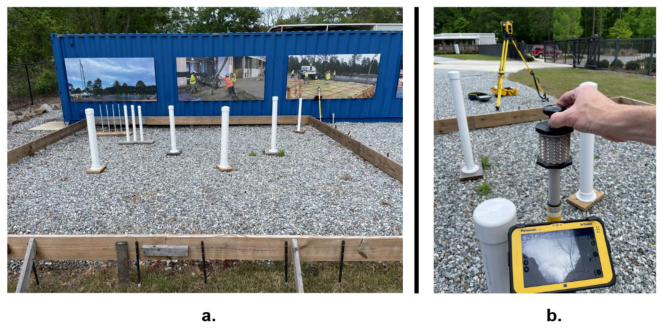
Simulated Construction Site The study was conducted in a simulated construction environment replicating a pre-concrete placement inspection (see Figure 1 a). The site measured 20 feet by 15 feet and was designed to mimic an actual construction project site’s environment. Students used the AR devices to position a survey prism (see Figure 1 b) atop a PVC pipe intended to simulate an underground utility pipe. The placement accuracy was then measured and compared to control points established in the simulated space. The site was outdoors and partially shaded to mimic typical construction site lighting conditions, adding practical relevance to the study. Although outdoor lighting and weather conditions were not measured, they are acknowledged as factors warranting further investigation.
Figure 1: (a) Simulated construction site and (b) Placement prism.
Enhancing Construction Industry Training Through Augmented Reality 1073
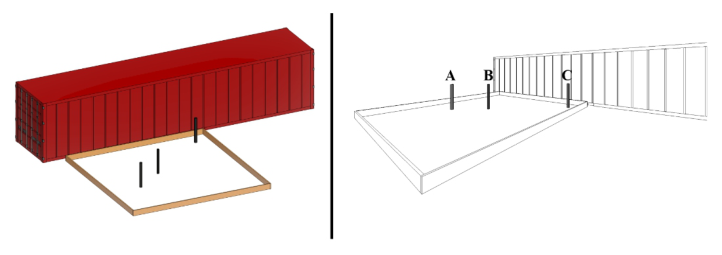
Mobile AR Application and Authoring Tools The AR experience was created using Trimble FieldLink MR, a platform based on Building Information Modeling (BIM) practices (Sacks et al., 2018). The virtual construction site model, initially developed in Autodesk Revit and converted to Trimble SketchUp, enabled seamless integration with Trimble FieldLink MR. This setup allowed consistent AR experiences across devices, with virtual PVC pipes (see Figure 2) serving as proxies for real-world utilities. Students used the AR devices to view and assess the placement of these virtual pipes ideally before concrete placement would occur.
Figure 2: Virtual pipe model visible on the AR devices.
Data Collection and Analysis Students were randomly assigned to one of the AR devices (iPhone or the iPad) and tasked with using the AR device to assist in positioning the survey prism at the observed center location of virtual pipes. The accuracy of their placements was measured using a robotic total station, which recorded both northing and easting coordinates. The difference between control point coordinates and observed coordinates determined the placement accuracy. Students also provided qualitative feedback through open-ended questions, offering insights into the AR tool’s utility, usability, and areas for improvement.
Exploring Accuracy and Precision This study focuses on the potential of AR tools to enhance quality control in construction by examining accuracy and precision. Accuracy is defined as hitting the target, while precision is hitting the target dependably. An ideal scenario would achieve both consistently. The use of the recorded coordinates in this study will help to measure both accuracy and precision of the student’s placement using the AR devices.
RESULTS
Observations and Measurements
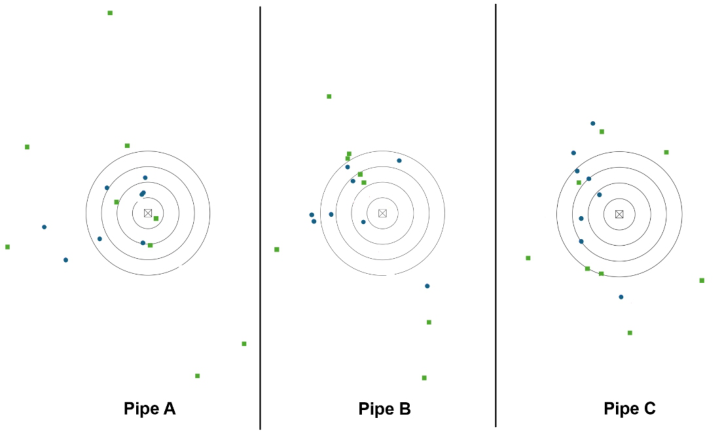
Figure 3 identifies the positional observations of three pipes recorded by students using the AR devices. Green squares depict observations made
1074 Kim and Olsen
with the iPhone and blue circles represent observations made with the iPad. Each student individually located the pipes using their assigned AR devices, resulting in three observations per student.
Figure 3: Positional observations of the virtual pipes by the students.
The northing and easting coordinates for each point were measured using a robotic total station and compared to control points to determine placement errors. Table 1 presents the average error distance (in inches), standard deviation, and the quantity of points recorded for each AR device.
Table 1. Student’s placement error results.
Table available in the original PDF paper.
Pipe ID iPhone iPad Pipe A (n = 8 for each device) Average SD 7.51 in. 4.22 3.30 in. 1.95 Pipe B (n = 8 for each device) Average SD 5.97 in. 2.80 3.66 in. 1.17 Pipe C (n = 8 for each device) Average SD 5.30 in. 1.43 3.79 in 1.39
Accuracy and Precision Analysis The study reveals significant differences in accuracy and precision between the AR devices. The iPad demonstrated the highest accuracy, with an average error of 3.59 inches and the iPhone at 6.26 inches. Standard deviation, reflecting precision, showed the iPad at 1.5 (average), and the iPhone at 2.82 (average). Visual comparisons in Figure 3 confirm the iPad’s superior performance, with observations consistently within the 8-inch PVC pipe perimeter, unlike the iPhone.
Enhancing Construction Industry Training Through Augmented Reality 1075
Device Performance and Practical Considerations The iPad is a viable solution, with minimal differences in error margins and precision. The iPhone offers better mobility and safety on construction sites when contrasted with the iPad which requires holding, sometimes with two hands, potentially restricting mobility and posing safety concerns (Alzhrani et al., 2018).
Construction tolerances are typically measured around an 1/8 to 1/4 inches and despite the limitations in accuracy found in this study, these AR tools show potential for educational purposes. The feedback from students underscores the benefits of these tools in training future practitioners, highlighting their value as educational assets.
Implications for Practice and Future Research The AR tool emerges as a potent educational resource, especially for training inspectors. Its immersive capabilities offer a platform for hands-on learning, helping students understand and rectify construction errors. Feedback from participants, such as, “The experience was fun and helped me to understand how to inspect for construction errors” indicates active engagement and meaningful learning experiences. Research supports that active learning, reducing cognitive load, improves student outcomes (Kim and Irizarry, 2021; Sweller, 2020).
Future research should address several factors:
1. Environmental Conditions: While replicating real-world variability is essential, controlling weather conditions can improve data reliability. 2. Sample Size: Increasing the student pool could provide more robust insights into the AR tool’s utility. 3. Hands-Free Operation: Investigating the impact of hands-free versus handheld devices on task performance could clarify their influence on outcomes.
While current AR tools may not meet the stringent accuracy requirements of construction practices, their educational value is significant. This study suggests that AR technology can transform learning experiences, fostering a culture of continuous improvement in the construction industry.
CONCLUSION
In conclusion, the construction industry faces significant challenges in maintaining quality and productivity, exacerbated by the departure of skilled professionals and resistance to adopting modern quality control approaches. Construction 4.0 technologies, such as AR, offer promising solutions to these issues. This study evaluated the reliability of AR devices, including for construction inspections, aiming to enhance quality control procedures. Our findings underscore the potential of AR technology to improve construction inspections, particularly in enhancing student comprehension and accuracy compared to traditional paper-based plans. The iPad demonstrated superior accuracy and precision compared to the iPhone. These results align with
1076 Kim and Olsen
previous research, affirming the efficacy of AR as a tool for training and work processes. Although the current capabilities of AR tools may not meet the stringent requirements of common construction industry practices, they show significant promise as educational resources. Simulated environments and hands-on installation experiences provided by AR can help students better grasp crucial concepts for managing quality inspections on construction sites.
Future research should address factors such as weather conditions, sample size limitations, and disparities in hands-free operation to further refine the effectiveness of AR in construction inspections. Exploring additional device types and considering hardware advancements, while tailoring active learning experiences to minimize cognitive load, supports positive student outcomes and meets the industry’s need for skilled professionals.
By leveraging the immersive features of AR and fostering active learning, we can usher in a transformative shift in educational paradigms within the construction industry. This transformation is essential for revitalizing productivity and quality control practices, ensuring the industry thrives in the 21st century. Embracing these technological advancements is not merely an option but a necessity for the success of innovating antiquated construction processes.
REFERENCES
Adebowale, O., & Agumba, J., 2022. Applications of augmented reality for construction productivity improvement: a systematic review. Smart and Sustainable Built Environment. https://doi.org/10.1108/sasbe-06-2022-0128 Allen, S., 1985. Why Construction Industry Productivity is Declining. Macroeconomics eJournal. https://doi.org/10.2307/1924811 Alzhrani, A., Cook, M., Johnstone, K. and Cooper, J., 2019. Handheld mobile devices—how do we use them at work? A university case study. In Proceedings of the 20th Congress of the International Ergonomics Association (IEA 2018) Volume III: Musculoskeletal Disorders 20 (pp. 126–137). Springer International Publishing. Arditi, D., & Gunaydin, H., 1997. Total quality management in the construction
process. International Journal of Project Management, 15, pp. 235–243. https://doi.org/10.1016/S0263-7863(96)00076-2 Clough, R. H., Sears, G. A., Sears, S. K., Segner, R. O. and Rounds, J. L., 2015.
Construction contracting: A practical guide to company management. John Wiley & Sons. Delgado, J., Oyedele, L., Beach, T., & Demian, P., 2020. Augmented and Virtual Reality in Construction: Drivers and Limitations for Industry Adoption. Journal of Construction Engineering and Management-asce, 146, p. 04020079. https://doi.org/10.1061/(ASCE) CO.1943–7862.0001844 Hajirasouli, A., Banihashemi, S., Drogemuller, R., Fazeli, A., & Mohandes, S., 2022.
Augmented reality in design and construction: thematic analysis and conceptual frameworks. Construction Innovation. https://doi.org/10.1108/ci-01-2022-0007 Harikrishnan, A., Abdallah, A., Ayer, S., Asmar, M., & Tang, P., 2021. Feasibility of augmented reality technology for communication in the construction industry. Adv. Eng. Informatics, 50, p. 101363. https://doi.org/10.1016/J. AEI.2021.101363
Enhancing Construction Industry Training Through Augmented Reality 1077
Khan, F., Muvva, V., Wu, D., Arefin, M., Phillips, N., & Swan, J., 2021. Measuring the Perceived Three-Dimensional Location of Virtual Objects in Optical See- Through Augmented Reality. 2021 IEEE International Symposium on Mixed and Augmented Reality (ISMAR), pp. 109–117. https://doi.org/10.1109/ismar52148. 2021.00025 Kim, J. and Irizarry, J., 2021. Evaluating the use of augmented reality technology to
improve construction management student’s spatial skills. International Journal of Construction Education and Research, 17(2), pp. 99–116. Li, X., Yi, W., Chi, H., Wang, X., & Chan, A., 2018. A critical review of virtual and augmented reality (VR/AR) applications in construction safety. Automation in Construction, 86, pp. 150–162. https://doi.org/10.1016/J. AUTCON.2017.11.003 Moraru, G., & Popa, D., 2021. Potential Resistance of Employees to Change in the Transition to Industry 5.0. MATEC Web of Conferences. https://doi.org/10.1051/ matecconf/202134307005 Olbina, S. and Glick, S., 2023. Using integrated hands-on and virtual reality
(VR) or augmented reality (AR) approaches in construction management education. International Journal of Construction Education and Research, 19(3), pp. 341–360. Rosenfeld, Y., 2009. Cost of quality versus cost of non-quality in construction: the crucial balance. Construction Management and Economics, 27, pp. 107–117. https://doi.org/10.1080/01446190802651744 Sacks, R., Eastman, C., Lee, G. and Teicholz, P., 2018. BIM handbook: A guide to
building information modeling for owners, designers, engineers, contractors, and facility managers. John Wiley & Sons. Sawhney, A., Riley, M., Irizarry, J. and Riley, M., 2020. Construction 4.0. Sawhney, A., Riley, M., Irizarry, J., Eds. Scherl, C., Stratemeier, J., Karle, C., Rotter, N., Hesser, J., Huber, L., Dias, A.,
Hoffmann, O., Riffel, P., Schönberg, S., Schell, A., Lammert, A., Affolter, A., & Männle, D., 2020. Augmented reality with HoloLens in parotid surgery: how to assess and to improve accuracy. European Archives of Oto-Rhino-Laryngology, 278, pp. 2473–2483. https://doi.org/10.1007/s00405-020-06351-7 Sweller, J., 2020. Cognitive load theory and educational technology. Educational Technology Research and Development, 68(1), pp. 1–16. Welfare, K., Sherratt, F., & Hallowell, M., 2021. Perceptions of Construction Work:
Views to Consider to Improve Employee Recruitment and Retention. Journal of Construction Engineering and Management. https://doi.org/10.1061/(ASCE) CO.1943–7862.0002057 Wright, R., 1989. Technology for competitiveness of the U. S. construction industry.
https://doi.org/10.6028/nist.ir.89-4099
LISTED IN THE AHFE DIGITAL BOOKSTORE CATALOGUE
Explore the complete digital volume
Human Factors in Design, Engineering, and Computing
Read this individual research paper free through the original publisher, or explore the full digital proceedings book.
ISBN 978-1-964867-35-9
Explore this ISBN in the AHFE Bookstore ↗Listed in the July 2026 bookstore catalogue; search by ISBN to confirm current availability · Digital book purchase optional