Aleksandar Pavic, Ahmed Mohammed, Ian Walker, Alessandro Margnelli, Iason Pelekis (2024). Investigating the Impact of Vertical Floor Vibration on Cognitive Performance. In: Human Factors in Design, Engineering, and Computing. AHFE Open Access, vol. 159, pp. 1244–1254. https://doi.org/10.54941/ahfe1005692
As construction materials and techniques improve, yielding stronger but lighter building floor structures, and architectural drive continues towards open plan, slender, and transparent designs, modern building floor structures – although strong and robust – increasingly feature considerably reduced mass, stiffness, and damping. This means that the so-called floor vibration serviceability design considerations replace structural strength considerations when determining the size and shape of modern floors in buildings.Every vibration serviceability problem can be rationalized into vibration source, path, and receiver. In the case of building floors, the vibration receiver is most frequently human occupants of the floor. Of the three parts of the vibration serviceability problem, the human receiver of vertical floor vibrations is by far the least researched and understood. Strong evidence is emerging that the current set of building design standards proposing limits for vertical floor vibration are unreliable and not fit for purpose.This paper describes the first-ever attempt to determine the effects of vertical floor vibration on the cognitive performance of the office floor users. A brand new and worldwide unique research facility VSimulator (based at the University of Exeter, UK) was used for the first time in the context of floor vibration serviceability.The paper describes the testing protocol employed for and the pilot data gathered from the Visual Search and Stroop cognitive tests carried out in a US$7m+ research facility. The pilot data gathered from the first group of 12 test subjects indicate that increasing the VSimulator floor vibration has a considerable effect on the scores from the two cognitive tests. The affected scores indicate a potential reduction in the cognitive performance of the test subjects with the increasing level of floor vibration.More test subjects are scheduled to take part in these tests during 2024 and the results could form the basis of the new generation of floor vibration serviceability standards. These will be based on objectively measured cognitive performance rather than subjectively assessed levels of floor vibration with ambiguous descriptors such as "annoying" or "low probability of adverse comment".
As construction materials and techniques improve, yielding stronger yet lighter building floor structures, and as architectural trends favour open- plan, slender, and transparent designs, modern floors - although robust - are increasingly lightweight. Consequently, following basic principles of physics, such as Newton’s Second Law, these floors with lower mass than before tend to vibrate more than before during everyday activities like walking.
Investigating the Effect of Vertical Floor Vibration on Cognitive Performance 1245
This shift means that, somewhat surprisingly, floor vibration serviceability is taking precedence over structural strength when determining modern building floors’ size, span, and weight.
Every vibration serviceability problem can be broken down into three components: vibration source, path, and receiver (International Organization for Standardization, 2007). For building floors, the receiver is most often the human occupants. Among these three components, the effect of vertical floor vibrations on humans remains the least researched and understood (Pavic and Reynolds, 2002).
However, strong evidence is emerging that the current set of building design standards, which propose upper limits for vertical floor vibrations affecting human occupants, is both unreliable and unfit for purpose (Wong and Wesolowsky, 2019). Supporting this, one-quarter of surveyed floor designers report that building users complain about excessive vibrations, even when the floors, on paper, comply with published floor vibration serviceability guidelines (Pavic, 2019).
Humans spend 90% of their lives indoors, maintaining constant physical contact with building floors - whether standing, sitting, or lying down. As such, floors are unique civil engineering structures that people physically interact with most frequently. When floor vibration governs this interaction, it significantly affects both the structure’s design and human occupants. Shorter, stiffer, and heavier floors vibrate less, making them more acceptable to occupants. However, these floors have always been less desirable for owners and architects due to higher costs and reduced flexibility, which can decrease the building’s asset value (Buxton, 2016).
The UN estimates that an additional 230 bn m2 of new floors will be needed globally by 2060 - equivalent to adding a city the size of Paris every week (UNEP, 2017). That is roughly doubling the current worldwide stock of building floors. Each 1 m2 of new floor generates approximately 500 kg of energy-related embodied carbon (CO2e), averaging at 3.6 bn tonnes of CO2e per year—about 10% of the world’s total energy-related embodied carbon (Orr, 2018), five times more than aviation. Surprisingly, this figure depends largely on how floors are designed to control vibrations, which in turn directly affects human occupants of buildings.
Considering such a huge environmental impact of constructing building floors whose design is governed very much by the effect of floor vibration on human occupants of buildings, there is an urgent need to understand better the effect of floor vibration on humans and improve the existing design guidance.
GUIDELINES FOR HUMAN VIBRATION IN BUILDINGS So, what is the problem with the current guidelines for human vibration in buildings? In his seminal work, Griffin (1990) summarizes research up to 1990 and explains the basis for key standards like those from the British Standards Institution (BSI, 1992) and the International Organization for Standardization (ISO, 1989). These standards form the foundation of most modern guidelines on acceptable vertical floor vibrations used nationally and internationally around the world.
Griffin (1990, p. 221) notes that the total absence of vibration in buildings is impossible, stating that: “Comfort or ‘a conscious well-being’ within a building merely requires the absence of ‘perceptible’ vibration for most of the time.”
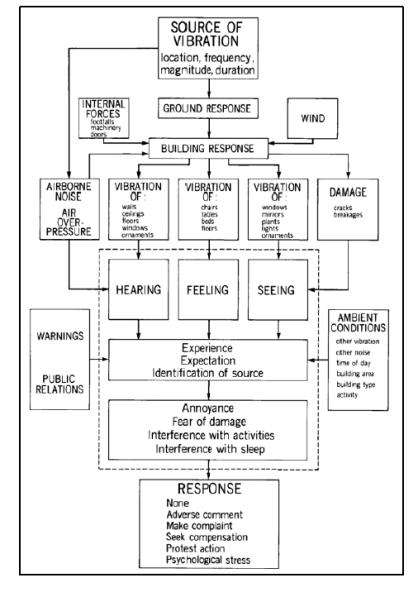
The lower threshold of subjectively unacceptable vibration is defined by the point at which it becomes perceptible. However, acceptable vibration levels can vary significantly depending on factors like building type (residential, office, etc.), human activities (sedentary or moving), sound or noise levels, and occupants’ familiarity with the vibration. Figure 1 (Griffin, 1990) illustrates the complexity of determining human responses to building vibrations, highlighting the interconnections of various factors involved.
Figure 1: A comprehensive model demonstrating the complex interactions that are affecting the human response to the building vibration. (Adapted from Griffin, 1990).
Interestingly, looking at the significant body of research presented by Griffin (1990) and, towards the end of the flow chart in Figure 1, very few of these consequences and responses are quantified in design standards and guidelines. There is a clear need to do that as a means of improving existing and unreliable design guidance increasingly yielding to unsatisfactory floor vibration serviceability performance.
Investigating the Effect of Vertical Floor Vibration on Cognitive Performance 1247
QUANTIFYING EFFECTS OF VERTICAL FLOOR VIBRATION Looking at the comprehensive model presented in Figure 1, this study focused on quantifying “Interference with activities”. This particular consequence appears to be quite relevant and there is almost no published research on that particular effect of vertical floor vibration on its human occupants.
Vertical floor vibrations are particularly important for office buildings which tend to feature long open-plan areas that are prone to excessive vibration due to humans walking across the floor (Murray et al., 2016). In offices, people do cognitive tasks involving computers and vibrating computer screens suspended from arms that tend to amplify mechanically the floor vibrations. In this context, interference with the cognition of office workers exposed to floor vibration is of particular interest considering its potentially direct link with work productivity. Despite its seemingly great strategic value and importance, to the best knowledge of the authors of this paper, this particular angle of vertical floor vibration and its effects on humans was never investigated previously.
The key reason for this has been the huge difficulty in gathering reliable data that links in a quantifiable manner the floor vertical vibration and cognitive ability. In principle, the best way to gather this kind of data is to rely on data from real buildings. This provides excellent practical validity, but also brings three serious shortcomings:
1. Limited scope: data collection relies on questionnaires, the highly qualitative results of which have limited scope and accuracy, especially if vibrations (or their effects) are subconscious; 2. Limited access: getting access to buildings and occupants for objective data collection is challenging. Hence, quantitative measurement of physiological and psychological effects in real buildings is all but impossible due to legal and logistical problems; 3. No control: critically, there is no control over the motion characteristics and environmental conditions, so the effects of a wide range of different conditions or characteristics cannot be untangled and explored systematically.
This study addresses some of these limitations by using strictly controlled laboratory studies to measure not only perception but also the effects of vertical floor vibration on the cognition of test subjects acting as office workers.
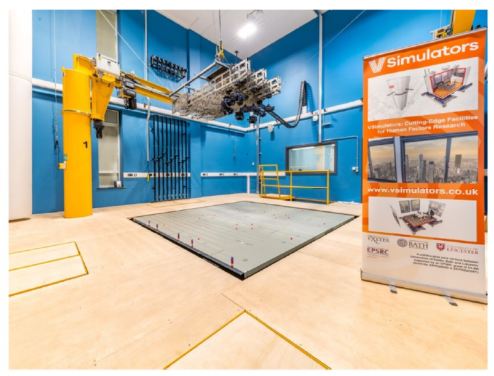
Description of VSimulator Research Facility at Exeter University, UK The new and worldwide unique VSimulator research facility at the University of Exeter, UK is central to this work (Figure 2).
Figure 2: VSimulator rigid platform within an 8 m cube purposely built to accommodate the facility built by The University of Exeter at Exeter Science Park.
The US$7m+ VSimulator provided, for the first time, the opportunity to objectively and systematically carry out a pilot study of the vertical floor vibration effects on human cognition with unprecedented levels of realism and control.
VSimulator is a 3.5-tonne electro-mechanical device featuring a 3.7 m by 3.7 m platform that can move as a ‘rigid’ body in six fully controllable degrees of freedom (three translations and three rotations). The platform can support a payload of 1 tonne. It can replicate the measured acceleration of real-life floors with a very high level of fidelity (Figure 4) which was important for the design of this particular pilot study.
Description of Pilot Tests on VSimulator Cognitive work performance was assessed objectively by the visual search (VS) and Stroop (S) tests. The visual search test (Treisman & Gelade, 1980), is a psychological task used to assess an individual’s ability to locate a target stimulus (a single inverted T letter in this particular case) among a set of many distracting elements (T letters). The Stroop test is a venerable procedure (Stroop, 1935) that measures cognitive control and the ability to manage interference between competing mental processes (respondents name the colour in which words describing a colour are printed, which is made difficult when, for example, the word ‘blue’ is printed in red ink, because the process of reading words is highly automated). The tests were executed on a computer by developing a code in the visual interactive software PhychoPy v2020 (Peirce et al., 2019). These two cognitive tests were chosen after Heshmati (2022) tested various cognitive procedures and found these were the most sensitive to the effects of sway vibration.
Floor vibration was simulated in the dominant vertical direction only, as appropriate. The test aimed to establish the effects of as realistic as possible floor vibrations of the kind that could be classified subjectively as
Investigating the Effect of Vertical Floor Vibration on Cognitive Performance 1249
‘lively’. These vibration levels were very much within the limits acceptable by standards and design guidelines with only very rare excursions above the codified vibration limit, which happens for whatever reason in reality as well. The vertical vibration signals were curated from a database of long-term vibration monitoring records of many problematic but operational building floors investigated over the years by the authors of this paper.
To simulate a realistic office floor scenario, the total test was relatively long, exactly 112 minutes. The test was divided into three periods (Table 1) featuring three or two 12-minute blocks of activity, separated by two rest periods.
Table 1. Sequencing of activities during a typical 112-minute test.
Table available in the original PDF paper.
Time since start of the test [minutes] Duration [minutes] Period Activity 0–12 12 1 Block 1 12–24 12 Block 2 24–36 12 Block 3 36–44 8 Rest 44–56 12 2 Block 4 56–68 12 Block 5 68–80 12 Block 6 80–88 8 Rest 88–100 12 3 Block 7 100–112 12 Block 8
Each 12-minute block of activity was structured as shown in Table 2.
Table 2. Sequencing of activities during each 12-minute block (from A to H) of activity.
Table available in the original PDF paper.
Activity
Time Since Start of the Activity Block [minutes]
Duration [minutes]
0–1 1 Reading instruction on the computer screen 1–5 4 Doing randomised VS or S tests 5–7 2 Subjective questionnaire about the experience in the just done VS/S test 7–11 4 Doing randomised VS or S tests 11–12 1 Subjective questionnaire about the experience in the just done VS/S test
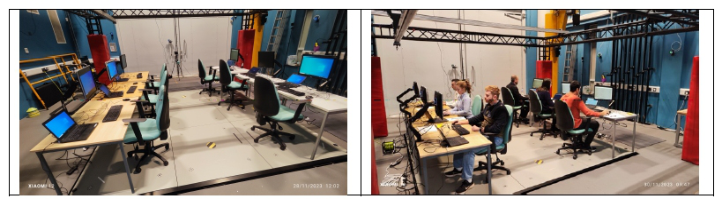
Seven of the eight blocks of activity shown in Table 1 were randomly sequenced. Each block consisted of 240 s long realistic acceleration time history of the kind that millions of people experience daily if they work on a lively office floor. The other block was with no vibration whatsoever, but the appearance of this block was randomised and test subjects did not know when this block happened in the randomised sequence of eight blocks. Figure 3 shows the test setup with six workstations and the first group of six
test subjects. The VS and S tests were also randomised so each test subject was doing a different problem at each point in time.
Figure 3: Left – ‘Office’ setup with six computer workstations. Right – six test subjects perform a 112-minute test.
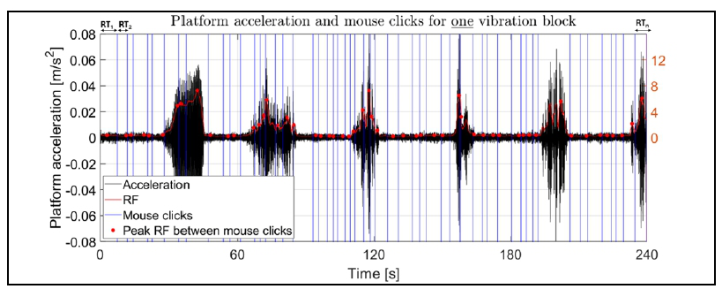
The VSimulator platform was moving only vertically like a rigid body, so a typical acceleration time history experienced by all test subjects during a 240 s VS or S test is shown in Figure 4. Only results from the VS tests are presented as pilot data in the remainder of the paper.
Figure 4: Typical acceleration time history experienced by all test subjects during a single 4-minute activity mentioned in Table 2.
In particular, the vertical blue lines in Figure 4 indicate the points in time when specifically the VS test click happened for a particular human test subject. The times between the two subsequent answers were recorded as RTi statistical variable where i goes from 1 to n where n is the total number of answers made by the test subject in 240 s. The red dots indicate the maximum transient vibration value of MTVV (International Organization for Standardization, 1989) divided by 0.005m/s2. This is how the so-called response factor (RF), shown on the right vertical axis, is calculated. RF shows how many times is the largest 1 s root-mean-square (RMS) acceleration, expressed in m/s2, greater than 0.005 m/s2 RMS vibration baseline defined by International Organization for Standardization (1989). For offices, RF should be less than 4 at any time, whereas some design guidelines are less
Investigating the Effect of Vertical Floor Vibration on Cognitive Performance 1251
stringent allowing RF<8. It can be seen in Figure 4 that RF was always less than 8 during this particular test. This confirms that the levels of vibration were what could be experienced in a normal office supported by a lively floor.
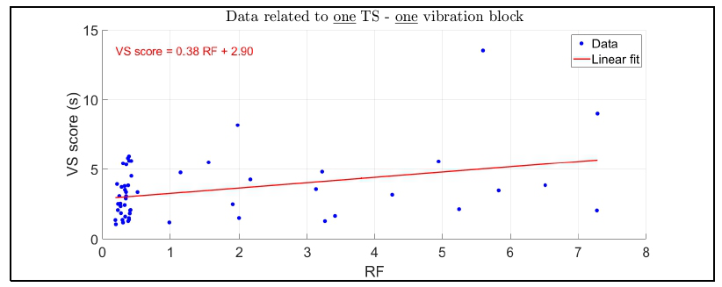
For the time-domain data in Figure 4, Figure 5 shows a relationship between the score in the VS test (the time between two subsequent answers, in which longer times indicate a more effortful search) and the maximum 1 s RF experienced by the test subject between those two answers. There is a statistically significant positive correlation between the maximum 1 s RFs and VS test scores. In other words, the more the floor was vibrating just before the finding was made, the test subject needed more time to find the inverted T letter surrounded by T letters.
Figure 5: Statistically significant positive correlation between RF and VS score based on 240 s data in Figure 3. A total of 53 samples with p-value less than 0.01.
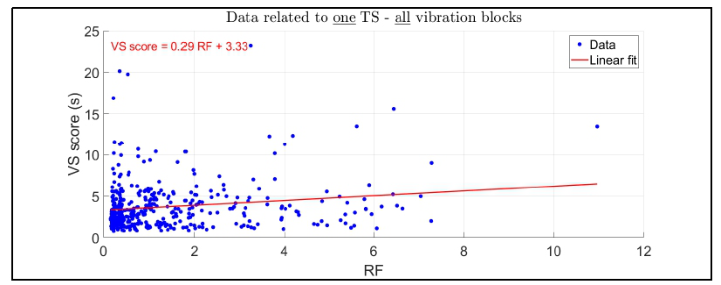
A complete VS score vs. RF data set for this particular test subject pertinent to the whole 112-minute testing is shown in Figure 6.
Figure 6: Statistically significant positive correlation between RF and VS scores based on all eight data blocks and complete 112-minute test for the same test subject with their partial data shown in Figures 3 and 4. A total of 403 samples with p-value less than 0.01.
A total of 12 test subjects participated in two groups of six, each doing the 112-minute testing exposed to the same sequence of vibration but doing different tests during the 240 s vibration blocks. The two groups had different sequences of the eight vibration blocks Depending on their speed of finding the inverted T letter within the given 240 s period, a different number of answers (each resulting in a pair of RF and VS score values) was generated by different test subjects. Also, for each test subject, each 240 s period resulted in a different number of RF and VS score pairs. However, each test subject did the same number of eight VS and eight S tests.
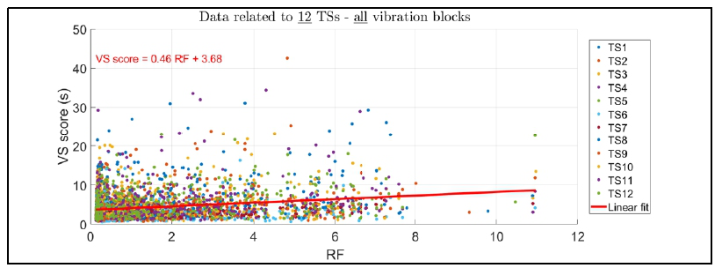
For all VS tests, a statistical analysis of data for each test subject revealed a similar trend as shown in Figures 5 and 6: statistically significant positive correlation between maximum 1 s RF and the length of time to find the answer. In total, 4241 data points were statistically analysed across all 12 test subjects and the results are shown in Figure 7.
Figure 7: Statistically significant positive correlation between maximum 1 s RF and VS scores based on all 12 test subjects during the pilot testing. A total of 4241 samples with p-value considerably less than 0.001.
The observed relationship between maximum 1 s RF and VS scores in Figure 7 is not likely to be due to random chance as the p-value was well below 0.001. Looking at the linear regression model (red line) representing the observed data, it does appear that the VS score increased considerably when the level of vibration was greater. In other words, as the test subjects needed more time to find the correct answer during the VS test, the increased level of vibration which caused this effect harmed their cognitive ability. For RF = 0 floor vibrations are imperceptible of course and the predicted VS score value is 3.68 s which is the average time to find an answer when vibrations are not perceptible. However, for the upper limit of RF = 8 for office floors, the model predicts 7.36 s, which is twice as long, quite revealing and the key finding of this pilot study.
CONCLUSION
The pioneering pilot data gathered in VSimulator indicate that increasing the vertical floor vibration had a considerable effect on the scores from the visual search test. The affected scores indicate a potentially significant reduction in
Investigating the Effect of Vertical Floor Vibration on Cognitive Performance 1253
the cognitive performance of the test subjects with the increasing level of floor vibration. Specifically, the following two conclusions could be made based on the pilot data:
1. A binary pass-fail criterion, used until now by structural engineers to design floors, may be fundamentally flawed. This is because the VSimulator tests demonstrated that any level of perceptible floor vibration can increase the thinking time to complete the task, indicating reduced cognitive performance. 2. Frequently occurring perceptible but - according to design guidelines - ‘acceptable’ vibration levels will render longer periods when the cognitive ability of the floor occupants is reduced. This, in turn, may mean that ‘acceptable’ but frequently occurring floor vibration can harm the productivity of office workers more than the same levels of vibration less frequently occurring.
ACKNOWLEDGMENT
The authors would like to acknowledge financial support from The Tyrens Group, an independent engineering and design consultancy group dedicated to sustainable solutions and customer value, and in-kind support from Full Scale Dynamics Ltd.
REFERENCES
BSI. (1992). Guide to Evaluation of human exposure to vibration in buildings (1 Hz to 80 Hz). BS 6472:1992. British Standards Institution. Buxton, P. (2016). How far can you go? The RIBA Journal. 12 May 2016. https:
//www.ribaj.com/intelligence/how-far-can-you-go accessed 26 September 2024. Heshmati, K. (2022). Acceptability of wind-induced vibrations in tall buildings’ office environments. PhD Thesis. University of Bath International Organization for Standardization. (1989). Evaluation of human
exposure to whole-body vibration – Part 2: Continuous and shock-induced vibration in buildings (1 to 80Hz). ISO 2631-2:1989(E). First edition 1989-02-15 International Organization for Standardization. (2007). Bases for design of structures – Serviceability of buildings and walkways against vibrations. ISO 10137:2007(E). Second edition 2007-11-15. Murray, T. M., Allen, D. E., Ungar, E. E. and Davis, D. B. (2016). Vibrations of Steel-Framed Structural Systems Due to Human Activity. Design Guide 11. Second Edition. American Institute of Steel Construction. Pavic, A. (2019). Results of IStructE 2015 survey of practitioners on vibration
serviceability. SECED Conference, 9–10 September, London, UK. Pavic, A. and Reynolds, P. (2002) Vibration serviceability of long-span concrete building floors. Part 1: Review of background information. The Shock and Vibration Digest, 34(3), pp. 191–211 Peirce, J. W., Gray, J. R., Simpson, S., MacAskill, M. R., Höchenberger, R., Sogo, H.,
Kastman, E., Lindeløv, J. (2019). PsychoPy2: experiments in behavior made easy. Behavior Research Methods. https://doi.org/10.3758/s13428-018-01193-y. Stroop, J. R. (1935). Studies of interference in serial verbal reactions. Journal of experimental psychology, 18 (6), 643.
Treisman, A., & Gelade, G. (1980). A feature-integration theory of attention.
Cognitive Psychology, 12, 97–136. UNEP. (2017). As buildings and construction sector grows, time running out to cut energy use and meet Paris climate goals. United Nations Environmental Programme (UNEP). Press Release, 17 December. https: //www.unep.org/news-and-stories/press-release/buildings-and-construction-s ector-grows-time-running-out-cut-energy accessed 26 September 2026. Wong, M. W. Y and Wesolowsky, M. J. (2019). Why is my coffee cup rattling: A reassessment of the office vibration criterion. 37th International Modal Analysis Conference (IMAC XXXVII), 28–31 January, Orlando, USA.
LISTED IN THE AHFE DIGITAL BOOKSTORE CATALOGUE
Explore the complete digital volume
Human Factors in Design, Engineering, and Computing
Read this individual research paper free through the original publisher, or explore the full digital proceedings book.
ISBN 978-1-964867-35-9
Explore this ISBN in the AHFE Bookstore ↗Listed in the July 2026 bookstore catalogue; search by ISBN to confirm current availability · Digital book purchase optional