Bartłomiej Gąsienica - Walczak, Artur Kalina (2024). The relationship between the cognitive and behavioral potential of young adults resistant to motor modifications and the effects of learning safe falling techniques. In: Human Factors in Design, Engineering, and Computing. AHFE Open Access, vol. 159, pp. 1483–1490. https://doi.org/10.54941/ahfe1005716
Publisher statistics will load when you open Metrics.
AHFE OPEN ACCESS OPEN ACCESS CONFERENCE PROCEEDINGS PAPER
The relationship between the cognitive and behavioral potential of young adults resistant to motor modifications and the effects of learning safe falling techniques
The discovery of the phenomenon of resistance to motor modifications targeted at increasing personal safety during an unintentional fall raises questions about the relationship between the cognitive-behavioral potential of adults with such properties and the effects of learning how to safely collide with the ground due to loss of balance. The aim of these pilot studies is to resolve the question whether multi-month safe falling courses are a sufficient incentive for adults who are resistant to this type of modifications not only to eliminate the errors of colliding with the ground with distal parts of the body (it is about diagnosing the phenomenon of susceptibility to the body injuries during the fall - symbolic abbreviation: SFI) ), but also fully professionally mastered safe falling techniques.Among the 14 students of physiotherapy and physical education who had suffered at least one body injury in the past and at the same time committed the errors of colliding with the ground with four parts of the body during three tasks of the susceptibility test to the body injuries during the fall (SFIindex from 100% to 78.57%). still 9 of the physiotherapy students made mistakes, even though they participated in two safe fall courses - first for people with visual impairments, then for people with limb amputations. Two of them (22.22%) eliminated 100% of errors compared to the results preceding the training (SFIindex 0 points). The rest reduced errors by 92.31% to 76.92%. In this fraction (n = 7), three students still made mistakes with their legs and hands, and four only with their hands. None of the students performed the 'test for safe fall' (TSF) flawlessly - results from 95% to 85%). The results of the degree of error reduction by the fraction of 7 students are highly positively correlated (r = 0.802, p<0.05, and with a one-tailed test p<0.025) with the TSF results. The degree of error reduction by this fraction is highly negatively correlated (r = −0.769, p<0.05) with the comprehensive health effects of fall (CHEF). The relationships of these indicators are not as clear with the results of the body balance disturbation tolerance skills test (before the courses r = 0.363, after the courses r = 0.430).Conclusion: correlations of the degree of reduction of the SFI phenomenon in the course of teaching safe falling techniques to people who are resistant (in the cognitive and behavioral sense) to motor modifications with the indicators used to assess adaptation effects allow the following hypothesis to be put forward: complete resistance to motor modifications may turn out to be the simplest predictor of cognitive and cognitive potential. human behavioral health, and such knowledge would be provided by widespread research for the purpose of selective prevention and treatment of the effects of SFI, starting from early school age.
The discovery of the phenomenon of resistance to motor modifications (Ga˛sienica-Walczak & Kalina, 2023) at increasing personal safety during an unintentional fall raises questions about the relationship between the cognitive-behavioral potential of adults with such properties and the effects of learning how to safely collide with the ground due to loss of balance.
These motor modifications are part of the susceptibility test to body injuries during the fall - STBIDF (Kalina, 2009). During three motor tasks involving a simulated backward fall in laboratory conditions, the contact of the legs and hips, hands, head at the moment of impact with the ground is observed. Modifications are used to eliminate errors of collision of hands and head with the ground in the second and third tasks. The first one is pressing a typical washing sponge with the chin to the chest (the subject must be informed that dropping it or holding it with the hand, as well as losing control of it while lying down, is an error). The second modification consists of continuous clapping of hands until the task is completed (clapping ends at the ‘stop’ signal).
Additional inspiration came from the observation results based on innovative method of diagnosing the SFI of children from 2 to 6 years (Kalina et al., 2022). Kalina et al. (2022, p. 222) pointed out two phenomena: ‘One is the ability of a large proportion of two-year-olds, and only a few older children, to protect the distal parts of the four body segments (lower limbs, hips, upper limbs, head) during a collision with the ground due to an unintentional fall, which they have not yet realized (sensory memory). The second is to make mistakes during each fall and ground impact, which means extreme risk of loss of life or injury in non-laboratory circumstances’. Based on these observations and many studies using STBIDF, it was found that some adults make the maximum or close to the maximum number of errors during simulated falls in laboratory conditions (Ga˛sienica-Walczak & Kalina, 2023).
Mroczkowski et al. (2017) studied 37 female physiotherapy students. Their experiment consisted of conducting STBIDF twice in an interval of two weeks. The first test was performed according to the original instruction of the test, participants were not aware of the assessment criteria of the test (Kalina et al., 2011). Before the second trial, all assessment criteria were presented (on the day of the research). After that, a second test was conducted. Knowledge of the test evaluation criteria influenced the final results, but a significant part of participants committed errors despite knowing how to perform the test correctly.
The aim of this pilot study is to resolve the question of whether several months of safe falling courses are a sufficient incentive for adults who are resistant to this type of modifications not only to eliminate the errors of hitting the ground with distal parts of the body but also to fully professionally master the techniques of safe falling.
The Relationship Between the Cognitive and Behavioral Potential 1485
MATERIAL & METHODS Participants
The study group consisted of 9 physiotherapy students (6 women, and 3 men). Age 21.78±0.83, body height 172.22±8.41, body weight 66.44±12.45, who had suffered at least one body injury in the past and at the same time made errors of colliding with the ground with four body parts during three tasks of the susceptibility test to the body injuries during the fall (SFIindex from 100% to 78.57%).
Study Design Students participated in two safe fall courses: the first one – for people with visual impairments (it included teaching backward and side falls; it consisted of 10 training and methodological sessions, each 90 minutes long, plus 5 lectures, each 90 minutes long); the second one – for people with limb amputations (it consisted of improving the skills of backward and side falls, extending the teaching to include forward falls and forward falls with a roll over the shoulder; the course structure was identical to the first one).
Before and after completing the training cycle (both courses), students performed the ‘Rotational Test’ – RT (Kalina et al., 2013) – which measures body balance disturbance tolerance skills (BBDTS) – and the susceptibility test to body injuries during the fall – STBIDF (Kalina, 2009). To make the scientific analysis of the phenomenon under study of the susceptibility of the body injuries during a fall more accessible, the three-part neologism “susceptibility fall injuries” – SFI was proposed (Ga˛sienica-Walczak & Kalina, 2021).
Students performed RT in two versions. Before the beginning of the courses, without restrictions, and after the completion of the courses, the version without restrictions and the version with eyes blindfolded. For comparative analysis of RT results, the raw results of this test were transformed into the T scale (Table 1).
Table 1. T-scale points in relation to raw RT scores.
Before starting the first course, students completed an author’s survey that included information concerning their physical activity, the number of falls, and the number and types of injuries they had experienced due to falling (Ga˛sienica-Walczak, 2017). Based on this survey, the health effects were calculated by calculating the CHEF (comprehensive health effects of fall) index for the surveyed students (Ga˛sienica-Walczak & Kalina, 2023).
After completing the second course, to assess whether the participants had fully professionally mastered the techniques of safe falling, the ‘test for safe fall’ - TSF was conducted (Kalina et al., 2003).
1486 Ga˛sienica-Walczak and Kalina
Statistical Analysis The estimation of the results is based on the following indicators: frequency (N, n); arithmetic mean (M); minimum (Min); maximum (Max); standard deviation (SD or ±); skewness (g1); kurtosis (g2); significance level, probability (p). The Pearson correlation coefficient between pairs of specified variables was calculated. In the studies, the level of at least p<0.05 and higher was shown as statistically significant differences.
RESULTS
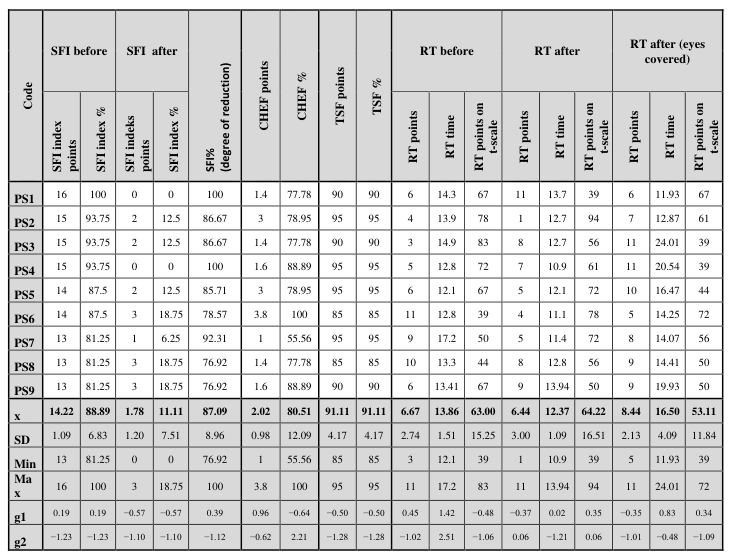
Two students (22.22%) eliminated 100% of errors compared to the results before the training (SFIindex 0 points). The rest reduced errors from 92.31% to 76.92% (Table 2). In this fraction (n = 7), three students still made errors with their legs and hands, and four only with their hands (Table 3). None of the students performed the ‘test for safe fall’ without errors – results from 95% to 85% (Table 2).
Table 2. Results of physiotherapy students (n = 9).
PS – physiotherapy student, x – mean, SD – standard deviation, Min – minimum, Max – maximum, q1 – skewness, q2 - kurtosis
The Relationship Between the Cognitive and Behavioral Potential 1487
Table 3. Body control errors (expressed in points) detected during STBIDF performance before and after safe falling courses.
Table available in the original PDF paper.
Code STBIDF Before STBIDF After Legs Hips Hands Head Legs Hips Hands Head
The results of the degree of error reduction by the fraction of 7 students are highly positively correlated (r = 0.802, p<0.05, and with a one-sided test p<0.025) with the TSF results. The degree of error reduction by this fraction is highly negatively correlated (r = −0.769, p<0.05) with the comprehensive health effects of fall (CHEF). The relationships of these indicators are not as clear with the results of the body balance disturbance tolerance skills study (before the courses r = 0.363, after the courses r = 0.430).
Table 4. Correlation matrix of indicators of the fraction of physiotherapy students (n = 7) who made errors in STBIDF after the courses.
Table available in the original PDF paper.
Variable 1 2 3 4 5 1 SFI% (degree of reduction) x 2 CHEF% -0.769* x 3 RT before 0.363 -0.111 x 4 RT after 0.430 -0.028 0.021 x 5 RT after (eyes covered) -0.169 0.358 -0.572 0.621 x 6 TSF% 0.802* -0.606 0.553 0.430 -0.238
*p<0.05
DISCUSSION
The phenomenon of resistance to motor modifications of some adults educated at a higher level, who should reduce the errors of collisions with the ground of distal parts of the body without the need for verbal explanations, is important from the point of view of personal safety (Kalina & Kalina, 2020). In extreme circumstances of an unintentional fall, it is the distal parts of the body that are subject to various damages.
The surveyed students indicated injuries of varying severity in the surveys conducted before the start of the fall safety courses. The most serious effects of an unintentional fall were: concussion, posterior cruciate ligament rupture, and metatarsal fracture. The majority of the surveyed declared sprains or
1488 Ga˛sienica-Walczak and Kalina
dislocations in the joints, contusions, bruises, and abrasions. Unfortunately, the survey did not include a question about the circumstances of the fall. Only one surveyed person indicated that she had fallen from a horse several times. However, she did not provide detailed information on the consequences of these falls. Therefore, in the future, before performing STBIDF (regardless of the version used), instead of a written declaration, a detailed interview with the surveyed person (or their legal guardian) should be conducted. The CHEF index was developed based on the survey. The degree of error reduction by the fraction of 7 students is highly negatively correlated with the comprehensive health effects of fall.
The authors of this paper have found that people who have suffered serious bodily injuries in the past as a result of a fall tend to protect their injured body parts in an unprofessional manner during subsequent falls. Such behavior can cause serious damage to other parts of the body.
One way to reduce fall-related injuries is to combine fall prevention programs (Wolf et al., 1993, Tinetti et al., 1994, Sattin et al., 1998, Roberson et al., 2002, Clemson et al., 2004, Skelton et al., 2005, Shier et al., 2016, Hill et al., 2018) with programs aimed at preventing the effects of falls (Kalina et al., 2008, Dobosz et al., 2018, Kubacki et al., 2020). One of the most effective programs is teaching safe falling, which has been promoted for many years by the “Polish School of Safe Falling” (this is the name used by Iermakov et al., 2022). Teaching safe falling is also one of the three methods of prevention and therapy of “Innovative Agonology” (Kalina & Kalina 2020, Kalina & Kruszewski 2023).
In the study, none of the students performed TSF without errors. Four students achieved 95% of the highest possible assessment of this motor competence, three 90%, and two 85%. These results justify the conclusion that during an unintentional fall, these students will safely control the distal parts of the body and minimize the effects of this event. The results of the degree of error reduction by the fraction of 7 students are highly positively correlated with TSF assessments. This means that people who reduced errors also mastered safe fall techniques at a high level.
One of the important coordination competencies is the ability to tolerate disturbances in body balance. This is important from the point of view of preventing falls because any event of this type is initiated by a loss of balance (apart from successfully performed throws by a competitor in combat sports or by an aggressor). This applies to people of all ages, but most of all to older people. Therefore, in this work, one of the correlated indicators was precisely this coordination ability - body balance disturbance tolerance skill measured by RT. The results of this test did not correlate highly with other indicators of phenomena measured during these studies. The correlations of the degree of error reduction by the fraction of 7 students with RT (before and after courses) are not as clear as in the case of TSF.
CONCLUSION
The correlations between the degree of reduction of the SFI phenomenon during teaching safe falling techniques to people resistant (in the cognitive
The Relationship Between the Cognitive and Behavioral Potential 1489
and behavioral sense) to motor modifications and the applied indicators of the assessment of adaptive effects allow us to put forward the following hypothesis: complete resistance to motor modifications may turn out to be the simplest predictor of cognitive-behavioral potential possible in applications in prevention and therapy, starting from diagnosing people from the early school period during common studies of the phenomenon of susceptibility to the body injuries during the fall.
REFERENCES
Clemson, L. Cumming, RG. Kendig, H, Swann, M. Heard, R. Taylor, K. (2004) The effectiveness of a community-based program for reducing the incidence of falls in the elderly. A randomized trial. J Am Geriatr Soc. 52(9):1487– 94. https.//doi.org/10.1111/j.1532–5415.2004.52411.x Dobosz, D. Barczy´nski, BJ. Kalina, A. Kalina, RM. (2018) The most effective and
economic method of reducing death and disability associated with falls. Arch Budo 14: 239–246. Ga˛sienica-Walczak, B. (2017) Motoryczne. metodyczne i mentalne kwalifikacje studentów fizjoterapii z zakresu bezpiecznego upadania – perspektywa prewencji upadków osób z wadami wzroku, z unieruchomiona˛ lub amputowana˛ ko´nczyna˛ [PhD Thesis]. Rzeszow: Uniwesytet Rzeszowski. Wydział Medyczny; 2017 [in Polish]. Ga˛sienica-Walczak, B. Kalina, A. (2023) Predictive validity of STBIDF (the susceptibility test to the body injuries during the fall) – two methodological aspects. Arch Budo Sci Martial Art Extreme Sport 19: 219–246. Ga˛sienica-Walczak, B. Kalina, RM. (2021) Validation of the new version of “the
susceptibility test to the body injuries during the fall” (STBIDF-M). Arch Budo 17: 371–400. Hill, KD. Suttanon, P. Lin, SI. Tsang, WWN. Ashari, A. Hamid, TAA Farrier, K. Burton, E. (2018) What works in falls prevention in Asia. a systematic review and meta-analysis of randomized controlled trials. BMC Geriatrics 18: 3. https.//doi.org/10.1186/s12877-017-0683-1 Iermakov, S. Podrigalo, L. Podrigalo, O. Yermakova, T. Jagiełło, W. (2022) Means
and methods of physical activity in the context of prevention and treatment of Alzheimer’s disease (analysis of Russian-language scientific resources) and the perspective of implementing the unique achievements of the “Polish School of Safe Falling”. Arch Budo 18: 121–143. Kalina, RM. (2009) Miekkie la˛dowanie. Med Tribune 13: 28–29 [in Polish]. Kalina, RM. Barczy´nski, BJ. Jagiełło, W. Prze´zdziecki, B. Kruszewski, A. Harasymowicz, J. Syska, J. Szamotulska, K. (2008) Teaching of safe falling as most effective element of personal injury prevention in people regardless of gender, age and type of body build – the use of advanced information technologies to monitor the effects of education Arch Budo 2008; 4(4): 82–90. Kalina, RM. Barczy´nski, BJ. Klukowski, K. Langfort, J. Ga˛sienica-Walczak, B. (2011) The method to evaluate the susceptibility to injuries during the fall - validation procedure of the specific motor test. Arch Budo 7(4): 203–216. Kalina, RM. Dłubacz, N. Zachwieja, J. Pilarska, E. Dobosz, D., Ga˛sienica-Walczak,
B. Kruszewski A. (2022) Innovative method of diagnosing the susceptibility to the body injuries during the fall of children from 2 to 6 years. Arch Budo Sci Martial Art Extreme Sport 2022; 18: 211–228.
1490 Ga˛sienica-Walczak and Kalina
Kalina, RM. Jagiełło, W. Barczy´nski, BJ. (2013) The method to evaluate the body balance disturbation tolerance skills – validation procedure of the ‘Rotational Test’. Arch Budo 1: 59–80. Kalina, RM, Kalina, A. (2020) Three methods of prophylaxis and therapy of
innovative agonology, important from the perspective of personal safety. Arch Budo Sci Martial Art Extreme Sport 16: 7–15. Kalina, RM. Kruszewski, A. (2023) INNOAGON is an acronym for ‘innovative agonology’, but is not synonymous with ‘science of martial arts’. Arch Budo 19: 193–204. Kalina, RM. Kruszewski, A. Jagiełło, W. Włoch, G. (2003) Combat sports
propedeutics – basics of judo. Warsaw: Wydawnictwa AWF [in Polish]. Kubacki, R. Bołociuch, M. Rauk-Kubacka, A. (2020) Teacher Ball Ukemi: metody i narzedzia modelowania sposobów nauczania bezpiecznego upadania. Jelenia Góra: Wydawnictwo AD-Rem [in Polish]. Mroczkowski, A. Mosler, D. Gemziak, EP. (2017) Relation between knowledge about
assessment criteria of susceptibility test of body injuries during a fall and body control during the test. Arch Budo Sci Martial Art Extreme Sport 13: 55–61. Roberson, MC. Campbell, AJ. Gardner, MM. Devlin, N. (2002) The effectiveness of a community-based program for reducting the incidence of falls in the elderly. a randomized trial. J Am. Geriatr. Soc. 50: 905–911. Sattin, RW. Rodriguez, JG. DeVito, CA. Wingo, PA. (1998) Study to Assess
Falls Among the Elderly (SAFE) Group. Home Environmental Hazards and the Risk of Fall Injury Events Among Community-Dwelling Older Persons. Journal of the American Geriatrics Society 46:669–76. https.//doi.org/10.1111/j.1532– 5415.1998.tb03799.x Shier, V. Trieu, E. Ganz, DA. (2016) Implementing exercise programs to prevent falls. systematic descriptive review. Injury Epidemiology, 3: 16. https.//doi.org/10.1186/s40621-016-0081-8 Skelton, D. Dinan, S. Campbell, M. Rutherford, O. (2005) Tailored group exercise (Falls Management Exercise—FaME) reduces falls in community- dwelling older frequent fallers (an RCT). Age Ageing. 2005; 34(6):636– 39. https.//doi.org/10.1093/ageing/afi174 Tinetti, ME. Baker, DI. McAvay, G. Claus, EB. Garret, P. Gottschalk, M. Koch, ML.
Trainor, K. Horwitz, RI. (1994) A multifactorial intervention to reduce the risk of falling among elderly older people living in the community. N. Engl. J. Med. 331(13): 821– 827. https.//doi.org/10.1056/NEJM199409293311301 Wolf, SJ. Kutner, NG. Green, RC. McNeely, E. (1993) The Atlanta FICSIT Study.
Two Exercise Interventions to Reduce Frailtv in Elders. JAGS 41.329– 332. https.//doi.org/10.1111/j.1532–5415.1993.tb06713.x
LISTED IN THE AHFE DIGITAL BOOKSTORE CATALOGUE
Explore the complete digital volume
Human Factors in Design, Engineering, and Computing
Read this individual research paper free through the original publisher, or explore the full digital proceedings book.
ISBN 978-1-964867-35-9
Explore this ISBN in the AHFE Bookstore ↗Listed in the July 2026 bookstore catalogue; search by ISBN to confirm current availability · Digital book purchase optional