Daniel Rukare, Lisa Steinhauser (2024). From Gap to Gain: Advancing Gender Equity in Venture Capital Investing. In: Human Factors in Design, Engineering, and Computing. AHFE Open Access, vol. 159, pp. 1684–1694. https://doi.org/10.54941/ahfe1005736
The persistent gender funding gap in the United Kingdom's venture capital sector represents a significant economic and ethical challenge, hindering the realization of substantial new value and exposing systemic inequities. Despite growing awareness and evidence suggesting that women-founded businesses perform equally well or better, growth in investments in such enterprises remains slow. While existing research predominantly explores founder- and funder-driven causes of this gap, limited focus has been placed on effective remedies and the role of venture capitalists' perspectives in addressing this issue.This paper aims to address these deficiencies by exploring venture capitalists' views on the gender funding gap, including perceived causes and their capacity to mitigate it. The study investigates motivations and barriers to adopting inclusive practices and identifies what these practices entail. Employing an inductive, exploratory approach, this research conducted ten interviews with representatives from firms publicly expressing commitment to addressing the gender gap and compared responses to founder gender investment data.Findings reveal diverse opinions on the causes of the gender funding gap among venture capitalists, with some emphasizing supply-side factors while others focus on demand-side explanations. The study indicates that recognition of supply-side factors is crucial in motivating firms to adopt gender-inclusive practices. Additionally, this paper identifies diversity, equity, and inclusion performance management as only the first step and highlights the importance of targeted strategies around an inclusive culture, deal flow, and a diverse ecosystem as critical elements in narrowing the gap.The research culminates in the development of the Gender-Inclusive Venture Capital Investment Framework, detailing the interplay between venture capitalists' perspectives and the adoption of gender-inclusive practices. This framework organizes practice categories by implementation level, serving as a practical guide for developing targeted strategies for inclusive investing while sustaining investment performance. The paper contributes to the growing body of literature on gender equity in venture capital and provides actionable insights for practitioners and policymakers aiming to address the gender funding gap.
This paper explores the gender VC funding gap in the United Kingdom (UK), an area that has attracted increasing attention within the VC industry and broader entrepreneurship community. Particularly, it highlights the concerning statistic that female founding teams receive only 2% of venture capital invested in the UK, and 73% of all UK VC deals go to all-male teams (Beauhurst, 2023). The Rose Review, commissioned by His Majesty’s Treasury of the UK government in 2019, estimates that, if women founded and grew businesses at the same rate as men, the UK economy could potentially see an addition of up to £ 250 billion in new value (Rose, 2019). Moreover, research findings suggest an equal or better performance of female founders, and a more widespread awareness of Diversity, Equity, and Inclusion (DEI) in the industry that is slowly leading to an increase in investments in female- and mixed-gender teams (Demartini, 2018; Hebert, 2018; Gompers et al., 2021; Beauhurst, 2023; BVCA, 2023).
From Gap to Gain: Advancing Gender Equity in Venture Capital Investing 1685
This increased interest has opened new avenues for research on the specific causes of the gender VC funding gap, yet significant gaps in understanding the VC perspective and the study of remedies for the gender VC funding gap remain (Malmström, Johansson and Wincent, 2017; Brush et al., 2018; Hebert, 2018; Aernoudt and De San José, 2020; Balachandra, 2020; Kanze et al., 2020; Raina, 2021).
This study aims to bridge these gaps by understanding the view of UK- investing VCs on the gender VC funding gap and learning from proven industry best practices leading to more promising investments in female- founded ventures.
THE GENDER VC FUNDING GAP To understand this persistent gap, researchers have examined both founder- and funder-driven factors, leading to the first research question.
Research Question 1.1: How do current academic perspectives on demand- and supply-side factors explain the gender disparity in VC funding compared to the insights of VCs themselves?
Demand-side factors highlight how women’s own actions may contribute to the gender VC funding gap (Aernoudt and De San José, 2020; Geiger, 2020). A significant issue is the low number of women pursuing entrepreneurship, with only a third of UK entrepreneurs being female (Guzman and Kacperczyk, 2019; Rose, 2019; Aernoudt and De San José, 2020). The underrepresentation of women in high-productivity sectors in the UK, where they constitute only 25% of entrepreneurs, coupled with their tendency to start businesses in industries less appealing to venture capital investors, further exacerbates the gap (Hebert, 2018; British Business Bank, BVCA, and Diversity VC, 2019; Rose, 2019; Aernoudt and De San José, 2020; Schillo and Ebrahimi, 2022). Moreover, female entrepreneurs often seek lower funding amounts from alternative sources, partly due to the nature of their ventures, which are smaller in size and less capital-intensive (Geiger, 2020; Rose, 2023). Guzman and Kacperczyk (2019) note that these growth orientation factors account for two-thirds of the 63% lower likelihood of female-led businesses obtaining VC funding compared to male-led startups. Given the substantial impact of these demand-side factors on the gender VC funding gap, this leads to the second research question of the first research objective: Research Question 1.2: How effectively can VCs address and reduce the gender disparity in VC funding?
The supply-side is concerned with how VCs, as suppliers of capital, may create an imbalance in how much funding they provide to women- led ventures compared to those led by men (Aernoudt and De San José, 2020; Geiger, 2020). Guzman and Kacperczyk’s 2019 study suggests that supply-side factors likely account for the remaining 35% of the lower likelihood of female founders obtaining VC funding. Firstly, the VC industry is heavily male-dominated, particularly in decision-making positions, with 88% of senior investment team roles held by men, favoring male entrepreneurs due to homophily (Malmström, Johansson and
1686 Rukare and Steinhauser
Wincent, 2017; Balachandra et al., 2019; British Business Bank, 2023; BVCA, 2023). Secondly, structural issues within the VC deal flow, such as deal sourcing from referrals and existing networks, contribute to this funding gap (British Business Bank, BVCA, and Diversity VC, 2019; British Business Bank, 2023). Finally, implicit gender biases shape VC decision-making in ways that disadvantage women entrepreneurs, despite research showing comparable or superior performance across size, profitability, efficiency, and financial management indicators of female-led startups if funded (Heilman, 1983; Kanze et al., 2017, 2020; Malmström, Johansson and Wincent, 2017; Demartini, 2018; Hebert, 2018; Balachandra et al., 2019; Balachandra, 2020; Geiger, 2020).
NAVIGATING CHANGE IN VENTURE CAPITAL To address the gender VC funding gap, it is essential to understand the factors that motivate or prevent VCs from implementing effective interventions. The Integrated-Change Model (I-Change Model) offers a framework for understanding behavioral change (De Vries et al., 2003, 2005). De Vries et al.’s (2003) model proposes that behavior results from intentions, abilities, and the absence of barriers. Intentions depend on motivational factors influenced by predisposing factors, information exposure, and awareness. This leads to the next research question:
Research Question 2.1: What motivates VCs to adopt and execute specific strategies designed to reduce the gender disparity in VC funding, and what are the primary challenges they perceive in this endeavor?
The I-Change Model indicates that alongside intention, ability is crucial to reach the behavioral state in which active steps towards a goal are attempted and maintained (De Vries et al., 2003, 2005). While extensive research has explored the reasons behind the gender gap in VC funding, few studies have investigated potential remedies. Many scholars have highlighted this research gap, emphasizing the need for practical initiatives that VCs can implement to make a meaningful impact (Malmström, Johansson and Wincent, 2017; Brush et al., 2018; Hebert, 2018; Aernoudt and De San José, 2020; Balachandra, 2020; Kanze et al., 2020; Raina, 2021). This leads to the final research question: Research Question 2.2: What strategies have VCs implemented to narrow their internal gender VC funding gap while maintaining or increasing return objectives?
By addressing these research questions, this study aims to bridge the current gaps in knowledge and provide insights into effective strategies for reducing the gender disparity in VC funding. Understanding both the perspectives of VCs and the practical initiatives they can implement is crucial for advancing towards more equitable funding practices in the VC industry.
RESEARCH METHODOLOGY This study is guided by an interpretivist epistemology with a subjectivist ontology and an exploratory purpose, utilizing an inductive approach. To
From Gap to Gain: Advancing Gender Equity in Venture Capital Investing 1687
ensure robustness, the research adopts a multi-method design that allows for triangulation. It employs a multiple-case study strategy and gathers qualitative data through semi-structured interviews with ten investors from firms committed to closing the gender VC funding gap. This primary data source is complemented by secondary sources, including informant verification, private data on the firm-internal gender funding gap, and publicly accessible information, such as regional, industry, or venture stage focus, serving as control variables and for case comparison. The study follows a cross-sectional time horizon, capturing a snapshot of the VC firms’ strategies and practices at a specific point in time.
Purposive sampling, specifically extreme case sampling, was used to select information-rich cases from investment firms committed to gender inclusivity. This sample aims to understand practices in firms already motivated to support female entrepreneurs. Only firms publicly and explicitly expressing a significant commitment to gender DEI on their website, defined as commitment level 3 or 4 as elaborated in Table 1, were considered. After analyzing 124 firms, 50 qualified for this criterion, and representatives were contacted. Ultimately, ten investors from ten different firms agreed to be interviewed.
Table 1. Level of publicly expressed commitment to gender DEI.
Table available in the original PDF paper.
Commitment Level Expressed Commitment to Gender DEI on the Firm Website Level 1 Does not clearly or explicitly state any commitment. Level 2 Shows limited signs of commitment, e.g., by showcasing the Investing in Women Code badge, but nothing else. Level 3 Explicitly expresses commitment to gender DEI as a core value or has an Environmental, Social, and Governance (ESG) subpage elaborating inclusive practices. Level 4 Is built around the premise of investing in female founders, making gender DEI in entrepreneurship its central purpose.
For data collection, semi-structured interviews were conducted with nine participants via video call, lasting about 30 minutes each, and one via email. This method provided structured yet flexible guidance, promoting rich data collection and participant engagement. Questions were reviewed for clarity and neutrality to avoid biased responses and all participants received and signed an Information and Consent Sheet detailing the study’s purpose and confidentiality measures.
To prepare for subsequent analysis, interviews were recorded, transcribed verbatim, and anonymized to enhance reliability and confidentiality. Transcribed interviews were thematically analyzed to identify recurring themes related to the research questions. The cases were divided into above- average and below-average groups with five cases each, based on their proportion of investments in companies with at least one female founder compared to the UK VC average of 27% (Beauhurst, 2023). Both qualitative and quantitative methods were used to compare responses across these groups, revealing patterns in participants’ experiences and views.
1688 Rukare and Steinhauser
FINDINGS AND DISCUSSION The analysis finds no significant differences between above-average and below-average cases in terms of industry focus, investment stage focus, or gender distribution of interviewees.
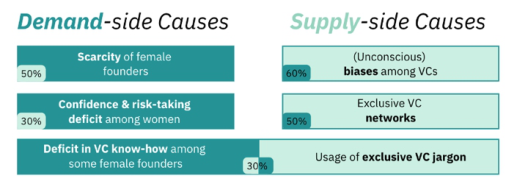
Figure 1: Perceived causes of the gap.
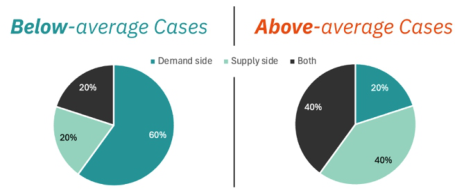
The research findings reveal significant insights into the perception and addressing of the gender VC funding gap. All participants acknowledged the existence of the gap, aligning with statistical data. When examining the perceived causes of this disparity (see Figure 1), a notable trend emerged between above-average and below-average cases. 80% of above-average cases attributed the gap primarily to supply-side reasons, while only 40% of below-average cases shared this view (see Figure 2). Conversely, 60% of below-average cases solely cited demand-side causes.
Figure 2: Perceived causes of the gap: Below- vs. above-average cases.
Regarding the perceived capability of VC firms to reduce the gender VC funding gap, all participants agreed that firms like theirs’ have some impact. However, the perceived extent of this influence varied. 80% of above-average cases expressed confidence in VC firms’ ability to reduce the gap, while 80% of below-average cases were more skeptical, citing limitations. Notably, 30% of all participants expressed uncertainty about significantly addressing the gap without compromising performance, citing commercial considerations and previous unsuccessful attempts.
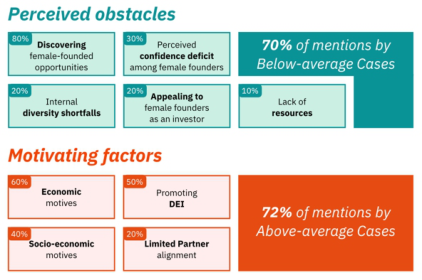
The research identified five major obstacles (see Figure 3) to funding more female founders, with 70% of these obstacles reported by below- average cases. This suggests that below-average cases perceive a higher barrier to increasing investments in female-founded companies. Conversely,
From Gap to Gain: Advancing Gender Equity in Venture Capital Investing 1689
when examining motives for increasing investments in female founders or implementing more inclusive practices (see Figure 3), 72% of all motives were mentioned by above-average cases, indicating a higher motivation among these firms to proactively implement such initiatives.
Figure 3: Obstacles and motivating factors in funding more female founders.
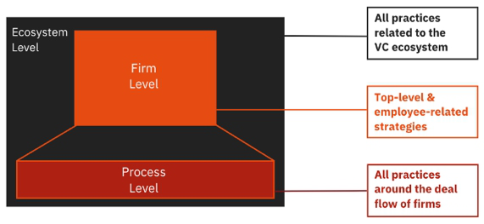
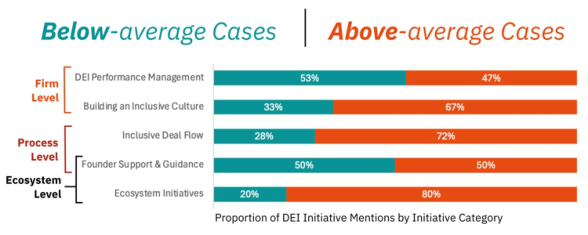
Regarding internal initiatives and practices adopted to increase investments in female-founded startups, 62% were mentioned by above- average cases. The practices were categorized into Firm, Process, and Ecosystem Level as levels for practice implementation (see Figure 4 and 5). Below-average cases primarily focused on DEI performance management (29%) and building an inclusive culture (23%), with ecosystem initiatives being the least mentioned (6%). Above-average cases emphasized having an inclusive deal flow (32%) and creating an inclusive culture (28%), with ecosystem initiatives comprising 14% of mentioned practices.
Figure 4: Visualization of the levels of practice implementation.
Comparing gender DEI strategies between case groups, above-average cases mentioned significantly more practices within ecosystem initiatives (80%), inclusive deal flow (72%), and building an inclusive culture (67%) (see Figure 5). The categories of DEI performance management and founder support and guidance showed similar mentions across both groups. These findings align with expectations because making DEI a strategic objective fits
1690 Rukare and Steinhauser
the nature of this research sample and while founder support and guidance empower female founders and ensure DEI post-investment, they do not directly increase investments in female founders. These results confirm that targeted actions within ecosystem initiatives, maintaining an inclusive deal flow, and fostering an inclusive culture are most effective in narrowing the internal gender VC funding gap.
Figure 5: Proportion of DEI initiative mentions by initiative category: Below- vs. above- average cases.
Finally, regarding the impact of investing in female-led startups on firm performance, 80% of participants stated it was too early to draw definitive conclusions. However, some observations were made, including no significant performance differences based on founder gender and reports of impressive performance from female-founded companies in some portfolios. Potential strengths of female founders were noted, such as mature leadership strategies, exceptional organizational skills, and mission-driven approaches.
These findings provide valuable insights into the perceptions, practices, and potential impact of addressing the gender VC funding gap, highlighting differences between above-average and below-average cases in their approaches and attitudes towards this issue.
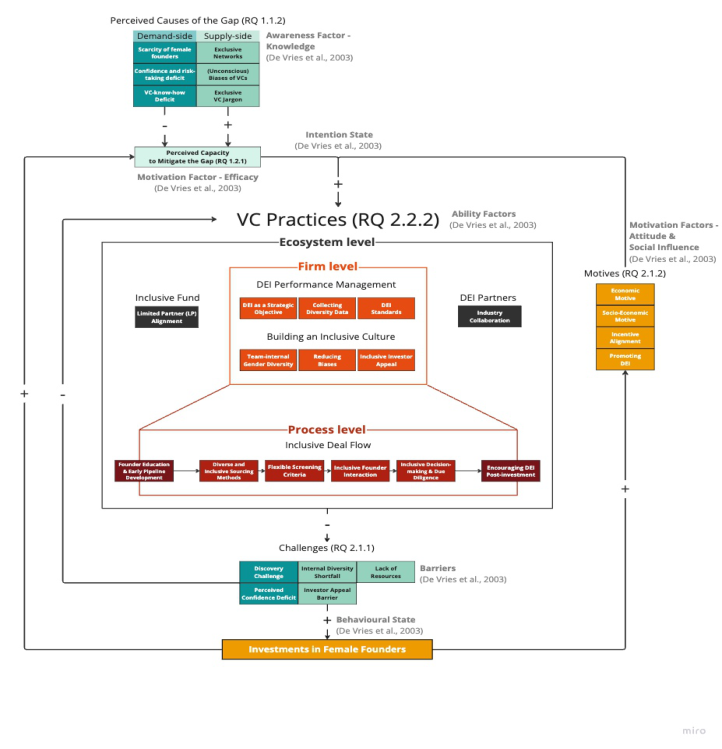
The Gender-Inclusive Venture Capital Investment Framework The GIVCI Framework (see Figure 7) is a conceptual model illustrating the relationships between factors influencing VCs’ implementation of gender- inclusive strategies. This model synthesizes key findings from this research and adapts elements from the I-Change Model (De Vries et al., 2003, 2005) to the context of behavioral and strategic change in VC firms.
Central to the framework are VC practices, categorized by implementation level within the firm. These practices are influenced by the perceived causes of the gender gap in VC funding, the perceived capacity to mitigate the gap, and motivating factors.
The findings suggest that VCs attributing the gap more to supply- side factors perceived a higher capacity to mitigate it compared to those emphasizing demand-side explanations. The framework proposes interdependencies between these elements, potentially creating a positive feedback loop, where successful investments in female-founded companies
From Gap to Gain: Advancing Gender Equity in Venture Capital Investing 1691
may enhance perceived capacity and motivation, reinforcing the implementation of DEI practices.
Figure 6: The gender-inclusive VC investment (GIVCI) framework.
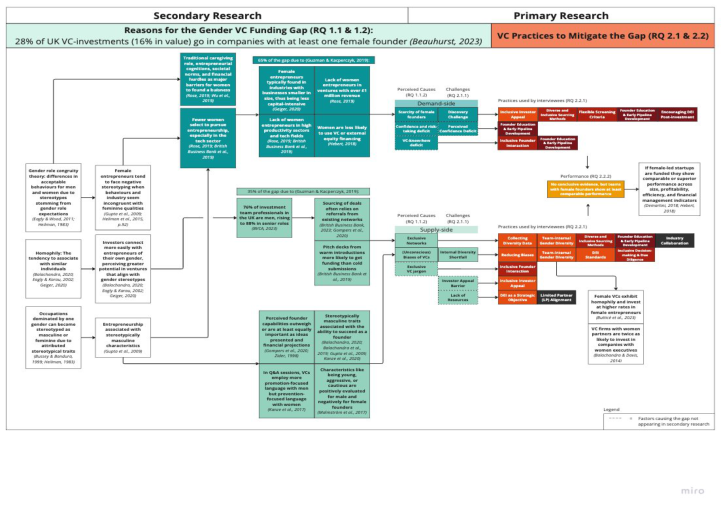
Building on the GIVCI Framework, the Extended GIVCI Framework (see Figure 8) integrates the primary research findings with existing literature on the gender gap in VC funding. This comprehensive model compares literature-based causes of the gender gap with VC practitioners’ perceptions, links challenges faced by VC firms to corresponding causes and solutions identified in this study, and illustrates the interplay between gender theory, entrepreneurship, and VC industry practices.
The Extended GIVCI Framework maps VC practices against causes of the gender investment gap and addresses challenges in mitigating this disparity. It serves as a tool for VC firms to identify effective strategies and enhances understanding of VCs’ multifaceted roles in narrowing the gender gap.
1692 Rukare and Steinhauser
This research reveals that VCs’ views on gap causes mostly align with existing research but also highlight factors less prominent in literature, such as perceived deficits in VC know-how and confidence among some female founders.
In conclusion, these frameworks contribute to closing research gaps by synthesizing VCs’ perspectives, aligning them with existing literature, and proposing interconnections between perceptions, practices, and outcomes in gender-inclusive VC investing.
Figure 7: The extended GIVCI framework.
CONCLUSION
This study provides a comprehensive examination of the gender funding gap in VC from the perspective of UK-based VC firms committed to gender diversity. Findings unveil divergent viewpoints among VCs regarding the causes of this persistent gap, with some attributing it to demand-side factors and others emphasizing supply-side explanations. Furthermore, a positive correlation between awareness of supply-side factors and a greater commitment to implementing gender-inclusive practices within VC firms was observed. This awareness appears to initiate a positive feedback loop, where efforts to narrow the gender gap drive further initiatives to promote equity in VC investing. Additionally, this study identifies DEI performance management as only the first step for VC firms committed to making a change and highlights the importance of targeted strategies around an inclusive culture, deal flow, and a diverse ecosystem as most effective strategies in narrowing the gap.
From Gap to Gain: Advancing Gender Equity in Venture Capital Investing 1693
A key contribution of this work is the development of the GIVCI Framework, which systematically organizes VCs’ perspectives, motivating factors, and specific practices aimed at addressing the gender funding disparity. The Extended GIVCI Framework further connects these findings to foundational theories and existing literature, uncovering research gaps and providing a holistic overview of the underlying reasons for the gender VC funding gap.
This research offers several important implications for both theory and practice. Firstly, it provides a nuanced understanding of how individual VC perspectives influence organizational practices and investment decisions. Secondly, the GIVCI Framework offers VC firms a flexible tool to develop and tailor their DEI strategies. Finally, for policymakers and organizations promoting gender equity in the VC sector, these findings can inform more targeted and effective interventions.
Limitations include the small sample size and limited generalizability beyond the context of UK-investing VC firms already showing some commitment to closing the gap. Further research is warranted to quantify VC firms’ capacity to address the gap, explore understudied factors like VC jargon barriers, and validate findings using quantitative methods. Additionally, investigating how the GIVCI Framework can be adapted to address other forms of diversity in VC funding would be valuable.
In conclusion, this study advances the understanding of the gender funding gap in VC and provides actionable insights for creating a more equitable distribution of capital. By addressing this disparity, this study advances inclusive growth and innovation in the entrepreneurial landscape, ultimately contributing to a more diverse and robust economy.
ACKNOWLEDGMENT
The authors would like to thank the investors who shared their insights and provided access and responses regarding the gender VC funding gap and gender-inclusive investing. Their contributions were instrumental in developing the GIVCI Framework.
REFERENCES
Aernoudt, R. and De San José, A. (2020) ‘A gender financing gap: fake news or evidence?’, Venture Capital, 22(2), pp. 127–134. Balachandra, L. et al. (2019) ‘Don’t Pitch Like a Girl!: How Gender Stereotypes
Influence Investor Decisions’, Entrepreneurship Theory and Practice, 43(1), pp. 116–137. Balachandra, L. (2020) ‘How gender biases drive venture capital decision-making: exploring the gender funding gap’, Gender in Management: An International Journal, 35(3), pp. 261–273. Beauhurst (2023) The Deal 2022. Available at: https://www.beauhurst.com/wp-
content/uploads/2023/02/The-Deal-FY-2022.pdf?utm=0 (Accessed: 15 February 2024).
1694 Rukare and Steinhauser
British Business Bank (2023) Annual Invest In Women Code Report 2023. British Business Bank, pp. 26–41. Available at: https://www.british-business-bank.co.uk/ about-us/our-values-and-culture/investing-in-women-code/annual-report-2023/ (Accessed: 30 January 2024). British Business Bank, BVCA, and Diversity VC (2019) UK Venture Capital and Female Founders report. British Business Bank. Available at: https://www.british-business-bank.co.uk/wp-content/uploads/2019/02/Brit ish-Business-Bank-UK-Venture-Capital-and-Female-Founders-Report.pdf (Accessed: 13 February 2024). Brush, C. et al. (2018) ‘The gender gap in venture capital- progress, problems, and
perspectives’, Venture Capital, 20(2), pp. 115–136. BVCA (2023) Diversity & Inclusion 2023 Report. BVCA. Available at: https://www.bvca.co.uk/Research/BVCA-Publications/Details/Diversity-and- Inclusion-2023-Report (Accessed: 20 February 2024). De Vries, H. et al. (2003) ‘The European Smoking Prevention Framework Approach (EFSA): an example of integral prevention.’, Health education research, 18(5), pp. 611–626. De Vries, H. et al. (2005) ‘The general public’s information needs and perceptions
regarding hereditary cancer: an application of the Integrated Change Model’, Patient Education and Counseling, 56(2), pp. 154–165. Demartini, P. (2018) ‘Innovative Female-Led Startups. Do Women in Business Underperform?’, Administrative Sciences, 8(4), p. 70. Geiger, M. (2020) ‘A meta-analysis of the gender gap (s) in venture funding: Funder-
and entrepreneur-driven perspectives’, Journal of Business Venturing Insights, 13, p. e00167. Gompers, P. A. et al. (2021) ‘How Venture Capitalists Make Decisions’, Harvard Business Review, 3 January, pp. 70–78. Guzman, J. and Kacperczyk, A. (Olenka) (2019) ‘Gender gap in entrepreneurship’,
Research Policy, 48(7), pp. 1666–1680. Hebert, C. (2018) ‘Mind the Gap: Gender Stereotypes and Entrepreneur Financing’, SSRN Electronic Journal [Preprint]. Heilman, M. E. (1983) ‘Sex bias in work settings: The Lack of Fit model.’, Research
in Organizational Behavior, 5, pp. 269–298. Kanze, D. et al. (2017) ‘We Ask Men to Win & Women Not to Lose: Closing the Gender Gap in Startup Funding’, Academy of Management Proceedings, 2017(1), p. 10010. Kanze, D. et al. (2020) ‘Evidence that investors penalize female founders for lack of
industry fit’, Science Advances, 6(48), p. eabd7664. Malmström, M., Johansson, J. and Wincent, J. (2017) ‘We Recorded VCs’ Conversations and Analyzed How Differently They Talk About Female Entrepreneurs’, Harvard Business Review, pp. 2–5. Raina, S. (2021) ‘VCs, Founders, and the Performance Gender Gap’, SSRN
Electronic Journal [Preprint]. Available at: https://doi.org/10.2139/ssrn.2846047. Rose, A. (2019) The Alison Rose Review of Female Entrepreneurship. 1. HM Treasury. Available at: https://assets.publishing.service.gov.uk/media/5c8147e2e 5274a2a595bb24a/RoseReview_Digital_FINAL.PDF. Rose, A. (2023) The Alison Rose Review of Female Entrepreneurship. Progress
Report 2023. 5. Available at: https://www.natwestgroup.com/news-and-insights /latest-stories/enterprise/2023/feb/the-alison-rose-review-of-female-entrepreneu rship.html (Accessed: 17 February 2024). Schillo, R. S. and Ebrahimi, H. (2022) ‘Gender dimensions of digitalisation: a comparison of Venture Capital backed start-ups across fields’, Technology Analysis & Strategic Management, 34(7), pp. 733–745.
LISTED IN THE AHFE DIGITAL BOOKSTORE CATALOGUE
Explore the complete digital volume
Human Factors in Design, Engineering, and Computing
Read this individual research paper free through the original publisher, or explore the full digital proceedings book.
ISBN 978-1-964867-35-9
Explore this ISBN in the AHFE Bookstore ↗Listed in the July 2026 bookstore catalogue; search by ISBN to confirm current availability · Digital book purchase optional