Fadi Alnaimat, Bobby Mathew (2024). Improved teaching and education of engineering students using computational fluid dynamics. In: Human Factors in Design, Engineering, and Computing. AHFE Open Access, vol. 159, pp. 1921–1927. https://doi.org/10.54941/ahfe1005759
This paper studies the use of computational fluid dynamics (CFD) to enhance students' understanding as an effective educational and learning method. The improved educational method studies the impact of CFD implementation in course project on students' comprehension and performance in fluid mechanics course. Implementing the CFD method is increasingly essential specifically for Mechanical Engineering students, and it can also be applicable to variety of fields, including Science, Technology, Engineering, and Mathematics (STEM). One of the most important improvements of using CFD in course teaching is the strong comprehension and improved students’ performance related to the fluid movements, frictional affect, pressure and velocity variation. This was evident through the strong interactive teaching in classroom. The use of simulation related to the studied fluid flow case has proven to be effective in enhancing student attention and improving their understanding of fluid mechanics.
Fluid mechanics are widely used for a variety of purposes and in many different industries, including aerospace, microelectronics, robotics, biomedical, automotive, nuclear, power plants, and chemical processing, conditioning, heating, and cooling, as well as chemical processing. Fluid mechanics encompasses numerous fundamental concepts and covers various topics requiring understanding and applications of conservation laws including continuity equation, conservation of momentum and conservation of energy. Fluid mechanics principles includes various concepts and include different mathematical derivation related to differential equations applied on fluids at rest or in motion.
There has not been much focus on improving the teaching and education of fluid mechanics topics in details. Nonetheless, some noteworthy work has been done by Cimbala (2006), who discussed the evolution of fluid mechanics in older time and in the future. According to Cimbala (2006), integrating computational fluid dynamics (CFD) into fluid mechanics
undergraduate education significantly improves the curriculum. Using CFD, Navaz et al. (2002) demonstrated method for teaching about compressible flows over aerofoils. A novel idea for an electronic learning system that makes use of a CFD package was presented by Hung et al. (2005). The information that the more recent textbooks on fluid mechanics often contain a series of exercises and problems solved through computational fluid dynamics (CFD) methods; Çengel and Cimbala’s (2006) work is a prime example. These exercises provide a demonstrable improvement in teaching A new philosophy of learning and teaching is apparent, and new pedagogical techniques are gradually emerging. A mixed-mode approach comprising project-based learning and traditional education was employed in the courses covered here. Mills and Treagust (2003) have investigated the distinctions, benefits, and constraints between project-based learning and problem-based learning in engineering education. For the kind of course under consideration, project-based learning has proven especially effective; this is likely due to the fact that academics and engineers are more accustomed to using project concepts in their professional lives. In project-based learning, the project takes center stage; most of the content is prepared by the teacher, and students access it as needed (Mills and Treagust, 2003).
In this paper, the primary concerns addressed by the undergraduate teaching course are outlined and the drawbacks of the current. Second, a review of the different guidelines pertaining to the new pedagogical approach used is conducted. Thirdly, descriptions are given of student project from the teaching course.
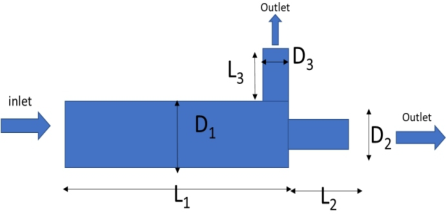
PROJECT BASED LEARNING Using the operating conditions provided, students were asked to carry out a CFD simulation using ANSYS Fluent software on the flow domain as described in Figure 1. Fluid flows in a pipe with length and diameter as shown in diagram below. The pipe is connected with two outlets as shown. Students were asked to simulate fluid flow in fluid CAD model as shown in Figure 1. The simulation model can be simplified as 2-D. Different geometries were given for each student’s groups. The geometries for the case discussed here is given as D1 = 0.03 m, D2 = 0.015 m, D3 = 0.02 m, L1 = 0.5 m, L2 = L3 = 0.5 m.
Figure 1: CAD model of the pipe with 2 exits.
Improved Teaching and Education of Engineering Students 1923
The students were asked to do the following upon completion of the simulation, and to provide a report with the following information.
Draw the CAD problem with all boundary conditions;
Write the governing continuity and Navier-Stokes equations;
Show and discuss all assumptions;
Draw contours for velocity, pressure and streamlines;
Draw the calculated flow rate at outlet 1 and outlet 2 for different flow Reynolds number.
Calculate average shear force at the wall and the pressure drop between the inlet and outlet from fluent.
Compare these results with the analytical solution.
Provide a detailed discussion of the obtained results and the obtained finding trend.
MATHEMATICAL AND ANALYTICAL SOLUTION The analytical solution for the fluid flow inside the flow domain is determined based on the applying the following equations.
1. Continuity Equation
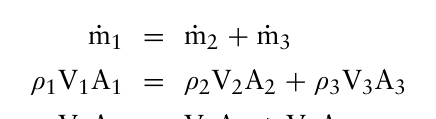
The continuity equation is also the mass conservation equation witch states that the mass entering a system is equal to the mass leaving that system under steady state conditions. In our case, there is only one inlet with two exists.
Equation reproduced from the original PDF.
where A is the area (m2), A = π/4D2, V is the velocity at each inlet or exits. 2. Reynolds Number
Re = ρVD µ
where Re: Reynolds number, ρ is fluid density (kg/m3) V is the velocity in (m/s), D is the diameter (m)which represent the characteristic length for the pipe, and µ is the dynamics viscosity (Pa.s). 3. Wall Shear Force Equation
Equation reproduced from the original PDF.
1924 Alnaimat and Mathew
4. Pressure Drop Equation
Pressure drop can be estimated from Energy equation: V12 V22 2g + z2 + hturbine + hl P1 ρ1g + α1 2g + z1 + hpump = P2 ρ2g + α2
V22 −V12
P1 −P2 = ρg( α
) + hl 2g where α is the correction factor, g is the gravitational acceleration, and hL is the head loss (m). It is noticed that the pressure drop is defined as P1 −P2.
hl,total = hl,minor + hl,major
CFD MODELING
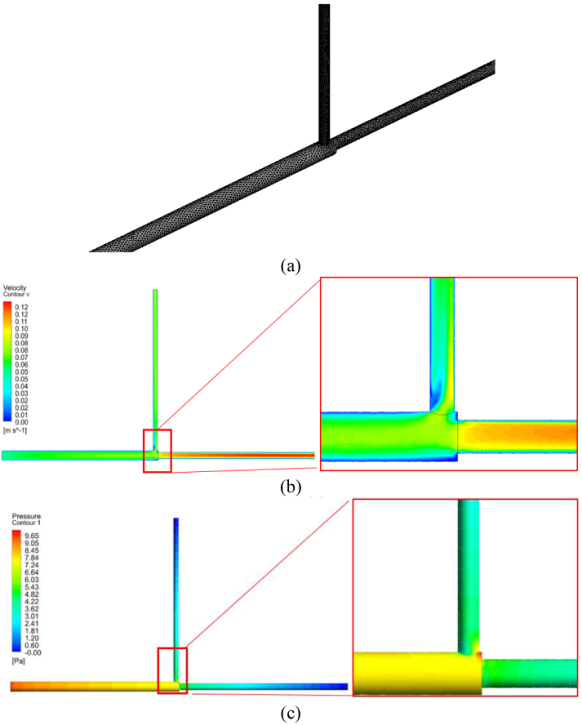
Figure 2 shows samples of the obtained results related to the assigned project. Figure 2(a) shows the discretised meshed domain, Figure 2(b) shows the velocity contour, and Figure 2(c) shows the pressure contour. The different steps related to the CFD modeling of the fluid flow problem in the project are implemented by the majority of the students. The students were able to understand the concept of velocity and pressure distribution contours and understand why increases or decreases at some locations depending on the flow geometries and flow orientations.
Improved Teaching and Education of Engineering Students 1925
TEACHING ENHANCEMENT OF PROJECT BASED LEARNING There are two approaches to examine a problem in fluid mechanics, which includes the integral approach and differential approach. The integral approach involves deriving the conservation equations from a given, suitably selected control volume. The differential approach includes simplifying the conservation partial differential equations and attempting to find an analytical solution. Sufficient information should be provided about the starting and boundary conditions. Both strategies have a number of drawbacks and restrictions, as would be expected. Rather than concentrating solely on mathematical procedures, engineering education should encourage the creative thinking behind modeling and design. Therefore, the emphasis was on using CFD modeling components like mesh generation, applying initial and boundary conditions, and interpreting the obtained results such as the pressure and velocity distribution in the domain. The obtained CFD
1926 Alnaimat and Mathew
results understanding and interpretation is more essential in the project as opposed to the understanding of sophisticated numerical algorithms.
The primary components of the teaching method are as follows:
1. student familiarity with fluid mechanics applications in many industries; 2. student ability to formulate new fluid flow problems, which students can utilize CFD tool; 3. student gaining experience with various problem types that have been numerically simulated and contrasted with experimental results from the literature; 4. comprehending the problem through graphic visualization, which may be accomplished through CFD tool; 5. student ability to defend and justify a fluid flow problem’s solution, including the necessary critical analysis of the numerical results obtained.
Students evaluation of the course is based on the following: (1) Midterm and Final exams covering the fundamental material covered in the syllabus; (2) homework assignments given by the instructor; (3) comprehensive written project reports (in groups); (4) public presentation of the group project work.
Students understanding of fluid mechanics is being revolutionized by the cutting-edge field of computational fluid dynamics (CFD) method, which combines computer science and physics. Engineers and scientists can virtually explore and optimize the dynamics of liquids and gases in a variety of applications, from climate modeling to aerospace design, by using numerical simulations and algorithms, or CFD. The use of simulation related to the studied fluid flow case has proven to be effective in enhancing student attention and improving their understanding of fluid mechanics.
CONCLUSION
Using CFD modeling method for this kind of fluid mechanics course, Fluent was a useful tool for promoting the project-based learning system’s tenets. The primary outcome was an improvement in the students’ theoretical and technical abilities as well as their motivation. In addition, the approach provided a sophisticated and potent practical experience with CFD that satisfied the standards of a mechanical engineer’s professional practice. In summary, it can be said that the technique used is effective and has significantly raised the students’ level of satisfaction.
ACKNOWLEDGMENT
This research was funded by the United Arab Emirates University-National Water and Energy Center through Grants (31R153 and 12R127).
Improved Teaching and Education of Engineering Students 1927
REFERENCES
H. K. Navaz, B. S. Henderson, R. M. Berg and S. M. A. Nekcoei, (2002), A new approach to teaching undergraduate thermal/fluid sciences-courses in applied computational fluid dynamics and compressible flow, Int. J. Mech. Engineering. Educ., 30(1), 35–49. J. M. Cimbala, (2006), The role of CFD undergraduate fluid mechanics education,
in 59th Annual Meeting of the APS (American Physical Society) Division of Fluid Dynamics, Tampa Bay, Florida, USA pp. 19–21. J. Mills and D. Treagust, (2003), Engineering education – is problem-based or projectbased learning the answer?, Australasian J. Engineering. Educ. T. C. Hung, S. K. Wang, S. W. Tai and C. T. Hung, (2005), An Innovative Improvement
of Engineering Learning System Using Computational Fluid Dynamics Concept, Computer Applications Engineering. Educ., 13(4), 306–315. Y. A. Çengel and J. M. Cimbala, (2006), Fluid Mechanics (Fundamentals and Applications) (McGraw-Hill, New York), ch. 15.
LISTED IN THE AHFE DIGITAL BOOKSTORE CATALOGUE
Explore the complete digital volume
Human Factors in Design, Engineering, and Computing
Read this individual research paper free through the original publisher, or explore the full digital proceedings book.
ISBN 978-1-964867-35-9
Explore this ISBN in the AHFE Bookstore ↗Listed in the July 2026 bookstore catalogue; search by ISBN to confirm current availability · Digital book purchase optional